CPIC(601601)

Search documents
中国太保(02601) - 2025 Q2 - 业绩电话会
2025-08-29 08:30
Financial Data and Key Metrics Changes - Group operating income amounted to CNY 200.5 billion, up 33% [7] - Group OPAT was CNY 19.9 billion, up 7.1% [8] - Net profit increased by 11% [7] - EV reached CNY 588 billion, up 4.7% [7] - AUM totaled CNY 3.8 trillion, up 6.5% [7] - Comprehensive solvency margin was 264% and core solvency margin was 190% [8] Business Line Data and Key Metrics Changes - Life insurance recorded a return premium of CNY 193.5 billion, up 13.1% [15] - New business value (NBV) grew by 32% [15] - Property and Casualty (P&C) premium income was CNY 112.8 billion, up 0.9% [19] - Auto insurance premiums were CNY 53.6 billion, up 2.8% [19] - Non-auto premiums were CNY 59.8 billion, down 0.8% [19] Market Data and Key Metrics Changes - The bank channel realized CNY 41.7 billion in premiums, up 82% [18] - The share of mid-tier customers and above increased by 3.8 percentage points year on year [16] - The number of high net wealth customers from the bank channel grew by 75% [16] Company Strategy and Development Direction - The company aims to pursue high-quality development and strengthen its market position [6] - Focus on health, elderly care, internationalization, and AI integration as key strategies [26] - Emphasis on digital finance and technology insurance to enhance service offerings [14][12] Management's Comments on Operating Environment and Future Outlook - The management noted resilience in the Chinese economy despite uncertainties [5] - New regulations are expected to enhance risk prevention and promote high-quality growth in the insurance industry [30] - The company is committed to stable and prudent business operations to ensure shareholder value [10] Other Important Information - The company has launched various initiatives in technology and green insurance, serving 75,000 enterprises [11][12] - The dividend policy links payouts to OPAT while considering investment contributions [9] Q&A Session Summary Question: Comments on performance for the first half of the year and macroeconomic opportunities - Management highlighted stable growth in China's economy and improvements in domestic demand [29][30] Question: Strategy for promoting the share of par business and AI applications - The company is focusing on customer needs and differentiating strategies by channel and region [41][45] Question: Future strategy for life and bank channels - The company is enhancing team management and digital empowerment to improve agent productivity [50][56] Question: Impact of investment market volatility and net asset drop - Management acknowledged uncertainties in the macroeconomic environment and emphasized a long-term stable trend for assets [71][76]
中国太保(02601) - 2025 H1 - 电话会议演示
2025-08-29 07:30
Financial Performance Highlights - Group operating income reached RMB 200496 billion, a 30% increase[6] - Group OPAT (Operating Profit Attributable to shareholders of the Parent) increased by 71% to RMB 19909 billion[6] - Group net profit increased by 110% to RMB 27885 billion[6] - Group embedded value (EV) grew by 47% to RMB 588927 billion[6] - Group Assets under Management (AuM) increased by 65% to RMB 3772961 billion[6] Solvency Position - CPIC Group's Comprehensive Solvency Margin Ratio increased by 8 percentage points to 264%[9] - CPIC Group's Core Solvency Margin Ratio increased by 8 percentage points to 190%[9] - CPIC Life's Comprehensive Solvency Margin Ratio increased by 6 percentage points to 215%[9] - CPIC Life's Core Solvency Margin Ratio increased by 5 percentage points to 136%[9] - CPIC P/C's Comprehensive Solvency Margin Ratio increased by 13 percentage points to 241%[9] - CPIC P/C's Core Solvency Margin Ratio increased by 19 percentage points to 196%[9] Life Insurance Performance - New Business Value (NBV) increased significantly by 323% to RMB 9544 million[26] - First-year premiums increased by 287% to RMB 193470 million[26] - Bancassurance NBV increased substantially by 1561% to RMB 3604 million[31] Property and Casualty Insurance Performance - Primary premium income for auto insurance increased by 28% to RMB 53606 million[34] - Primary premium income for non-auto insurance decreased by 08% to RMB 59154 million[34] - The underwriting combined ratio for auto insurance improved by 18 percentage points to 953%[37] - The underwriting combined ratio for non-auto insurance improved by 23 percentage points to 948%[39] Asset Management - Group in-house investment assets increased by 70% to RMB 2924728 million[42] - Third-party AuM increased by 50% to RMB 848233 million[42]
中国太保(02601):中国太保(601601):NBV增长强劲,OPAT稳步提升
HTSC· 2025-08-29 07:05
Investment Rating - The investment rating for the company is "Buy" [7][5]. Core Views - The company reported a strong growth in New Business Value (NBV) of 32% year-on-year, driven primarily by the bancassurance channel, which saw a 156% increase in NBV [2][5]. - The operating profit after tax (OPAT) increased by 7.1% year-on-year, with life insurance operating profit growing by 5% [1][5]. - The combined operating ratio (COR) for property insurance improved, decreasing by 0.8 percentage points to 96.3%, mainly due to a reduction in expense ratios [1][3]. Summary by Sections Life Insurance - The NBV for life insurance increased by 32% year-on-year, with new single premium income rising approximately 29% [2]. - The bancassurance channel significantly contributed to this growth, while the agent channel experienced a decline in new single premium income [2]. - The profit from life insurance grew by 3.2% year-on-year, supported by improved investment returns [2]. Property Insurance - Property insurance premiums grew by 0.9% year-on-year, with a focus on reducing high COR business [3]. - The COR for property insurance improved to 96.4%, with a notable decrease in expense ratios [3]. - The company anticipates a low single-digit growth rate of 3% for property insurance premiums in 2025 [3]. Investment Performance - The total investment return rate for the first half of 2025 was 2.3%, a decrease of 40 basis points year-on-year [4]. - The net investment return rate was 1.7%, down 10 basis points from the previous year [4]. - The company's asset allocation saw a slight increase in equity investments, while bond investments decreased [4]. Profit Forecast and Valuation - The EPS forecast for 2025 has been adjusted to RMB 4.88, reflecting a slight increase in expectations for life insurance NBV growth and property insurance performance [5]. - The target price for A/H shares has been raised to RMB 47/HKD 42, maintaining the "Buy" rating [5][7]. - The company is expected to maintain a steady growth trajectory in both life and property insurance segments, with a projected EPS growth rate of 30% for NBV in 2025 [2][5].
中国太保(601601):业绩增速转正 持续推动分红险转型
Xin Lang Cai Jing· 2025-08-29 06:33
Core Viewpoint - The company reported a year-on-year increase in net profit and operating profit for the first half of 2025, driven by strong growth in new business value and stable performance in property and casualty insurance [1][2]. Financial Performance - In H1 2025, the group achieved a net profit attributable to shareholders of 27.9 billion yuan, up 11% year-on-year, and an operating profit of 19.9 billion yuan, up 7.1% year-on-year [1]. - The group's net investment yield was 1.7%, total investment yield was 2.3%, and comprehensive investment yield was 2.4%, all showing a decline compared to the previous year [1][4]. New Business Value (NBV) - The life insurance segment reported a NBV of 9.5 billion yuan, reflecting a significant year-on-year increase of 32.3% [2]. - The new business value margin increased by 0.4 percentage points to 15%, benefiting from adjustments in the preset interest rate and the integration of sales channels [2]. Property and Casualty Insurance - The property and casualty insurance segment recorded original premiums of 112.8 billion yuan, a slight increase of 0.9% year-on-year, with auto insurance premiums rising by 2.8% and non-auto insurance premiums declining by 0.8% [3]. - The combined ratio for property and casualty insurance improved to 96.3%, a decrease of 0.8 percentage points year-on-year, with the loss ratio at 69.5% [3]. Investment Strategy - The group’s investment assets reached 2.92 trillion yuan, an increase of 7% from the previous year, with a focus on increasing allocations to bonds, stocks, and funds [4]. - The bond allocation increased to 62.5% of the total investment portfolio, while stock allocation rose to 9.7% [4][5]. Future Outlook - The company adjusted its EPS forecasts for 2025-2027 to 5.2, 5.5, and 5.7 yuan respectively, with a target price of 47.5 yuan for 2025, maintaining a "recommended" rating [5].

新华保险盘中涨超6%,保险板块全线飘红!分析师:中期业绩、债市调整引爆行情,当前是保险最舒适的环境
Mei Ri Jing Ji Xin Wen· 2025-08-29 06:29
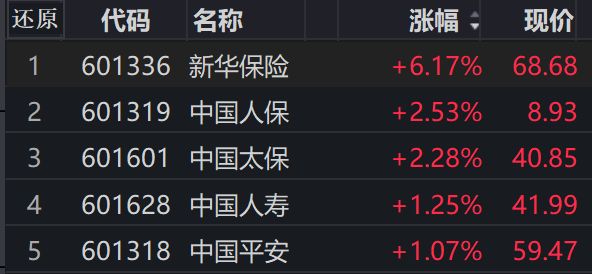
Core Viewpoint - The insurance sector in the A-share market has seen a collective rise, driven by positive earnings reports and favorable market conditions for insurance companies [1][2]. Group 1: Market Performance - On August 29, the insurance sector rose over 2%, with notable increases in stock prices: New China Life Insurance up 6.17%, China Pacific Insurance up 2.28%, and China Life Insurance up 1.25% [1][2]. - The overall increase in the insurance sector was 2.22%, with China Life Insurance and China Pacific Insurance also showing significant gains [1][2]. Group 2: Earnings Reports - The five major listed insurance companies reported a total net profit of 178.19 billion yuan for the first half of the year, marking a year-on-year increase of 3.7% [2][3]. - New China Life Insurance reported a net profit of 14.8 billion yuan, a 33.5% increase year-on-year, while China Life Insurance saw a 6.9% increase to 40.93 billion yuan [3]. Group 3: Business Performance - The new business value for life insurance companies has significantly improved, with New China Life Insurance's new business value increasing by 58.4% to 6.18 billion yuan [3]. - The comprehensive cost ratio for property insurance at PICC was 95.3%, the best level in nearly a decade, indicating improved profitability in the sector [3]. Group 4: External Factors and Future Outlook - The rise in insurance stocks is attributed to favorable external policies and a positive industry outlook, with the insurance sector benefiting from China's high-quality economic development [4][5]. - Regulatory improvements and policy measures have enhanced the stability and sustainability of the insurance industry, contributing to the positive market sentiment [5].




中国太保(601601):COR改善支撑业绩增长,新业务CSM增速较快
KAIYUAN SECURITIES· 2025-08-29 06:11
Investment Rating - The investment rating for China Pacific Insurance (601601.SH) is "Buy" (maintained) [1] Core Views - The report highlights that the improvement in the cost of risk (COR) supports performance growth, with new business CSM (Contractual Service Margin) showing rapid growth [1][4] - The group's net profit for H1 2025 reached 27.89 billion, a year-on-year increase of 11.0%, showing significant improvement compared to the -18.1% year-on-year decline in Q1 [4] - The report predicts that the new business value (NBV) will grow by 11.5%, 12.1%, and 14.2% for the years 2025 to 2027, respectively [4] Financial Performance Summary - In H1 2025, the group achieved a premium income of 193.47 billion, a year-on-year increase of 13.1% [4] - The NBV for H1 2025 reached 9.54 billion, a year-on-year increase of 5.6% (non-retrospective basis), and 32.3% (retrospective basis) [4] - The total investment assets at the end of the period were 2.92 trillion, an increase of 7.0% from the beginning of the year [4] - The net profit forecast for the years 2025 to 2027 is adjusted to 50.6 billion, 56.8 billion, and 63.1 billion, respectively, with year-on-year growth rates of 12.6%, 12.3%, and 11.1% [4][8] Business Segment Insights - The life insurance segment saw a new single premium of 63 billion, a year-on-year increase of 26%, continuing the growth advantage from Q1 [4] - The property insurance segment achieved a premium income of 114.19 billion, a year-on-year increase of 0.9% [4] - The report notes a decrease in the comprehensive cost ratio for property insurance, contributing to higher profits [4] Valuation Metrics - The report provides a forecast for the price-to-earnings (P/E) ratio to be 7.55, 6.73, and 6.05 for the years 2025 to 2027, respectively [8] - The price-to-embedded value (P/EV) is projected to be 0.63, 0.58, and 0.53 for the same period [8]
中国太保(601601):业绩增速转正,持续推动分红险转型
Huachuang Securities· 2025-08-29 05:46
Investment Rating - The report maintains a "Recommended" rating for China Pacific Insurance (601601) with a target price of 47.5 CNY [2][7]. Core Views - The company has turned its performance growth positive, continuing to drive the transformation towards dividend insurance [2]. - The net profit attributable to shareholders for the first half of 2025 increased by 11% year-on-year to 27.9 billion CNY, with the operating profit also showing a 7.1% increase [7]. - The new business value (NBV) for the life insurance segment saw a significant increase of 32.3% year-on-year, reaching 9.5 billion CNY [7]. Financial Performance Summary - **Revenue Growth**: Total revenue is projected to grow from 404,089 million CNY in 2024 to 450,095 million CNY in 2027, with a year-on-year growth rate of 24.7% in 2024, slowing to 5.3% by 2027 [3][8]. - **Net Profit**: The net profit attributable to shareholders is expected to rise from 44,960 million CNY in 2024 to 54,567 million CNY in 2027, with a peak growth rate of 64.9% in 2024 [3][8]. - **Earnings Per Share (EPS)**: EPS is forecasted to increase from 4.7 CNY in 2024 to 5.7 CNY in 2027 [3][8]. - **Valuation Ratios**: The price-to-earnings (P/E) ratio is expected to decrease from 8.5 in 2024 to 7.0 in 2027, indicating improving valuation [3][8]. Business Segment Insights - **Life Insurance**: The life insurance segment's new business value (NBV) increased significantly, with a notable rise in the proportion of dividend insurance in new premium income, reaching 42.5% [7]. - **Property and Casualty Insurance**: The property and casualty insurance segment reported a slight increase in original premium income by 0.9% year-on-year, with a combined ratio of 96.3% [7]. - **Investment Performance**: The group’s investment assets grew by 7% year-on-year to 2.92 trillion CNY, with a focus on increasing allocations to bonds and equities [7].
瑞银:中国太保上半年净利润超预期 目标价上调至41港元
Xin Lang Cai Jing· 2025-08-29 05:20
瑞银发表研究报告指,中国太保上半年净利润按年增长11%,超越市场预测的2%至9%增幅;营运溢利 增长7.1%,略高于瑞银预测的增长6%。重述后上半年新业务价值按年升32%,符合预期。按可比口径 太保新业务价值增长于第二季放缓,瑞银归因于首年保费增长按季减慢所致,但表现仍属强劲。因应中 国太保近期股价上扬,瑞银将其2025年内涵价值预测上调5%,目标价从37港元上调至41港元,评级"买 入"。 ...
中国太保(601601):保险投资稳健增长,新业务价值持续提升
Guoxin Securities· 2025-08-29 05:19
Investment Rating - The investment rating for the company is "Outperform the Market" [6] Core Views - The company has shown steady growth in insurance investments and a continuous improvement in new business value, with a 10.95% year-on-year increase in net profit attributable to shareholders in the first half of 2025 [1] - The new business value of Taibao Life Insurance reached 9,544 million yuan, a significant increase of 32.3% year-on-year, with a new business value rate of 15.0% [2] - The company is focusing on building an "insurance + health care" integrated ecosystem, enhancing operational efficiency and risk control through intelligent services [1] Financial Performance Summary - Total operating revenue for the first half of 2025 was 2,004.96 billion yuan, up 3.01% year-on-year, with total profit reaching 322.59 billion yuan, a 9.74% increase [1] - The company achieved an insurance service income of 968.31 billion yuan in the first half of 2025, reflecting a 4.0% year-on-year growth [3] - The comprehensive cost ratio for underwriting improved to 96.3%, a decrease of 0.8 percentage points year-on-year, with underwriting profit increasing by 30.9% to 35.5 billion yuan [3] Investment Strategy and Forecast - The company is increasing its direct investment in bonds and stocks, achieving a total investment return rate of 2.3% in the first half of 2025 [4] - The earnings per share (EPS) forecast for 2025 to 2027 is 4.77, 4.90, and 5.08 yuan per share, respectively, with the current stock price corresponding to P/EV ratios of 0.59, 0.51, and 0.45 [4][5] - The company maintains its earnings forecast for 2025 to 2027, indicating a stable transition strategy and solid operational results [4]
TMT板块首只万亿股出炉,集体大涨,龙头创近三年新高
Zheng Quan Shi Bao· 2025-08-29 05:14
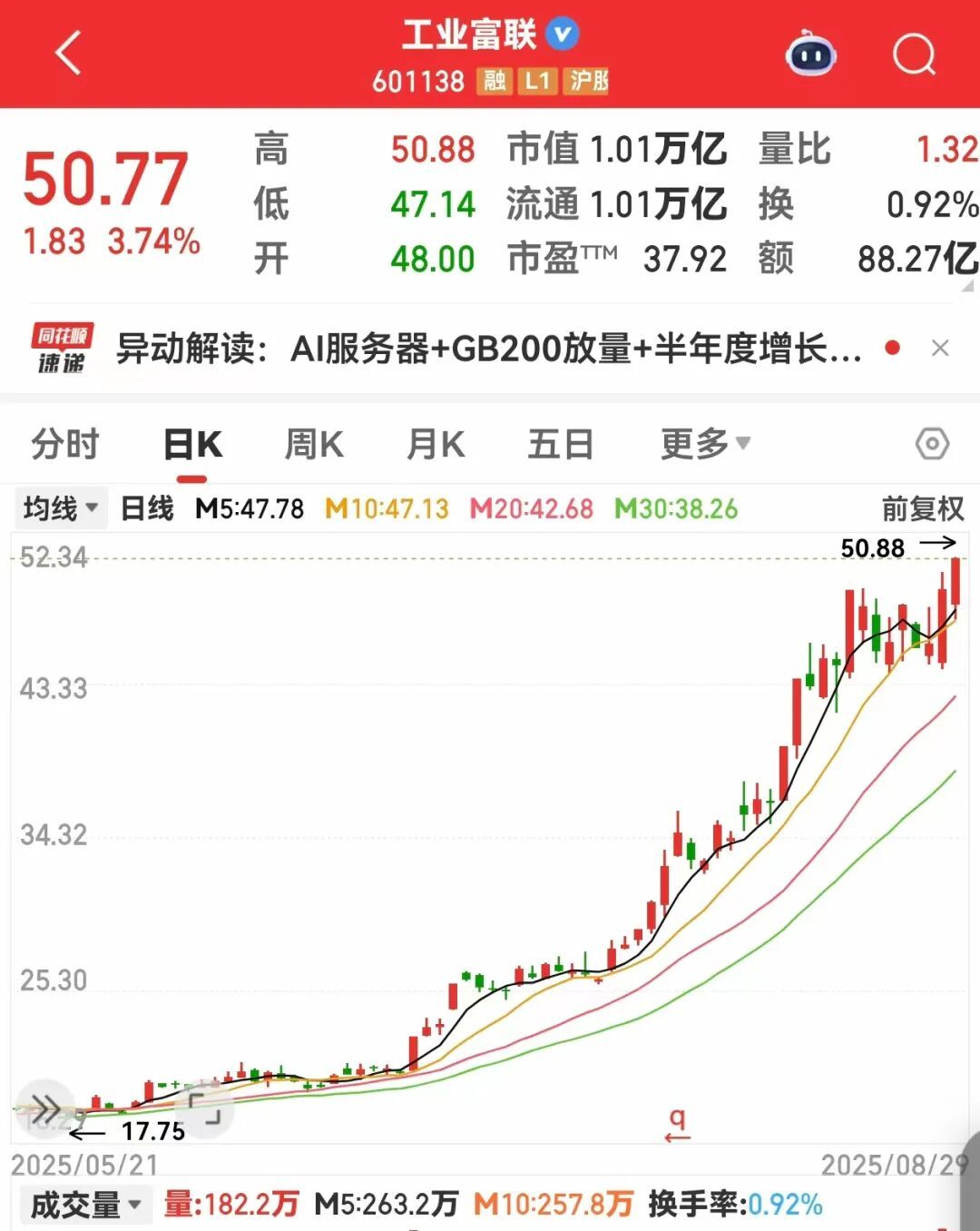
Group 1: Industrial Fulian - Industrial Fulian's market capitalization surpassed 1 trillion yuan, reaching 10082.65 billion yuan, becoming the first stock in the TMT sector to achieve this milestone [1] - In the first half of the year, Industrial Fulian reported a net profit attributable to shareholders of 121.13 billion yuan, a year-on-year increase of 38.61%, marking a record high for the same period since its listing [3] - The company's core business shows strong growth momentum, with server revenue in the second quarter growing over 50%, and AI server revenue increasing by over 60% year-on-year [3] Group 2: CATL - CATL's stock price reached a nearly three-year high, with a maximum increase of 14.15%, closing up 11.45% and surpassing 300 yuan [4][5] - The lithium battery sector saw a collective rise, with several leading companies experiencing significant stock price increases [7] Group 3: Lithium Battery Sector - Multiple leading companies in the lithium battery sector reported impressive performance in the first half of the year, with net profit growth exceeding 60% for companies like Zhongcai Technology and Huayou Cobalt [8] - The demand for new energy vehicles continues to grow, with sales in the first half of 2025 reaching 5.878 million units, a year-on-year increase of 34.3%, driving the demand for power batteries [10] Group 4: Insurance Sector - The insurance sector experienced a collective rise, with the industry index reaching a maximum increase of 4.52% [11][12] - New China Life Insurance reported a net profit of 147.99 billion yuan in the first half of the year, a year-on-year increase of 33.53%, marking the highest growth rate since 2020 [12] - The insurance industry saw a total premium income of 3.7 trillion yuan in the first half of 2025, a year-on-year increase of 5.1% [15] Group 5: Dividend Distribution - Several insurance companies, including China Ping An and China Life, announced mid-term dividend plans, with a total proposed dividend distribution of 293.36 billion yuan [16]