CPIC(601601)

Search documents
太保寿险两家分支公司合计被罚款42万元 财务数据不真实
Xi Niu Cai Jing· 2026-02-02 07:06
| 序 | 当事人名称 | 主要违法违规行为 | 行政处罚内容 | 作出决定 | | --- | --- | --- | --- | --- | | 름 | | | | 机关 | | | 中国太平洋人 | | 对中国太平洋人寿保 | 监管局 | | | 寿保险股份有 | | 险股份有限公司吉林 | | | | 限公司吉林省 | | 省分公司罚款40万 | | | | 分公司及相关 | 财务数据不真实, | 元,对中国太平洋人 | | | 1 | 责任人、中国 | 销售人员擅自印制 | 寿保险股份有限公司 | 吉林金融 | | | 太平洋人寿保 | 产品宣传材料中包 | 长春中心支公司警告 | | | | 险股份有限公 | 含误导宣传内容、 | 并合计罚款2万元。 | | | | 司长春中心支 | 销售人员通过朋友 | 对李元华、张琳、襟 | | | | 公司及相关责 | 圈进行不实宣传 | 长有、宋艳红、孙桂 | | | | 任人 | | 华、姜亚茹警告并罚 | | | | | | 款共计14.5万元。 | | 同时,相关责任人李元华、张琳、禚长有、宋艳红、孙桂华、姜亚茹被警告并被罚款共计14.5万元。 1月 ...


保险业2025业绩出炉
Jing Ji Wang· 2026-02-02 02:29
Core Insights - The insurance industry in China achieved a total premium income of 6.12 trillion yuan in 2025, marking a year-on-year growth of 7.43% [3] - By the end of 2025, the total assets of the insurance industry reached 41.31 trillion yuan, an increase of 15.06% from the beginning of the year [2] Group 1: Premium Income and Growth - The insurance industry experienced a significant recovery in premium income, with a total of 6.12 trillion yuan in 2025, up 7.43% year-on-year [3] - Life insurance premiums contributed notably, with a total of 4.65 trillion yuan, reflecting a growth of 9.05% [3] - Health insurance premiums approached the 1 trillion yuan mark, with a total of 997.3 billion yuan, growing by 2.04% [3] Group 2: Asset Growth - The total assets of the insurance industry surpassed 41 trillion yuan, reaching 41.31 trillion yuan by the end of 2025, an increase of 5.4 trillion yuan from 35.91 trillion yuan at the beginning of the year [2] - The insurance asset management scale also grew, with the investment balance exceeding 37 trillion yuan by the end of September 2025 [2] Group 3: Performance of Different Insurance Segments - Property insurance premiums totaled 1.76 trillion yuan, with a growth rate of 3.92%, indicating a slowdown compared to previous years [5] - Within property insurance, auto insurance premiums were 940.9 billion yuan, growing by 2.98%, while its market share continued to decline [6] - Non-auto insurance premiums saw a growth of 5%, with significant increases in agricultural insurance (4.78%) and health insurance (11.31%) [6] Group 4: Distribution Channels and Future Outlook - The bancassurance channel was a major driver for life insurance premium growth, with some companies reporting over 40% growth in this segment [3][4] - Analysts expect a strong performance for listed insurance companies in 2026, driven by ongoing trends in deposit migration and attractive insurance product rates compared to bank deposits [4]
1月最牛金股大涨99%!2月券商金股出炉,聚焦三大行业
证券时报· 2026-02-02 01:54
Core Viewpoint - The article highlights the strong performance of brokerage "golden stocks" in January, with the top stock rising nearly 99%, and anticipates a continuation of the spring market trend into February, particularly favoring technology growth and cyclical sectors [1][2][3]. January Performance - In January, the best-performing golden stock was Zhuoyi Information, which surged by 98.94%, followed by Hongjing Technology with a 68.75% increase, and Shenghui Integration at 61.59% [3]. - Other notable stocks that rose over 50% included Huafeng Measurement Control, Huahong Semiconductor, and Jinan Guojin, among others [3]. - A total of 11 brokerage golden stock portfolios outperformed the market index, with the Shanghai Composite Index and CSI 300 rising by 3.76% and 1.65%, respectively [3]. Brokerage Performance - Shenwan Hongyuan's golden stock portfolio led with a monthly gain of 16.19%, while Zhongyou Securities followed with 15.16% [4][5]. - Other brokerages such as Ping An Securities and Huayuan Securities also achieved over 12% monthly returns [4][6]. February Outlook - The February golden stock list features a strong focus on the electronics, machinery, and non-ferrous metals sectors, with stocks like Haiguang Information and Tencent Holdings receiving significant attention [2][8]. - The electronics sector is particularly favored due to factors like storage cycle price increases and domestic substitution [8]. - The non-ferrous metals sector remains popular, with stocks like Zijin Mining and Luoyang Molybdenum receiving multiple recommendations from brokerages [8]. Market Sentiment - Brokerages generally expect the spring market trend to continue, with potential market fluctuations before the Spring Festival [11][12]. - Analysts suggest maintaining stock positions during the holiday, anticipating a resurgence in market activity post-festival [11][12]. - Key investment themes include technology growth and cyclical sectors, with a focus on AI, gaming, and resource-related stocks [12][13].




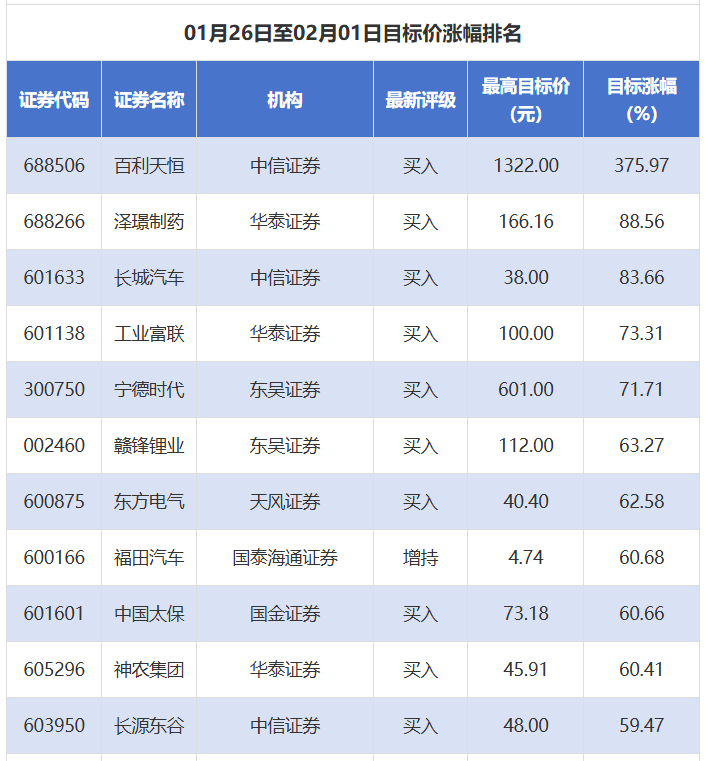
百利天恒目标价涨幅近376% 金辰股份评级被调低丨券商评级观察
2 1 Shi Ji Jing Ji Bao Dao· 2026-02-02 01:31
Core Viewpoint - The report highlights significant target price increases for several listed companies from January 26 to February 1, with notable mentions including Baili Tianheng, Zexing Pharmaceutical, and Great Wall Motors, indicating strong bullish sentiment in the market for these stocks [1][2]. Target Price Increases - Baili Tianheng (688506) has a target price increase of 375.97%, with a highest target price set at 1322.00 yuan [2]. - Zexing Pharmaceutical (688266) shows a target price increase of 88.56%, with a highest target price of 166.16 yuan [2]. - Great Wall Motors (601633) has a target price increase of 83.66%, with a highest target price of 38.00 yuan [2]. - Other companies with notable target price increases include Industrial Fulian (601138) at 73.31% and CATL (300750) at 71.71% [2][3]. Broker Recommendations - A total of 265 listed companies received broker recommendations during the period, with Qingdao Bank receiving the highest number of recommendations at 8 [3][4]. - Other companies with multiple recommendations include Xian Dao Intelligent and Wancheng Group, each receiving 5 recommendations [3][4]. Rating Adjustments - Eight companies had their ratings upgraded, including Shanghai Jahwa (600315) from "Hold" to "Buy" and ZTE Corporation (000063) from "Cautious Buy" to "Buy" [5][6]. - Two companies had their ratings downgraded, including Jincheng Shares (603396) from "Buy" to "Hold" and Huasheng Group (603018) from "Buy" to "Hold" [6]. First-Time Coverage - During the same period, 75 instances of first-time coverage were reported, with notable ratings including Shaanxi Tourism (603402) receiving a "Outperform Industry" rating and Bichu Electronics (688188) receiving a "Buy" rating [7].





1月最牛金股大涨99%!2月券商金股出炉,聚焦三大行业
券商中国· 2026-02-02 00:54
作为券商月度策略的精华,券商金股在1月份展现了亮眼的超额收益能力,最牛金股单月大涨约99%。 进入2月,新一期券商金股名单陆续出炉,主要集中在电子、机械设备、有色金属等行业。个股方面,海光信息、腾讯控股、中国太保、紫金矿业的人气最 高。 展望2月,券商普遍认为,春季行情趋势仍在延续,春节之前市场可能震荡,科技成长、顺周期板块受到青睐。还有券商建议,投资者在春节持股过节。 1月最牛金股大涨近99% 回顾1月金股表现,1月涨幅居前的金股集中在计算机、电子、化工、电力设备、有色金属等板块。 每市APP显示,由华龙整体推荐的卓易信息涨幅高达98.94%,成为1月最牛金股。排名第二的是由国联民生证券推荐的宏景科技,单月涨幅达68.75%,国新 证券推荐的盛晖集成则排名第三,1月上涨了61.59%。 1月份涨幅超50%的还包括华峰测控(太平洋证券推荐)、华虹半导体(兴业证券推荐)、金安国纪(东莞证券推荐)、东方铁塔(西部证券推荐)、迈为 股份(东吴证券、华源证券推荐)等等。此外,紫金黄金国际(东北证券推荐)、华锡有色(西南证券推荐)、兆易创新(中航证券、中国银河证券推 荐)1月涨超45%。 券商金股组合也在1月展现了亮眼 ...

券商本月金股热门标的渐次“露面”
Zheng Quan Ri Bao· 2026-02-01 15:54
Group 1 - The core focus of the article is on the stock recommendations from brokerages for February, highlighting popular stocks such as Zijin Mining, Wanhua Chemical, and China Pacific Insurance due to their high recommendation frequency [1][2] - In February, Zijin Mining, Wanhua Chemical, and China Pacific Insurance received recommendations from three brokerages each, while stocks like Zhongji Xuchuang, Beixin Building Materials, and Zhaoyi Innovation received recommendations from two brokerages [2] - Zijin Mining is identified as a leading global gold and copper resource company, benefiting from rising gold and copper prices and expected to achieve growth in both volume and price due to ongoing production increases [2] Group 2 - Analysts maintain a cautiously optimistic outlook for the A-share market in February, anticipating a core bullish period before the Spring Festival, with a focus on sectors like technology and non-ferrous metals [2][3] - The market is currently experiencing low volatility and is in an upward trend, with opportunities expected in theme assets following adjustments [3] - Recommendations for stock allocation include a balanced growth strategy focusing on technology, raw material price increases, and sectors benefiting from urban renewal policies [3] Group 3 - In January, 67% of the 307 stocks recommended by brokerages saw price increases, with seven stocks rising over 50%, indicating strong performance in the stock recommendations [4] - Notable high-performing stocks included Zhuoyi Information, which saw a 98.94% increase, and other stocks with significant gains across various sectors [4] - The popularity of stocks like Zhongji Xuchuang and Zijin Mining was reflected in their high recommendation counts, with respective price increases of 6.39% and 16.45% in January [4] Group 4 - The performance of brokerage stock indices is noteworthy, with the "Guoyuan Securities Gold Stock Index" leading with a 16.55% monthly increase, indicating strong stock selection capabilities among brokerages [5] - Other brokerage indices also showed monthly increases exceeding 10%, further demonstrating the effectiveness of brokerage research [5]

非银金融行业跟踪周报:券商股或迎业绩催化,保险估值仍待提升-20260201
Soochow Securities· 2026-02-01 14:38
Investment Rating - The report maintains an "Accumulate" rating for the non-bank financial sector [1] Core Insights - The non-bank financial sector has shown mixed performance, with the insurance industry outperforming the CSI 300 index recently, while the securities and diversified financial sectors lagged [10][11] - The report highlights a positive outlook for the insurance sector, driven by expected growth in new policies and the ongoing development of the "insurance + health care" model [24][28] - The securities sector is experiencing increased trading volumes and regulatory support, which may lead to new growth opportunities [16][22] - The diversified financial sector is transitioning to a more stable growth phase, with trust assets and futures trading volumes remaining robust [32][38] Summary by Sections 1. Recent Performance of Non-Bank Financial Sub-Sectors - In the last five trading days (January 26-30, 2026), the insurance sector rose by 5.55%, while the securities sector fell by 0.70% and diversified financials dropped by 3.49% [10] - Year-to-date, the diversified financial sector has increased by 2.06%, followed by insurance at 1.24%, while the securities sector has decreased by 1.64% [11] 2. Insights on Non-Bank Financial Sub-Sectors 2.1 Securities - Trading volume has increased significantly, with an average daily trading value of 34,743 billion yuan in January, up 155.35% year-on-year [16] - The China Securities Regulatory Commission (CSRC) is proposing to expand the types of strategic investors, which may enhance market stability [20][21] 2.2 Insurance - The insurance sector's premium income for 2025 is projected at 52,696 billion yuan, reflecting an 8.5% year-on-year increase [25] - The report anticipates strong performance in new policy sales for 2026, particularly in health and pension insurance [31] 2.3 Diversified Financials - The trust industry saw its asset scale reach 32.43 trillion yuan by mid-2025, a 20.11% increase year-on-year [32] - The futures market recorded a trading volume of 9.51 billion contracts in December 2025, with a transaction value of 90.81 trillion yuan, marking a 45.17% year-on-year growth [38] 3. Industry Ranking and Key Company Recommendations - The report ranks the insurance sector highest, followed by securities and diversified financials, recommending companies such as China Life, Ping An, and CITIC Securities for investment [32][46]






借鉴美国Corgi模式,太保将试点AI原生分支机构
第一财经· 2026-02-01 12:30
2026.02. 01 "Corgi的风险定价不再依赖年度的精算假设,而是基于客户实时行为与外部风险信号的动态调整; 利润的来源不再依靠扩大保费规模,而是通过对新兴风险,如AI责任、网络安全等的认知优势来获得 风险溢价,规模扩张不再显著推高成本。"魏骄华称。太保科技在上述报告中表示,这种新模式能带 来显著的运营成本节约和效率提升,并通过精准的个性化服务和风险定价,实现了客户满意度和盈利 能力的进步,预示着保险行业一个全新时代的到来。 除了AI原生分支机构试点,傅帆还明确了另外两个层次的AI改革:其一,重塑风险管理的前瞻性和主 动性,借助AI智能风控,在科技创新、绿色发展、普惠民生和养老健康等领域实现有效风险减量,推 动保险从事后补偿者向事前风控、事中减量转型;其二,重塑服务体验的温度和精准度,利用AI深度 数据挖掘能力,开发以客户需求为导向的个性化保障,通过自动化处理,让秒级定损、瞬间服务成为 常态。 傅帆同时强调,AI战略落地需坚守三项要求:坚持"一把手工程",坚决打破数据壁垒;强化动态评 估与资源精准调优;拒绝表面数字化。 本文字数:1488,阅读时长大约3分钟 作者 | 第一财经 杨倩雯 "数字化转型不 ...
喜娜AI速递:今日财经热点要闻回顾|2026年2月1日
Sou Hu Cai Jing· 2026-02-01 11:20
Group 1: Market Trends - The silver market experienced a historic drop, with spot silver prices plunging 36%, marking the largest intraday decline in history, while spot gold prices fell over 12%, the largest single-day drop in 40 years. This decline is attributed to the nomination of Kevin Warsh as the next Federal Reserve Chairman, interpreted as a shift towards a more hawkish monetary policy, alongside factors like an overheated market and a downturn in U.S. stocks [2] - Bitcoin fell below $79,000, reaching its lowest level since April 2025, with over 420,000 investors liquidated, totaling $2.561 billion in liquidation. The price drop is influenced by escalating tensions between Israel and Iran, as well as delays in new regulatory frameworks for the U.S. crypto industry [2] - The semiconductor industry in South Korea saw a significant increase in exports, totaling $20.5 billion in January, a year-on-year surge of over 102%, indicating strong global demand for semiconductors. Additionally, domestic chip manufacturers are raising prices, with increases up to 80% across key segments [3] Group 2: Company Financials - Vanke announced an expected loss of 82 billion yuan for 2025, which would set a record for losses among A-share real estate companies. The anticipated losses are attributed to a decline in project settlement scale, low gross margins, and various impairments [2] - Ten companies, including Deep Konka A and Jiyou Co., have issued warnings about potential delisting due to financial indicators falling below required thresholds, including negative net assets and profits [4] - Several brokerages have released their investment recommendations for February, focusing on sectors such as technology and cyclical stocks, with companies like China Pacific Insurance and Zijin Mining receiving multiple endorsements [5]






2月十大金股推荐
Ping An Securities· 2026-02-01 10:36
Group 1: Market Outlook - The current market environment is characterized by ample liquidity, with structural highlights in the fundamentals indicated by high-frequency economic tracking and company performance forecasts[3] - The equity market is expected to continue its upward trend, with a focus on sectors benefiting from both domestic and external demand, particularly in technology manufacturing and cyclical industries[3] Group 2: Recommended Stocks - Beijing Junzheng (300223.SZ) has a total market value of RMB 66.2 billion, with a TTM PE of 208.6 and PB of 5.3, driven by the upward cycle in storage and L3 autonomous driving catalyzing automotive electronics[3] - Jingfang Technology (603005.SH) has a market cap of RMB 20.1 billion, TTM PE of 58.9, and PB of 4.4, benefiting from the expansion of automotive CIS demand, with a projected net profit growth of 44.41%-52.32% in 2025[3] - Haiguang Information (688041.SH) has a market value of RMB 607.3 billion, TTM PE of 256.6, and PB of 27.7, positioned to benefit from the AI wave and domestic substitution trends[3] - Hehe Information (688615.SH) has a market cap of RMB 40.6 billion, TTM PE of 91.1, and PB of 14.5, with accelerated profit growth driven by AI and overseas market expansion[3] - Jinfeng Technology (002202.SZ) has a market value of RMB 103.4 billion, TTM PE of 42.8, and PB of 3.0, with improving profitability in wind turbine manufacturing and green methanol projects[3] - Luoyang Molybdenum (603993.SH) has a market cap of RMB 55.74 billion, TTM PE of 29.6, and PB of 7.4, with copper prices expected to rise, benefiting from volume and price increases[3] - Zhongman Petroleum (603619.SH) has a market value of RMB 17.2 billion, TTM PE of 33.7, and PB of 4.0, with high growth potential amid rising oil prices[3] - Beixin Building Materials (000786.SZ) has a market cap of RMB 48.6 billion, TTM PE of 15.7, and PB of 1.8, with expected recovery in gypsum board profitability[3] - China Duty Free (601888.SH) has a market value of RMB 190.3 billion, TTM PE of 56.2, and PB of 3.4, with anticipated recovery in operations due to strategic partnerships[3] - China Pacific Insurance (601601.SH) has a market cap of RMB 414.6 billion, TTM PE of 8.5, and PB of 1.6, with stable growth in liabilities and high dividend yield[3]