China Life(601628)

Search documents
大理金融监管分局同意撤销中国人寿弥渡县支公司寅街镇营销服务部
Jin Tou Wang· 2025-09-05 04:16
Core Viewpoint - The Dali Financial Regulatory Bureau has approved the request from China Life Insurance Company to revoke the marketing service department in Yidu County, indicating a strategic restructuring within the company [1] Summary by Sections - Approval of Revocation: The Dali Financial Regulatory Bureau has officially agreed to the request for the cancellation of the marketing service department in Yidu County [1] - Immediate Actions Required: Following the approval, China Life Insurance Company must cease all operations of the revoked department and return the license to the regulatory bureau within 15 working days, complying with relevant laws and regulations [1]
华安期货金融工程日报-20250905





Xin Yong An Guo Ji Zheng Quan· 2025-09-05 03:45
The provided content does not contain any quantitative models or factors related to financial engineering or quantitative analysis. It primarily consists of financial news, stock performance data, and corporate updates. No relevant information for summarizing quantitative models or factors is present.
上市险企中报观察:AI赋能保险业降本增效
Zhong Guo Jing Ji Wang· 2025-09-05 03:26
Core Insights - The application of AI in the domestic insurance industry is entering a new phase of large-scale implementation, with major companies focusing on cost reduction and efficiency enhancement across the entire business chain [1][2][3] AI Integration in Business Processes - AI technology is transforming core insurance processes from manual to intelligent-driven, significantly improving service efficiency and customer experience [2] - In underwriting and customer service, AI has enhanced operational efficiency, with automated underwriting rates reaching 95.8% and customer service response accuracy exceeding 95% [3][4] Cost Control and Risk Reduction - AI applications in customer service and auditing have substantially reduced labor costs, with companies like ZhongAn Insurance utilizing over 100 active AI robots, achieving 4.5 billion calls in the first half of the year [4][5] - Enhanced AI risk control capabilities have led to significant reductions in fraud losses, with Ping An Insurance intercepting fraud claims worth 6.44 billion yuan, a year-on-year increase of 6% [5] Future Development and Strategic Direction - Several listed insurance companies have identified AI as a long-term strategic direction, with China Pacific Insurance focusing on building an enterprise-level AI capability system [7][8] - The integration of AI is expected to drive innovation in personalized products, health management services, and investment capabilities, with Ping An's investment return rate rising to 3.1% [7][8]




一线调研看变化|织密社会保障网和灾害防控网 实探中国人寿服务社会治理的山西路径
Shang Hai Zheng Quan Bao· 2025-09-04 14:01
Core Viewpoint - The article emphasizes the role of insurance in enhancing social governance and disaster prevention in China, highlighting the contributions of China Life Insurance in various sectors such as medical and pension security, environmental governance, and social management [1]. Group 1: Social Governance and Insurance - China Life Insurance is recognized as a key player in improving social governance efficiency through its functions as an economic stabilizer and social stabilizer [1]. - The company has actively participated in the operation of the Road Traffic Accident Social Rescue Fund in Shanxi, significantly improving the efficiency of fund operations and emergency responses since its management began in August 2019 [2][3]. Group 2: Financial Contributions and Impact - China Life has cumulatively advanced 1.46 billion yuan and recovered 745 million yuan through the Road Traffic Accident Fund, assisting 36,463 individuals and addressing social issues such as poverty due to injuries [3]. - The company has implemented innovative solutions to enhance recovery efficiency, including a specialized payment reminder system that has sent over 1,150 recovery messages, resulting in nearly 30 million yuan in recovered funds [3]. Group 3: Environmental Protection and Support for Forest Rangers - China Life has developed a dedicated risk protection program for forest rangers in Shanxi, providing over 44 billion yuan in risk coverage for more than 8,700 rangers [5]. - The company has integrated ecological protection efforts with insurance services, allocating a portion of insurance premiums to biological pest control and forest fire prevention initiatives [5]. Group 4: Economic and Disaster Risk Management - In 2024, China Life aims to increase its insurance coverage to over 700 trillion yuan, with direct investments in the real economy reaching approximately 5 trillion yuan [6]. - The company is managing around 2.1 trillion yuan in various pension funds and is expanding its elderly care projects across 26 major cities [6]. - China Life's disaster risk management services are set to enhance, with projected claims payments exceeding 356 billion yuan in 2024, and a significant increase in catastrophe insurance coverage [6].
2025上半年寿险公司利润榜:平安、国寿、太保TOP3,投资↑新业务价值↑行业利润三连升...
13个精算师· 2025-09-04 12:23
Core Viewpoint - The life insurance industry in the first half of 2025 has shown significant profit growth, with 73 companies reporting a total net profit of 185.8 billion, a year-on-year increase of approximately 37 billion, or 25% [10][12][13]. Group 1: Profit Growth and Performance - 52 out of 73 life insurance companies reported profits, while 21 incurred losses, indicating a positive trend in profitability [1][22]. - The net profit of major companies such as Ping An and China Life has significantly contributed to the overall profit increase, with Ping An reporting a net profit of 50.6 billion and China Life 40.3 billion [2][24]. - The industry has experienced three consecutive years of profit growth, reaching a new high that surpasses the same period in 2019 [10][12]. Group 2: Investment and Business Value - The increase in equity investment has led to a rise in investment returns, with the average investment yield for 73 companies rising to 4.22%, up from 3.59% year-on-year [16][18]. - The total amount directly invested in stocks by insurance companies exceeded 3 trillion, marking an increase of approximately 1 trillion compared to the previous year [18]. - New business value has also seen substantial growth, particularly in the bancassurance channel, with companies like China Life and Xinhua Insurance reporting over 100% growth in new single premiums [31][35]. Group 3: Company Rankings and Market Dynamics - The top six life insurance companies have shown robust performance, with significant increases in both premium income and new business value [23][28]. - Tai Kang Life has seen a notable profit increase, attributed to the implementation of new accounting standards and improved investment returns [38][40]. - AIA's new business value rate remains high at 58.6%, reflecting its strong market position and effective agent model [41]. Group 4: Losses and Challenges for Smaller Companies - Despite the overall positive trend, 21 companies reported losses, with many being smaller firms struggling with high liability costs and investment volatility [22][43]. - Companies like Heng Tai Life and Guo Lian Life have faced significant challenges, with declining investment yields contributing to their financial difficulties [49][50]. - The continuous losses among smaller firms highlight the need for capital strengthening and improved operational efficiency to enhance solvency [47][48].


中国人寿(601628):业务转型价值稳增,加大权益配置力度
Guotou Securities· 2025-09-04 09:50
Investment Rating - The report maintains a "Buy-A" investment rating for the company [6] Core Views - The company reported a revenue of 239.24 billion yuan for the first half of 2025, a year-on-year increase of 2.1%, and a net profit attributable to shareholders of 40.93 billion yuan, up 6.9% year-on-year [2] - The embedded value reached 1,477.83 billion yuan, reflecting a growth of 5.5% since the beginning of the year, while the new business value was 28.55 billion yuan, showing a year-on-year increase of 20.3% [2] - The company is undergoing a structural transformation, with new single premiums reaching 161.26 billion yuan, a slight increase of 0.6% year-on-year, and first-year regular premiums declining by 16.5% to 81.25 billion yuan [2] - The individual insurance channel saw rapid growth in dividend insurance, accounting for over 50% of first-year regular premiums, with a new business value increase of 9.5% to 24.34 billion yuan [2] - The bank insurance channel's new single premiums increased by 111.1% to 35.87 billion yuan, with first-year regular premiums up 34.4% [2] Financial Performance Summary - As of the end of the first half of 2025, the company's investment assets reached 71,271.5 billion yuan, a growth of 7.8% since the beginning of the year, with a total investment return rate of 3.29%, down 0.30 percentage points year-on-year [3] - The net investment return rate was 2.78%, down 0.25 percentage points year-on-year, with the asset allocation showing a bond proportion of 59.0%, stock proportion of 8.7%, and fund proportion of 4.9% [3] - The projected earnings per share (EPS) for 2025-2027 are 3.95 yuan, 4.30 yuan, and 4.77 yuan respectively, with a target price of 47.88 yuan based on a 0.9x 2025 P/EV ratio [3][4]
日赚近10亿、分红293亿,五大险企押注分红险,部分公司新业务占比超50%
3 6 Ke· 2025-09-04 09:21
Group 1: Core Insights - The five major listed insurance companies in A-shares achieved a total net profit of 1781.92 billion yuan in the first half of 2025, averaging a daily profit of 9.84 billion yuan [1][4] - These companies announced significant cash dividends, with a total proposed dividend of approximately 293.36 billion yuan, led by China Ping An at 172.02 billion yuan [1][4] - The rise of participating insurance is becoming a new growth engine for the industry, with several companies reporting substantial increases in new premium income from participating insurance [1][7] Group 2: Financial Performance - The total operating revenue of the five major insurance companies reached 1.33 trillion yuan, a year-on-year increase of 4.89% [3] - New business value for life insurance companies saw explosive growth, with China Life and Ping An Life achieving new business values of 285 billion yuan and 223.35 billion yuan, respectively, reflecting year-on-year growth rates of 20.3% and 39.8% [5] Group 3: Participating Insurance Growth - The proportion of participating insurance in new business has significantly increased, with China Life reporting that over 50% of its new business premium comes from participating insurance [7][9] - New premium income from participating insurance for New China Life reached 182.69 billion yuan, a year-on-year increase of 24.9% [7] - The shift towards participating insurance is seen as both a response to the low interest rate environment and a long-term strategy for risk-sharing with customers [2][8] Group 4: Strategic Responses - Insurance companies are focusing on optimizing their product structures and enhancing the sales capabilities of their agents to adapt to the changing market conditions [10][11] - The adjustment in product sales strategies emphasizes understanding customer needs for risk protection and financial management, moving away from solely promoting high guaranteed returns [11]
保险板块9月4日涨0.16%,中国人寿领涨,主力资金净流出1.94亿元
Zheng Xing Xing Ye Ri Bao· 2025-09-04 08:48
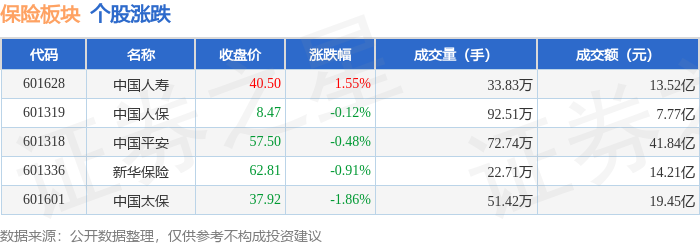
Core Insights - The insurance sector experienced a slight increase of 0.16% on September 4, with China Life leading the gains [1] - The Shanghai Composite Index closed at 3765.88, down 1.25%, while the Shenzhen Component Index closed at 12118.7, down 2.83% [1] Insurance Sector Performance - China Life (601628) closed at 40.50, up 1.55% with a trading volume of 338,300 shares and a transaction value of 1.352 billion [1] - China Pacific Insurance (601601) closed at 37.92, down 1.86% with a trading volume of 514,200 shares and a transaction value of 1.945 billion [1] - New China Life (601336) closed at 62.81, down 0.91% with a trading volume of 227,100 shares and a transaction value of 1.421 billion [1] - China Ping An (601318) closed at 57.50, down 0.48% with a trading volume of 727,400 shares and a transaction value of 4.184 billion [1] - China Re (601319) closed at 8.47, down 0.12% with a trading volume of 925,100 shares and a transaction value of 777 million [1] Fund Flow Analysis - The insurance sector saw a net outflow of 194 million from institutional investors, while retail investors experienced a net outflow of 143 million [1] - Speculative funds recorded a net inflow of 337 million into the insurance sector [1] Individual Stock Fund Flow - China Life (601628) had a net inflow of 69.29 million from institutional investors, accounting for 5.12% of total transactions [2] - New China Life (601336) had a net inflow of 66.60 million from institutional investors, accounting for 4.69% of total transactions [2] - China Ping An (601318) experienced a net outflow of 192 million from institutional investors, representing 4.59% of total transactions [2] - China Pacific Insurance (601601) had a net outflow of 91.25 million from institutional investors, accounting for 4.69% of total transactions [2] - China Re (601319) had a net outflow of 46.37 million from institutional investors, representing 5.97% of total transactions [2]

保险业交出稳中有进“周年答卷”
Jin Rong Shi Bao· 2025-09-04 08:41
Core Viewpoint - The "New National Ten Articles" released by the State Council aims to strengthen regulation, prevent risks, and promote high-quality development in the insurance industry over the next 5 to 10 years, marking a significant policy direction for the sector [1] Industry Performance - As of the end of Q2 2025, the insurance industry's asset scale reached 39.22 trillion yuan, with a year-on-year growth of 9.2% [2] - The total insurance premium income amounted to 3.74 trillion yuan, reflecting a 5.3% increase compared to the same period in 2024 [2] - Insurance companies' claims and payouts reached 1.3 trillion yuan, showing a notable growth of 9% year-on-year, outpacing premium growth [2] Social Welfare Services - The insurance sector has enhanced its role in social welfare, particularly in disaster relief, with 20.5 billion yuan paid out during extreme weather events in 2025 [3] - The urban catastrophe insurance program has provided risk protection for 64.39 million households, amounting to 22.36 trillion yuan in coverage [3] - Technological advancements have improved risk reduction services, with significant outreach for disaster warnings to millions of clients [3] Health Insurance Development - The urban commercial medical insurance, known as "惠民保," has seen significant growth, with 615.9 million participants in Shenzhen and over 22 billion yuan in claims paid [4] - The commercial health insurance sector has also expanded, with claims reaching 405.2 billion yuan in 2024 and long-term health insurance reserves exceeding 2.5 trillion yuan [4][5] Support for the Real Economy - The insurance industry is aligning with national strategies by enhancing risk protection in technology innovation and green development [6][7] - Insurance services for technology activities provided coverage of nearly 24 trillion yuan in the first half of 2025 [6] - Green insurance products have seen a 23.9% increase in risk coverage, with over 126.35 trillion yuan provided [7] Investment in Strategic Areas - Insurance companies are increasing investments in strategic sectors, with China Life establishing a fund focused on high-demand industries like AI and advanced manufacturing [8] - New China Life's investment in national strategic areas surpassed 1.21 trillion yuan, reflecting a 54% year-on-year increase [8] Industry Reform and Transformation - The insurance sector is undergoing significant reforms in pricing mechanisms and product structures to enhance quality and efficiency [10][11] - The introduction of floating yield insurance products has led to a 33% share of new life insurance products in the first half of 2025 [11] - The insurance intermediary market is also experiencing a contraction, with a 11.7% decrease in the number of professional intermediary institutions in Jilin province [11] Future Outlook - The insurance industry is expected to continue leveraging its long-term advantages to contribute to the construction of a financial strong nation and support modernization efforts in China [12]
保险业AI暗战:从“规模厮杀”到“效率竞赛”,谁能跑通新范式?
Guan Cha Zhe Wang· 2025-09-04 08:00
Core Insights - The application of artificial intelligence (AI) in China's insurance industry is experiencing a qualitative leap, transitioning from conceptual exploration to industrial implementation in the first half of 2025 [1] - Intelligent transformation is becoming the core driving force for the industry's upgrade, fundamentally changing traditional insurance business models [1] Group 1: Underwriting and Claims Processing - The underwriting process is undergoing deep transformation with AI, addressing long-standing challenges in processing unstructured data [1] - Ping An Property & Casualty has achieved an intelligent issuance rate of 81.2% in car insurance, reducing average processing time to under one minute [1] - ZhongAn Insurance's cloud core system "Wujieshan" generated 6.699 billion policies in the first half of the year, with an automated underwriting rate of 99% [1] - Claims processing has seen significant improvements, with Ping An's "111 Fast Claim" service achieving a 59% share of instant claims, and injury claims automated processing rate reaching 55% [1][2] Group 2: Customer Service and Risk Assessment - China Life's digital underwriting system has an intelligent review rate of 95.8%, and its new intelligent customer service has an accuracy rate exceeding 95% [2] - Sunshine Insurance's remote service has achieved a 65% automation rate in the entire process, with an 82% satisfaction rate for intelligent services [2] - ZhongAn's "Lingxi Platform" deployed nearly 110 intelligent robots, handling 450 million calls in the first half of the year [2] - Ping An's anti-fraud system intercepted losses of 6.44 billion yuan, a 6% year-on-year increase [2] Group 3: Strategic Development and Future Outlook - Many insurance companies are elevating AI to a core strategic level, with China Pacific Insurance emphasizing "AI+" as a key strategy [3] - The insurance industry is transitioning from "scale-driven" to "efficiency-driven" and "value-driven" models due to the deep integration of AI technology [3] - The intelligent transformation is not only enhancing operational efficiency and reducing costs but also paving new paths for high-quality development in the insurance sector [3]