
China Life(601628)

Search documents
盘点上市险企负债端:银保、分红险撑起增长,新能源车险进入盈利区间
第一财经· 2025-09-04 07:57
Core Viewpoint - The article highlights the significant improvement in the new business value and comprehensive cost ratio of listed insurance companies in China during the first half of the year, driven by the explosive growth of the bancassurance channel and a shift towards dividend insurance products [2]. Bancassurance Channel Explosion - The bancassurance channel saw a remarkable recovery, with new single premium income reaching 1,525.47 billion yuan, a year-on-year increase of 76.19% [4]. - Major players like New China Life and China Life reported over 100% growth in this channel, with increases of 150.3% and 111.1% respectively [4]. - The share of new single premium income from the bancassurance channel rose to 41.38%, up 13.24 percentage points year-on-year [5]. Improvement in New Business Value Rate - The new business value rate for the bancassurance channel improved, with companies like China Ping An seeing a 9.7 percentage point increase to 28.6% [6]. - The average contribution of the bancassurance channel to new business value among listed insurers rose to 38.9%, an increase of 8.4 percentage points year-on-year [6]. Shift to Dividend Insurance - Insurance companies have been transitioning from traditional products to dividend insurance since last year, with significant progress noted in the first half of this year [8]. - Companies like China Pacific and China Life have seen dividend insurance account for over 50% of their new single premium income [8]. - The overall proportion of dividend insurance in total premium income is expected to increase further as the industry pushes for this product type [9]. Profitability of New Energy Vehicle Insurance - The comprehensive cost ratio for property insurance companies improved, with reductions of 0.8 to 2.6 percentage points [11]. - New energy vehicle insurance has turned profitable, with China Ping An reporting a 46% increase in premium income and positive underwriting profits [12]. - China Pacific also reported that new energy vehicle insurance accounted for 19.8% of its auto insurance premiums, indicating a positive trend in profitability [12].





25H1上市险企人身险成本盘点:新单成本平均同比下降 65bps
Huachuang Securities· 2025-09-04 07:43
Investment Rating - The industry investment rating is "Recommended" with expectations of exceeding the benchmark index by more than 5% in the next 3-6 months [24]. Core Insights - The average new business cost for listed insurance companies has decreased by 65 basis points year-on-year as of H1 2025, driven by adjustments in preset interest rates and the integration of individual insurance channels [2][12]. - The VIF breakeven yield for listed insurance companies is estimated to be in the range of 2.21% to 3.39%, while the NBV breakeven yield is between 1.5% and 2.89% [2]. - The report indicates that the quality of liability management in the insurance industry is gradually improving, with a potential slowdown in the speed of convergence of "interest spread gains" [12]. Summary by Sections New Business Cost Analysis - The average new business cost for listed insurance companies has shown a significant decline, with a decrease of 61 basis points quarter-on-quarter and 65 basis points year-on-year [2]. - The report anticipates that as new business continues to flow in, the existing cost may trend downward [2]. Breakeven Yield Metrics - The VIF breakeven yield for major insurance companies is as follows: China Life (2.43%), Ping An (2.51%), China Pacific (2.21%), New China Life (3.00%), China Re (3.39%), and Sunshine Insurance (2.80%) [3][10]. - The NBV breakeven yield for the same companies is: China Life (1.50%), Ping An (1.73%), China Pacific (1.76%), New China Life (2.68%), China Re (2.89%), and Sunshine Insurance (2.30%) [11]. Investment Recommendations - The report recommends the following order of preference for investment: China Pacific Insurance, China Life H, China Re H, and Sunshine Insurance H. If the equity market continues to outperform expectations, New China Life H is also recommended; if there are signs of recovery in the real estate sector, Ping An is recommended [12].

招银国际:升中国人寿(02628)目标价至29港元 评级“买入”
智通财经网· 2025-09-04 07:00
智通财经APP获悉,招银国际发布研报称,将中国人寿(02628)今年、明年及2027年每股盈利预测各上调 至2.99元人民币、3.23元人民币及3.67元人民币,其目标价由20港元上调至29港元,相当于预测今年股 价对内含价值的0.5倍,其评级为"买入"。 该行表示,中国人寿(02628)上半年纯利同比升7%至409亿元人民币,意味着次季盈利同比跌31%。尽管 季度波动,该行预计保险服务费用(ISE)的波动性将在第三季或下半年有所缓解,因为中国10年期国债 收益率反弹,且去年第四季利率暴跌,导致今年下半年保险服务业绩复苏的基数较低,认为今年第二季 纯利下滑属短期性,股息同比增长19%至0.24元人民币,增速快于净利润增长。 ...
招银国际:升中国人寿目标价至29港元 评级“买入”
Zhi Tong Cai Jing· 2025-09-04 06:57
该行表示,中国人寿(02628)上半年纯利同比升7%至409亿元人民币,意味着次季盈利同比跌31%。尽管 季度波动,该行预计保险服务费用(ISE)的波动性将在第三季或下半年有所缓解,因为中国10年期国债 收益率反弹,且去年第四季利率暴跌,导致今年下半年保险服务业绩复苏的基数较低,认为今年第二季 纯利下滑属短期性,股息同比增长19%至0.24元人民币,增速快于净利润增长。 招银国际发布研报称,将中国人寿(601628)(02628)今年、明年及2027年每股盈利预测各上调至2.99元 人民币、3.23元人民币及3.67元人民币,其目标价由20港元上调至29港元,相当于预测今年股价对内含 价值的0.5倍,其评级为"买入"。 ...
永川监管分局同意中国人寿荣昌区支公司万灵营销服务部变更营业场所
Jin Tou Wang· 2025-09-04 06:04
一、同意中国人寿保险股份有限公司荣昌区支公司万灵营销服务部将营业场所变更为:重庆市荣昌区万 灵镇学府支路27号。 二、中国人寿保险股份有限公司应按照有关规定及时办理变更及许可证换领事宜。 2025年9月1日,国家金融监督管理总局永川监管分局发布批复称,《关于中国人寿(601628)保险股份 有限公司重庆市荣昌区支公司万灵营销服务部营业场所变更的请示》(国寿人险渝发〔2025〕173号) 收悉。经审核,现批复如下: ...
南向资金年内增持前10个股曝光
2 1 Shi Ji Jing Ji Bao Dao· 2025-09-04 05:38
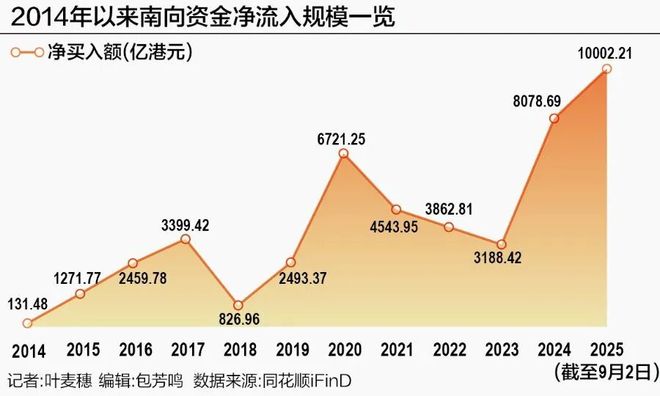
Core Viewpoint - The southbound capital inflow into the Hong Kong stock market has exceeded 1 trillion Hong Kong dollars this year, marking a new high since the launch of the Hong Kong Stock Connect in 2014 [4][5]. Group 1: Capital Inflow Data - As of September 2, 2023, the net inflow of southbound capital reached approximately 1,002.21 billion Hong Kong dollars, surpassing the 1 trillion mark [1][5]. - Since the launch of the Stock Connect on November 17, 2014, the total net inflow of southbound capital has reached 4.7 trillion Hong Kong dollars [5]. - The daily trading volume of southbound capital has increased from about 5% at the beginning of the Stock Connect to around 36% currently, maintaining a monthly share above 30% this year [6]. Group 2: Reasons for Capital Inflow - The significant valuation advantage and unique investment targets in the Hong Kong market are attracting southbound capital [6]. - High dividend stocks in the Hong Kong market provide stable cash flow and returns, appealing to institutional investors seeking stable investments [6]. - Policy incentives and a revitalized IPO market in Hong Kong are also contributing to the influx of southbound capital [6]. - The long-term strategic value of Hong Kong stocks, particularly in the context of RMB internationalization and the return of Chinese concept stocks, is drawing more capital for long-term allocation [6]. Group 3: Investment Preferences - The top ten stocks with the highest net purchases by southbound capital this year include Alibaba, Tencent, Meituan, and others, with Alibaba seeing a net buy of 12.67 billion Hong Kong dollars [8]. - Southbound capital is primarily concentrated in sectors such as finance, technology, and biomedicine, driven by the stability of financial stocks, the low valuation of technology stocks, and the growth potential of the biomedicine sector [8]. - The influx of southbound capital is enhancing liquidity in the market and increasing the influence of mainland capital on pricing, thereby stabilizing market expectations [8][9]. Group 4: Market Dynamics and Future Outlook - The shift in the investment landscape of the Hong Kong market is evident, with southbound capital now being driven by professional institutions rather than retail investors [9]. - The Hong Kong market is expected to experience a resonance of technological innovation and capital inflow by 2025, providing significant profit potential [9]. - The allocation of active mixed funds towards the Hong Kong market has increased, particularly in sectors like biomedicine and electronics, indicating a growing interest in these areas [10].




A股保险股普跌,中国太保、中国人保跌超2%
Ge Long Hui A P P· 2025-09-04 03:25
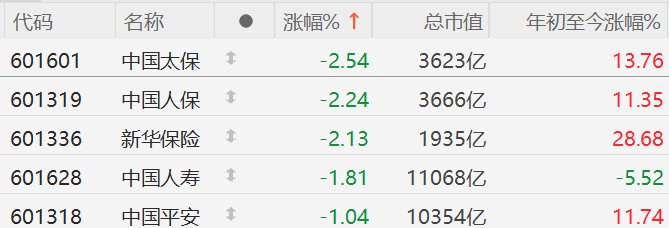
Core Viewpoint - The A-share market has seen a general decline in insurance stocks, with major companies experiencing significant drops in their stock prices [1] Group 1: Stock Performance - China Pacific Insurance (601601) decreased by 2.54%, with a total market capitalization of 362.3 billion and a year-to-date increase of 13.76% [2] - China Insurance (601319) fell by 2.24%, holding a market cap of 366.6 billion and a year-to-date increase of 11.35% [2] - New China Life Insurance (601336) dropped by 2.13%, with a market capitalization of 193.5 billion and a year-to-date increase of 28.68% [2] - China Life Insurance (601628) saw a decline of 1.81%, with a market cap of 1,106.8 billion and a year-to-date decrease of 5.52% [2] - Ping An Insurance (601318) decreased by 1.04%, with a market capitalization of 1,035.4 billion and a year-to-date increase of 11.74% [2] Group 2: Market Signals - A MACD golden cross signal has formed, indicating potential upward momentum for some stocks in the insurance sector [2]
五大险企上半年投资成绩:股票配置“乘势跃升”,规模增长近29%
Huan Qiu Wang· 2025-09-04 01:51
Core Viewpoint - The five major listed insurance companies in China reported significant growth in their investment portfolios and stock allocations as of June 30, 2025, reflecting a strategic shift towards long-term capital investment in equities [1][2][4]. Investment Performance - As of June 30, 2025, the total investment of the five major insurance companies reached 19.72 trillion yuan, a 7.52% increase from 18.34 trillion yuan at the end of 2024 [1]. - The total stock investment by these companies amounted to 1.846429 trillion yuan, marking a 28.71% increase from 1.434571 trillion yuan at the end of 2024 [2]. - China Ping An's stock investment reached 649.29 billion yuan, up 48.45% year-on-year, with a stock allocation ratio of 12.6% [2]. - China Life's equity financial assets accounted for 20% of its total investments, with stock and fund allocations of 620.14 billion yuan and 350.70 billion yuan, respectively [3]. Strategic Asset Allocation - Insurance companies are increasingly focusing on high-dividend value stocks and growth sectors such as technology and advanced manufacturing [4][6]. - The investment strategy emphasizes a balanced approach, maintaining a low duration gap between assets and liabilities while optimizing equity allocation [6][7]. - China Pacific Insurance is increasing its allocation to long-term interest rate bonds and innovative quality assets, including ABS and public REITs [7]. Market Response and Challenges - The insurance sector is responding to market volatility by employing strategies such as OCI accounts and FVOCI accounting classifications to mitigate the impact of market fluctuations on profits [4][8]. - Challenges include market volatility affecting solvency, accounting mismatches under new financial instrument standards, liquidity management, and the need for enhanced research capabilities in selecting high-dividend and growth stocks [8].
以股息补票息 险企增配权益资产 每年入市增量资金或超6000亿元
Zhong Guo Jin Rong Xin Xi Wang· 2025-09-04 00:38
Core Viewpoint - The A-share insurance sector is increasing its equity asset allocation in response to low interest rates and asset scarcity, with a projected annual increase of over 600 billion yuan in equity investments over the next three years [1][7]. Group 1: Performance of Major Insurance Companies - Four out of five major listed insurance companies reported year-on-year growth in net profit for the first half of 2025, with notable increases from Xinhua Insurance (33.5% to 14.8 billion yuan), China Pacific Insurance (11% to 27.9 billion yuan), and China Life (6.9% to 40.9 billion yuan) [1][2]. - Xinhua Insurance achieved a remarkable 1842% increase in investment income, reaching 18.76 billion yuan, primarily due to increased capital gains from asset sales [2]. Group 2: Asset Allocation Trends - All five major insurance companies increased their stock investment ratios, with China Ping An's stock investment ratio rising by 2.9 percentage points to 10.5%, and Xinhua Insurance's increasing by 1.4 percentage points to 11.6% [2][3]. - The overall stock and fund allocation ratio for listed insurance companies increased by 1.3 percentage points to 13.9%, with a total increase of nearly 480 billion yuan in allocation [3]. Group 3: Future Investment Strategies - Insurance companies are focusing on high-dividend stocks and growth sectors for future investments, with expectations of a stable increase in equity allocations [6][7]. - China Life and China Ping An expressed optimism about the A-share market, emphasizing the importance of high-dividend stocks and sectors representing new productive forces [6][7]. Group 4: Market Conditions and Challenges - Despite the increased allocation to equity assets, the average net investment yield for listed insurance companies fell to 3.0%, approaching the rigid liability cost of around 3% [4][5]. - The demand for long-term stable yield assets is rising due to the characteristics of liabilities and the pressure from low interest rates [5][7].
73家人身险公司上半年合计实现净利润1858亿
Zheng Quan Ri Bao· 2025-09-04 00:14
Core Insights - The life insurance industry in China has shown a significant recovery in net profits for the first half of the year, driven by business structure optimization, cost reduction measures, and improved investment returns [1][3]. Group 1: Profitability Overview - As of September 3, 73 life insurance companies reported a total net profit of 185.8 billion yuan, representing a year-on-year increase of approximately 25% [2][6]. - Out of these, 52 companies were profitable, collectively earning 190.08 billion yuan, while 21 companies reported losses totaling 4.27 billion yuan [2][3]. - Major profitable companies included Ping An Life, China Life, and China Pacific Life, each exceeding 10 billion yuan in net profit, with Ping An Life leading at 50.6 billion yuan [2][4]. Group 2: Losses and Challenges - The company with the highest loss was Hengqin Life, with a loss of 839 million yuan, followed by Bank of China Samsung Life and Aixin Life with losses of 543 million yuan and 384 million yuan, respectively [3][4]. - The competitive landscape is increasingly challenging for smaller insurance companies, which struggle against larger firms in terms of brand, capital, distribution channels, and talent [5][6]. Group 3: Strategic Adjustments - Companies are adjusting product pricing and business structures, including lowering product preset interest rates and promoting the transformation of dividend-type products, which has effectively reduced rigid liability costs [3][4]. - New business value has improved due to proactive optimization of business structures and cost reduction initiatives, with first-year premium income from regular premium products increasing by 25.5% year-on-year [4][5]. Group 4: Market Trends and Future Outlook - The "Matthew Effect" is evident, with the top seven life insurance companies accounting for over 80% of the industry's total net profit [5][6]. - Analysts expect continued improvement in the insurance industry's liability side, with a recovery in asset performance anticipated as macroeconomic conditions improve [6].