China Life(601628)

Search documents
中国万亿市值公司之变:4家新贵晋级,工业富联狂飙近200%
21世纪经济报道· 2026-01-08 11:47
Core Viewpoint - The number of companies with a market capitalization exceeding 1 trillion yuan in China's A+H share market has increased to 14 by the end of 2025, with a total market value increase of approximately 9 trillion yuan, reflecting a growth rate of over 50% [1][2]. Group 1: New Trillion-Yuan Companies - Four new companies have joined the trillion-yuan market cap club: Industrial Fulian, China Ping An, China Life, and China Merchants Bank [1][4]. - Industrial Fulian has seen a remarkable market cap increase of approximately 188%, driven by its core business in AI and precision manufacturing [4][5]. - The financial sector's recovery is highlighted by China Ping An's 32.02% increase, China Life's 16.16% increase, and China Merchants Bank's 10.87% increase in market cap [4][5]. Group 2: Market Trends and Characteristics - The market capitalization growth is characterized by a leading trend in technology and new sectors, while financial and energy sectors show stable growth [1][7]. - Tencent and Alibaba have both seen significant market cap increases, exceeding 1 trillion Hong Kong dollars, driven by AI advancements and recovery in e-commerce [7][9]. - The banking sector, particularly Agricultural Bank of China, has shown strong performance with a market cap increase and a notable rise in stock price, breaking the long-standing "price-to-book" ratio below 1 [11][12]. Group 3: Company Performance Highlights - Tencent's market cap reached 5.46 trillion HKD, with a year-on-year increase of 42.02%, supported by its AI strategy and business integration [2][8]. - Alibaba's market cap rose to 2.73 trillion HKD, benefiting from AI integration and a recovery in its e-commerce business [9]. - Agricultural Bank of China reported a revenue of 550.88 billion yuan and a net profit of 220.86 billion yuan, reflecting a stable asset quality and strong market recognition [12].








中国万亿市值公司之变:四家新贵晋级 两大增长逻辑
2 1 Shi Ji Jing Ji Bao Dao· 2026-01-08 11:41
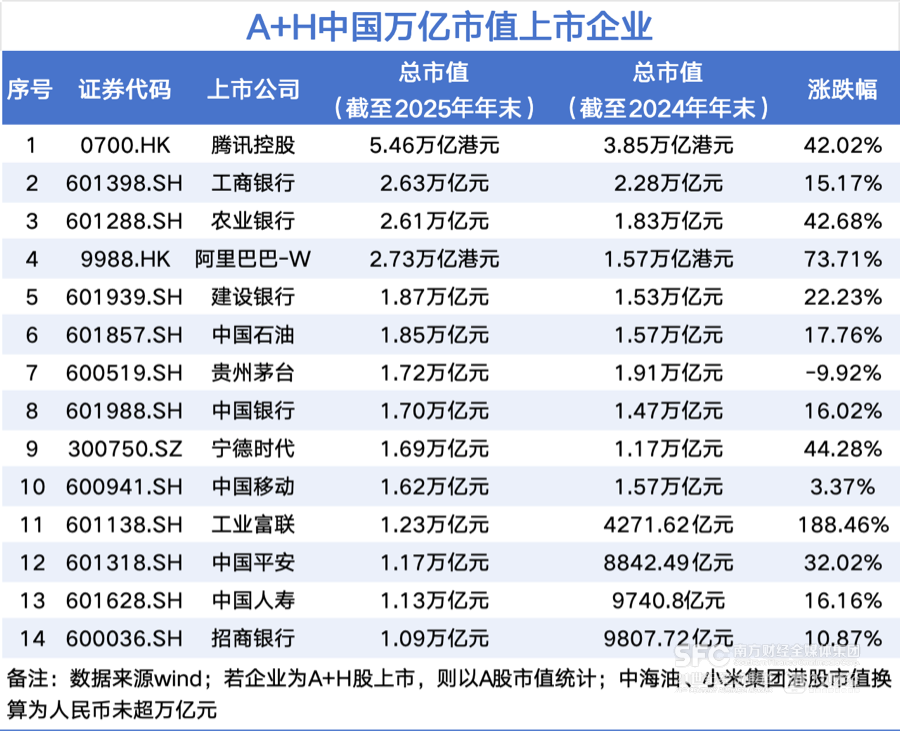
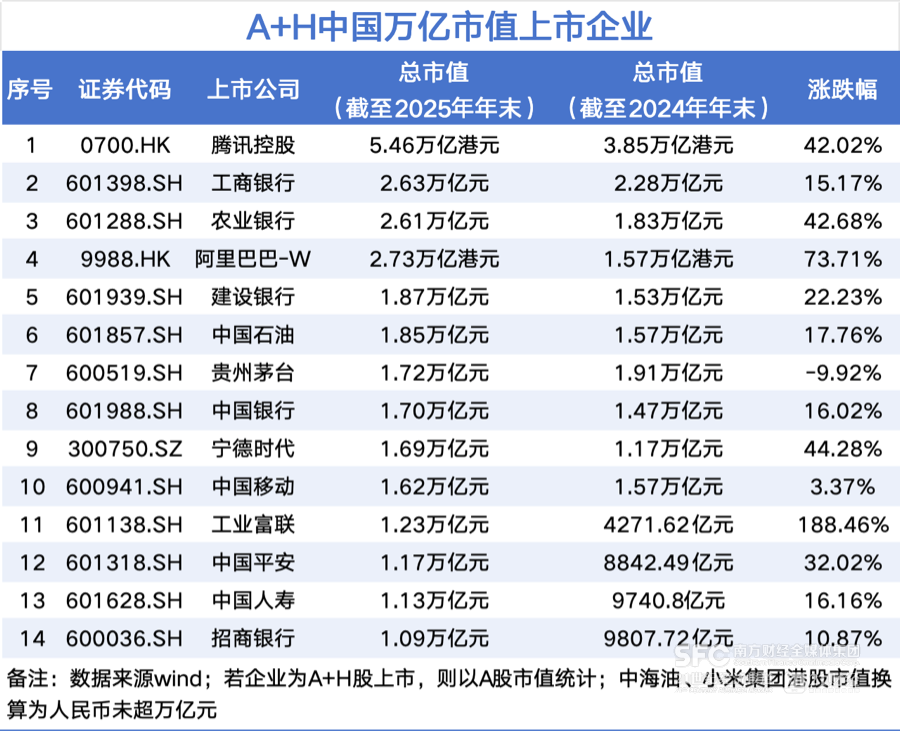
Core Insights - The number of companies with a market capitalization exceeding 1 trillion yuan in mainland China has increased to 14 by the end of 2025, with a total market value increase of over 9 trillion yuan, reflecting a growth rate of over 50% [1][2] Group 1: New Trillion-Yuan Companies - Four new companies have joined the trillion-yuan market cap club: Industrial Fulian, China Ping An, China Life, and China Merchants Bank, with four headquartered in Shenzhen [3][4] - Industrial Fulian has seen a remarkable market cap increase of approximately 188%, while the other three companies in the financial sector have experienced more modest growth rates: China Ping An at 32.02%, China Life at 16.16%, and China Merchants Bank at 10.87% [4][5] Group 2: Market Trends and Dynamics - The rise of these companies reflects two core market dynamics: explosive growth in the technology sector and valuation recovery in the financial sector [5] - Industrial Fulian's rapid growth is attributed to its comprehensive involvement in the AI industry chain, with a significant revenue increase of 38.4% year-on-year, reaching 603.93 billion yuan in the first three quarters of 2025 [6] - China Life has reported a total premium exceeding 700 billion yuan, with a 41% increase in total investment income, while China Ping An has established a strong competitive barrier through its extensive customer base and technology capabilities [7] Group 3: Performance of Major Players - Tencent and Alibaba have also seen significant market cap increases, with both companies adding over 1 trillion Hong Kong dollars to their valuations, driven by AI advancements and a recovery in their core businesses [8][10] - Tencent's market cap reached 5.46 trillion Hong Kong dollars by the end of 2025, with a stock price increase of over 40%, while Alibaba's market cap rose to 2.73 trillion Hong Kong dollars [10][11] Group 4: Banking Sector Insights - The banking sector has shown signs of valuation recovery, with Agricultural Bank of China achieving a notable stock price increase of over 50% and breaking the long-standing "price-to-book" ratio below 1 [12][13] - Agricultural Bank's revenue for the first three quarters of 2025 was 550.88 billion yuan, with a net profit of 220.86 billion yuan, reflecting a year-on-year increase of 3.03% [12][13]

中国万亿市值公司之变:4家新贵晋级,工业富联狂飙近200%
2 1 Shi Ji Jing Ji Bao Dao· 2026-01-08 11:38
Core Insights - The number of companies with a market capitalization exceeding 1 trillion yuan in mainland China has increased to 14 by the end of 2025, up from 10 at the end of the previous year, with a total market capitalization increase of approximately 9 trillion yuan, representing a growth rate of over 50% [1][4][15] Group 1: Market Capitalization Growth - The newly added companies to the trillion-yuan market cap club include Industrial Fulian, China Ping An, China Life, and China Merchants Bank, with four of them headquartered in Shenzhen [1][4] - The market capitalization ranking shows a "pyramid" structure, with Tencent leading at approximately 5 trillion yuan, followed by three companies (ICBC, ABC, Alibaba) in the 2-5 trillion yuan range, while most companies are in the 1-2 trillion yuan range [1][13] Group 2: Sector Performance - The growth in market capitalization is characterized by a leading performance in technology and new sectors, while financial and energy sectors show stable growth [1][9] - Technology and new sector companies have seen growth rates exceeding 40%, while financial and energy companies have growth rates concentrated in the 10%-35% range [9][15] Group 3: Notable Companies - Industrial Fulian has emerged as a standout performer with a staggering market cap increase of approximately 188%, driven by its core business in AI and precision manufacturing [4][5] - China Ping An, China Life, and China Merchants Bank represent the financial sector's recovery, with respective market cap growth rates of 32.02%, 16.16%, and 10.87% [4][5] Group 4: Financial Sector Dynamics - China Life has successfully transformed its product and business structure, achieving a total premium income exceeding 700 billion yuan and a significant increase in investment income [6] - China Ping An operates as a comprehensive service group with a strong customer base, which has contributed to its valuation recovery [6] - China Merchants Bank, known for its retail banking strength, reported a total revenue of 251.42 billion yuan in the first three quarters of 2025, maintaining its position as a leading bank [7] Group 5: AI Impact on Market - Tencent and Alibaba have both seen their market capitalizations increase by over 1 trillion yuan, driven by their advancements in AI technology and integration into their business models [9][10] - Tencent's market cap reached 5.46 trillion HKD, with a year-on-year increase of over 40%, while Alibaba's market cap rose to 2.73 trillion HKD, supported by a recovery in its e-commerce business [9][10][11]



大金融板块,持续走低
Di Yi Cai Jing Zi Xun· 2026-01-08 06:52
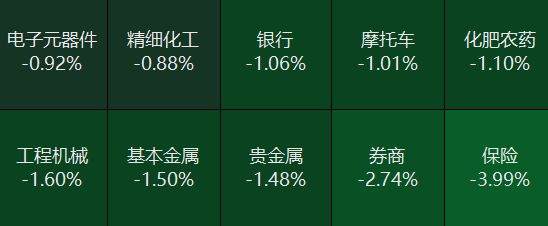
Core Viewpoint - The financial sector is experiencing a significant decline, with brokerage firms and insurance companies leading the downturn [1]. Group 1: Sector Performance - The financial sector, including brokerage and insurance, has seen notable declines, with the brokerage sector down by 2.74% and insurance down by 3.99% [2]. - Other sectors also reported losses, with engineering machinery down by 1.60% and basic metals down by 1.50% [2]. Group 2: Individual Company Performance - Huayin Securities has hit the daily limit down, falling by 10.00% to a price of 16.92 [3]. - Huashan Securities dropped by 5.58% to 7.11, while Huatai Securities fell by 4.88% to 23.99 [3]. - Other notable declines include China Ping An down by 4.63% to 70.05, and Guangfa Securities down by 4.19% to 22.19 [3]. - Several other companies, including CITIC Securities and Changjiang Securities, also experienced declines ranging from 2.57% to 3.19% [3].




2025年1-11月新疆维吾尔自治区原保险保费收入共计741.48亿元,同比增长4.09%
Chan Ye Xin Xi Wang· 2026-01-08 04:03
Group 1 - The core viewpoint of the news highlights the growth of the insurance industry in the Xinjiang Uygur Autonomous Region, with a total original insurance premium income of 74.148 billion yuan from January to November 2025, representing a year-on-year increase of 4.09% [1] - Life insurance accounted for the highest proportion of the total original insurance premium income in Xinjiang, amounting to 33.827 billion yuan, which is 45.62% of the total [1] - The report referenced is the "2026-2032 China Insurance Industry Development Analysis and Investment Prospect Forecast Report" published by Zhiyan Consulting, indicating a focus on future trends and investment opportunities in the insurance sector [1] Group 2 - The data source for the cumulative original insurance premium income statistics from 2020 to November 2025 is the National Financial Supervision Administration, organized by Zhiyan Consulting [2] - Zhiyan Consulting is recognized as a leading industry consulting firm in China, specializing in in-depth industry research reports, business plans, feasibility studies, and customized services [2]





2025年1-11月海南省原保险保费收入共计207.89亿元,同比增长2.88%
Chan Ye Xin Xi Wang· 2026-01-08 03:56
Core Viewpoint - The insurance premium income in Hainan Province for the period from January to November 2025 reached 20.789 billion, reflecting a year-on-year growth of 2.88% [1] Group 1: Insurance Premium Income - The total original insurance premium income in Hainan Province from January to November 2025 was 20.789 billion [1] - Life insurance accounted for the highest share of the total premium income, amounting to 9.512 billion, which represents 45.75% of the total [1] Group 2: Industry Analysis - The report titled "2026-2032 China Insurance Industry Development Analysis and Investment Prospect Forecast" was released by Zhiyan Consulting, a leading industry consulting firm in China [1] - Zhiyan Consulting has over a decade of experience in industry research, providing comprehensive industry research reports, business plans, feasibility studies, and customized services [1]

非银金融概念股走弱,证券保险相关ETF跌约2%
Mei Ri Jing Ji Xin Wen· 2026-01-08 02:20
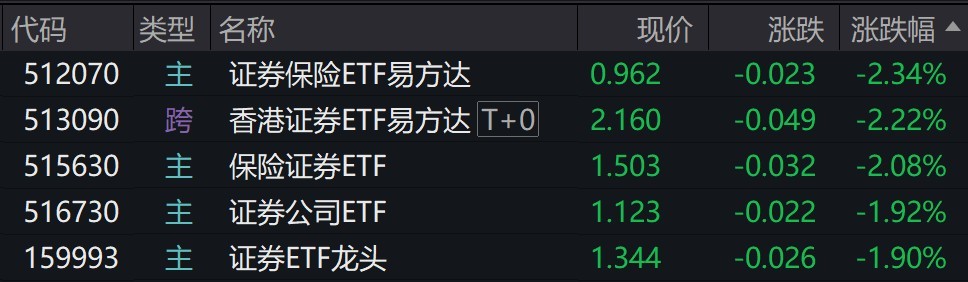
Group 1 - Non-bank financial stocks weakened, with Huatai Securities and GF Securities dropping over 3%, while China Ping An, Guotai Junan, China Pacific Insurance, and China Life fell over 2% [1] - Securities and insurance-related ETFs declined approximately 2% [1] Group 2 - Some brokerages indicate that the fundamentals of the brokerage sector will continue to improve in 2025, but the sector is currently "stagnant" with significantly undervalued valuations; looking ahead to 2026, broker ROE is expected to return to an upward trend, with margin financing balances and derivative business becoming the main leverage direction for brokerages, and accelerated mergers and acquisitions among leading brokerages expected to enhance industry concentration [2] Group 3 - In the insurance sector, the liability side showed strong performance, with leading insurance companies leveraging product structure optimization and market concentration advantages to lay a solid foundation for annual performance growth; simultaneously, the asset side continues to show resilience, as the spring market activity is expected to improve investment returns for insurance companies, further boosting profit expectations; the low base effect from the first quarter of last year is likely to amplify this year's year-on-year performance growth [3] - The dual benefits from both the liability and asset sides strengthen the valuation repair momentum for the insurance sector [3]


中国人寿获南向资金连续3天净买入
Zheng Quan Shi Bao Wang· 2026-01-07 14:36
中国人寿获南向资金连续3天净买入,累计净买入金额为12.50亿港元,股价累计上涨16.22%。 (文章来源:证券时报网) 证券时报·数据宝统计显示,1月7日港股通(包括沪市港股通及深市港股通)成交活跃股合计成交479.17 亿港元,净买入金额为46.21亿港元。 1月7日上榜的成交活跃股中,中国人寿通过港股通渠道成交金额为10.61亿港元,净买入金额为4.16亿港 元,不仅如此,该股已连续3日出现成交净买入,累计净买入金额为12.50亿港元,其间股价上涨 16.22%。(数据宝) ...
证券研究报告、晨会聚焦:非银葛玉翔:OCI选择权的两面性,税务追溯对现金流影响有限-20260107
ZHONGTAI SECURITIES· 2026-01-07 13:24
Core Insights - The report discusses the dual nature of the OCI (Other Comprehensive Income) option in the context of the tax adjustments for insurance companies transitioning to new accounting standards, indicating that the impact on cash flow from tax retroactivity is limited [3][4][6]. Summary by Sections Tax Adjustment Overview - The Ministry of Finance and the State Administration of Taxation issued a notice regarding the tax treatment for the transition to new insurance contract standards, effective from 2026, allowing companies to smooth out tax differences over five years [3][6]. - The overall impact of this tax adjustment on listed insurance companies is deemed limited, as most have already implemented the new standards since early 2023 [3][4]. Profitability and Tax Rates - Listed insurance companies have seen record high profits, with pre-tax profits in the first three quarters of 2025 exceeding the total for 2024, while actual tax rates have remained low, indicating a disconnect between tax obligations and operational performance [4][5]. - The average effective tax rates from 2020 to Q3 2025 were 10%, 8%, -1%, -6%, 12%, and 17%, with some companies reporting negative tax rates in certain years [4]. Impact of New Accounting Standards - The core difference in profits under the old and new accounting standards is attributed to the 750 curve, which has declined, affecting net profit levels, particularly for life insurance companies [5]. - The new standards provide an OCI option that mitigates the impact of interest rate declines on net profit, but it also removes the tax shield previously available under the old standards [5]. Cash Flow Implications - The tax adjustments are expected to have a minimal impact on operating cash flows, with the average effect on listed insurance companies estimated at 2.27%, while companies like Xinhua and China Life may experience a more significant impact of around 14% [6]. - The choice of how to account for retained earnings from the new standards will influence the actual cash flow effects, with options to either include them in the taxable income for 2026 or spread them over five years [6]. Investment Recommendations - The report suggests monitoring major listed insurance companies such as China Life, Ping An, China Pacific Insurance, Xinhua Insurance, and China Property & Casualty Insurance for potential investment opportunities [7].


“13精”发布分红险实力40强的核心数据,披露保险公司长期红利实现率指标!
13个精算师· 2026-01-07 11:03
Core Viewpoint - The article emphasizes the importance of analyzing the long-term payout capabilities and operational stability of insurance companies when evaluating dividend insurance products, rather than solely relying on high demonstration rates presented during sales [1][3]. Group 1: Sales Demonstration Rates - The sales demonstration rate of dividend insurance reflects the insurance company's expectations of future long-term investment returns, based on its asset allocation strategy and market conditions [3][5]. - In the current industry context, products with lower predetermined interest rates can exhibit higher sales demonstration rates due to reduced payout pressure and increased flexibility in equity asset allocation [5][10]. Group 2: Investment Strategy - Insurance companies are adjusting their asset allocation strategies in response to lower predetermined interest rates, decreasing reliance on fixed-income assets and increasing exposure to equity assets to enhance overall investment returns [5][10]. - The average return on equity assets in the insurance industry from 2007 to 2024 is 10%, but it exhibits significant annual volatility, highlighting the risks associated with high equity exposure [10][11]. Group 3: Evaluating Insurance Companies - When selecting a strong dividend insurance company, it is crucial to consider historical dividend realization rates, investment performance stability, and overall operational strength, rather than just high demonstration rates [15][16]. - The "13精" framework provides a detailed evaluation of insurance companies' dividend strength, focusing on long-term dividend realization rates, long-term investment returns, solvency adequacy, and overall operational stability [20][21].