China Life(601628)

Search documents
中国人寿获南向资金连续3天净买入
Zheng Quan Shi Bao Wang· 2026-01-07 14:36
中国人寿获南向资金连续3天净买入,累计净买入金额为12.50亿港元,股价累计上涨16.22%。 (文章来源:证券时报网) 证券时报·数据宝统计显示,1月7日港股通(包括沪市港股通及深市港股通)成交活跃股合计成交479.17 亿港元,净买入金额为46.21亿港元。 1月7日上榜的成交活跃股中,中国人寿通过港股通渠道成交金额为10.61亿港元,净买入金额为4.16亿港 元,不仅如此,该股已连续3日出现成交净买入,累计净买入金额为12.50亿港元,其间股价上涨 16.22%。(数据宝) ...

证券研究报告、晨会聚焦:非银葛玉翔:OCI选择权的两面性,税务追溯对现金流影响有限-20260107
ZHONGTAI SECURITIES· 2026-01-07 13:24
Core Insights - The report discusses the dual nature of the OCI (Other Comprehensive Income) option in the context of the tax adjustments for insurance companies transitioning to new accounting standards, indicating that the impact on cash flow from tax retroactivity is limited [3][4][6]. Summary by Sections Tax Adjustment Overview - The Ministry of Finance and the State Administration of Taxation issued a notice regarding the tax treatment for the transition to new insurance contract standards, effective from 2026, allowing companies to smooth out tax differences over five years [3][6]. - The overall impact of this tax adjustment on listed insurance companies is deemed limited, as most have already implemented the new standards since early 2023 [3][4]. Profitability and Tax Rates - Listed insurance companies have seen record high profits, with pre-tax profits in the first three quarters of 2025 exceeding the total for 2024, while actual tax rates have remained low, indicating a disconnect between tax obligations and operational performance [4][5]. - The average effective tax rates from 2020 to Q3 2025 were 10%, 8%, -1%, -6%, 12%, and 17%, with some companies reporting negative tax rates in certain years [4]. Impact of New Accounting Standards - The core difference in profits under the old and new accounting standards is attributed to the 750 curve, which has declined, affecting net profit levels, particularly for life insurance companies [5]. - The new standards provide an OCI option that mitigates the impact of interest rate declines on net profit, but it also removes the tax shield previously available under the old standards [5]. Cash Flow Implications - The tax adjustments are expected to have a minimal impact on operating cash flows, with the average effect on listed insurance companies estimated at 2.27%, while companies like Xinhua and China Life may experience a more significant impact of around 14% [6]. - The choice of how to account for retained earnings from the new standards will influence the actual cash flow effects, with options to either include them in the taxable income for 2026 or spread them over five years [6]. Investment Recommendations - The report suggests monitoring major listed insurance companies such as China Life, Ping An, China Pacific Insurance, Xinhua Insurance, and China Property & Casualty Insurance for potential investment opportunities [7].


“13精”发布分红险实力40强的核心数据,披露保险公司长期红利实现率指标!
13个精算师· 2026-01-07 11:03
Core Viewpoint - The article emphasizes the importance of analyzing the long-term payout capabilities and operational stability of insurance companies when evaluating dividend insurance products, rather than solely relying on high demonstration rates presented during sales [1][3]. Group 1: Sales Demonstration Rates - The sales demonstration rate of dividend insurance reflects the insurance company's expectations of future long-term investment returns, based on its asset allocation strategy and market conditions [3][5]. - In the current industry context, products with lower predetermined interest rates can exhibit higher sales demonstration rates due to reduced payout pressure and increased flexibility in equity asset allocation [5][10]. Group 2: Investment Strategy - Insurance companies are adjusting their asset allocation strategies in response to lower predetermined interest rates, decreasing reliance on fixed-income assets and increasing exposure to equity assets to enhance overall investment returns [5][10]. - The average return on equity assets in the insurance industry from 2007 to 2024 is 10%, but it exhibits significant annual volatility, highlighting the risks associated with high equity exposure [10][11]. Group 3: Evaluating Insurance Companies - When selecting a strong dividend insurance company, it is crucial to consider historical dividend realization rates, investment performance stability, and overall operational strength, rather than just high demonstration rates [15][16]. - The "13精" framework provides a detailed evaluation of insurance companies' dividend strength, focusing on long-term dividend realization rates, long-term investment returns, solvency adequacy, and overall operational stability [20][21].

2025年金融机构被罚没31亿元,反洗钱和数据相关罚单大增
2 1 Shi Ji Jing Ji Bao Dao· 2026-01-07 10:47
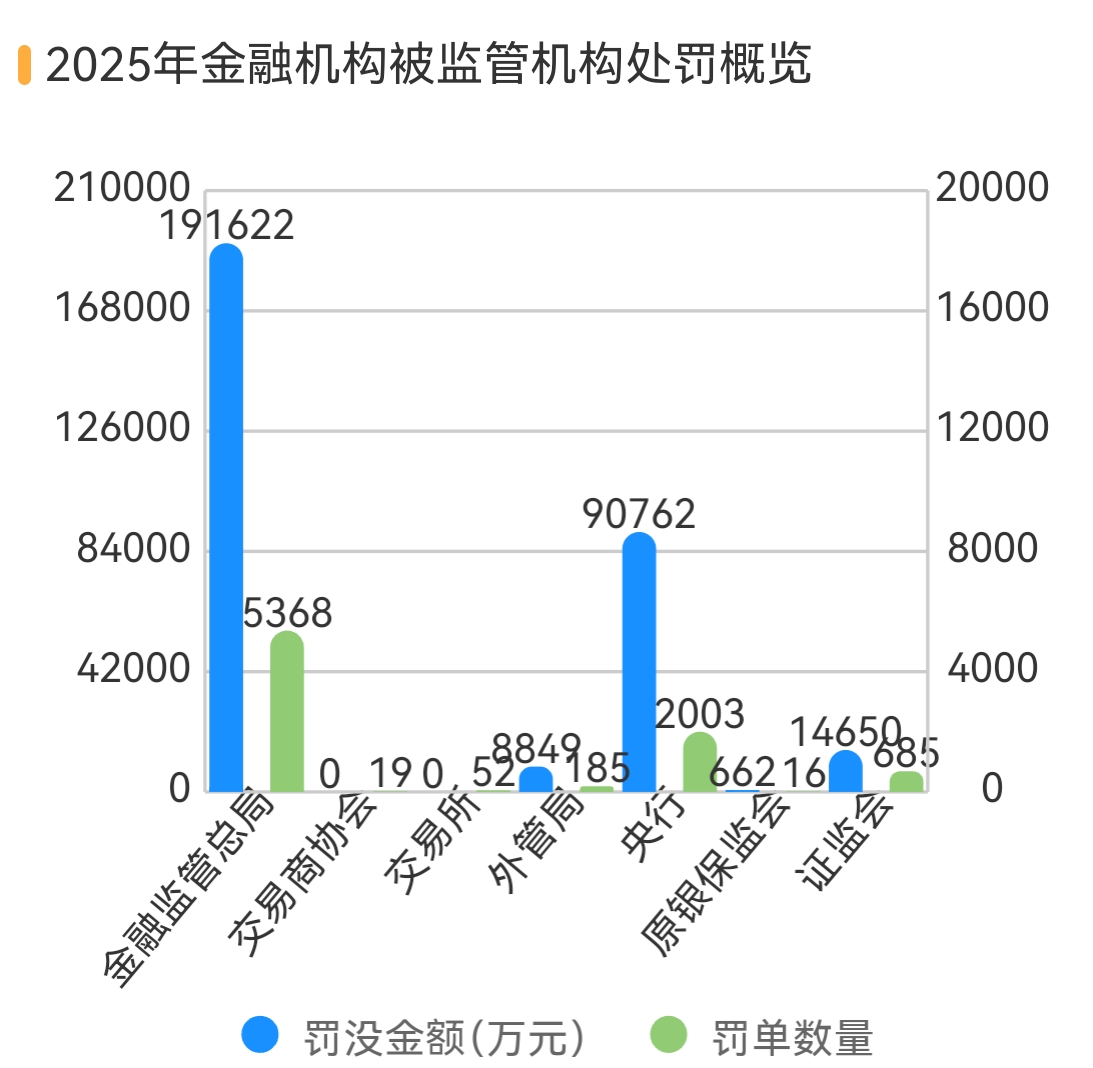
Core Insights - In 2025, financial institutions received a total of 8,328 fines, a year-on-year decrease of 8.41%, while the total amount of fines reached 3.065 billion yuan, an increase of 27.55% [1][2] Group 1: Penalty Overview - The National Financial Supervision Administration issued 5,368 fines totaling 1.916 billion yuan, the central bank issued 2,003 fines totaling 908 million yuan, the Securities Regulatory Commission issued 685 fines totaling 146 million yuan, and the State Administration of Foreign Exchange issued 185 fines totaling 88.49 million yuan [2] - Monthly distribution shows peaks in December, January, and July for the number of fines, with September and December having higher total fine amounts [4] Group 2: Institution-Specific Penalties - Banks received 5,313 fines in 2025, a decrease of 8.88% year-on-year, with total fines amounting to 2.461 billion yuan, an increase of 40.63% [7] - Insurance institutions received 2,166 fines, a decrease of 5.5%, with total fines of 325 million yuan, a decrease of 3.56% [7] - Securities firms received 195 fines, a significant decrease of 42.98%, but the total fines increased by 56.69% [7] Group 3: Major Penalty Cases - In 2025, there were 8 fines exceeding 50 million yuan, with the largest fine of 97.9 million yuan issued for issues related to company governance, loans, and asset quality management [13] - A village bank in Dalian had its financial license revoked due to multiple severe violations, marking a significant regulatory action [14] - A bank president was sentenced to death with a two-year reprieve for illegal lending and bribery, highlighting severe consequences for financial misconduct [15][16] Group 4: Compliance Characteristics - The main areas of violations for banks in 2025 were in credit business, anti-money laundering, and inadequate internal controls [22] - Insurance companies faced penalties primarily for untrue financial/business data and misleading sales practices [23] - Securities firms' violations were concentrated in personnel misconduct, investment banking, and internal control issues [24][25] Group 5: Anti-Money Laundering Violations - There was a significant increase of 188.25% in penalties related to anti-money laundering violations, with 1,349 fines issued [26] - Common violations included failure to identify customer identities and improper transaction reporting [26] Group 6: Data-Related Violations - Penalties related to data violations increased by 44.65%, with 554 fines issued, primarily affecting banks and insurance companies [27] Group 7: Penalty Rankings - Among non-banking institutions, Donghai Securities faced the highest fines at 60 million yuan, followed by China People's Property Insurance and China Pacific Property Insurance [30]


互联网保险概念下跌2.00%,主力资金净流出15股
Zheng Quan Shi Bao Wang· 2026-01-07 09:13
Group 1 - The internet insurance sector experienced a decline of 2.00%, ranking among the top losers in the concept sector, with notable declines from Tianli Technology, Jinzhen Co., and Jiayun Technology [1] - Among the stocks in the internet insurance sector, China Life, Xinhua Insurance, and Seven Wolves saw increases of 1.01%, 1.88%, and 3.65% respectively, despite the overall sector decline [1] - The concept sectors with the highest gains included photolithography with a rise of 6.05% and storage chips with an increase of 3.30% [1] Group 2 - The internet insurance sector faced a net outflow of 3.265 billion yuan, with 15 stocks experiencing net outflows, and 7 stocks seeing outflows exceeding 50 million yuan [1] - The stock with the highest net outflow was Dongfang Wealth, which saw a net outflow of 1.774 billion yuan, followed by Keda Xunfei and China Ping An with net outflows of 534 million yuan and 454 million yuan respectively [1] - Conversely, the stocks with the highest net inflows included China Life, Tongfang Co., and Xinzhisoft, with net inflows of 20.365 million yuan, 7.703 million yuan, and 734,100 yuan respectively [1][2]



情侣大学时花199元买了“恋爱险”,十年后结婚兑现1万元!还能买吗?保险公司:早已停售
Huan Qiu Wang· 2026-01-07 06:25
Core Viewpoint - A woman in Shaanxi, China, has successfully claimed a "love insurance" policy after ten years, choosing to receive 10,000 yuan in cash instead of roses, highlighting the unique nature of such insurance products and their appeal to young couples [1][3][10]. Group 1: Product Overview - The "love insurance" was developed by China Life Property Insurance and Anxin Insurance, targeting young consumers with options like a rose version and a diamond version [6]. - The policy stipulates that after three years from the policy's effective date, if the insured couple registers their marriage within ten years, they can receive either 10,000 roses or a half-carat heart-shaped diamond ring [10]. - This type of insurance gained popularity but faced criticism for being more of a marketing gimmick than a legitimate financial product [10]. Group 2: Market Status and Legal Context - The "love insurance" was discontinued in 2017 following regulatory guidelines that prohibited the development of products lacking legal recognition or substantive meaning [10][11]. - Despite the cessation of "love insurance," a new trend called "love contracts" has emerged, which offers similar promises for a fee, raising concerns about the potential commodification of relationships [11][13]. - Legal experts warn that many companies offering "love contracts" are small and may not be financially stable, posing risks to consumers regarding the fulfillment of these contracts [14].

菏泽监管分局同意中国人寿曹县支公司曹城营销服务部变更营业地址
Jin Tou Wang· 2026-01-07 05:35
2025年12月30日,国家金融监督管理总局菏泽监管分局发布批复称,《中国人寿(601628)保险股份有 限公司菏泽分公司关于中国人寿保险股份有限公司曹县支公司曹城营销服务部变更营业地址的请示》 (国寿人险菏发〔2025〕311号)收悉。经审核,现批复如下: 二、中国人寿保险股份有限公司菏泽分公司应按照有关规定及时办理变更及许可证换领事宜。 一、同意中国人寿保险股份有限公司曹县支公司曹城营销服务部变更营业地址为:山东省菏泽市曹县长 江东路路南中央华府商业1号中国人寿曹县支公司一楼103职场。 ...
进击的保险:不只是交易“开门红”,长债2%关口与重返1倍P/EV
Hua Er Jie Jian Wen· 2026-01-07 05:08
Core Viewpoint - The insurance sector experienced a significant rise of over 6% on January 5, 2026, with Xinhua Insurance and China Pacific Insurance reaching historical highs, driven by a cyclical logic of improved expectations, rising long-term interest rates, and reinforced profit elasticity since December 2025 [1] Group 1: Market Performance and Expectations - The current stock prices reflect an optimistic outlook for the "opening red" period of 2026, with Q1 2026 expected to be a peak for value and profit growth [2] - The average new business growth rate for listed insurance companies in Q1 2026 is projected to be 30%, with bancassurance and individual insurance growth rates at 50% and 20% respectively [2] - The low base from 2025 for individual insurance and the increasing focus on bancassurance channels by leading companies are expected to drive growth in new business [2] Group 2: Interest Rates and Valuation - The significance of long-term interest rates breaking the 2.0% mark is highlighted, with market expectations showing divergence on future trends [3] - If long-term rates exceed 2.0%, it could lead to a gradual approach of P/EV valuations towards 1x, benefiting insurance stock valuations [3] - The 10-year government bond yield is anticipated to range between 1.7% and 2.1% in 2026, with a favorable environment for insurance stock valuations due to improving credit spreads and term spreads [3] Group 3: Business Value and Growth Projections - The internal value (EV) credibility is gradually recovering, with expectations of a return to growth in EV for listed insurance companies from 2025 to 2027, averaging 10.6%, 10.9%, and 10.8% respectively [4] - The new business value (NBV) growth rates are projected at 34.7%, 21.7%, and 10.0% for the same period, indicating a positive outlook for the sector [4] - The insurance companies are expected to improve profitability through refined management of liability costs and benefit from upward catalysts in the asset side [4] Group 4: Strategic Recommendations - Investment in cyclical insurance stocks with strong performance support is recommended, as 2026 is expected to see growth in new business and value alongside continued management of liability costs [4] - The focus on bancassurance channels and the improvement in payment structures are likely to enhance value contributions from these channels [6]


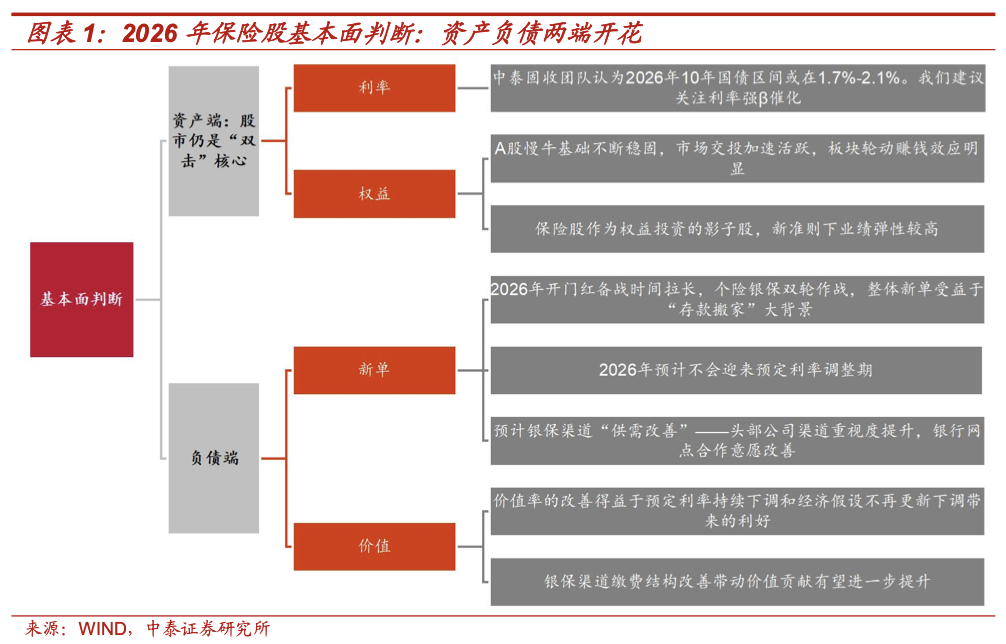
牛脸能贷款,海域有“身份证”?广西这样唤醒“沉睡资产”→
Jin Rong Shi Bao· 2026-01-07 04:56
Core Insights - The article highlights the transformation of rural assets in Guangxi, China, through innovative financial practices that awaken dormant resources and stimulate economic growth [1] Group 1: Challenges Faced by Rural Industries - Rural industries in Guangxi face multiple challenges, including the difficulty of asset realization and the lack of standardized valuation systems for livestock, which limits access to financing [2][3] - Natural disasters and market volatility pose significant risks to agricultural production, making it difficult for farmers to sustain their livelihoods [4] Group 2: Financial Innovations and Solutions - Innovative financial practices, such as the issuance of property rights certificates for aquaculture, have enabled farmers to secure loans by transforming previously unrecognized assets into collateral [5][6] - The introduction of technology, such as AI-based identification systems for livestock, has improved the efficiency of insurance and financing processes, allowing for better risk management [6][12] Group 3: Integration of Financial Services - The development of supply chain finance and tailored credit products has facilitated better access to funding for rural enterprises, addressing issues of weak collateral and fragmented supply chains [7][8] - Collaborative efforts between banks, insurance companies, and local governments have created a supportive ecosystem for agricultural financing, enhancing the resilience and sustainability of rural economies [10][11] Group 4: Systematic Approach to Rural Development - Guangxi has shifted from targeted assistance to a more systematic approach in promoting rural development, with policies that encourage financial resources to flow into agriculture [10][12] - The establishment of digital credit profiles for farmers has enabled the provision of unsecured loans, fostering financial inclusion and supporting agricultural growth [11][13]
资本市场投融资综合改革持续深化,与万亿险资同赴共赢新局
Sou Hu Cai Jing· 2026-01-07 04:42
Core Viewpoint - The continuous deepening of capital market investment and financing reform is a strategic focus of the Chinese government, aimed at enhancing the quality and vitality of economic development through systematic and effective reforms [2][3][4]. Group 1: Policy and Strategic Focus - The 2026 economic work plan emphasizes the importance of capital market investment and financing reform as a key task, reflecting the government's commitment to reform and development [2]. - The shift from "deepening" to "continuously deepening" in policy language indicates a strong strategic determination to enhance the capital market's role in economic growth [2][3]. - The ongoing reforms are designed to create a modern capital market system that is safe, transparent, and resilient, which is essential for national financial competitiveness and economic structure optimization [3][4]. Group 2: Role of Insurance Capital - Insurance capital plays a crucial role in supporting the real economy and driving capital market reforms, acting as a strategic force with long-term attributes [5]. - Regulatory policies are encouraging insurance capital to enter the market, enhancing investment efficiency and expanding financing opportunities for enterprises [5]. - The number of equity stakes taken by insurance companies reached a peak in 2025, with 37 instances of stake acquisitions, indicating strong confidence in quality listed companies [5]. Group 3: Investment Trends and Areas - A surge in the establishment of private equity funds by insurance companies has been observed, with major firms actively participating in various investment initiatives [6]. - Insurance capital is increasingly focusing on long-term equity investments in emerging industries, aligning with national strategic priorities [6][7]. - Significant investments have been made in green energy and technology sectors, with insurance companies supporting projects that promote ecological sustainability and innovation [7][8]. Group 4: Financial Performance - The insurance sector reported remarkable financial performance in 2025, with total revenue of 2.37 trillion yuan, a 13.6% increase year-on-year, and net profit growth of 33.54% [9]. - Investment returns have been a key driver of profit growth, with total investment income for major insurance firms reaching 887.5 billion yuan, a 35.64% increase [9][10]. - The investment strategies of insurance companies have led to consistent high returns, with some firms achieving average investment returns exceeding industry averages [10][11]. Group 5: Future Outlook - The ongoing reforms and strategic investments by insurance capital are expected to foster a more balanced and effective capital market, enhancing its role as a stabilizer for the economy [11]. - The evolution of insurance capital from mere fund providers to value discoverers and resource allocators is crucial for the sustainable development of the capital market [11].