GWMOTOR(601633)

Search documents
中国电动车企海外投资规模首超国内
Zheng Quan Shi Bao Wang· 2025-08-19 07:55
Group 1 - The core viewpoint of the articles highlights the increasing competitiveness of Chinese electric vehicle (EV) manufacturers in the global market, with a significant shift towards overseas investments and local manufacturing [1][2] - In 2023, China exported 1.203 million new energy vehicles, marking a year-on-year increase of 77.6%, and is projected to export 1.284 million units in 2024, a growth of 6.7% [1] - From January to July 2023, exports of Chinese new energy vehicles reached 1.308 million units, up 84.6% year-on-year, with July alone seeing exports of 225,000 units, a 120% increase [1] Group 2 - The report from Rhodium Group indicates that increasing regulatory barriers in markets like the EU are prompting more Chinese companies to establish local manufacturing operations [2] - Great Wall Motors announced the official production launch of its first factory in Brazil, with plans for a second factory under consideration [3] - BYD commenced production at its first factory in Brazil in July 2023, with overseas sales surpassing 545,000 units by July, exceeding the total expected for 2024 [3] Group 3 - Companies are leveraging capital markets to accelerate their global expansion, as seen with Seres' H-share issuance plan aimed at enhancing its global strategy [4] - Seres plans to localize high-end brands overseas and develop international models that comply with regional regulations and consumer preferences [4] - The automotive sector has become the second most active area for Chinese outbound investment, following materials and metals [4] Group 4 - Rhodium Group noted a surge in activity among electric vehicle component manufacturers, with several transactions exceeding $100 million [5] - The largest transaction involved China’s Grinm Group, which invested $293 million to expand its ternary precursor production facilities in Indonesia [5]




10年来首次!中国电动汽车行业海外投资超过国内
Guan Cha Zhe Wang· 2025-08-19 06:24
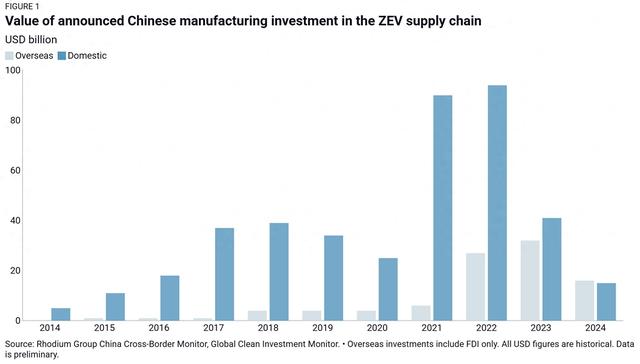
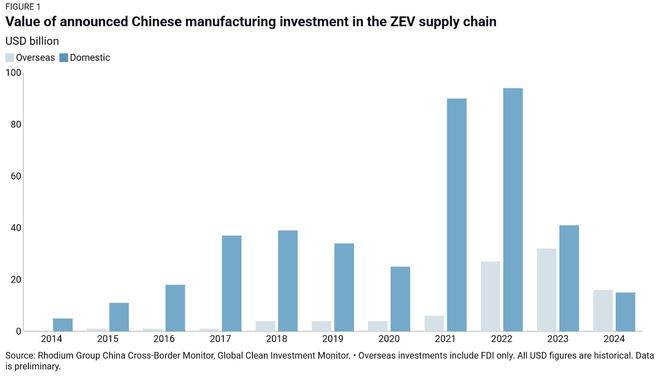
Core Insights - Chinese electric vehicle (EV) companies are increasing investments in overseas factories to enhance competition with global manufacturers like Tesla [1][2] - In 2022, overseas investments by Chinese EV supply chain companies reached approximately $16 billion, surpassing domestic investments of $15 billion for the first time since records began in 2014 [1][2] - The report indicates that battery manufacturers are leading the internationalization efforts, with 74% of overseas investments focused on the battery sector [1][2] Investment Trends - The domestic manufacturing investment in China's EV industry has significantly declined from $41 billion in 2023 to $15 billion last year, with previously announced projects peaking over $90 billion in 2022 [2] - The shift to overseas investment reflects a saturated domestic market and a strategic appeal for higher returns [2] - The automotive sector was the second most active area for Chinese outbound investments in Q2, totaling $6.8 billion across 29 major deals [5] Key Projects and Developments - Notable investments include a $2 billion investment by Huayou Cobalt in an EV battery complex in Indonesia and a $1.3 billion investment by GAC Group for an EV factory in Brazil [5] - Recent factory openings include Great Wall Motors' first factory in Brazil and BYD's acquisition of a former Ford plant in Bahia [6][7] - Envision AESC's battery factory in Douai, France, is expected to supply high-performance batteries for approximately 200,000 EVs annually [7] Future Outlook - Chinese automakers are accelerating global expansion, with BYD planning new facilities in Turkey and Indonesia, and Chery committing $1 billion for an EV factory in Turkey [7] - Great Wall Motors is considering establishing another factory in Latin America, with a decision expected by mid-next year [7]

10年来首次!“历史性反超”
Guan Cha Zhe Wang· 2025-08-19 06:23
Core Insights - Chinese electric vehicle companies are increasing investments in overseas factories to enhance competition with global manufacturers like Tesla [1][2] - In 2022, overseas investments by Chinese electric vehicle supply chain companies reached approximately $16 billion, surpassing domestic investments of $15 billion for the first time since 2014 [1][2] - The report indicates that battery manufacturers are leading the internationalization efforts, with 74% of overseas investments focused on the battery sector [1][2] Investment Trends - The domestic manufacturing investment in China's electric vehicle industry has significantly declined from $41 billion in 2023 to $15 billion last year, with previously announced projects peaking over $90 billion in 2022 [2] - The shift to overseas investment reflects a saturated domestic market and a strategic appeal for higher returns [2] - The automotive sector was the second most active area for Chinese foreign investments in Q2, totaling $6.8 billion across 29 major investments [4] Key Projects - Notable investments include a $2 billion investment by Huayou Cobalt in an electric vehicle battery complex in Indonesia and a $1.3 billion investment by GAC Group in a factory in Brazil [4] - BYD has taken over a former Ford plant in Brazil, while Envision AESC has launched a battery factory in France, expected to supply batteries for around 200,000 electric vehicles annually [7][8] - Great Wall Motors has officially launched its first factory in Brazil, with plans to further expand in Latin America [5][8]
长城/日产/福田市占率提升 雷达暴涨154% 7月皮卡销量排名揭晓 | 头条
第一商用车网· 2025-08-19 06:08
Core Viewpoint - The overall pickup market is experiencing a downturn in the first half of 2025, with the growth of new energy vehicles being a rare highlight in the market [3][25]. Sales Performance - In July 2025, the domestic pickup market sold a total of 20,248 units, representing a month-on-month decline of 1.59% and a year-on-year decline of 6.61% [6][18]. - Cumulatively, from January to July 2025, the total sales reached 159,178 units, down 4.23% compared to the same period last year [6][18]. Fuel Type Analysis - In July 2025, diesel pickup sales were 13,854 units, down 2.48% month-on-month and down 11.40% year-on-year [8]. - Pure electric pickups sold 1,182 units, with a year-on-year increase of 96.35, despite a month-on-month decline of 14.84% [8]. - Gasoline pickups sold 4,210 units, showing a slight month-on-month increase of 0.31% but a year-on-year decline of 15.33% [8]. - Hybrid pickups saw significant growth, with sales of 849 units, a month-on-month increase of 48.43% and a year-on-year increase of 139.15% [8]. Regional Performance - By July 2025, three regions in China had sales exceeding 10,000 units: Xinjiang (13,699 units), Yunnan (11,399 units), and Sichuan (10,313 units) [10]. - Guangdong showed remarkable growth with a cumulative sales increase of 27.01% year-on-year, reaching 8,600 units [10]. Brand Rankings - The top ten brands in July 2025 were led by Great Wall (9,224 units), followed by JMC (2,888 units) and Zhengzhou Nissan (2,378 units) [12][18]. - The brand Radar experienced the most significant growth, with a year-on-year increase of 153.92% in July [18]. Market Share - In the first seven months of 2025, Great Wall's market share was 46.52%, while JMC's was 14.45% [20]. - Zhengzhou Nissan and Jiangxi Isuzu had market shares of 10.37% and 7.35%, respectively, both better than the previous year [20]. New Energy Vehicle Sales - In July 2025, new energy pickup sales reached 2,031 units, a month-on-month increase of 3.62% and a year-on-year increase of 112.23% [22]. - Cumulatively, from January to July 2025, new energy pickups sold 12,416 units, a year-on-year increase of 114.92% [22]. Future Outlook - The pickup market is expected to continue facing pressure in the second half of 2025, but the transition to new energy and evolving regional demands are injecting new vitality into the market [25][26].




收购奔驰工厂!知名车企新工厂正式开业
鑫椤锂电· 2025-08-19 01:25
Core Viewpoint - Great Wall Motors has officially opened its factory in Brazil, marking a significant step in its expansion into the Latin American market [1][2]. Group 1: Factory Opening and Significance - The opening of the Brazilian factory was attended by Brazilian President Lula, highlighting its importance [2]. - This factory represents Great Wall Motors' commitment to establishing a presence in Latin America, bringing its advanced Hi4 hybrid four-wheel drive technology to the region [2]. Group 2: Factory Acquisition and Development - The Brazilian factory, located in Iracemápolis, São Paulo, was acquired from Mercedes-Benz, which had previously invested 600 million Brazilian Reais in its construction and an additional 100 million Euros for upgrades [5]. - The factory was idle after Mercedes-Benz ceased production in 2021, leading to Great Wall Motors acquiring the facility in August 2021 without transferring personnel [5]. - Following the acquisition, Great Wall Motors has upgraded the factory with its global production technologies, aiming for an annual production capacity of 50,000 vehicles, with plans for future increases [5]. Group 3: Production Plans - The initial production at the Brazilian factory will include models such as the Haval H6 gasoline and hybrid SUVs, Haval H9, and Poer pickup trucks [6]. - Additionally, ethanol hybrid models are planned to be produced in Brazil within a year [6].

长城汽车取得车辆中空调器控制相关专利
Jin Rong Jie· 2025-08-19 01:17
Group 1 - The core point of the article is that Great Wall Motors Co., Ltd. has obtained a patent for a vehicle air conditioning control method, device, vehicle, and electronic device, with the patent announcement number CN115431709B and application date of September 2022 [1] - Great Wall Motors Co., Ltd. was established in 2001 and is located in Baoding City, primarily engaged in the automotive manufacturing industry [1] - The company has a registered capital of 8,486.559123 million RMB [1] Group 2 - Great Wall Motors has invested in 75 companies and participated in 2,584 bidding projects [1] - The company holds 5,000 trademark information records and 5,000 patent information records [1] - Additionally, Great Wall Motors has 639 administrative licenses [1]
A股申购 | 巴兰仕(920112.BJ)开启申购 国内客户包括比亚迪汽车、理想汽车、长城汽车等知名整车厂商
智通财经网· 2025-08-18 22:52
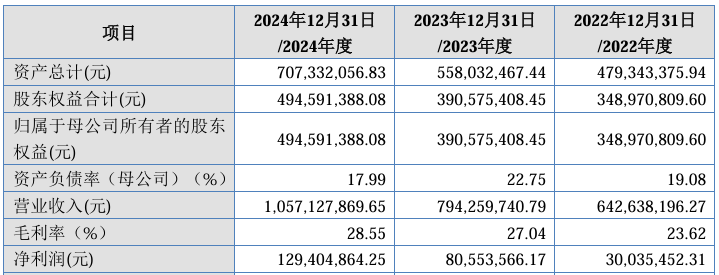
Core Viewpoint - Balanshi (920112.BJ) has initiated its subscription with an issue price of 15.78 CNY per share and a price-to-earnings ratio of 10.15 times, focusing on the automotive maintenance and repair equipment sector [1] Company Overview - The company specializes in the research, development, production, and sales of automotive maintenance, inspection, and repair equipment, including tire changers, balancing machines, lifts, refrigerant recovery and charging machines, and pneumatic oil extractors [1] - It is one of the largest manufacturers in the domestic automotive maintenance equipment industry, with a sales network covering most provinces, autonomous regions, and municipalities in China [1] - The company has established a strong brand presence in the domestic market, serving notable clients such as BYD, Li Auto, Great Wall Motors, and major automotive service chains [1] Intellectual Property and Standards - As of December 31, 2024, the company holds a total of 226 patents, including 20 invention patents, and has 18 software copyrights [2] - A subsidiary participated in drafting the national standard for automotive lifts published by the Ministry of Transport in February 2021 [2] Certifications and Awards - The company's products have received various domestic and international certifications, including ISO9001, CE, and TÜV [3] - The "UNITE" brand has been recognized as a famous trademark in Shanghai, and the company has received multiple awards from the China Automotive Maintenance Equipment Industry Association [3] Financial Performance - The company reported revenues of approximately 643 million CNY, 794 million CNY, and 1.057 billion CNY for the years 2022, 2023, and 2024, respectively [4] - Net profits for the same years were approximately 30 million CNY, 80 million CNY, and 129 million CNY [4] - Total assets increased from approximately 479 million CNY in 2022 to about 707 million CNY in 2024, with total equity rising correspondingly [5]
汽车周报:新车供给持续丰富,关注行业金九银十需求-20250818
Shenwan Hongyuan Securities· 2025-08-18 15:27
Investment Rating - The report maintains a positive outlook on the automotive industry, particularly focusing on the mid-to-high-end market and companies with strong alpha performance [4]. Core Insights - The report highlights the ongoing supply of new vehicles and anticipates increased demand during the "golden September and silver October" period. It emphasizes the potential for robotics in various applications, suggesting a similar growth trajectory to that of autonomous driving seen 6-8 years ago [4]. - The report suggests focusing on companies with scene implementation capabilities and strong control over their respective markets, including NIO, JAC Motors, Li Auto, Xiaomi, and their supply chain partners [4]. - The report notes a significant increase in the retail sales of new energy vehicles, with a penetration rate of 57.6% in the latest week [4]. Industry Update - In the 32nd week of 2025 (August 4-10), retail sales of passenger cars totaled 375,000 units, down 18.83% month-on-month and 7.41% year-on-year. Traditional energy vehicle sales were approximately 159,000 units, down 26.73% month-on-month and 16.75% year-on-year, while new energy vehicle sales reached 216,000 units, down 11.84% month-on-month but up 0.93% year-on-year [4]. - The automotive industry saw a total transaction value of 606.26 billion yuan this week, reflecting a 15.90% increase compared to the previous week [4]. - The report indicates that the automotive industry index rose by 3.08% this week, outperforming the Shanghai and Shenzhen 300 index, which increased by 2.37% [15]. Market Situation - The report identifies 183 stocks in the automotive sector that rose in value, with the largest gains seen in Feilong Co., Tenglong Co., and Shentong Technology, which increased by 39.1%, 35.1%, and 29.0%, respectively. Conversely, the largest declines were observed in Yibin Technology, Feile Audio, and Construction Industry, with decreases of -7.7%, -7.6%, and -7.3% [19]. - The report highlights significant events, including the announcement of new vehicle models by the Ministry of Industry and Information Technology, and the expansion of strategic cooperation between XPeng and Volkswagen in electronic and electrical architecture [8][10]. Investment Analysis - The report recommends focusing on domestic strong alpha manufacturers such as Li Auto, NIO, Xiaomi, and XPeng, as well as companies involved in the integration of state-owned enterprises like SAIC and Dongfeng [4]. - It also emphasizes the importance of companies with strong performance growth, robotics layout, or overseas expansion capabilities in the parts sector, recommending companies like Fuyao Glass, New Spring Co., and others [4].


GWM Hosts World’s First Factory Marathon, Showcasing China’s Automotive Innovation to the World
Globenewswire· 2025-08-18 14:00
Core Insights - GWM successfully hosted the 2025 GWM Smart Factory Half Marathon, showcasing its advanced automotive manufacturing capabilities with over 10,000 participants racing through its smart factory [1] - The event highlighted GWM's commitment to integrating automation and intelligence in its production processes, featuring fully automated production lines and innovative robotic systems [2] - GWM's engineering workforce consists of 23,000 professionals, indicating a strong focus on technical expertise within the company [3] Innovation and Technology - GWM's Environmental Wind Tunnel Laboratory is equipped with advanced systems to simulate extreme climate conditions, ensuring vehicles meet global standards [5] - The company has invested nearly RMB 10 billion in establishing a comprehensive testing complex with over 2,000 testing capabilities across various automotive technologies [5] - GWM is committed to a full-stack approach to intelligent vehicle technology, including proprietary driving models and an in-house supercomputing center [6] Supply Chain and Vertical Integration - GWM has transitioned from relying on external suppliers to establishing its own engine and component subsidiaries, enhancing in-house R&D and manufacturing capabilities [7] - The company spun off its component subsidiaries as independent companies in 2018, which led to increased competition and innovation within its supply chain [9][10] - GWM has built a fully integrated supply chain ecosystem over 35 years, emphasizing the importance of collaboration with suppliers and dealers [11] Global Expansion and Market Presence - GWM's new plant in São Paulo, Brazil, will have an annual production capacity of 50,000 new energy vehicles and create 2,000 local jobs, adopting intelligent production systems [13] - The company's "Ecological Globalization" strategy focuses on establishing integrated manufacturing bases abroad, marking a shift from product-driven to full-scale globalization [14] - GWM's international sales network covers over 170 countries, with more than 1,400 overseas dealerships and over 2 million vehicles sold outside China [16]

新能源5年补贴终审:北汽狂揽1/3蛋糕,比亚迪仅分到1%
第一财经· 2025-08-18 13:43
Core Viewpoint - The article discusses the financial support and subsidy distribution for the electric vehicle (EV) industry in China from 2016 to 2020, highlighting the significant disparities among various automakers and regions in terms of subsidy amounts received and the subsequent adjustments made during the final audit process [2][4]. Summary by Sections Subsidy Distribution - From 2016 to 2020, the Ministry of Industry and Information Technology (MIIT) issued a total of 16.5 billion yuan in subsidies for the promotion of EVs [2]. - Beijing New Energy Vehicle Company received approximately 555.55 million yuan, accounting for over 30% of the total subsidies, while BYD received only 15.74 million yuan, representing less than 1% [2][6]. Regional Analysis - Six regions received over 100 million yuan in subsidies, with Beijing leading at over 700 million yuan, followed by Zhejiang with approximately 303 million yuan [4][11]. - Guizhou province did not receive any subsidies during this period [4]. Subsidy Reduction - The article highlights the significant subsidy reductions faced by several automakers, with Chery Automotive experiencing the highest reduction of approximately 237 million yuan [4][7]. - The main reasons for subsidy reductions included non-compliance with documentation requirements and discrepancies in vehicle registration [4][7]. Comparison Among Automakers - Among the major automakers, Dongfeng Motor Group received 255.9 million yuan, making it the only state-owned enterprise to exceed 100 million yuan in subsidies [6]. - In contrast, Tesla received only 3.59 million yuan, and its subsidies were reduced by 761.45 million yuan during the final audit [9][6]. Future Trends - The article notes that the focus is shifting towards enhancing EV technology, with new requirements for tax exemptions set to take effect in 2024 [14][15]. - The expected growth in EV sales from 2021 to 2024 is projected to be significant, with a compound annual growth rate of 38.2% [15].