
GWMOTOR(601633)

Search documents
重点车企2月销量速览
数说新能源· 2026-03-03 03:04
Core Viewpoint - The article highlights the performance of various electric vehicle manufacturers in terms of sales growth and export figures for the first two months of the year, indicating a mixed but generally positive trend in the new energy vehicle market. Group 1: Sales Performance - NIO, Xiaomi, Leap Motor, and SAIC have shown significant year-on-year growth in sales for January and February [2] - BYD reported February sales of 190,000 units, down 41% year-on-year and 9% month-on-month, with cumulative sales of 400,000 units for the first two months, down 36% year-on-year [2] - Geely's February sales reached 206,000 units, up 1% year-on-year but down 24% month-on-month, with cumulative sales of 476,000 units for the first two months, also up 1% year-on-year [2] - Chery's February sales were 161,000 units, down 11% year-on-year and 20% month-on-month, with cumulative sales of 361,000 units for the first two months, down 11% year-on-year [3] - Great Wall Motors reported February sales of 73,000 units, down 7% year-on-year and 20% month-on-month, with cumulative sales of 163,000 units for the first two months, up 3% year-on-year [3] Group 2: Export Performance - BYD's export sales reached 101,000 units in February, up 50% year-on-year and stable month-on-month [2] - Geely's export sales were 61,000 units, up 138% year-on-year and 1% month-on-month [2] - Chery's exports totaled 12,500 units, up 42% year-on-year [3] - Great Wall Motors exported 43,000 units, up 37% year-on-year and 5% month-on-month [3] Group 3: New Product Launches - Li Auto plans to launch new models L9 and L9 Livis in Q2 2026 [5] - Zeekr's sales reached 24,000 units, up 70% year-on-year, with the new model expected to launch in Q2 2026 [2][5]





长城汽车后续展望
数说新能源· 2026-03-03 03:04
Group 1 - The core viewpoint of the article emphasizes the recovery of the domestic passenger car market and the expected growth in exports, particularly in the Middle East and Latin America [2] - In March, domestic passenger car sales are projected to gradually improve, with traditional commercial vehicle consumption peaking, and new models contributing to sales in April and May [2] - Inventory levels are reported at 1.5 months domestically and 2-3 months overseas, indicating a stable supply chain [2] Group 2 - The export market is expected to see significant contributions from regions such as Latin America, right-hand drive markets, and the Middle East, with Russia anticipated to account for one-third of exports [2] - Brand structure in February shows Haval at approximately 70%, with Tank and pickup trucks each contributing 10-15% [2] - The strategy for the EU market includes enhancing brand presence, establishing sales subsidiaries, and expanding the product range to include fuel and HEV models [2] Group 3 - The impact of raw material price increases is noted, with copper and aluminum comprising less than 5% of BOM costs, and strategies in place for cost management [3] - The cost increase per vehicle due to memory components is around 1,000 yuan, with a focus on supply assurance and cost transmission [3] - Battery supply chain dynamics are shifting, with Honeycomb's market share increasing from 40% to 70% [3] Group 4 - The company is enhancing its marketing efforts in the high-end market to strengthen consumer recognition of its intelligent driving capabilities [3] - Future products from Ora and Haval will focus on urban NOA functionality, indicating a push towards smart driving features [3] - The company is also expanding its intelligent driving technology into international markets [3]

长城汽车20260302
2026-03-03 02:52
Key Points Summary of Great Wall Motors Conference Call Company Overview - **Company**: Great Wall Motors - **Date**: March 2, 2026 Industry Insights - **Sales Performance**: The company maintains stable sales with an increasing proportion of high-end models, positively impacting overall gross margin. However, the specific gross margin for Q1 will be assessed after March sales data and the impact of high-end model sales, cost reduction pace, and raw material price increases are evaluated [2][3][5] - **Cost Pressures**: Facing three main cost pressures: 1. Raw materials (aluminum, copper) 2. Memory costs due to tight supply from computing center construction, increasing per vehicle cost by approximately 1,000 yuan 3. Battery supply chain pressures, particularly from rising lithium carbonate prices [2][4] Sales and Market Strategy - **Overseas Sales**: Strong performance in February, primarily from non-Russian markets including Latin America, right-hand drive markets, and the Middle East. The target for overseas sales in 2026 is at least 600,000 vehicles, focusing on growth in non-Russian markets through dealer agreements and product diversification [2][4] - **Domestic Market Recovery**: The domestic market is gradually recovering, supported by the "old-for-new" policy and the commercial vehicle consumption peak season. New models are set to launch around the Beijing Auto Show, expected to improve domestic sales performance [2][5] Product Development - **New Models**: The WEY brand V9X is built on the new "Guiyuan" platform, supporting 800V/900V voltage, with a maximum pure electric range of 400 kilometers and equipped with a 6C fast-charging battery. It aims to enhance new energy power capabilities and features advanced AI for higher-level autonomous driving needs [2][6][7] - **Tank Brand**: The Tank brand's sales are expected to recover significantly from March onwards, driven by the Tank 700 and the major update of the Tank 300 [2][8] Competitive Landscape - **Market Competition**: The probability of a price war in 2026 is low, with a shift in competition focus towards brand strength, product quality, technology, and user reputation rather than direct price competition [3][9] - **EU Market Strategy**: The EU is positioned as a high-potential market, with plans to enhance brand building, diversify product offerings, and ensure compliance with local regulations starting in 2026 [10][11] Financial Outlook - **Sales Targets**: The company maintains a sales target of 1.8 million vehicles for 2026, despite challenges in Q1 due to tax policy changes and holiday impacts. Monthly sales are expected to recover to over 100,000 units [14][19] - **Capital Expenditure**: Fixed asset investments are expected to decline, focusing more on components rather than vehicle manufacturing. R&D investments are anticipated to increase to enhance competitiveness in smart driving and automation [18] Inventory Management - **Inventory Levels**: Domestic inventory is expected to be controlled at approximately 1.5 months, while overseas inventory is around 2-3 months [15] Future Focus - **Operational Priorities**: The company will focus on launching new models and improving terminal sales performance, particularly in March and the following months. There will also be efforts to strengthen overseas sales channels and partnerships [19]
这个2月有点冷,国内车企销量洗牌
凤凰网财经· 2026-03-02 13:18
Core Viewpoint - The automotive market in February 2026 experienced a significant downturn, with all new energy vehicle manufacturers failing to exceed 30,000 units in monthly deliveries, marking a shift in market dynamics and highlighting the challenges faced by both new entrants and established brands [1][2]. Group 1: Sales Performance Overview - In February, BYD's sales reached 190,190 units, a 41% decline year-on-year, with domestic sales dropping to just over 90,000 units, indicating strong pressure from the seasonal downturn [4][5]. - Geely reported total sales of 206,160 units, showing a slight increase of 1% year-on-year, supported by a remarkable performance from its Zeekr brand, which saw a 70% increase in sales [6]. - Great Wall Motors sold 72,600 vehicles in February, down 7% year-on-year and 20% month-on-month, with 12,744 units being new energy vehicles [9]. Group 2: New Energy Vehicle Manufacturers - New energy vehicle manufacturers collectively faced significant challenges, with AITO and XPeng showing notable declines in sales, with AITO delivering approximately 18,000 units in February, a drop of nearly 50% from January [11]. - XPeng delivered 15,256 vehicles in February, reflecting a nearly 50% year-on-year decline and a 24% month-on-month drop, attributed to the aging of older models and product transition pains [12]. - In contrast, Li Auto delivered 26,421 vehicles, showing a slight year-on-year increase, while NIO achieved a substantial 57.6% year-on-year growth with 20,797 units delivered, driven by strong demand for its ES8 model [18][19]. Group 3: Market Dynamics and Future Outlook - The automotive market is experiencing a dual pressure of declining domestic demand and intense price competition, with over 20 brands, including BYD and Tesla, engaging in long-term low-interest promotions [23]. - Despite the challenges, opportunities exist in the form of decreasing battery costs and advancements in smart driving technology, which could enhance the penetration of new energy vehicles in the market [23]. - The export market is becoming increasingly vital for Chinese automotive brands, with BYD's exports exceeding 100,000 units in February, marking a potential shift in focus from domestic to international markets [5].



每天车闻:奇瑞、比亚迪、长城、吉利汽车发布2026年2月销量业绩
Xin Lang Cai Jing· 2026-03-02 11:48
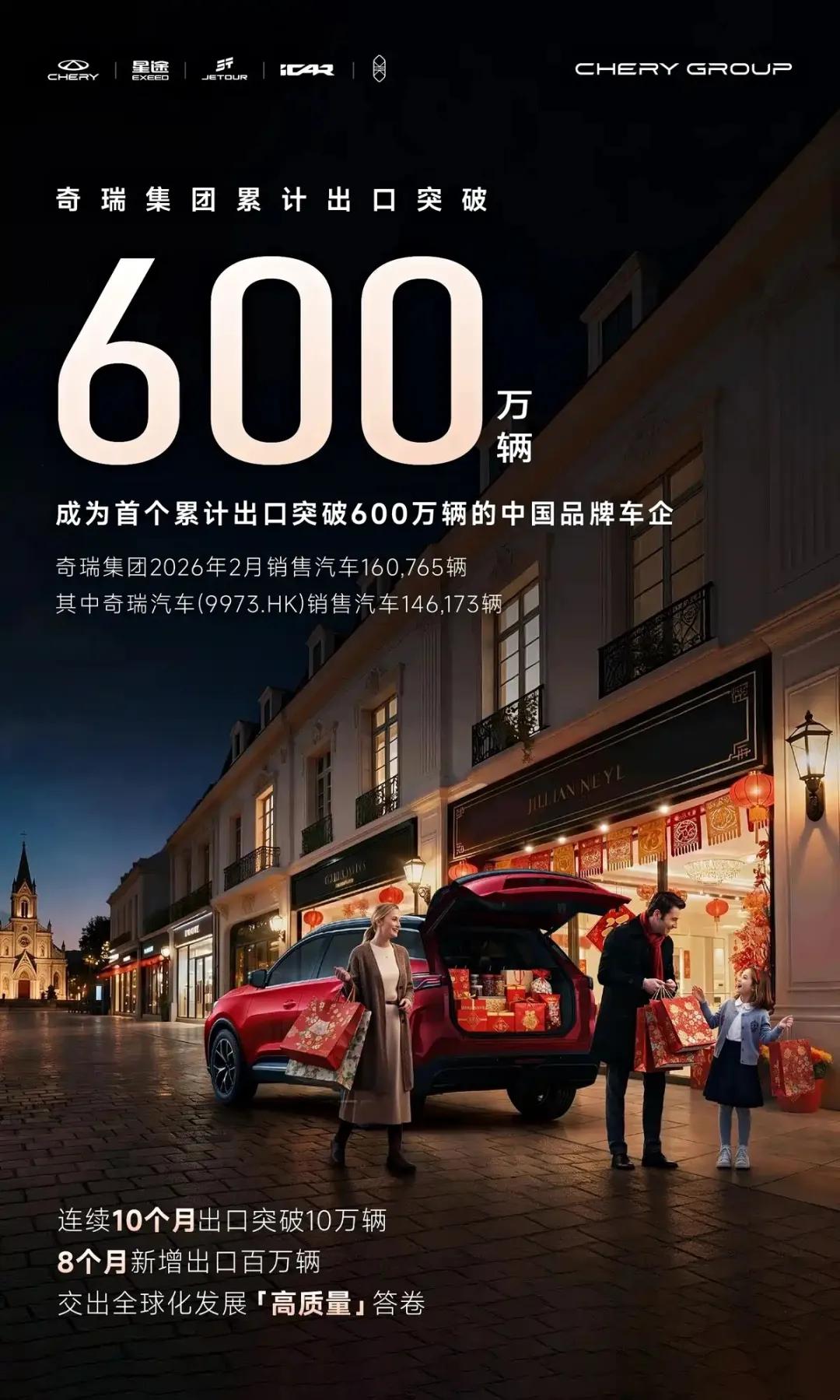
Group 1: Chery Group - Chery Group sold 160,765 vehicles in February, with Chery brand sales at 146,173 units [4][19] - The cumulative export of Chery Group has surpassed 6 million units, maintaining over 100,000 units in exports for 10 consecutive months, and achieving an additional million units in exports over the past 8 months [4][19] Group 2: BYD - BYD's sales in February reached 190,190 units, with passenger vehicle sales at 187,782 units and overseas sales of passenger vehicles and pickups at 100,151 units, marking a year-on-year increase of 41.4% [5][19] - In the first two months, BYD's cumulative sales totaled 400,241 units, with overseas sales of passenger vehicles and pickups at 200,160 units [21] Group 3: Great Wall Motors - Great Wall Motors sold 72,594 new vehicles in February, with overseas sales increasing by 37.36% year-on-year [9][22] - The total sales for the first two months reached 162,906 units, reflecting a year-on-year growth of 2.58% [22][28] - Specific brand performances include Haval brand sales of 43,660 units, WEY brand sales of 5,615 units (up 54.13%), and Tank brand sales of 10,036 units [14][28] Group 4: Geely Automobile - Geely Automobile's sales in February amounted to 206,160 units, with new energy vehicle sales at 117,488 units, representing 57% of total sales [15][29] - The overseas export sales saw a significant increase of 138% year-on-year [15][29] - Geely brand sales were 154,934 units, with Lynk & Co brand sales at 27,359 units and Zeekr brand sales at 23,867 units, showing a year-on-year growth of 70% [15][29]
长城汽车(601633) - 长城汽车股份有限公司关于可转换公司债券转股暨股份变动公告
2026-03-02 09:45
重要内容提示: 一、可转债转股情况 (一)可转债发行上市概况 | | | 长城汽车股份有限公司 关于可转换公司债券转股暨股份变动公告 本公司董事会及全体董事保证本公告内容不存在任何虚假记载、误导性陈述或者重 大遗漏,并对其内容的真实性、准确性和完整性承担法律责任。 (二)可转债转股情况 公司本次公开发行的"长汽转债"转股期为2021年12月17日起至2027年6月9日。 可转债转股情况:2026年2月1日至2026年2月28日期间,共有0元"长汽转债"已转 换成公司股票,转股数为0股。自2021年12月17日至2026年2月28日,累计共有4,953,000 元"长汽转债"已转换为公司股票,累计转股数为129,880股,占可转债转股前公司已 发行股份总额的0.0014%。 截至2026年2月28日,尚未转股的可转债金额为3,495,046,000元,占可转债发行总 量的99.8585%。 本次股份变动后,公司股权分布仍具备上市条件。 特此公告。 经中国证券监督管理委员会《关于核准长城汽车股份有限公司公开发行可转换公司 债券的批复》(证监许可[2021]1353号)核准,长城汽车股份有限公司(以下简称"公 司" ...
长城汽车(601633) - H股公告-长城汽车股份有限公司股份发行人的证券变动月报表
2026-03-02 09:45
截至月份: 2026年2月28日 狀態: 新提交 股份發行人及根據《上市規則》第十九B章上市的香港預託證券發行人的證券變動月報表 呈交日期: 2026年3月2日 I. 法定/註冊股本變動 | 1. 股份分類 | 普通股 | | 股份類別 | H | | | 於香港聯交所上市 (註1) | | 是 | | | --- | --- | --- | --- | --- | --- | --- | --- | --- | --- | --- | | 證券代號 (如上市) | 02333 | | 說明 | 無 | | | | | | | | 多櫃檯證券代號 | 82333 | RMB | 說明 | 無 | | | | | | | | | | | 法定/註冊股份數目 | | | 面值 | | | 法定/註冊股本 | | | 上月底結存 | | | | 2,318,776,000 | RMB | | | 1 RMB | | 2,318,776,000 | | 增加 / 減少 (-) | | | | 0 | | | | RMB | | | | 本月底結存 | | | | 2,318,776,000 | RMB | | | 1 ...
长城汽车(02333) - 海外监管公告
2026-03-02 09:22
香港交易及結算所有限公司及香港聯合交易所有限公司對本公告的內容概不負責,對其準確性或完整性亦不發表任何 聲明,並明確表示,概不對因本公告全部或任何部份內容而產生或因倚賴該等內容而引致的任何損失承擔任何責任。 長 城 汽 車 股 份 有 限 公 司 GREAT WALL MOTOR COMPANY LIMITED* (於中華人民共和國註冊成立的股份有限公司) 股份代號:02333(港幣櫃台)及82333(人民幣櫃台) 海外監管公告 此海外監管公告是根據香港聯合交易所有限公司證券上市規則第 13.10B 條發出。以下為長城汽 車股份有限公司於上海證券交易所網站(www.sse.com.cn)所刊發之「長城汽車股份有限公司 於可轉換公司 券 股 股份變動公告」。 承董事會命 長城汽車股份有限公司 公司秘書 李紅栓 中國河北省保定市,2026 年 3 月2 日 於本公告日期,董事會成員如下: 執行董事: 魏建軍先生、趙國慶先生及李紅栓女士。 职工董事:盧彩娟女士。 非執行董事:何平先生。 獨立非執行董事: 樂英女士、 輝先生及鄒兆麟先生。 * 僅供識別 | 证券代码:601633 | 证券简称:长城汽车 | 公告编号 ...
研报掘金丨爱建证券:维持长城汽车"买入"评级,盈利弹性进入释放阶段
Ge Long Hui A P P· 2026-03-02 08:48
Core Viewpoint - Great Wall Motors experienced a decline in February 2026 sales, with a total of 72,594 vehicles sold, representing a year-on-year decrease of 6.79% and a month-on-month decrease of 19.61% [1] Sales and Production Summary - February production was recorded at 64,811 vehicles, showing a year-on-year decline of 13.42% [1] - The month-on-month sales drop is attributed to the reduced working days during the Spring Festival holiday and seasonal fluctuations in market demand [1] Brand Performance Summary - Haval's sales remain stable, while the premium brand Wey has shown significant breakthroughs [1] - The Tank brand faces short-term pressure due to intensified competition in the off-road segment [1] - Ora is undergoing a transformation, while the pickup truck segment maintains its leading position [1] Overseas Sales and Strategy Summary - Overseas sales reached 42,675 vehicles in February, marking a year-on-year increase of 37.36%, with a cumulative total of 82,953 vehicles sold in January and February [1] - The company is enhancing its influence in markets like Brazil and Australia through sports event marketing, continuing its ecological overseas strategy [1] Profitability and Future Outlook Summary - With the rollout of new platform models, improved efficiency in direct sales channels, and an increase in the proportion of high-value overseas models, the company is expected to achieve scale effects and improved profitability per vehicle [1] - The profitability elasticity is entering a release phase, indicating potential for future growth [1] - The company maintains a "Buy" rating [1]
长城汽车(02333) - 月报表
2026-03-02 08:38
股份發行人及根據《上市規則》第十九B章上市的香港預託證券發行人的證券變動月報表 截至月份: 2026年2月28日 狀態: 新提交 致:香港交易及結算所有限公司 公司名稱: 長城汽車股份有限公司 呈交日期: 2026年3月2日 I. 法定/註冊股本變動 | 1. 股份分類 | 普通股 | | 股份類別 | H | | | 於香港聯交所上市 (註1) | | 是 | | | --- | --- | --- | --- | --- | --- | --- | --- | --- | --- | --- | | 證券代號 (如上市) | 02333 | | 說明 | 無 | | | | | | | | 多櫃檯證券代號 | 82333 | RMB | 說明 | 無 | | | | | | | | | | | 法定/註冊股份數目 | | | 面值 | | | 法定/註冊股本 | | | 上月底結存 | | | | 2,318,776,000 | RMB | | | 1 RMB | | 2,318,776,000 | | 增加 / 減少 (-) | | | | 0 | | | | RMB | | | | 本月底結存 | | ...