GWMOTOR(601633)

Search documents
一周一刻钟,大事快评(W139):补贴政策受益分析,小鹏、零跑、长城销量解读
Shenwan Hongyuan Securities· 2026-01-07 09:13
Investment Rating - The industry investment rating is "Overweight" indicating that the industry is expected to outperform the overall market [12]. Core Insights - The 2026 new energy vehicle purchase tax subsidy policy has shifted from a "one-size-fits-all" model to a tiered proportional subsidy, resulting in a slight decrease in per-vehicle subsidy amounts. Companies with a higher proportion of low-end models, such as Geely and BYD, will experience a more significant subsidy reduction, while high-end brands are largely unaffected [2][3]. - The adjustment in subsidy policy is expected to significantly reshape the sales structure of new energy vehicles in 2026, with demand for low-end models likely to decline, benefiting mid-to-high-end models and companies with higher average selling prices (ASP) [3]. Summary by Sections Subsidy Policy Analysis - The 2026 subsidy policy will lead to a reduction in subsidies for companies with a higher share of low-end models, with Geely facing a 19% reduction and BYD a 14% reduction. In contrast, companies like Xiaopeng, Great Wall, and Leap Motor will see a reduction of around 10% due to their higher proportion of mid-to-high-end models [3][4]. Sales Analysis of Key Companies - **Xiaopeng Motors**: Projected delivery volume for 2025 is approximately 430,000 units, a 126% increase year-on-year. December deliveries were 37,500 units, showing a decline due to subsidy reductions. The ASP is expected to drop from nearly 190,000 yuan in 2024 to 160,000 yuan in the first half of 2025. Xiaopeng plans to launch seven dual-power models in 2026, which are expected to benefit from the policy changes [4][5]. - **Leap Motor**: Expected to deliver 597,000 units in 2025, doubling from 290,000 units in 2024. The growth is driven by new models and overseas market expansion. Despite the introduction of lower-priced models, Leap Motor has maintained its gross margin due to effective cost control. The 2026 sales target is set at 1 million units [5][6]. - **Great Wall Motors**: Anticipated sales for 2025 are 1.32 million units, a 7% increase. The company has optimized its internal structure, with new models compensating for declines in older models. The sales target for 2026 is set at 1.8 million units, reflecting a 40% year-on-year growth expectation [6]. Investment Recommendations - The report suggests focusing on new energy vehicle companies that have advantages in AI and robotics, such as Xiaopeng, NIO, and Li Auto, as well as key Tier 1 suppliers. It also recommends second-hand car companies and component manufacturers with low valuations and growth potential, such as Yinchuan, Fuda, and others [2][6].

9.6万人投票,长城归元平台:一次真正的用户定义
Xin Lang Cai Jing· 2026-01-07 09:05
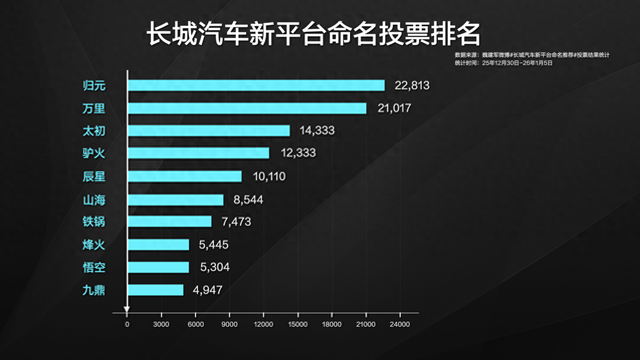
Core Viewpoint - The automotive industry is experiencing homogenization, reflected in both products and naming conventions. Great Wall Motors has taken a unique approach by allowing the public to name its new platform, resulting in the name "Guiyuan," which signifies a return to user-centric values and a commitment to technological innovation and strategic ambition [1][3]. Naming Origin: From User Co-Creation to the Essence of "Guiyuan" - The naming process involved over 96,000 participants and more than 110,000 votes, emphasizing user engagement and co-creation, aligning with Great Wall's long-term, user-centered development philosophy [3][6]. - The name "Guiyuan" encapsulates the essence of returning to the fundamentals of automotive design and technology, focusing on genuine user needs and the core logic of industry development [3][4]. Technical Foundation: User-Centric Implementation of the Guiyuan Platform - The Guiyuan platform is designed for the next 10-20 years, emphasizing versatility with capabilities for multiple powertrains and vehicle types, catering to diverse user needs [6][10]. - The platform's compatibility with various energy forms, including gasoline, hybrid, electric, and hydrogen, reflects a strategic approach to global market demands [7][11]. Global Strategy: Guiyuan as a Vehicle for China's Automotive Expansion - Great Wall Motors aims to expand globally, recognizing that understanding local user needs and adapting to diverse market conditions is crucial for success [11][12]. - The Guiyuan platform's ability to adapt to different powertrain requirements enhances efficiency and cost-effectiveness in international markets, addressing the challenges posed by varying energy structures and infrastructure [11][12]. Conclusion - The Guiyuan platform represents Great Wall Motors' commitment to innovation and user-centric design, supported by a robust technical foundation and a strategic vision for global expansion. This approach aims to transform the Chinese automotive industry from mere scale expansion to value enhancement [12][13].

长城汽车新平台定名“归元” 兼容多动力解决方案
Zhong Guo Zhi Liang Xin Wen Wang· 2026-01-07 07:22
Core Viewpoint - Great Wall Motors has officially named its new "multi-power" platform as "Guiyuan," which will serve as the ecological foundation for intelligent mobility [1] Group 1: Platform Overview - The Guiyuan platform is centered around the core idea of "tracing the origin of the industry and returning to user needs," focusing on the essence of automotive mobility and technological innovation [3] - It supports "one vehicle, multiple power sources; one vehicle, multiple categories; one vehicle, multiple forms," providing comprehensive adaptability for various scenarios [3] Group 2: Technical Compatibility - The Guiyuan platform is inherently compatible with multiple power solutions, including gasoline, diesel, BEV (Battery Electric Vehicle), HEV (Hybrid Electric Vehicle), PHEV (Plug-in Hybrid Electric Vehicle), and hydrogen energy [3] - It covers a range of product categories such as SUVs and MPVs, aiming to provide technology that truly fits the needs of users in different global markets and energy conditions [3] Group 3: Strategic Implications - The platform's foundational, inclusive, and growth-oriented characteristics reflect Great Wall Motors' comprehensive layout from ecological foundation construction to global adaptation strategy [3] - Each keyword associated with the Guiyuan platform corresponds to a response to the actual interests of users, emphasizing the company's commitment to user-centric innovation [3]
研报掘金丨爱建证券:长城汽车盈利弹性进入释放阶段,维持"买入"评级
Ge Long Hui· 2026-01-07 06:41
爱建证券研报指出,长城汽车继续推进高端化+全球化,2026年目标180万辆。年末价格竞争加剧,公 司或主动控产去库存,12月产量同比降幅大于销量,单月销量承压,新能源车与出口表现占优。2026年 目标销量120万辆(不含出口),高端新能源车为核心增量。2026年出口目标60万辆,强化非俄市场。 随着新平台车型放量、直营渠道效率提升及海外高价值车型占比提升,规模效应与单车盈利改善有望同 步兑现,盈利弹性进入释放阶段。维持"买入"评级。 ...
复盘2025新能源汽车下半场:在喧嚣、焦虑与体验升级中打响淘汰赛
Xin Lang Cai Jing· 2026-01-07 05:57
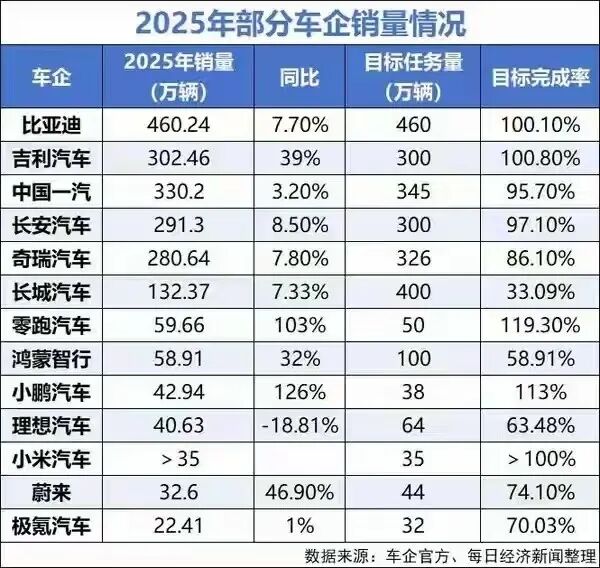
Core Insights - The 2025 year for the electric vehicle (EV) industry is characterized by aggressive growth, a backlash against internal competition, and uncertainty heading into 2026 [2][17][19] Group 1: Aggressive Growth - The EV industry is projected to sell 12.852 million units in 2025, with a market penetration rate surpassing 50% [3] - BYD leads the market with 4.6024 million units sold, achieving a 7.7% year-on-year growth [6] - New players like Leap Motor and Xiaomi are also showing significant growth, with Leap Motor achieving a 103% year-on-year increase [4][6] Group 2: Backlash Against Internal Competition - The industry has faced issues of malicious competition, with average price reductions of 9.2% leading to a decline in profit margins from 6.2% in 2020 to 4.3% in 2025 [17][18] - Regulatory bodies are advocating for a shift towards innovation and service differentiation rather than price wars [18] - The backlash aims to guide companies towards better product definitions and fair competition practices [18] Group 3: Uncertainty in 2026 - The competition in the EV sector is expected to intensify, with a slowdown in growth rates and increased pressure on product iteration [19][20] - Key factors influencing competition will be autonomous driving capabilities and expansion strategies [20][25] - The industry may face a dilemma regarding price wars as average vehicle prices have decreased from 184,000 yuan in 2024 to 178,000 yuan in 2025 [27]




马斯克旗下xAI公司完成200亿美元融资;微信辟谣好友太多会被封
Sou Hu Cai Jing· 2026-01-07 01:30
Group 1 - The State Administration for Market Regulation will accelerate the update and upgrade of a batch of national standards for green consumption [2] - The administration aims to create a favorable market environment and enhance public satisfaction through various initiatives [2] - Key initiatives include improving energy and water efficiency labeling systems, promoting "green dining" services, and strengthening law enforcement against violations in green product areas [2] Group 2 - Starting January 1, 2026, cosmetic surgery will be subject to VAT, while medical services provided by medical institutions will remain exempt [3] - The definition of "medical institutions" excludes profit-driven beauty medical institutions [3] Group 3 - Bawang Tea Ji responded to a viral video of a staff member preparing tea with bare hands, stating it was a staged act for social media and not for sale [3] - The company has taken disciplinary actions, including indefinite closure of the store and termination of the involved staff [3] Group 4 - Lee Jae-Yong, Chairman of Samsung Electronics, was spotted shopping in Beijing, purchasing 100 Labubu items [4][5] - This event occurred after his attendance at a China-Korea business forum [4] Group 5 - Elon Musk's xAI company completed a $20 billion funding round with investors including Nvidia and Qatar Investment Authority [5] - The funding has been in preparation for several months, although specific investment amounts from each party were not disclosed [5] Group 6 - Nvidia CEO Jensen Huang announced new AI products at CES 2026, including the next-generation Rubin architecture GPU [6] - The new GPU's performance is significantly improved compared to the previous Blackwell GB200 model [6] - Nvidia is also releasing several new models targeting various AI applications, including autonomous driving and robotics [6] Group 7 - Xiaomi announced disciplinary actions following an investigation into its team's interaction with KOLs, resulting in the dismissal of involved personnel [6] Group 8 - WeChat clarified that rumors about new account restrictions are false, emphasizing that normal social behavior will not be limited [7][8] Group 9 - Apple responded to criticism regarding the price of a Year of the Horse phone case, stating that the design is a collaboration and the price reflects its quality [8] Group 10 - Xiaohongshu is testing a paid note feature, allowing creators to charge for high-quality content with various payment models [9] Group 11 - KKV store in Shenzhen faced a forced closure due to alleged rent arrears, leading to employee injuries and emotional distress [10] Group 12 - Magic Cube Life Service Group is facing operational disputes in multiple cities, with claims of unpaid rent and forced tenant evictions [11] - The company stated it is optimizing its store operations and remains committed to expanding new projects [11] Group 13 - Tesla announced a new financing plan for Model 3 and Model Y vehicles, including a 5-year interest-free option [12] Group 14 - Moutai's Year of the Horse liquor is being resold at inflated prices, with some resellers offering up to 3000 yuan for a bottle originally priced at 1899 yuan [12] Group 15 - Great Wall Motors has officially implemented a full weekend off policy for all employees, marking a significant change in its work schedule [13] Group 16 - A recent incident involving a physical altercation between a pilot and co-pilot on a flight has been addressed by the airline, confirming compliance with operational standards [14] Group 17 - The C919 aircraft has successfully carried over 4 million passengers, with ongoing developments in new aircraft models and engine certifications [15] Group 18 - GAC Honda announced a two-week production halt due to semiconductor supply issues and production line upgrades, stating that the impact on overall production will be manageable [16]



海外销量占比43%!长城汽车征战CES2026,中国车企不按套路出牌
Xin Lang Cai Jing· 2026-01-07 01:29
Core Insights - Great Wall Motors is one of the first domestic brands to officially announce participation in CES 2026, aiming to enhance its global brand recognition and communication [4][28] - The company plans to showcase its latest products and technologies at CES 2026, including the new WEY models and advanced technologies such as Hi4, V8 engines, hydrogen fuel power, and ASL 2.0 [6][30] Product Highlights - The WEY brand's new models, including the Blue Mountain and High Mountain 9, are positioned as the core of Great Wall's technology output at CES 2026, emphasizing China's strength in automotive intelligence [8][32] - The Blue Mountain features the industry-leading VLA visual language behavior model, enabling defensive driving, blind spot risk prediction, and voice command control, even in low visibility conditions [10][34] - The High Mountain series redefines high-end travel standards with a dedicated platform for new energy MPVs, offering a high "usable area rate" of 61.1% and versatile interior configurations [10][34] Technological Innovations - Great Wall's participation in CES 2026 is not just about showcasing products but also about breaking stereotypes of Chinese automobiles in international markets through technology and ecosystem exports [14][40] - The Hi4 intelligent four-wheel drive hybrid technology and hydrogen fuel systems demonstrate the company's commitment to diverse new energy solutions [14][38] - The ASL 2.0 upgrade transforms vehicles from "smart tools" to "AI agents," enhancing the potential for various travel scenarios [14][38] Global Market Strategy - As of June 2025, Great Wall Motors has established sales channels in over 170 countries and regions, with more than 1,400 sales outlets, indicating a solid foundation in international markets [17][41] - In November 2025, the company's overseas sales reached 57,309 units, a 32.7% year-on-year increase, accounting for 43.02% of total sales for that month [17][41] - The strategy of "technology export" and "ecosystem export" is seen as more impactful than mere product export, aiming to leave a lasting impression on global consumers [14][40] Event Significance - CES 2026 is viewed as a critical milestone in Great Wall's globalization journey, allowing the company to engage directly with global users and industry partners [20][44] - The event will provide insights into the latest trends in intelligence and electrification, driving the evolution of products and technologies [20][44]
特斯拉中国推出5年0息购车方案;小米辞退投放大熊经办人员,对许斐徐洁云通报批评;霸王茶姬店员「手拌奶茶」系摆拍!官方:辞退涉事员工
雷峰网· 2026-01-07 00:36
Group 1 - Apple is negotiating long-term DRAM supply agreements with Samsung and SK Hynix, as their current contracts are set to expire, with prices for 12GB LPDDR5X chips rising to $70, a 230% increase from early 2025 [5][6] - The ongoing DRAM shortage is causing significant pressure on major tech companies, including Microsoft and Google, to secure supply agreements, with some executives facing internal pressure to ensure supply [6] - If Apple cannot secure favorable DRAM pricing, it may face profit margin pressures for its upcoming iPhone models [6] Group 2 - Tesla China has launched a limited-time car purchase plan offering 5 years of 0% interest for Model Y L, with a down payment of 99,900 yuan and monthly payments starting at 3,985 yuan [11] - The new purchase plan aims to boost sales amid competitive market conditions, with additional incentives for trade-ins and old car scrappage [11] Group 3 - Great Wall Motors has confirmed the implementation of a standard two-day weekend policy starting in 2026, which is seen as a positive shift in employee work-life balance [13][14] - Employees expressed satisfaction with the change, celebrating the decision as a long-awaited improvement in their working conditions [14] Group 4 - Xiaomi has responded to a controversy involving a KOL by terminating the involved employee and issuing reprimands to senior management, emphasizing the importance of maintaining trust with its customer base [16][17] - The incident highlights the challenges companies face in managing public relations and maintaining brand integrity in the digital age [16] Group 5 - NIO's CEO highlighted the significant pressure from rising memory prices on the automotive industry, urging consumers to purchase vehicles sooner rather than later [21] - The company is currently managing the cost pressures without passing them onto consumers, but the situation remains dynamic [21] Group 6 - LG Display is reportedly planning to lay off over 1,000 employees at its Yantai factory, with compensation based on an "N+1" standard, indicating a significant restructuring in its LCD business [24][25] - This move follows previous signals of operational adjustments at the factory, reflecting broader trends in the display panel industry [25] Group 7 - Xiaomi's market capitalization has surpassed BYD, placing it among the top three global automotive companies, with a reported market value of $131.49 billion [31] - The company achieved significant growth in vehicle deliveries, with a 110% year-over-year increase in December, indicating strong market performance [31][32] Group 8 - The Korean government is implementing a 4.5-day workweek policy, providing monthly subsidies to companies that adopt this model, aimed at improving work-life balance [47][48] - This initiative reflects a broader trend in labor policy aimed at enhancing employee satisfaction and productivity [48]

财经早报:降准降息可期!央行2026年政策定调,A股新开户数创近三年新高丨2026年1月7日
Xin Lang Cai Jing· 2026-01-06 23:39
Group 1 - The Ministry of Commerce of China has decided to strengthen export controls on dual-use items to Japan, prohibiting all dual-use items from being exported to military users and any end-users that could enhance Japan's military capabilities [2][45][46] - China is considering tightening the export license review for medium and heavy rare earth items to Japan, which will be implemented starting April 4, 2025, under the Export Control Law [3][47] - China's Foreign Ministry has warned that Japan's recent moves towards militarization, including revising security documents to increase defense spending and develop offensive military capabilities, pose a danger to regional peace [4][48] Group 2 - The People's Bank of China has outlined seven key priorities for 2026, emphasizing the importance of monetary policy in promoting high-quality economic development and price stability, with a flexible approach to using tools like interest rate cuts [8][51] - A significant increase in new A-share accounts was reported, with 2.74369 million new accounts opened in 2025, marking a 9.75% year-on-year growth and the highest annual figure since 2022 [9][52][53] - The Shanghai Composite Index achieved a record 13 consecutive positive trading days, marking the longest streak in its history, with a 1.5% increase on January 6 [9][53] Group 3 - Financial regulators are conducting research to address barriers to long-term capital entering the market, focusing on enhancing the investment scale and proportion of bank wealth management products in A-shares [10][54] - The commercial aerospace sector continues to show strong growth potential, with expectations of a turning point in the industry [16][60] - The lithium carbonate market is experiencing a significant price increase at the start of the year due to tight supply and demand conditions [16][60]

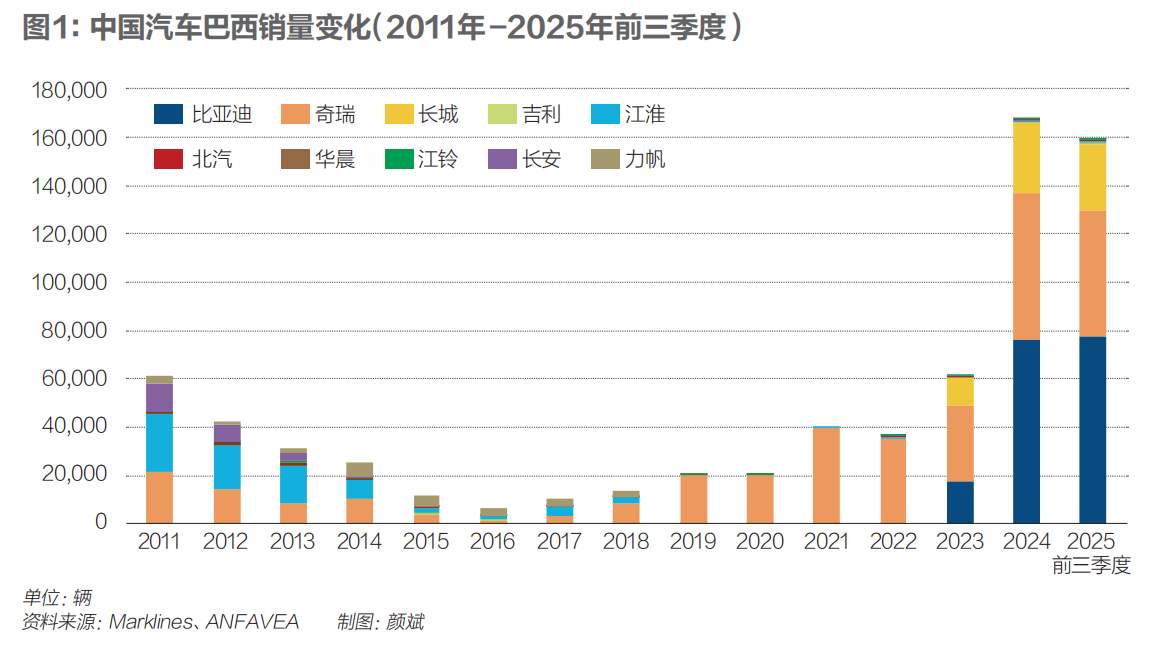
中国车企深入巴西腹地
Cai Jing Wang· 2026-01-06 13:38
Core Insights - Chinese automotive brands are rapidly establishing a foothold in the Brazilian market, with nearly 40% representation at the São Paulo International Motor Show, showcasing a significant shift in market dynamics [1][3] - The success of Chinese companies in Brazil hinges on their ability to localize supply chains and enhance after-sales services, addressing past shortcomings [1][4] Group 1: Market Presence and Strategy - The São Paulo International Motor Show marked a collective appearance of Chinese brands, with notable participation from companies like BYD, Great Wall, and Chery, indicating a strong market presence [1][2] - Chinese brands are adopting high pricing strategies, with BYD's Tang L model priced at 399,900 reais (approximately 530,000 RMB), reflecting a shift towards the premium segment [1] - The overall market share of Chinese automotive companies in Brazil has surpassed 10%, establishing them as emerging players in the local automotive industry [3] Group 2: Historical Context and Evolution - The journey of Chinese automotive companies in Brazil can be divided into distinct phases: the initial wave from 2009 to 2014, a rebuilding phase from 2015 to 2020, and a resurgence starting in 2021 [7] - The first wave (2009-2014) was characterized by low-cost strategies and heavy marketing, but faced challenges due to a lack of localization and subsequent government policies that increased import taxes on non-localized vehicles [8][11] - The second phase saw companies like Chery pivoting to local partnerships, which helped improve brand perception and sales, with CAOA Chery achieving a 122% sales increase by 2018 [12] Group 3: Technological and Market Adaptation - The current wave (2021 onwards) is marked by significant capital investment and a focus on local production, with companies like Great Wall acquiring existing factories to establish a manufacturing base [13] - Chinese companies are leveraging advanced technologies in electric and hybrid vehicles, with BYD and Great Wall forming a duopoly in the Brazilian new energy vehicle market [14][20] - The adaptation to local market conditions includes developing vehicles that cater to Brazil's unique energy structure, particularly the prevalence of ethanol as a fuel source [27][28] Group 4: Challenges and Opportunities - The Brazilian automotive market presents challenges such as a highly unequal income distribution and specific consumer preferences for smaller vehicles due to parking constraints [23][24] - Chinese brands are addressing these challenges by offering compact, technologically advanced vehicles that appeal to middle-class consumers, moving away from the low-cost strategy of the past [25] - The Brazilian government's "MOVER" plan aims to stimulate local investment in high-efficiency vehicles, providing a framework for Chinese companies to align their strategies with national goals [29][32] Group 5: Future Outlook - The success of Chinese automotive companies in Brazil will depend on their ability to integrate technology transfer, deepen local market engagement, and enhance supply chain capabilities [33] - The potential for Chinese brands to act as a catalyst for innovation in the Brazilian automotive sector is recognized by the government, which seeks to leverage their presence for broader industrial upgrades [19][32]