PSBC(601658)

Search documents
中国邮政集团湖北省分公司总经理姚杰被查
Xin Lang Cai Jing· 2025-11-19 07:21
责任编辑:刘万里 SF014 中央纪委国家监委网站11月19日通报,据中央纪委国家监委驻中国邮政集团有限公司纪检监察组、湖北 省纪委监委消息:中国邮政集团有限公司湖北省分公司党委书记、总经理姚杰涉嫌严重违纪违法,目前 正接受中央纪委国家监委驻中国邮政集团有限公司纪检监察组纪律审查和湖北省监委监察调查。 ...

区域银行频获增持,银行ETF天弘(515290)规模近62亿元,机构:银行营收端增速有望持续改善
2 1 Shi Ji Jing Ji Bao Dao· 2025-11-19 03:31
Group 1 - The A-share market showed a positive trend on November 19, with the banking index rising by 0.93% [1] - The Tianhong Bank ETF (515290) recorded a trading volume exceeding 35 million yuan, indicating strong investor interest [1] - Major banks such as Bank of China, Everbright Bank, and Postal Savings Bank saw their stock prices increase by over 2% [1] Group 2 - As of November 18, the Tianhong Bank ETF had a total scale of nearly 6.2 billion yuan, covering 42 listed banks across various categories [2] - There has been significant insider buying in regional banks this year, with several banks announcing plans for share buybacks in November [2] - Securities firms noted that the profit growth rate for listed banks improved in Q3, driven by reduced provisioning, stabilized net interest margins, and improved wealth management income [2]





又有银行股创新高!中国银行涨近3%创历史新高
Ge Long Hui A P P· 2025-11-19 02:34
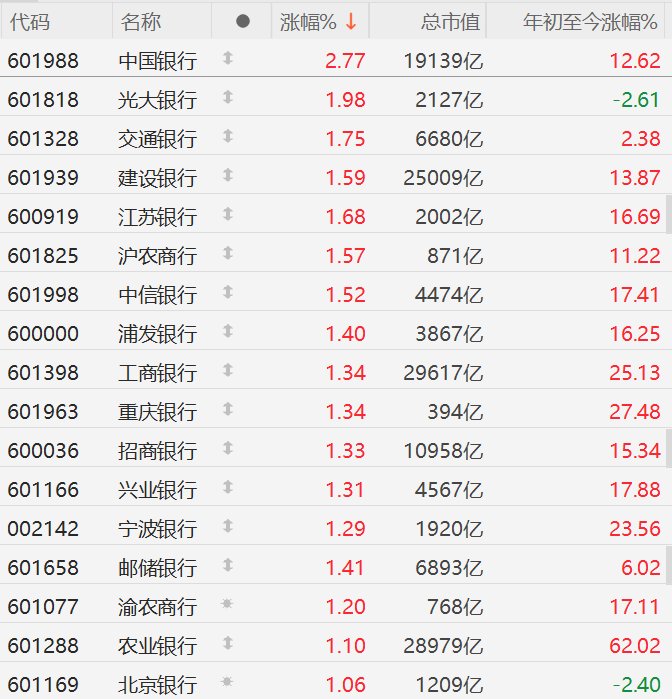
Core Insights - The A-share market saw a collective rise in bank stocks, with notable increases in China Bank, which rose nearly 3%, and other banks like Everbright Bank, Bank of Communications, and Agricultural Bank of China also showing gains of over 1% [1] Summary by Category Stock Performance - China Bank increased by 2.77%, reaching a total market capitalization of 191.39 billion, with a year-to-date increase of 12.62% [2] - Everbright Bank rose by 1.98%, with a market cap of 21.27 billion and a year-to-date decline of 2.61% [2] - Bank of Communications saw a 1.75% increase, with a market cap of 66.80 billion and a year-to-date increase of 2.38% [2] - Agricultural Bank of China increased by 1.10%, with a market cap of 289.79 billion and a year-to-date increase of 62.02% [2] - Other banks such as Construction Bank, Jiangsu Bank, and Industrial and Commercial Bank of China also reported gains, with year-to-date increases ranging from 15.34% to 25.13% [2] Historical Performance - China Bank reached a new historical high, following similar achievements by Agricultural Bank and Industrial and Commercial Bank [1]


年内133家公司实施定增,合计募资8397.72亿元
Zheng Quan Shi Bao Wang· 2025-11-19 01:55
Core Points - A total of 133 companies have implemented private placements this year, raising a total of 839.77 billion yuan [1] - The companies involved in private placements span across 24 industries, with the most active sectors being electronics, power equipment, and basic chemicals [1] - The largest fundraising amounts were recorded in the banking sector, with China Bank leading at 165 billion yuan [2] Group 1: Fundraising Overview - 133 companies have conducted private placements, with a total of 1,060.52 million shares issued and a cumulative fundraising amount of 839.77 billion yuan [1] - The distribution of fundraising by market shows that the Shanghai main board raised 706.55 billion yuan, while the Shenzhen main board raised 489.93 billion yuan [1] - The number of companies that raised over 100 billion yuan is 10, while 11 companies raised between 50 billion and 100 billion yuan [1] Group 2: Industry Analysis - The banking sector has the highest fundraising amounts, with China Bank raising 165 billion yuan, followed by Postal Savings Bank at 130 billion yuan and Bank of Communications at 120 billion yuan [2] - The electronics industry had 21 companies participating in private placements, while the power equipment sector had 16 companies [1] - The top three industries by fundraising amount are banking (520 billion yuan), non-bank financials (506.84 billion yuan), and electronics (491.56 billion yuan) [1] Group 3: Price Performance - There are 133 records where the latest closing price exceeds the placement price, with the highest premium recorded by AVIC Aircraft at 877.35% [2][3] - The records showing a discount to the placement price include 13 instances, with the largest discount from Shen High-Speed at -22.14% [2][4] - The average premium and discount rates indicate significant price movements post-placement, reflecting market sentiment and investor confidence [2][4]

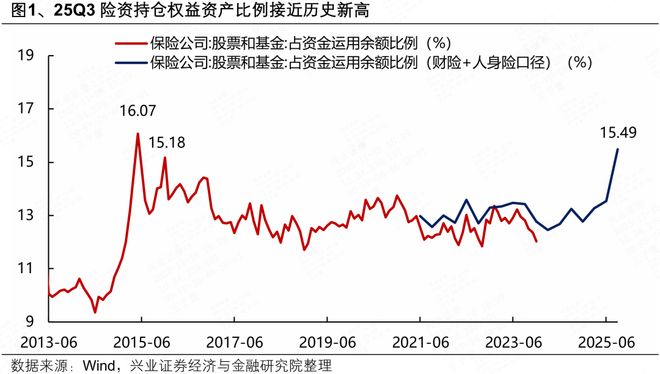
25Q3险资持仓权益比例接近历史新高
Ge Long Hui· 2025-11-18 12:13
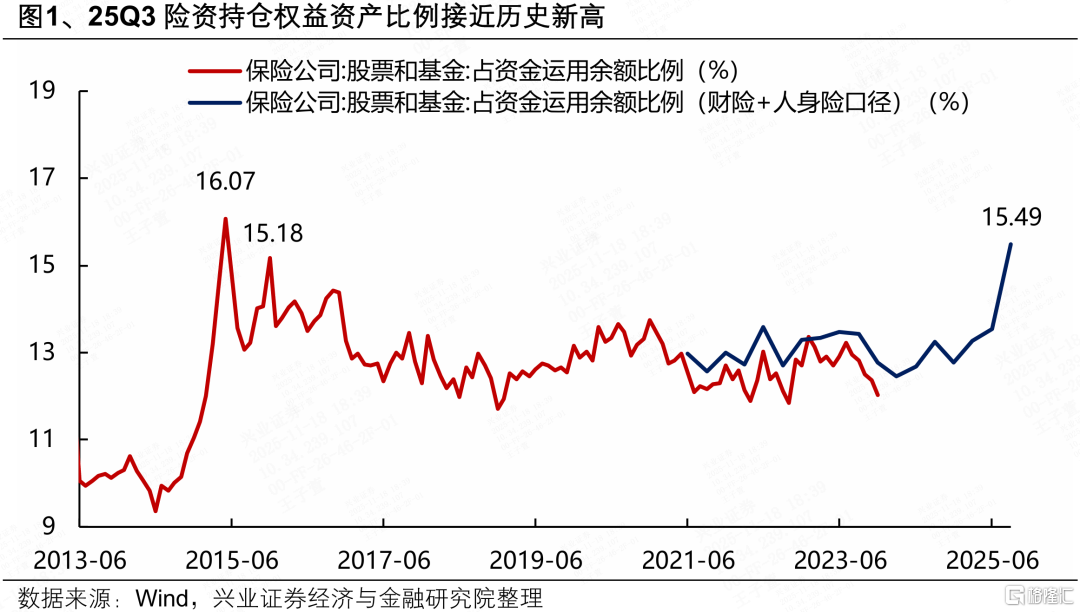
Core Insights - In Q3 2025, insurance capital significantly increased its allocation to equity assets, with the proportion of equity assets approaching historical highs [1][4] - The investment distribution of insurance capital in Q3 2025 included 7.9% in bank deposits, 50.3% in bonds, 10.0% in stocks, 5.5% in funds, 7.9% in long-term equity investments, and 18.4% in other assets [1] - The investment in bank deposits and bonds decreased by 0.7 percentage points and 0.8 percentage points respectively compared to Q2 2025, while the investment in stocks and funds surged to 15.5%, nearing the historical peak of 16.1% in H1 2015 [1] Investment Trends - In Q3 2025, insurance capital continued to increase its allocation to dividend-paying stocks, particularly in the TMT (Technology, Media, and Telecommunications) and high-end manufacturing sectors, while adjusting its internal allocations [4] - The insurance capital significantly increased its holdings in banks, steel, and textile sectors, while reducing positions in high-end manufacturing sectors such as new energy, military, and machinery [4] - The overall trend showed that the dividend yield remained a crucial reference for insurance capital's stock selection, with a decreasing trend in dividend yield from increased to reduced holdings [4] Stock Specifics - The top stocks added by insurance capital in Q3 2025 included Agricultural Bank of China (329.1 billion), Postal Savings Bank (125.9 billion), and Industrial and Commercial Bank of China (57.4 billion) [7] - Conversely, the top stocks reduced included GCL-Poly Energy (7.0 billion), Wan Feng Auto (7.1 billion), and Aero Engine Corporation of China (7.6 billion) [7] Shareholding Activities - Insurance capital's shareholding activities accelerated in Q3 2025, with a notable increase in the number of companies targeted, particularly in Hong Kong stocks [9] - As of now, insurance capital has made 30 shareholding increases this year, surpassing the total for 2020 and 2024, with 25 of these being in Hong Kong stocks [9][11]



【兴证策略】25Q3险资持仓权益比例接近历史新高
Xin Lang Cai Jing· 2025-11-18 11:57
Core Insights - Insurance capital continues to increase its allocation to equity assets, with the proportion of equity assets reaching near historical highs in Q3 2025 [1] - The allocation structure shows a significant increase in technology and a reduction in high-end manufacturing sectors [5][6] - Insurance capital has accelerated its stake acquisitions in listed companies, particularly in Hong Kong stocks, with a notable increase in the number of acquisitions compared to previous years [9] Allocation Trends - In Q3 2025, the allocation of insurance capital to various asset classes is as follows: bank deposits (7.9%), bonds (50.3%), stocks (10.0%), funds (5.5%), long-term equity investments (7.9%), and other assets (18.4%) [1] - The investment proportions in bank deposits and bonds decreased by 0.7 percentage points and 0.8 percentage points, respectively, while the investment in stocks and funds surged to 15.5%, approaching the historical peak of 16.1% in H1 2015 [1] Sector and Stock Preferences - Insurance capital has significantly increased its allocation to banks, steel, and textile sectors, while reducing holdings in high-end manufacturing sectors such as new energy and military [5] - Key stocks that saw increased investment include Agricultural Bank of China, Postal Savings Bank, Industrial and Commercial Bank of China, and Hikvision, while reductions were noted in stocks like Goldwind Technology and Aviation Industry Corporation of China [6][8] Shareholding Activities - In 2025, insurance capital has made 30 stake acquisitions in listed companies, surpassing the total for the entire years of 2020 and 2024, with 25 of these acquisitions in Hong Kong stocks [9] - The trend indicates a shift towards acquiring dividend-yielding assets in Hong Kong due to declining bond yields and rising traditional dividend assets [9]


河南南阳卧龙区:快递进村加速度 城乡流通活起来
Zhong Guo Jing Ji Wang· 2025-11-18 11:36
Core Insights - The logistics hub in Nanyang, Henan Province, has attracted 16 leading logistics companies, including China Post and Muyuan Logistics, with over 400,000 packages dispatched daily [1] - The "Hub Economy" strategy aims to enhance logistics infrastructure and services, focusing on international, cold chain, and e-commerce logistics [1] - The establishment of regional public distribution centers and village-level service stations is improving logistics efficiency and accessibility in rural areas [2] Group 1 - The Nanyang Yuzhi Haiyuan Supply Chain Management Company reports a bustling logistics environment with packages being sorted and dispatched rapidly [1] - The "Hub + Logistics + Channel" infrastructure system is being developed to facilitate the efficient movement of goods between urban and rural areas [1] - A new regional logistics distribution center is being constructed on a 30-acre site to support the integration of major express delivery companies [1] Group 2 - Nine regional public distribution service centers are being planned to enhance the logistics network in surrounding towns, with two centers already operational [2] - The operational centers have successfully integrated services from major brands like China Post and YTO Express, handling over 600,000 packages daily [2] - The establishment of 165 village-level comprehensive service stations is aimed at improving rural logistics services and accessibility for residents [2]

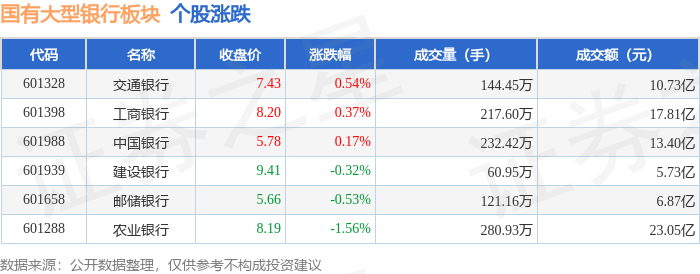
国有大型银行板块11月18日跌0.48%,农业银行领跌,主力资金净流出3.05亿元
Zheng Xing Xing Ye Ri Bao· 2025-11-18 08:11
Core Viewpoint - The state-owned large bank sector experienced a decline of 0.48% on November 18, with Agricultural Bank leading the drop. The Shanghai Composite Index closed at 3939.81, down 0.81%, while the Shenzhen Component Index closed at 13080.49, down 0.92% [1] Summary by Category Stock Performance - The closing prices and performance of major state-owned banks are as follows: - Bank of Communications (601328): Closed at 7.43, up 0.54%, with a trading volume of 1.4445 million shares and a turnover of 1.073 billion yuan - Industrial and Commercial Bank of China (601398): Closed at 8.20, up 0.37%, with a trading volume of 2.176 million shares and a turnover of 1.781 billion yuan - Bank of China (601988): Closed at 5.78, up 0.17%, with a trading volume of 2.3242 million shares and a turnover of 1.340 billion yuan - China Construction Bank (601939): Closed at 9.41, down 0.32%, with a trading volume of 609,500 shares and a turnover of 573 million yuan - Postal Savings Bank of China (601658): Closed at 5.66, down 0.53%, with a trading volume of 1.2116 million shares and a turnover of 687 million yuan - Agricultural Bank of China (601288): Closed at 8.19, down 1.56%, with a trading volume of 2.8093 million shares and a turnover of 2.305 billion yuan [1] Capital Flow - The net capital flow for the state-owned large bank sector showed a net outflow of 305 million yuan from main funds, while retail funds saw a net inflow of 257 million yuan and speculative funds had a net inflow of 48.0376 million yuan [1]
“AI+金融”系列专题研究(一):行业拐点已至,金融是AI应用落地的绝佳“试验田”
Haitong Securities International· 2025-11-18 07:25
Investment Rating - The report suggests a positive investment outlook for the financial industry, highlighting its strong alignment with AI application and digital transformation needs [3][7]. Core Insights - The financial industry is identified as an ideal "testing ground" for AI applications due to its data-intensive nature and the increasing demand for digital transformation [1][7]. - The release of DeepSeek R1 in 2025 is anticipated to be a pivotal moment for local AI deployment in financial institutions, enhancing model reasoning capabilities and reducing costs [3][7]. - AI applications are rapidly penetrating core business areas and back-office functions within various financial institutions, with the potential to reshape business processes and organizational structures [3][7]. Summary by Sections Investment Recommendations - The report emphasizes the financial sector's need for digital transformation, which aligns well with the characteristics of large models in AI. It predicts a shift from "digital intelligence" to "artificial intelligence" in financial institutions [7]. - Key areas to focus on include: 1. Financial information services with relevant companies like Tonghuashun, Jiufang Zhitu Holdings, and Guiding Compass [8]. 2. Third-party payment services, particularly New大陆 and New国都, with related companies like Lakala [9]. 3. Bank IT, focusing on companies such as Yuxin Technology, Jingbeifang, and Guodian Yuntong [9]. 4. Securities IT, with a focus on companies like Hengsheng Electronics and Jinzhen Shares [10]. 5. Insurance IT, highlighting companies like Newzhisoft and Zhongke Soft [11]. Industry Drivers and Policy Support - The report discusses the strong internal and external drivers for AI application in finance, including the continuous expansion of IT spending by financial institutions and supportive government policies [14][25]. - The maturity of large model technology and its alignment with the financial industry's needs are emphasized, indicating a shift towards industry adaptation [14][18]. Technical Aspects - The report outlines two main technical paths for AI integration in finance: general models trained with financial data and specialized financial models [36]. - DeepSeek R1 is highlighted as a significant advancement in AI deployment for financial institutions, offering enhanced reasoning capabilities and cost efficiency [45][52]. - The report notes that the performance of DeepSeek R1 has improved significantly, with accuracy rates in complex reasoning tasks rising from 70% to 87.5% after updates [48]. Market Trends - The financial sector's technology investment is projected to grow significantly, with a total expected investment of 650 billion yuan by 2028, reflecting a compound annual growth rate of approximately 13.3% [25][31]. - The report indicates a notable increase in AI-related procurement projects within the financial sector, with 133 large model projects initiated in 2024 alone [27][35].




美好正发生,“邮”你趣打卡!邮储银行青岛分行跨界打造城市文旅新场景
Xin Lang Cai Jing· 2025-11-18 06:07
Core Insights - Postal Savings Bank of China successfully held a cultural interaction event in Qingdao, integrating finance, culture, and commerce to enhance urban leisure experiences [1][3][5] Group 1: Event Overview - The event took place from November 15 to 17, attracting significant participation from citizens and tourists [1] - Various performances, including choir and dance, created a vibrant atmosphere, with interactive segments engaging the audience [3] Group 2: Financial Engagement - Postal Savings Bank offered interactive activities such as credit card sign-up gifts and savings card demonstrations, making financial services more engaging for the public [3][5] - The bank's initiatives helped bridge the gap between financial services and the community, enhancing customer relations [3] Group 3: Consumer Benefits - The collaboration with over ten local merchants provided consumers with discounts and benefits, boosting both customer traffic and sales for participating businesses [5] - The event demonstrated a successful model of "finance + culture + commerce," benefiting consumers, merchants, and the local economy [5]