
PETROCHINA(601857)

Search documents
中国石油申请钝化后镍系加氢催化剂专利,可实现初活性“缓释”
Sou Hu Cai Jing· 2026-01-14 12:22
Group 1 - The core point of the article is that China National Petroleum Corporation (CNPC) has applied for a patent for a "passivated nickel-based hydrogenation catalyst and its preparation method and application," indicating innovation in catalyst technology [1] - The patent application was filed on July 2024, with the publication number CN121314697A [1] - The passivated nickel-based hydrogenation catalyst includes a reduced nickel-based catalyst, a first passivating agent occupying part of the pore channels, and a protective layer formed by a second passivating agent on the catalyst surface [1] Group 2 - The first passivating agent consists of high melting point wax, while the second passivating agent contains low melting point wax, with their respective contents being 0.5-15% and 0.1-5% of the total weight of the catalyst [1] - The mechanical strength of the catalyst is improved through passivation, reducing risks during storage and transportation, and allowing for a "slow release" of initial activity during use [1] - The preparation method of the catalyst is characterized by controllable passivation levels, direct feed operation, and shortened startup periods [1] Group 3 - CNPC was established in 1999 and is primarily engaged in oil and gas extraction, with a registered capital of 18,302,097,000 RMB [2] - The company has invested in 1,296 enterprises and participated in 443 bidding projects, holding 38 trademark records and 5,000 patent records [2] - Additionally, CNPC possesses 168 administrative licenses [2]

中国石油申请烃源岩类型识别方法及系统专利,提供一种识别客观、识别效率高、判对准确的识别方法
Sou Hu Cai Jing· 2026-01-14 11:35
Group 1 - The core viewpoint of the news is that China National Petroleum Corporation (CNPC) has applied for a patent for a method and system for identifying hydrocarbon source rock types, aimed at improving the efficiency and accuracy of hydrocarbon exploration and development [1] Group 2 - The patent application, published as CN121324614A, was filed on July 2024 and addresses the limitations of existing methods that are heavily influenced by human subjectivity and have low identification efficiency and accuracy [1] - The proposed method involves analyzing the correlation of various parameters of hydrocarbon source rock samples and classifying them into different types through a hierarchical merging approach [1] - Different identification models for various types of hydrocarbon source rocks will be established based on the parameter data of these samples, allowing for efficient classification of unidentified samples [1] Group 3 - CNPC, established in 1999 and headquartered in Beijing, primarily engages in oil and gas extraction, with a registered capital of 18,302,097,000 RMB [2] - The company has invested in 1,296 enterprises and participated in 443 bidding projects, holding 38 trademark records and 5,000 patent records, along with 168 administrative licenses [2]
炼化及贸易板块1月14日跌1.02%,中国石油领跌,主力资金净流出4.41亿元
Sou Hu Cai Jing· 2026-01-14 08:57
Group 1 - The core viewpoint of the article indicates that the refining and trading sector experienced a decline of 1.02% on January 14, with China Petroleum leading the drop [1] - The Shanghai Composite Index closed at 4126.09, down 0.31%, while the Shenzhen Component Index closed at 14248.6, up 0.56% [1] - The main capital flow in the refining and trading sector showed a net outflow of 441 million yuan, while speculative funds had a net inflow of 448 million yuan, and retail investors experienced a net outflow of 6.8698 million yuan [1] Group 2 - The article provides a summary of the capital flow for individual stocks within the refining and trading sector, indicating varied performance among different stocks [1]


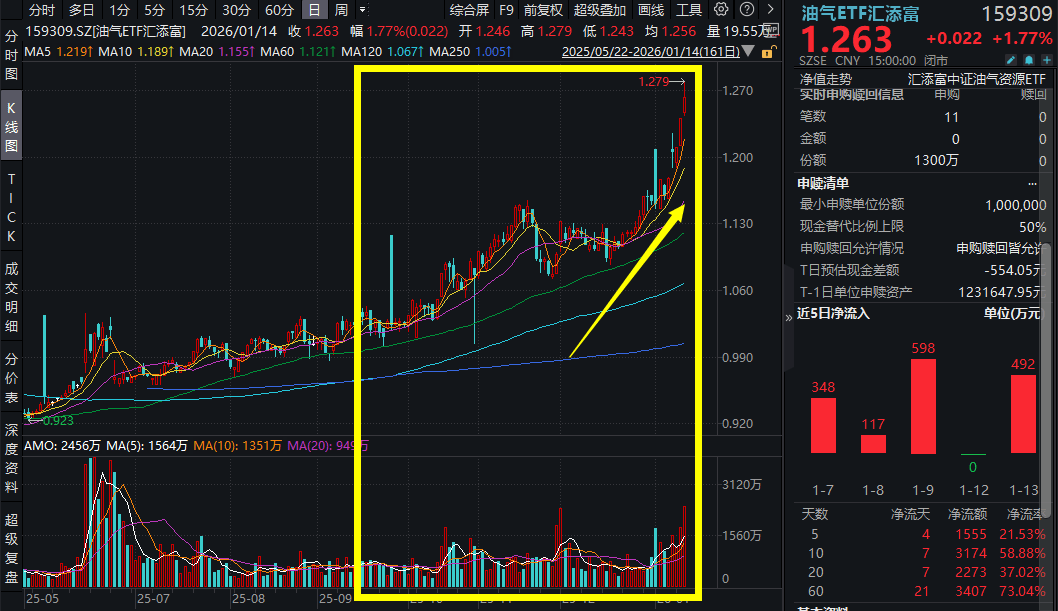
油价连续上攻,洲际油气涨停,油气ETF汇添富(159309)喜提五连涨,强势吸金超1600万元!解密商品超级周期轮动规律,接下来是石油了?
Sou Hu Cai Jing· 2026-01-14 08:44
Core Viewpoint - The A-share market experienced fluctuations with the Shanghai Composite Index rising and then retreating, while the oil and gas sector showed strong performance, particularly the oil and gas ETF Huatai-PineBridge (159309), which achieved a five-day consecutive increase and reached a historical high [1][3]. Group 1: Market Performance - The total trading volume in the two markets approached 4 trillion yuan, setting a new historical record [1]. - The oil and gas ETF Huatai-PineBridge (159309) saw a net inflow of over 16 million yuan for the day, accumulating more than 20 million yuan in the last two days [1]. Group 2: Sector Analysis - The majority of the index component stocks for the oil and gas ETF saw price increases, with notable performances including a limit-up for Jerry Holdings and over 4% increase for Continental Oil [3]. - The main oil contracts, including West Texas Intermediate (WTI) and Brent crude, rose by 2.69% and 2.43%, respectively, due to concerns over oil supply amid regional tensions [5]. Group 3: Commodity Market Insights - The commodity market is experiencing a strong trend, with precious and industrial metals reaching new highs, indicating a potential super cycle for commodities driven by economic conditions [5][6]. - Historical patterns during economic downturns suggest that oil prices may rise following increases in gold and industrial metals, with oil being influenced by geopolitical factors [7][8]. Group 4: Strategic Outlook - The oil and gas sector is highlighted as having long-term investment value, with the oil and gas ETF Huatai-PineBridge focusing on the upstream and downstream of the oil and gas industry [8]. - The current low levels of strategic oil reserves in the U.S. and OECD countries, combined with rising commodity ratios, suggest that oil prices are undervalued relative to other commodities [7].



AI赋能油气勘探开发
Ren Min Ri Bao Hai Wai Ban· 2026-01-14 08:13
Core Viewpoint - The oil and gas industry must transition from a hypothesis-driven approach to a data-driven approach, especially in the context of advancements in artificial intelligence (AI) which is seen as a transformative force in the industry [1][9]. Group 1: Hypothesis-Driven vs. Data-Driven Approaches - Hypothesis-driven methodology relies on existing knowledge and theories to formulate assumptions, which are then tested through various forms of data collection and analysis [2]. - The advantages of hypothesis-driven approaches include clear direction and focus on specific problems, while the disadvantages involve potential biases from initial assumptions [2]. - Data-driven approaches emphasize the use of data to uncover patterns and insights, utilizing statistical analysis and machine learning, which can lead to more objective findings [3]. - The integration of AI technologies enhances the data-driven approach, allowing for significant advancements in the oil and gas sector [3]. Group 2: Historical Context and Evolution - Early oil and gas discoveries were primarily based on intuition and experience, with significant historical examples such as the first commercial oil well drilled by Edwin Drake in 1859 [5]. - The development of geological theories in the mid-19th century laid the groundwork for large-scale oil discoveries, demonstrating the effectiveness of hypothesis-driven exploration [6]. - Recent advancements in data-driven methodologies, such as the GeoGPT model, signify a shift towards integrating AI in geological research, enhancing the efficiency of oil and gas exploration [7]. Group 3: Future Implications and Industry Transformation - The oil and gas industry is witnessing a paradigm shift towards data-driven management, which is expected to significantly improve operational efficiency and decision-making processes [9]. - The potential for AI to revolutionize the industry includes enhancing resource discovery, increasing recovery rates, and integrating with renewable energy sources [10]. - Companies are encouraged to embrace the "AI + oil and gas" era, adapting to new technologies and methodologies to remain competitive and sustainable [10].
中国石油东方物探:数智破解地下“油气密码”AI赋能物探领域转型新生态
Xin Hua Wang· 2026-01-14 08:13
Core Viewpoint - The article highlights the advancements made by China National Petroleum Corporation's GeoEast in digital exploration technology, emphasizing the integration of innovative software and high-performance computing to enhance oil and gas exploration efficiency and accuracy [1][2][4]. Group 1: Technological Advancements - GeoEast has developed an integrated seismic data processing and interpretation software, which has evolved from version 1.0 to 4.4, significantly improving work efficiency and addressing various exploration challenges [2][3]. - The software is widely used across eight domestic basins, covering over 460,000 km², and has been successfully implemented in over 40 countries and regions internationally [3]. Group 2: High-Performance Computing - The establishment of Asia's largest computing and data storage center by GeoEast provides robust support for large-scale seismic data processing, enabling efficient project execution [4]. - The center has achieved a computing capacity of 16.1 Pflops and a storage capacity of 90 PB, facilitating the rapid processing of seismic data across various projects [4]. Group 3: Equipment Innovation - The introduction of advanced equipment such as the EV-80 controlled source and eSeisNeo node seismometers has transformed seismic data collection into a more digital, automated, and intelligent process, enhancing exploration accuracy and efficiency [5][6]. - Notable achievements include the KOC three-dimensional exploration project in Kuwait, which set a record with 234,000 production lines, and a project in Oman that increased daily efficiency from 10,000 to 55,000 shots, maintaining the highest safety record in the industry [6]. Group 4: Future Directions - GeoEast aims to continue its digital transformation and develop revolutionary exploration technologies to contribute to national energy security and global energy cooperation [6].
“十四五”时期,中国首口超万米科探井完钻,成为亚洲第一、世界第二垂直深度井——掘进地下万米
Ren Min Ri Bao Hai Wai Ban· 2026-01-14 08:13
Core Viewpoint - The successful completion of China's first 10,000-meter scientific exploration well, the Deep Taka 1 Well, marks a significant milestone in deep earth engineering, enhancing national energy security and showcasing advancements in drilling technology and geological understanding [1][6][12]. Group 1: Drilling Achievements - The Deep Taka 1 Well reached a depth of 10,910 meters, setting five drilling records, including the fastest completion of a 10,000-meter well on land and the deepest tailpipe cementing [2][5]. - The well is located in the Tarim Basin, where depths exceeding 9,000 meters are classified as ultra-deep wells, presenting significant challenges akin to standing atop Mount Everest and looking down at the Yarlung Tsangpo River [3][4]. Group 2: Technical Challenges - The drilling faced extreme environmental conditions, with temperatures ranging from over 50 degrees Celsius in summer to nearly -30 degrees Celsius in winter, complicating operations [3]. - The well encountered complex geological formations, requiring frequent adjustments to drilling techniques and equipment due to rapid changes in rock properties at depth [4][8]. Group 3: Technological Innovations - The project utilized a self-developed 12,000-meter automated drilling rig capable of lifting 900 tons, significantly enhancing operational efficiency and reducing manual labor by over 80% [8][9]. - Advanced drilling technologies, including high-temperature resistant drilling fluids and specialized drill bits, were developed to meet the unique challenges of ultra-deep drilling [8][9]. Group 4: Geological Insights - The successful drilling provided valuable geological data from depths previously unexplored, confirming the potential for oil and gas resources in the Tarim Basin, which is recognized as a major oil and gas reservoir in China [6][10]. - The exploration of deep geological formations will contribute to understanding ancient environmental conditions and the evolution of sedimentary basins, aiding in broader scientific research [11]. Group 5: Strategic Importance - The advancement in deep drilling technology is crucial for China's energy security, as the country relies heavily on oil and gas imports, with significant resources located in deeper geological layers [10]. - The successful completion of the well signifies a shift from occasional breakthroughs in deep drilling to more routine operations, reflecting China's commitment to enhancing its capabilities in this critical area [12][13].
“我为祖国献石油”——一场七十五年的深情奔赴
Xin Hua Wang· 2026-01-14 08:13
Core Viewpoint - The development of China's oil industry is closely intertwined with the country's economic growth and energy security, showcasing a historical journey of dedication and innovation over 75 years [1][4][15]. Group 1: Historical Development - In the early years of New China, domestic production of gasoline and diesel was less than 10% of demand, leading to a heavy reliance on imports [3]. - The Daqing Oilfield campaign in the late 20th century marked a significant turning point, establishing a production base with an annual capacity of 6 million tons within three years [3]. - Subsequent oilfield campaigns expanded China's oil production landscape, with numerous oilfields and pipelines developed across the country [3]. Group 2: Current Achievements - China has achieved a production capacity of 100 million tons for both crude oil and natural gas, alongside overseas oil and gas equity production [4]. - Domestic oil and gas production accounts for approximately half and two-thirds of national output, respectively, with significant contributions from major oilfields like Daqing and Changqing [4]. - The company has maintained a steady production rate, with Daqing Oilfield surpassing 2.5 billion tons of cumulative crude oil production [4]. Group 3: Reform and Innovation - Reform has been a core driving force for the company, with significant changes initiated post-1978, including the establishment of an integrated upstream and downstream structure [6]. - The company has embraced market-oriented reforms and technological innovations, leading to the discovery of multiple billion-ton oilfields and consistent double-digit growth in natural gas production [6]. - The company has expanded its global footprint, operating in over 30 countries and establishing a comprehensive oil and gas cooperation network [7]. Group 4: Technological Advancements - The company has focused on technological self-reliance and innovation, achieving breakthroughs in shale oil and deep-water exploration [10]. - Significant advancements include the successful production of over 1.5 million tons of shale oil annually and the discovery of several billion-ton oilfields [10]. - The company has developed a comprehensive digital transformation strategy, enhancing operational efficiency and decision-making through advanced data systems [11]. Group 5: Social Responsibility - The company actively participates in national development and social welfare, contributing to poverty alleviation and rural revitalization efforts [13]. - Initiatives include building infrastructure and supporting local industries, significantly benefiting communities and enhancing local economies [13]. - The company has committed to green development, improving fuel quality and investing in clean energy technologies [14].
石化化工行业AI+进展点评:政策指引推动AI+转型,三大路径驱动化工企业智能化落地
EBSCN· 2026-01-14 06:22
Investment Rating - The report maintains an "Overweight" rating for the basic chemical industry [1] Core Insights - The chemical and new materials industry is set to drive the comprehensive "AI + manufacturing" transformation, as outlined in the State Council's policy document released in August 2025, which aims for deep integration of AI across six key sectors by 2027 [3][4] - The focus for the petrochemical industry is on "quality improvement and efficiency enhancement" through AI, utilizing large models and digital twin technologies to optimize various processes [5] - The report identifies three main pathways for chemical companies to implement AI: self-developed large models, third-party model integration, and investment in AI startups [13][14] Summary by Sections Policy Guidance - The State Council's document emphasizes the necessity for AI integration in the chemical industry, marking it as a compulsory aspect for achieving high-quality development [3] - The Ministry of Industry and Information Technology's implementation opinions further detail goals for AI technology and its application in manufacturing by 2027 [4] AI Empowerment in Petrochemical Industry - AI's role in the petrochemical sector focuses on enhancing operational efficiency and safety through predictive maintenance and process optimization [5] - The establishment of high-quality data sets and infrastructure is crucial for supporting AI applications in the industry [5] AI Empowerment in New Materials Industry - The new materials sector aims to leverage AI for deep integration in research and development, enhancing capabilities in material design and synthesis [5] Implementation Pathways - **Self-Developed Large Models**: Companies like China National Petroleum Corporation (CNPC) and China National Offshore Oil Corporation (CNOOC) are developing proprietary AI models to enhance their operational capabilities [9][10] - **Third-Party Model Integration**: WanHua Chemical collaborates with Huawei Cloud to implement AI solutions for predictive maintenance and operational efficiency [11] - **Investment in AI Startups**: Companies like Qicai Chemical are investing in AI startups to accelerate innovation in materials science [12][13] Investment Recommendations - The report suggests focusing on leading companies that excel in data utilization and AI integration, such as CNPC, Sinopec, and WanHua Chemical [14] - Attention is also drawn to companies involved in new materials and fine chemicals, which are expected to benefit significantly from AI-driven R&D advancements [14]

中国石油申请聚醚基础油及其制备方法和应用专利,该聚醚基础油具有优异的黏温性能
Sou Hu Cai Jing· 2026-01-14 04:13
Group 1 - The core point of the article is that China National Petroleum Corporation (CNPC) has applied for a patent for a new type of polyether base oil and its preparation method, indicating innovation in the oil and gas sector [1] - The patent application, published as CN121319355A, was filed on July 2024 and describes a polyether base oil produced through a melt polycondensation method [1] - The unique structure of the polyether ester includes alternating ether and diester bonds, which enhances its performance characteristics such as viscosity-temperature performance, oxidation resistance, rust prevention, and anti-wear properties [1] Group 2 - CNPC was established in 1999 and is primarily engaged in oil and natural gas extraction, with a registered capital of 18,302,097,000 RMB [1] - The company has made investments in 1,296 enterprises and participated in 443 bidding projects, showcasing its extensive involvement in the industry [1] - CNPC holds 38 trademark registrations and 5,000 patent records, along with 168 administrative licenses, reflecting its significant intellectual property portfolio [1]