
CHINA COAL ENERGY(601898)

Search documents
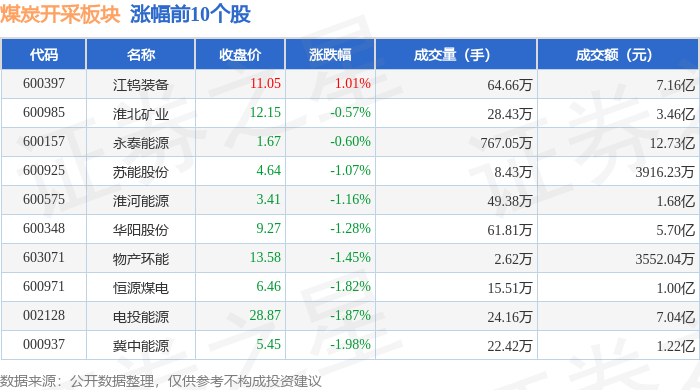
煤炭开采板块1月27日跌2.41%,大有能源领跌,主力资金净流出6.31亿元
Zheng Xing Xing Ye Ri Bao· 2026-01-27 08:56
Market Overview - The coal mining sector experienced a decline of 2.41% on January 27, with Dayou Energy leading the drop [1] - The Shanghai Composite Index closed at 4139.9, up 0.18%, while the Shenzhen Component Index closed at 14329.91, up 0.09% [1] Individual Stock Performance - Jiangte Equipment (600397) closed at 11.05, up 1.01% with a trading volume of 646,600 shares and a transaction value of 716 million [1] - Dayou Energy (600403) closed at 7.01, down 4.76% with a trading volume of 608,900 shares and a transaction value of 429 million [2] - Huabei Mining (600985) closed at 12.15, down 0.57% with a trading volume of 284,300 shares and a transaction value of 346 million [1] - Yongtai Energy (600157) closed at 1.67, down 0.60% with a trading volume of 7,670,500 shares and a transaction value of 1.273 billion [1] Capital Flow Analysis - The coal mining sector saw a net outflow of 631 million from institutional investors, while retail investors had a net inflow of 174 million [2] - Major stocks like Shaanxi Coal and Chemical (601225) had a net inflow of 25.7 million from institutional investors, but a net outflow of 64.4 million from retail investors [3] - Zhongmei Energy (601898) experienced a net inflow of 15.8 million from institutional investors, with a net outflow of 21.9 million from retail investors [3]




华源证券:均价回升煤企业绩或环比续增 供给政策持续煤价弹性可期
智通财经网· 2026-01-27 06:25
Core Viewpoint - The coal market is expected to see a recovery in performance in Q4 2025, driven by rising coal prices and a favorable supply-demand balance, with potential for a spring rally in Q1 2026 [1][7]. Price Trends - The average price of Qinhuangdao 5500 kcal thermal coal increased from 672 CNY/ton in Q3 2025 to 765 CNY/ton in Q4 2025, marking a 13.8% increase [3]. - In Q4 2025, the price fluctuated significantly, peaking at 834 CNY/ton before dropping to a low of 670 CNY/ton, yet still achieving a notable average increase [2]. Profitability Outlook - The profitability of coal companies is expected to improve, with thermal coal prices rising and coking coal prices also showing significant increases, particularly in long-term contracts [4]. - The average price for coking coal at Jing Tang Port rose to 1726 CNY/ton in Q4 2025, a 10.5% increase from Q3 [4]. Production Dynamics - The "overproduction check" policy has led to a mixed production performance among listed coal companies, with some reporting declines while others saw increases in output [5]. - Major coal producers like China Shenhua and China Coal Energy reported production decreases of 5.0% and 2.1% respectively, while Shaanxi Coal and Yanzhou Coal Energy reported increases of 3.6% and 1.0% [5]. Cost Management - Cost control remains a priority for coal companies, with strategies shifting from volume-driven to cost-focused approaches due to previous low coal prices [6]. - Despite a slight increase in costs expected in Q4 due to rising coal prices and year-end expense settlements, companies have managed to maintain a focus on cost efficiency [6]. Future Supply and Demand - The exit of certain coal supply capacities is anticipated to significantly improve the coal supply-demand balance, with a potential reduction of around 100 million tons if implemented nationwide [8]. - This policy aligns with previous market predictions and is expected to lead to a notable reduction in coal inventories, enhancing price elasticity in 2026 [8]. Investment Recommendations - Companies to watch include stable large-cap thermal coal firms such as China Shenhua, China Coal Energy, and Shaanxi Coal, as well as high-elasticity coal firms like Yanzhou Coal Energy and Jin Coal Industry [9].




25Q4煤炭行业基金持仓分析:基金持仓环比小幅提升,但仍处于较低水平
Guolian Minsheng Securities· 2026-01-26 15:03
Investment Rating - The report maintains a "Recommended" rating for the coal industry, indicating a positive outlook for the sector [2][3]. Core Insights - The report highlights a slight increase in fund holdings in the coal sector, with total market value rising to 6.874 billion yuan in Q4 2025, up 12.13% from Q3 2025, but still at a low level compared to historical data [9]. - The report notes that the coal sector's fund holding ratio is at its lowest in three years, suggesting low investment crowding in the sector [9]. - Key companies such as China Shenhua and Zhongmei Energy are favored by funds, with significant increases in holdings for Yancoal Energy and Shanxi Coal International [9]. - Short-term supply tightening and ongoing replenishment demand are expected to stabilize and potentially rebound coal prices, projected to fluctuate between 750-1000 yuan per ton [9]. - The report recommends focusing on companies with high spot market elasticity, such as Jinko Coal Industry and Shanxi Coal International, as well as industry leaders like China Shenhua and Shaanxi Coal Industry [9]. Summary by Sections Fund Holdings Analysis - Fund holdings in coal stocks increased to 6.874 billion yuan in Q4 2025, a 12.13% rise from Q3 2025, with a holding ratio of approximately 0.36% of total fund holdings [9]. - The report identifies the top five companies by fund holdings, including China Shenhua and Shaanxi Coal Industry, with notable increases in holdings for Yancoal Energy and Shanxi Coal International [9]. Price Outlook - The report anticipates that coal prices will stabilize and rebound due to supply constraints and replenishment needs, with a seasonal fluctuation expected between 750-1000 yuan per ton [9]. - The analysis indicates that the coal industry is likely to return to a state of basic supply-demand balance in 2023-2024, driven by production cuts and regulatory normalization [9].


中煤能源:公司在新疆区域以推进存量项目为主
Zheng Quan Ri Bao Wang· 2026-01-26 13:14
证券日报网讯1月26日,中煤能源(601898)在互动平台回答投资者提问时表示,目前,公司在新疆区 域以推进存量项目为主,区域业务占公司整体业务的比重较少。下一步,将以中国中煤在新疆区域的发 展和业务开拓为主,结合实际积极稳妥有序落实区域发展规划。 ...
——煤炭2025年四季度业绩前瞻:均价回升业绩或环比续增供给政策持续煤价弹性可期
Hua Yuan Zheng Quan· 2026-01-26 10:56
Investment Rating - The investment rating for the coal mining industry is "Positive" (maintained) [4] Core Insights - The "overproduction check" effect continues to push up the coal price center, with demand fluctuations causing rapid price changes. From July to December 2025, domestic raw coal production fell for six consecutive months year-on-year, significantly improving the coal supply-demand balance. The price of Qinhuangdao 5500 kcal thermal coal rose from 621 RMB/ton on June 30, 2025, to 689 RMB/ton on January 20, 2026. In Q4 2025, despite significant monthly fluctuations in coal demand, the average price of Qinhuangdao 5500 kcal thermal coal increased from 672 RMB/ton in Q3 to 765 RMB/ton in Q4, a rise of 13.8% [4][5] - The profitability of the sector is expected to rebound, with coking coal enterprises likely to see significant improvements. The average price of Qinhuangdao 5500 kcal thermal coal in Q4 2025 is reported at 765 RMB/ton, up 13.8% quarter-on-quarter. The long-term contract price for thermal coal also increased, with the average price for Q4 reported at 685 RMB/ton, up 2.3% [4][5] - Production levels are stable, with fluctuations among listed coal companies. The "overproduction check" policy strictly requires that annual production does not exceed announced capacity, impacting production levels in the second half of 2025. Major listed coal companies showed mixed production results in Q4, with China Shenhua and China Coal Energy reporting decreases of 5.0% and 2.1%, respectively, while Shaanxi Coal and Yanzhou Coal reported increases of 3.6% and 1.0% [4][5] - Cost control remains a key focus, although rising coal prices and year-end cost settlements may increase costs. In H1 2025, coal prices declined, prompting companies to shift from volume-based strategies to cost control. As coal prices rebound, costs are expected to rise slightly in Q4 compared to Q3 [4][5] - The sector's performance is expected to continue its positive trend into Q4 2025, with anticipated earnings growth. The coal price has shown a quarterly step-down trend, but Q4 2025 is expected to see a rebound in performance due to rising coal prices [4][5] Summary by Sections - **Performance of the Sector**: The average price of Qinhuangdao 5500 kcal thermal coal increased significantly in Q4 2025, indicating a recovery in the sector's profitability [4][5] - **Production and Supply**: The "overproduction check" policy has led to a decrease in production, stabilizing the supply-demand balance [4][5] - **Cost Management**: Companies are focusing on cost control, with expectations of slight increases in costs due to rising coal prices [4][5] - **Future Outlook**: The coal sector is expected to see continued performance improvement into 2026, driven by supply-side policy changes and price rebounds [4][5]
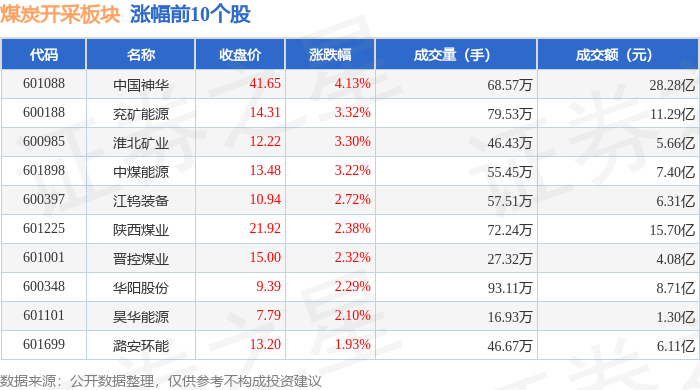
煤炭开采板块1月26日涨2.87%,中国神华领涨,主力资金净流入6.17亿元
Zheng Xing Xing Ye Ri Bao· 2026-01-26 09:41
Core Viewpoint - The coal mining sector experienced a rise of 2.87% on January 26, with China Shenhua leading the gains, while the overall Shanghai Composite Index fell by 0.09% and the Shenzhen Component Index decreased by 0.85% [1] Group 1: Stock Performance - China Shenhua closed at 41.65, up 4.13%, with a trading volume of 685,700 shares and a transaction value of 2.828 billion [1] - Other notable performers included Tuokun Energy, which rose by 3.32% to 14.31, and Huai Bei Mining, which increased by 3.30% to 12.22 [1] - The coal mining sector's stocks showed a mixed performance, with some stocks experiencing declines, such as Zhengmei Electric, which fell by 4.81% to 4.35 [2] Group 2: Capital Flow - The coal mining sector saw a net inflow of 617 million in main funds, while retail investors experienced a net outflow of 656 million [2] - Major stocks like China Shenhua had a net inflow of 239 million from main funds, but a significant outflow of 203 million from retail investors [3] - Shaanxi Coal and Energy also reported a net inflow of 152 million from main funds, indicating strong institutional interest despite retail selling pressure [3]
——煤炭行业周报(2026.1.17-2026.1.23):节前寒潮频繁扰动,有望支撑煤价反弹-20260126
Shenwan Hongyuan Securities· 2026-01-26 05:25
型及広 煤炭/ 煤炭开采 版费 行业 相关研究 近券研究报 证券分析师 严天鹏 A0230524090004 yantp@swsresearch.com 闫海 A0230519010004 yanhai@swsresearch.com 施佳瑜 A0230521040004 shijy@swsresearch.com 研究支持 施佳瑜 A0230521040004 shijy@swsresearch.com 联系人 施佳瑜 A0230521040004 shijy@swsresearch.com 2026 年 01 月 26 日 节前寒潮频繁扰动,有望支撑 委员 娱炭行业周报(2026.1.17-2026.1.23) 本期投资后了 ● 动力煤方面,截至 1 月 23 日,据中国煤炭市场网,秦皇岛港口 Q4500、Q5000、 Q5500动力煤现货价收报 514、599、685元/吨,环比-8、-9、-10 元/吨。供给端, 据中国煤炭市场网,环渤海四港区本周日均调入量 159.11 万吨,环比上周减少 0.6 万 吨,降幅 0.39%,同比下降 4.12%,产地生产正常,降雪对运输的影响已消除。需求 端,寒潮来 ...
中煤能源涨2.07%,成交额2.44亿元,主力资金净流入1532.72万元
Xin Lang Cai Jing· 2026-01-26 02:39
Group 1 - The core viewpoint of the news is that China Coal Energy Co., Ltd. has shown fluctuations in stock performance and financial metrics, with a notable decrease in revenue and net profit year-on-year [1][2][3] Group 2 - As of January 26, the stock price of China Coal Energy increased by 2.07% to 13.33 CNY per share, with a total market capitalization of 176.738 billion CNY [1] - The company has seen a year-to-date stock price increase of 7.15%, with a 1.83% increase over the last five trading days and a 4.96% increase over the last 20 days, while it has decreased by 3.41% over the last 60 days [1] - The company's main business segments include coal business (81.03% of revenue), coal chemical business (12.48%), and coal mining equipment manufacturing (6.24%) [1] Group 3 - For the period from January to September 2025, China Coal Energy reported operating revenue of 110.584 billion CNY, a year-on-year decrease of 21.24%, and a net profit attributable to shareholders of 12.485 billion CNY, down 14.57% year-on-year [2] - The company has distributed a total of 45.074 billion CNY in dividends since its A-share listing, with 21.386 billion CNY distributed in the last three years [3] Group 4 - As of October 31, the number of shareholders of China Coal Energy was 82,300, a decrease of 11.46% from the previous period, while the average number of circulating shares per person remained unchanged at 121,724 shares [2] - The top ten circulating shareholders include China Securities Finance Corporation, holding 336 million shares, and Guotai Junan CSI Coal ETF, which increased its holdings by 44.101 million shares to 72.507 million shares [3]
煤炭开采行业周报:BTU续创新高,海外“三小煤”需重点关注
GOLDEN SUN SECURITIES· 2026-01-25 14:24
Investment Rating - The report maintains a rating of "Buy" for several key companies in the coal industry, including China Shenhua, Shaanxi Coal and Energy, and Xinji Energy, among others [11][14]. Core Insights - The coal market is currently experiencing a weak supply-demand balance, with prices expected to remain stable amidst high inventory levels and fluctuating demand [18][30]. - The report highlights the potential for "black swan" events, particularly from increased demand in the U.S. and reduced production/export from Indonesia, which could significantly impact coal prices [3]. - The report emphasizes the importance of monitoring companies with overseas operations, such as Qinfa and Yancoal Australia, as they may benefit from shifts in the global coal trade [3]. Market Overview - The CITIC Coal Index reached 3743.77 points, up 1.44%, outperforming the CSI 300 Index by 2.06 percentage points [77]. - The U.S. coal stock BTU reached a new high of $39.95 per share, indicating a strong market performance [2]. - Indonesia is tightening coal supply by closing illegal mining operations, which could further influence global coal prices [2]. Key Areas of Analysis - **Thermal Coal**: Daily consumption is rising, but high inventory levels are leading to a weak market sentiment. Prices are expected to fluctuate as the market approaches the Chinese New Year [18][30]. - **Coking Coal**: The first round of price increases has faced resistance, and market sentiment is weakening. Focus is on pre-holiday stockpiling needs [37][51]. - **Coke**: Price increases have been delayed, and market sentiment is declining, with steel mills maintaining cautious purchasing strategies [51][75]. Key Companies - The report recommends focusing on companies such as China Shenhua, Yancoal Australia, and Qinfa, which are well-positioned to capitalize on market changes [14][12]. - Companies like Peabody (BTU) and Jin控煤业 are also highlighted for their potential growth opportunities [14][12].


煤炭开采行业周报:BTU续创新高,海外“三小煤”需重点关注-20260125
GOLDEN SUN SECURITIES· 2026-01-25 13:32
Investment Rating - The report maintains a rating of "Buy" for several key companies in the coal industry, including China Shenhua, Shaanxi Coal and Energy, and Xinji Energy, while maintaining an "Overweight" rating for Pingmei Shenma Group [5][11]. Core Insights - The coal market is expected to face a dual weakness in supply and demand as the Spring Festival approaches, leading to a potential stabilization in coal prices [18][31]. - The report highlights the impact of AI on reshaping the U.S. coal market, indicating a rebound in demand that could influence global coal trade dynamics [2][3]. - Indonesia's government is tightening regulations on illegal mining, which may affect coal supply and prices globally [2][3]. Market Overview - The CITIC Coal Index rose to 3743.77 points, an increase of 1.44%, outperforming the CSI 300 Index by 2.06 percentage points [78]. - The report notes that U.S. coal consumption is experiencing explosive growth, while exports are expected to slow down, leading to a tighter global coal trade balance [3][35]. - As of January 23, 2026, the price of thermal coal at northern ports was reported at 691 RMB/ton, reflecting a week-on-week decrease of 13 RMB/ton [31][19]. Key Areas of Analysis - **Thermal Coal**: The report indicates a rise in daily consumption and cost support, but high inventory levels may lead to price fluctuations [18][31]. - **Coking Coal**: The first round of price increases has faced resistance, and market sentiment is weakening due to rising costs impacting profitability for coking enterprises [38][49]. - **Coke**: The market is experiencing a pause in price increases, with a shift in sentiment leading to increased selling pressure from intermediaries [52][76]. Focused Companies - Key companies recommended for investment include China Shenhua, Yancoal Australia, and Shaanxi Coal and Energy, with a focus on those involved in smart mining and international coal markets [14][12]. - The report also highlights companies like Peabody (BTU) and China Qinfa, which are positioned to benefit from international market dynamics [14][3].