
BANK OF CHINA(601988)

Search documents
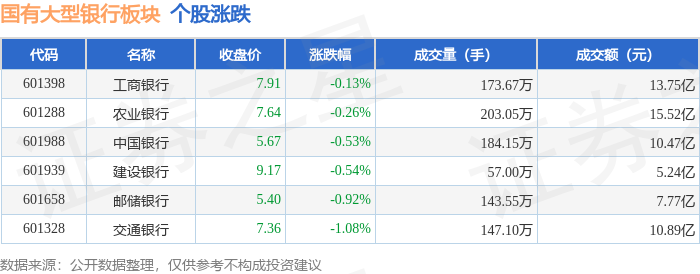
国有大型银行板块12月24日跌0.33%,交通银行领跌,主力资金净流出5.43亿元
Zheng Xing Xing Ye Ri Bao· 2025-12-24 09:10
以上内容为证券之星据公开信息整理,由AI算法生成(网信算备310104345710301240019号),不构成投资建议。 从资金流向上来看,当日国有大型银行板块主力资金净流出5.43亿元,游资资金净流入2.32亿元,散户资 金净流入3.11亿元。国有大型银行板块个股资金流向见下表: | 代码 | 名称 | 主力净流入(元) | 主力净占比 游资净流入 (元) | | 游资净占比 散户净流入 (元) | | 散户净占比 | | --- | --- | --- | --- | --- | --- | --- | --- | | 601939 建设银行 | | -1881.14万 | -3.59% | 1195.21万 | 2.28% | 685.94万 | 1.31% | | 601988 中国银行 | | -4754.44万 | -4.54% | -135.47万 | -0.13% | 4889.91万 | 4.67% | | 601398 工商银行 | | -5965.57万 | -4.34% | -268.76万 | -0.20% | 6234.34万 | 4.53% | | 601328 交通银行 | ...





航宇科技(688239.SH):收到中国银行间市场交易商协会《接受注册通知书》
Ge Long Hui A P P· 2025-12-24 08:21
Core Viewpoint - The company, Hangyu Technology (688239.SH), has received a registration notice from the trading association for its technology innovation bonds, allowing it to issue bonds worth 200 million yuan over a two-year period [1] Group 1 - The registered bond type is a super short-term financing bond with a total registration amount of 200 million yuan [1] - The registration validity period is two years from the date of the notice [1] - Guizhou Bank Co., Ltd. is the lead underwriter for the bond issuance [1] Group 2 - The company can issue technology innovation bonds in installments during the registration validity period [1] - Any issuance after registration must be filed with the trading association in advance [1] - The company is required to manage the issuance according to the resolutions of authorized institutions and relevant management requirements [1]

航宇科技:收到中国银行间市场交易商协会《接受注册通知书》
Ge Long Hui· 2025-12-24 08:16
Core Viewpoint - The company, Hangyu Technology (688239.SH), has received a registration notice from the trading association for its technology innovation bonds, allowing it to issue bonds worth 200 million yuan over a two-year period [1] Group 1 - The registered bond type is a super short-term financing bond with a total registration amount of 200 million yuan [1] - The registration validity period is two years from the date of the notice [1] - Guizhou Bank Co., Ltd. is the lead underwriter for the bond issuance [1] Group 2 - The company can issue technology innovation bonds in installments during the registration validity period [1] - Any issuance after registration must be filed with the trading association in advance [1] - The company is required to manage the issuance according to the resolutions of authorized institutions and relevant management requirements [1]
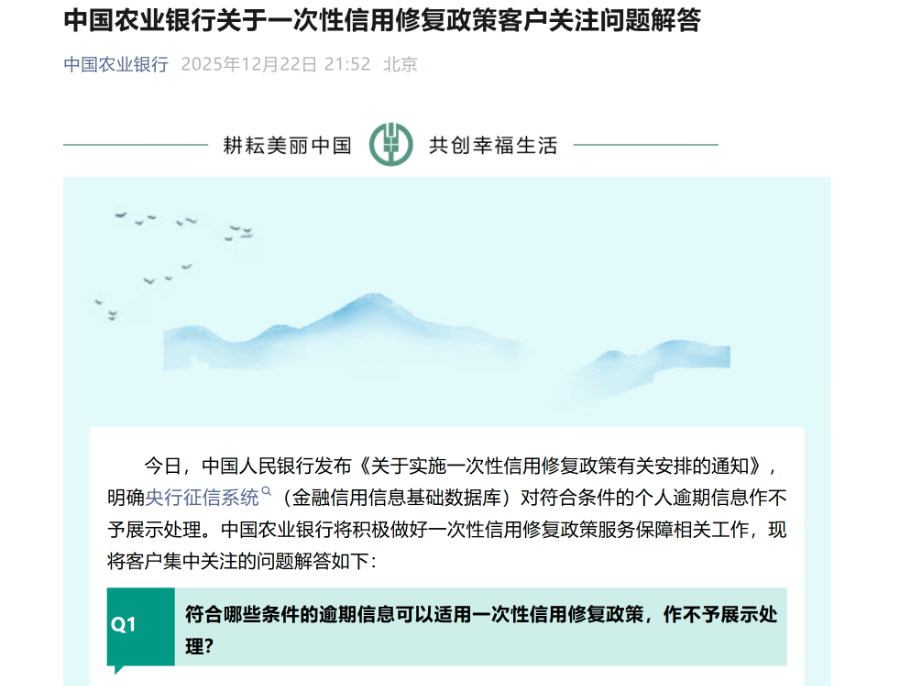
个人信用修复“免申即享”落地 多家国有大行火速响应
2 1 Shi Ji Jing Ji Bao Dao· 2025-12-24 08:08
Core Viewpoint - The People's Bank of China has introduced a new policy for one-time credit repair, allowing eligible individuals to have their overdue information not displayed in the financial credit information database, marking a shift towards a dual focus on both punishment and repair in the credit system [1][15] Group 1: Policy Overview - The policy, effective from December 22, 2025, features an "automatic enjoyment" mechanism, significantly lowering the barriers and operational costs for credit repair [2][16] - It covers various personal credit products, including mortgages, consumer loans, and credit cards, without requiring individuals to apply actively [1][15][19] - Eligible overdue information must meet three criteria: it must have occurred between January 1, 2020, and December 31, 2025, the overdue amount must not exceed 10,000 RMB, and the debt must be fully repaid by March 31, 2026 [5][20] Group 2: Implementation by Banks - Major state-owned banks, including ICBC, ABC, CCB, BOC, and others, quickly responded to the policy by optimizing service measures to ensure effective implementation [7][21] - Banks have enhanced their systems for credit report inquiries and established risk monitoring mechanisms to facilitate the policy's rollout [21][22] - Specific channels for customer inquiries and corrections have been set up by various banks to ensure quick responses to any issues [22] Group 3: Clarification on Debt Repayment - Full repayment of overdue debts requires borrowers to settle both historical overdue amounts and current monthly payments [24][25] - Banks emphasize the importance of confirming the final repayment amount with financial institutions to avoid issues with policy eligibility [25] Group 4: Balancing Rights and Risk - The new policy aims to balance individual rights protection with financial risk prevention, encouraging overdue borrowers to repay their debts and helping banks recover non-performing assets [12][26] - The policy is seen as a significant opportunity for banks to enhance their service quality and better assess borrowers' creditworthiness [27] Group 5: Economic Impact - The credit repair policy is expected to stimulate demand for personal credit products, potentially boosting the lending market [13][27] - However, the overall improvement in credit demand will require support from fiscal and real estate policies due to the current economic environment [14][27] Group 6: Distinction from Debt Forgiveness - The credit repair policy is distinct from debt forgiveness, as it requires full repayment of overdue loans before any credit record corrections are made [28]

中国银行贯通式服务护航国家科技自立自强
Zhong Guo Xin Wen Wang· 2025-12-24 03:40
Core Viewpoint - The Bank of China has launched the "Integrated Cultivation Plan" to provide comprehensive financial services for technology enterprises, focusing on key sectors and allocating 60 billion yuan in special funds to promote high-level technological self-reliance and strength [1][6]. Group 1: Plan Overview - The "Integrated Cultivation Plan" aims to address the full lifecycle financial needs of technology enterprises with growth potential, transitioning from fragmented to one-stop financial services [2]. - The plan includes a relay-style support system that provides a comprehensive financial service package over a 3 to 5-year period, adapting to the operational rhythm of enterprises [2][3]. Group 2: Financial Support Structure - The initial phase of the plan will be piloted in five regions, with a total of 60 billion yuan allocated, including 10 billion yuan for equity investment and 50 billion yuan for credit support, targeting at least 100 high-quality enterprises with key technologies [4]. - A full-stack fund system will be established to cover different stages of enterprise development, including early-stage investment and growth support [4]. Group 3: Collaborative Mechanisms - The plan emphasizes a unified approach to financial services, promoting collaboration between equity and debt financing, and ensuring seamless service delivery through expert consultations and joint evaluations [4]. - An "Innovation Ecological Alliance" will be formed with various partners to enhance resource connectivity for enterprises, integrating both financial and non-financial resources [5]. Group 4: Focus Areas and Goals - The plan aligns with the "14th Five-Year Plan" and prioritizes support for sectors such as integrated circuits, artificial intelligence, low-carbon energy, and precision medicine [6]. - The Bank of China aims to create a replicable model of integrated technology financial services to help enterprises navigate challenges and achieve sustainable growth [7].
超媒体控股(00072)股东将股票由国泰君安(香港)转入中国银行(香港) 转仓市值981.20万港元
智通财经网· 2025-12-24 00:23
Core Viewpoint - Super Media Holdings (00072) is undergoing a significant share transfer and acquisition that will enhance its control over a digital media subsidiary and improve its operational efficiency in the creative business sector [1] Group 1: Share Transfer - On December 23, Super Media Holdings transferred shares from Guotai Junan (Hong Kong) to Bank of China (Hong Kong), with a market value of HKD 9.812 million, representing 10.04% of the total shares [1] Group 2: Acquisition Details - Super Media Holdings announced that its wholly-owned subsidiary, e-Starship Limited, plans to acquire approximately 3% of the issued share capital of Modern Digital Holdings Limited from Hong Kong Seven Wolves Investment Holdings Limited for an initial price of RMB 11.6 million, to be paid in cash [1] - Upon completion of the acquisition, the buyer's equity interest in the target company's issued share capital will increase from approximately 77% to 80% [1] Group 3: Strategic Implications - The board believes that this acquisition will provide the group with greater control over the operations of the target company, ensuring efficiency and management in its digital media business, and enhancing the group's influence in the diversified creative business [1] - The acquisition is expected to increase the attributable profit for the company's equity shareholders due to the rise in the buyer's equity interest in the target company [1]
超媒体控股股东将股票由国泰君安(香港)转入中国银行(香港) 转仓市值981.20万港元
智通财经网· 2025-12-24 00:20
超媒体控股公布,于2025年12月23日,该公司直接全资附属公司e-Starship Limited拟向香港七匹狼投资 控股有限公司收购现代数码控股有限公司约3%的已发行股本,初始代价为人民币1160万元,将以现金 支付。待完成后,买方于目标公司已发行股本的权益将由约77%增至80%。 董事会认为,收购事项将使集团对目标公司的运营拥有更多控制权,以确保其数字媒体业务的效率及管 理,并提升集团于多元创意业务中的影响力。收购事项亦会增加公司权益股东应占溢利(乃由于买方于 目标公司已发行股本中的权益由约77%增长至80%)。 智通财经APP获悉,香港联交所最新资料显示,12月23日,超媒体控股(00072)股东将股票由国泰君安 (香港)转入中国银行(香港),转仓市值981.20万港元,占比10.04%。 ...
金价高位震荡叠加政策合规要求 银行收紧个人贵金属投资通道
Shen Zhen Shang Bao· 2025-12-23 23:03
Core Insights - The international gold and silver prices have reached historical highs in 2023, with COMEX gold surpassing $4500 per ounce and a year-to-date increase of 71%, while COMEX silver has surged by 138% [1] - Banks are tightening their personal precious metal investment channels by closing speculative leveraged businesses and raising margin requirements [1][4] Group 1: Market Performance - As of December 23, 2023, COMEX gold hit a record high of $4530.80 per ounce, while COMEX silver peaked at $70.155 per ounce [1] - The current spot gold price reached $4473 per ounce before consolidating, indicating strong market sentiment [1] Group 2: Bank Policies - Banks are actively closing "zombie accounts" and halting speculative leveraged business, with institutions like Hengfeng Bank and ICBC announcing the cessation of services for accounts with no positions or inventory [2][3] - The China Banking sector is shifting from high-risk speculative products to more stable offerings, such as physical gold bars and ETFs, to protect investors [3][6] Group 3: Investment Thresholds - Banks are increasing margin requirements for gold investments, with institutions like Everbright Bank raising standard margin ratios for various contracts [4] - The entry barriers for gold ETFs are high, requiring investors to have significant assets or income, which aims to deter less risk-tolerant investors [4] Group 4: Investment Strategy - Analysts suggest that individual investors should avoid blindly following market trends and focus on value-based investment strategies in precious metals [5][6] - The current market volatility necessitates a cautious approach, with recommendations for investors to limit gold investments to 10%-20% of their total assets for long-term strategies [4][6]

银行车企年末冲业绩 “0”字组合超常规车贷揽客
Zhong Guo Zheng Quan Bao· 2025-12-23 20:19
Core Insights - The automotive finance market in China is experiencing intensified competition due to various favorable policies, leading to unconventional financial offerings such as "0 down payment" and "0 interest" loans [1][3] Group 1: Market Dynamics - Financial institutions are collaborating with both traditional fuel and new energy vehicle manufacturers to lower car purchase costs and simplify loan processes, especially during the peak sales season in December [1][2] - There is a notable increase in promotional financing options, including significant discounts on vehicle prices and attractive loan terms, such as "loan for 5 years, pay back in 2 years" [1][2] - The market is seeing a rise in "0 down payment + 0 interest" financing schemes, which were previously not available simultaneously, indicating a shift in strategy to boost year-end sales [3][4] Group 2: Financial Institution Strategies - Banks are increasing auto loan incentives to expand credit scale and compensate for declines in other lending areas, while also aiming to drive inventory sales for car manufacturers [5] - Financial institutions are transitioning from being mere credit providers to "ecosystem service providers," focusing on compliance, risk control, and long-term customer value rather than short-term high returns [6] - The automotive finance sector is undergoing significant transformation, with a shift towards customized financial solutions that cater to specific purchasing scenarios, such as new energy vehicles and used car transactions [6]

银行车企年末冲业绩“0”字组合超常规车贷揽客
Zhong Guo Zheng Quan Bao· 2025-12-23 20:18
Core Insights - The automotive finance market in China is experiencing intensified competition due to various favorable policies, leading to unconventional financial offerings such as "0 down payment + 0 interest" [1][3][4] - Financial institutions are collaborating with both traditional fuel vehicle manufacturers and new energy vehicle producers to lower purchase costs and simplify loan processes, aiming to capture market share during peak sales seasons [1][2][5] Group 1: Market Dynamics - December is identified as a critical month for sales, with automakers and financial institutions increasing consumer incentives to boost vehicle sales [1][2] - Financial institutions are strategically increasing auto loan offerings to compensate for declines in other lending areas, such as housing loans, while also aiming to expand their market presence [5][6] Group 2: Financial Offerings - Various auto loan options are being presented, including significant discounts on vehicle prices and flexible repayment terms, such as "loan for 5 years, pay back in 2 years" [1][2] - Some dealerships are offering "0 down payment + 0 interest" financing options, which have become more common since the new auto loan regulations were implemented in 2024 [3][4] Group 3: Industry Transformation - The automotive finance sector is undergoing a transformation, moving from a focus on high commissions and short-term incentives to a more compliant and customer-oriented service model [5][6] - Financial institutions are expected to develop customized financial solutions tailored to specific purchasing scenarios, such as for new energy vehicles and used car transactions, while enhancing digital and online service capabilities [6]