
BANK OF CHINA(601988)

Search documents
多家银行发布公告 明确个人消费贷款财政贴息细节
Yang Shi Xin Wen· 2026-01-23 05:59
Core Viewpoint - The Ministry of Finance, the People's Bank of China, and the Financial Regulatory Administration have extended the implementation period of the personal consumption loan interest subsidy policy until the end of this year, and included credit card installment services in the support scope, prompting multiple financial institutions to announce related service measures [1] Group 1: Policy Implementation - The personal consumption loan interest subsidy policy will be effective from September 1, 2025, to December 31, 2026, allowing automatic application of the latest subsidy policy for loans signed before January 1, 2026, without the need for a new agreement [2] - The China Bank has removed the restriction on consumption amounts of 50,000 yuan and above, meaning transactions of this amount will no longer be limited to specific categories such as home vehicles, education, and healthcare [3] Group 2: Financial Institutions' Responses - The Industrial and Commercial Bank of China has detailed the subsidy scope, which includes areas such as home vehicles, elderly care, education, cultural tourism, home decoration, electronic products, and healthcare [4] - Agricultural Bank of China has included credit card installment services in the subsidy policy with an annual interest subsidy rate of 1%, applicable from January 1, 2026, to December 31, 2026 [5] - The Transportation Bank has set the annual interest subsidy rate for credit card installments at 1%, with a maximum subsidy limit of 3,000 yuan per year for each borrower [6] Group 3: Application Process and Compliance - The Postal Savings Bank has simplified the application process for personal consumption loans or credit card installment subsidies, requiring only the signing of a subsidy application authorization or agreement [7] - The new policy includes city commercial banks, rural commercial banks, foreign banks, and consumer finance companies as processing institutions, facilitating public access to services [8] Group 4: Compliance and Fraud Prevention - The notification emphasizes the need for processing institutions to monitor loan purposes and fund flows, with strict penalties for fraudulent activities or misuse of subsidy funds [9]






个人消费贷贴息如何落实?六大行集体公告→
Ren Min Ri Bao· 2026-01-23 02:50
Core Viewpoint - The six major banks in China have collectively announced the implementation of the latest fiscal interest subsidy policy for personal consumption loans, aiming to enhance related services and support consumer spending [1]. Group 1: Policy Implementation - The implementation period for the fiscal interest subsidy policy for personal consumption loans has been extended to December 31, 2026 [1]. - The scope of support has been expanded to include credit card bill installment services [1]. Group 2: Subsidy Expansion - The subsidy field has been broadened by removing the restriction on single transactions of 50,000 yuan and above [1]. - The subsidy standard has been improved by eliminating the cap of 500 yuan on single transaction subsidies and the previous limit of 1,000 yuan on cumulative subsidies for each borrower at a single institution [1]. Group 3: Existing Agreements - For loans that have already signed the "Fiscal Interest Subsidy Service Agreement for Personal Consumption Loans," any consumption occurring after January 1, 2026, will automatically apply the latest fiscal interest subsidy policy without the need to re-sign the agreement [1].
金融界财经早餐:潘功胜发声,今年降准降息还有空间!多家银行落实消费贷贴息优化;中际旭创成公募基金第一重仓股;商业航天领域动态频出;阿里旗下平头哥筹划IPO(1月23日)
Jin Rong Jie· 2026-01-23 01:47
Economic Policy - The People's Bank of China will continue to implement a moderately loose monetary policy in 2026, utilizing various tools such as reserve requirement ratio cuts and interest rate reductions to maintain ample liquidity [1] - The Ministry of Commerce and nine other departments have issued opinions to promote high-quality development in the pharmaceutical retail industry, supporting mergers and acquisitions among retail pharmacies [1] Capital Market Developments - The People's Bank of China announced a 900 billion yuan MLF operation to maintain liquidity in the banking system, with a one-year term [3] - Public funds have focused on core sectors such as electronics and power equipment, with Zhongji Xuchuang becoming the largest holding stock, valued at 78.421 billion yuan [3] - The National Development and Reform Commission has allocated 93.6 billion yuan in special bonds to support over 4,500 projects across various sectors, driving total investment exceeding 460 billion yuan [3] Industry Highlights - The commercial aerospace sector is gaining attention, with Blue Arrow Aerospace's IPO status changing to "inquiry" as it aims to become the first commercial aerospace stock [7] - Domestic AI chip company Suiyuan Technology has received approval for its IPO, aiming to raise 6 billion yuan for AI chip development [7] - The human-shaped robot sector remains active, with Zhejiang's innovation center completing a 450 million yuan Pre-A round of financing [7] Company Updates - Zhaoyi Innovation expects a net profit of 1.61 billion yuan for 2025, a year-on-year increase of approximately 46%, benefiting from AI computing demand [8] - ST Biology announced the termination of its major asset restructuring plan to acquire a 51% stake in Hunan Huize Biomedical Technology [9] - Xiaomi Group plans to repurchase up to 2.5 billion Hong Kong dollars of its Class B shares starting January 23 [10] - Alibaba has decided to support its chip subsidiary "Pingtouge" for future independent listing, initiating a restructuring process [11] - Intel reported a fourth-quarter revenue of 13.674 billion dollars, with a net loss of 591 million dollars, while its annual revenue was 52.853 billion dollars [11]


工、农、中、建、交、邮储,六大行集体公告
Sou Hu Cai Jing· 2026-01-23 01:31
Group 1 - The core viewpoint of the news is that major Chinese banks have announced the implementation of optimized personal consumption loan subsidy policies, which will automatically apply to loans signed before January 1, 2026, without the need for re-signing agreements [1][3] Group 2 - The implementation period for the personal consumption loan subsidy policy has been extended to December 31, 2026 [3] - The support scope has been expanded to include credit card bill installment services [3] - Restrictions on single transactions of 50,000 yuan and above have been removed, broadening the subsidy areas [3] - The subsidy standards have been improved by removing the cap of 500 yuan on single transaction subsidies and the cumulative limit of 1,000 yuan for each borrower at a single institution for transactions below 50,000 yuan [3]

谁能跻身全球品牌价值500强?光大银行下滑71名,民生银行降60名
Xin Lang Cai Jing· 2026-01-23 01:08
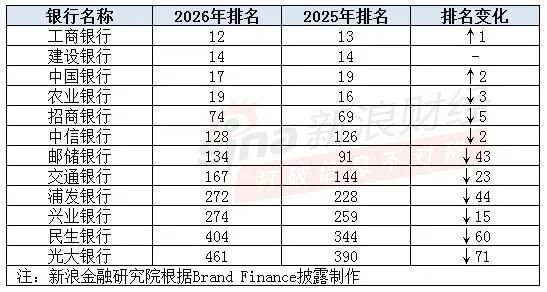
Group 1: Core Insights - The Brand Finance 2026 Global Brand Value 500 report was released, highlighting the performance of various banks and insurance companies [1][7] - Chinese brands have shown a double-digit growth in total value, indicating strong resilience and potential for future growth [7] Group 2: Banking Sector Summary - Major Chinese banks included in the ranking are Industrial and Commercial Bank of China (ICBC) at 12th, China Construction Bank at 14th, and Bank of China at 17th, with ICBC holding a brand value of $90.88 billion and a brand strength index of 91.5 [2][3] - China Bank surpassed Agricultural Bank, which dropped to 19th place, while China Merchants Bank ranked 74th as the highest among joint-stock banks [3][4] - Notable declines were observed for China Everbright Bank, which fell 71 places to 461st, and Minsheng Bank, which dropped 60 places to 404th [1][4] Group 3: Insurance Sector Summary - Among the insurance companies, Ping An Insurance ranked 32nd globally, being the only Chinese insurer in the top 100, with a brand strength rating of AAA- [5][6] - Other insurers like China Life and China Pacific Insurance also maintained positions within the top 200, while Prudential Insurance saw a significant drop of 117 places to 350th [5][6] - Notably, Cathay Life Insurance improved its ranking by 180 places to 407th [6] Group 4: Overall Brand Performance - The report indicates that 12 Chinese brands made it to the top 50 globally, with Douyin's brand value increasing by 45.1% to $153.54 billion, ranking 6th [7] - State Grid Corporation achieved a brand value of $102.44 billion, ranking first in the global utility sector, with a 19.6% increase in brand value [8]


多家银行开启 信用卡分期贴息补申请通道
Bei Jing Shang Bao· 2026-01-23 01:05
Core Viewpoint - The new personal consumption loan interest subsidy policy aims to enhance consumer spending by expanding the scope of eligible loans and simplifying the application process for consumers [1][4]. Group 1: Policy Implementation - The Ministry of Finance, the People's Bank of China, and the financial regulatory authority jointly issued a notice to optimize the implementation of the personal consumption loan interest subsidy policy [1]. - The subsidy period for personal consumption loans is set from September 1, 2025, to December 31, 2026, while the credit card installment subsidy period is from January 1, 2026, to December 31, 2026 [1]. - Major banks, including ICBC, ABC, Bank of China, and others, have quickly responded by issuing operational guidelines and FAQs regarding the subsidy services [1][2]. Group 2: Eligibility and Application Process - Customers who have previously signed consumption loan subsidy agreements do not need to re-sign; the new policy will automatically apply to their existing loans [2]. - For credit card installment services newly included in the subsidy, banks like Postal Savings Bank and Agricultural Bank have outlined specific application paths for customers [2][3]. - Agricultural Bank requires customers to sign a supplementary agreement for credit card installment subsidies, with each card needing a separate agreement [3]. Group 3: Impact on Interest Rates - The new policy includes a 1% annual subsidy rate for credit card installments, which could lower the effective interest rate for eligible borrowers to the "2% range" after subsidies [4]. - The minimum execution interest rate for consumption loans remains at 3%, indicating potential benefits for borrowers with good credit ratings [4].

2026年中国银行个人金融全球资产配置白皮书-中国银行
Sou Hu Cai Jing· 2026-01-23 00:56
Macro Overview - The global economy is expected to continue a weak recovery in 2026, with growth projected at 3.1% and inflation decreasing to 3.7% [1][4] - China's economy is anticipated to stabilize and rebound with a growth rate of 4.7% to 5.0% due to supportive macro policies [1][4] - The US economy is likely to maintain potential growth, with the Federal Reserve expected to cut interest rates three more times and expand its balance sheet [1][4] Equity Market Insights - The A-share market is expected to maintain a slow bull market, potentially evolving into a long bull market supported by policy dividends, profit recovery, and long-term capital inflows [1][6] - The Hong Kong stock market will benefit from the internationalization of RMB assets and external liquidity easing, continuing its value reassessment [1][6] - Non-US stock markets are projected to outperform US markets, with European and Japanese stock markets expected to rise moderately, while emerging markets present structural opportunities [1][6][9] Bond Market Analysis - The bond market is influenced by the Federal Reserve's interest rate cuts and balance sheet expansion, leading to a downward shift in US Treasury yields [1][7] - China's 10-year government bond yields are expected to fluctuate between 1.6% and 1.9%, with a moderately loose funding environment but limited downward yield movement [1][7] - UK bonds present high allocation value, while German bonds are expected to perform relatively weakly [1][7] Commodity Market Trends - Gold is expected to continue its long-term upward trend, potentially reaching new historical highs, while silver's price is supported by multiple attributes but may experience increased volatility [2][5] - Copper and aluminum prices are anticipated to rise due to demand from AI development and new energy sectors [2][5] - The oil market remains in a state of oversupply, with prices expected to fluctuate around cost levels [2][5] Currency Market Dynamics - The foreign exchange market shows a downward shift in the US dollar, with non-US currencies exhibiting differentiation [2][6] - The Chinese yuan is likely to experience two-way fluctuations, appreciating against the US dollar [2][6] - The euro and Malaysian ringgit are expected to perform strongly, while the Canadian dollar is anticipated to weaken due to tariffs and oil price impacts [2][6]

头部农商行再添一员,中国银行业格局生变
2 1 Shi Ji Jing Ji Bao Dao· 2026-01-22 23:18
Core Viewpoint - A new force characterized by regional deepening is rapidly rising in China's banking industry, with Chengdu Rural Commercial Bank becoming the fifth rural commercial bank to surpass an asset scale of 1 trillion yuan, joining the ranks of other major urban rural commercial banks [1][2]. Group 1: Growth of Rural Commercial Banks - The five rural commercial banks that have crossed the 1 trillion yuan mark are all based in major national cities, which are characterized by high urbanization levels and strong economic radiation capabilities [1][2]. - These banks have successfully achieved leapfrog development by deeply understanding and closely binding with the regional economy, creating a growth path centered on localized services [1][2]. Group 2: Strategic Focus on Local Markets - The success of these banks is attributed to their strategic focus on local markets, aligning their development with regional economic growth, which is consistent with regulatory guidance emphasizing local service [2][3]. - Regulatory bodies have encouraged rural financial institutions to focus on serving local communities and the agricultural sector, reinforcing the importance of localized banking [2]. Group 3: Unique Development Models - Each of the trillion-yuan rural commercial banks has developed unique models based on local characteristics, such as Beijing Rural Commercial Bank focusing on "three rural" services and Shanghai Rural Commercial Bank developing technology and pension finance [3]. - Chengdu Rural Commercial Bank aims to be a bank that understands rural revitalization and local industries, optimizing its branch layout to enhance service breadth and depth [3][4]. Group 4: Financial Performance - Chengdu Rural Commercial Bank's asset scale has grown from less than 500 billion yuan in 2019 to over 1 trillion yuan in early 2026, with an annual growth rate significantly higher than the industry average [4]. - The bank maintains a stable asset quality, with a non-performing loan ratio of 1.02% and a provision coverage ratio of 441.83%, indicating strong financial health compared to peers [4]. Group 5: Challenges and Transformation - Surpassing the 1 trillion yuan mark signifies a new development stage for these banks, necessitating a restructuring of their development models and management capabilities [6]. - The banks face three core challenges: pressure on profit growth due to narrowing net interest margins, accelerated capital consumption, and increased difficulty in risk management amid regional economic adjustments [6][7]. Group 6: Pathways for Transformation - Transformation strategies should focus on capital replenishment through both internal and external means, diversifying income sources beyond traditional lending, and enhancing risk management capabilities [7]. - Chengdu Rural Commercial Bank's approach includes innovating products in green finance and technology finance, with its green loan balance nearing 50 billion yuan, reflecting a significant growth engine [7][8]. Group 7: Digitalization and Local Service - The bank's strategy to address digital challenges involves focusing on local scenarios and enhancing digital platforms, with over 4 million mobile banking users and a community service platform linking 110 communities [8]. - The emergence of trillion-yuan rural commercial banks indicates that impactful financial institutions can be cultivated in the regional economic service sector, emphasizing the importance of local roots and sustainable development [8].
头部农商行再添一员 中国银行业格局生变
2 1 Shi Ji Jing Ji Bao Dao· 2026-01-22 23:10
Core Viewpoint - A new force characterized by regional deepening is rapidly emerging in China's banking industry, with Chengdu Rural Commercial Bank becoming the fifth rural commercial bank to surpass 1 trillion yuan in assets, highlighting a structural change in the industry towards localized service models [1][2]. Group 1: Emergence of Regional Banks - Chengdu Rural Commercial Bank officially announced its asset scale surpassed 1 trillion yuan on January 1, 2026, joining the ranks of four other major rural commercial banks [1]. - The five banks that have reached this milestone are all urban rural commercial banks headquartered in national central cities, which have high urbanization levels and strong economic radiation capabilities [1]. - The success of these banks is attributed to their deep understanding of local economies and a strategic focus on localized services, aligning with regulatory guidance emphasizing support for local communities and agriculture [2]. Group 2: Development Strategies - Each of the trillion-yuan rural commercial banks has developed unique advantages based on local characteristics, such as Beijing Rural Commercial Bank focusing on "three rural" services and Shanghai Rural Commercial Bank developing technology and elderly finance [3]. - Chengdu Rural Commercial Bank aims to be a bank that understands rural revitalization and local industries, optimizing its branch layout to enhance service breadth and depth [3]. - The bank has achieved over 80% account opening rates for new agricultural operators and over 72% credit coverage for major grain producers, demonstrating its effective local engagement [3][4]. Group 3: Financial Performance - Since the end of 2019, Chengdu Rural Commercial Bank's asset scale has grown from less than 500 billion yuan to over 1 trillion yuan by early 2026, with an annual growth rate significantly above the industry average [4]. - The bank maintains a stable asset quality, with a non-performing loan ratio of 1.02% and a provision coverage ratio of 441.83% as of mid-2025, indicating strong financial health compared to peers [4]. Group 4: Challenges and Transformation - Surpassing the 1 trillion yuan mark signifies a new development stage for these regional banks, necessitating a restructuring of their development models and management capabilities [6]. - The banks face three core challenges: pressure on profit growth due to narrowing net interest margins, accelerated capital consumption from risk-weighted asset expansion, and increased difficulty in risk management amid economic adjustments [6][7]. - To address these challenges, banks must diversify their income structures, enhance capital accumulation, and strengthen risk management through digital means [7][8]. Group 5: Digitalization and Future Outlook - Chengdu Rural Commercial Bank is focusing on digitalization by enhancing mobile banking and online service platforms, with over 4 million mobile banking users and a community service platform linking 110 communities [8]. - The emergence of trillion-yuan rural commercial banks indicates that impactful financial institutions can be cultivated in regional economies, emphasizing the importance of local engagement for sustainable development [8].
中国银行股份有限公司深圳市分行与中国信达资产管理股份有限公司深圳市分公司债权转让通知暨债务催收联合公告
Jing Ji Ri Bao· 2026-01-22 22:19
Core Viewpoint - China Bank has signed a bulk asset transfer agreement with China Cinda Asset Management, transferring its rights to certain debt claims to the latter, effective from September 22, 2025 [1]. Group 1: Agreement Details - The agreement involves the transfer of principal debt claims and all rights under the relevant guarantee contracts to China Cinda Shenzhen Branch [1]. - Borrowers and guarantors listed in the announcement are required to fulfill their repayment obligations immediately upon the announcement [1]. Group 2: Debt Information - The announcement includes a list of borrowers with their respective debt amounts, with the principal balances as of the transfer benchmark date of August 6, 2025 [1]. - The total principal amounts for some of the borrowers include: - Shenzhen Xin Hai Wei Cloud Computing Co., Ltd: 4,561,480.35 RMB [4] - Shenzhen Jing Shi Construction Repair Waterproof Engineering Co., Ltd: 3,119,978.37 RMB [4] - Shenzhen Mi Tu Technology Co., Ltd: 2,349,541.00 RMB [4] - Shenzhen Ai Mei Commercial Management Co., Ltd: 9,999,773.33 RMB [4]. Group 3: Contact Information - Contact details for inquiries are provided for both China Bank and China Cinda Asset Management, including phone numbers and addresses [3][4].