
BANK OF CHINA(601988)

Search documents
工农中建交邮储六大行集体公告!数字人民币实名钱包余额计付利息,计结息规则与活期存款一致
Sou Hu Cai Jing· 2026-01-04 06:55
Core Viewpoint - Major Chinese banks, including ICBC, ABC, BOC, CCB, BOCOM, and PSBC, will start paying interest on the balances of digital RMB wallets at the rate of their respective demand deposit rates from January 1, 2026 [1][2][4][5][8][9]. Group 1: Bank Announcements - ICBC will pay interest on digital RMB wallet balances according to its demand deposit rate, with interest calculation rules consistent with those for demand deposits [1]. - ABC will also apply the same interest payment policy for digital RMB wallet balances starting January 1, 2026 [2]. - BOC will follow the same approach, paying interest on digital RMB wallet balances at its demand deposit rate from January 1, 2026 [4]. - CCB will implement interest payments on digital RMB wallet balances based on its demand deposit rate, with relevant service agreement updates [5]. - BOCOM will pay interest on digital RMB wallet balances according to its demand deposit rate, effective January 1, 2026 [8]. - PSBC will also apply the same interest payment policy for digital RMB wallet balances starting January 1, 2026 [9].





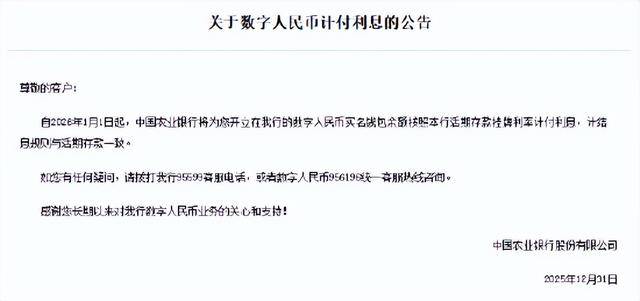
1月1日起中国银行数字人民币计付利息
Jin Tou Wang· 2026-01-04 06:29
Core Viewpoint - Starting from January 1, 2026, Bank of China will pay interest on the balance of digital RMB real-name wallets at the same rate as its current deposit rates, with interest calculation rules consistent with those of current deposits [1] Group 1 - Bank of China announced the implementation of interest payments for digital RMB wallets [1] - The interest rate will be aligned with the bank's current deposit rates [1] - The interest calculation rules will follow the same guidelines as those for current deposits [1]
优先股隐退永续债上位!银行业资本补充进入密集冲刺期,年利息至少省3%
Xin Lang Cai Jing· 2026-01-04 05:31
Core Viewpoint - The Chinese banking industry is undergoing a significant transformation, with banks redeeming high-cost preferred shares and issuing perpetual bonds as a more cost-effective financing alternative, driven by declining social financing costs and regulatory changes [2][4][11]. Group 1: Redemption of Preferred Shares - By the end of 2025, a total of 9 banks announced the redemption of preferred shares, amounting to 111.8 billion RMB in domestic preferred shares and 5.72 billion USD in foreign preferred shares [4]. - In December 2025 alone, five banks, including Changsha Bank and Beijing Bank, redeemed a total of 45.8 billion RMB in preferred shares [3]. - The redemption of preferred shares is facilitated by their lack of maturity dates but includes redemption clauses, allowing banks to manage capital flexibly [4]. Group 2: Issuance of Perpetual Bonds - As of December 31, 2025, Chinese commercial banks issued 69 perpetual bonds, raising a total of 821.8 billion RMB, marking a historical high in both issuance quantity and scale [5]. - The interest rates for newly issued perpetual bonds generally ranged from 2.0% to 2.9%, the lowest in nearly three years, with a significant issuance peak occurring in the second half of 2025 [5][6]. - The issuance of perpetual bonds is seen as a response to the urgent need for capital replenishment, especially among small and medium-sized banks facing declining capital adequacy ratios [2][6]. Group 3: Cost Savings and Financial Efficiency - By replacing preferred shares with perpetual bonds, banks can save at least 3% annually on interest expenses, significantly reducing their financing costs [8][10]. - For instance, the interest rate on newly issued perpetual bonds is substantially lower than that of previously issued preferred shares, with examples showing potential annual savings of 12.8 million RMB for banks like Industrial Bank [10]. - The transition from preferred shares to perpetual bonds is viewed as a strategic move to optimize capital structure and reduce interest payment burdens, aligning with regulatory requirements [8][10]. Group 4: Regulatory Environment and Market Dynamics - The shift towards perpetual bonds is influenced by regulatory changes that favor capital instruments with loss absorption capabilities, making traditional preferred shares less attractive [11]. - The approval process for issuing perpetual bonds is simpler and faster compared to preferred shares, which require dual regulatory approvals, thus enhancing their appeal to banks [11]. - The current low-interest-rate environment is expected to persist, allowing banks to lock in low financing costs for the next 5 to 10 years, effectively mitigating the pressure from narrowing net interest margins [10].





2026年起数字人民币余额计息 年利率0.05%仅限实名钱包
Sou Hu Cai Jing· 2026-01-04 03:38
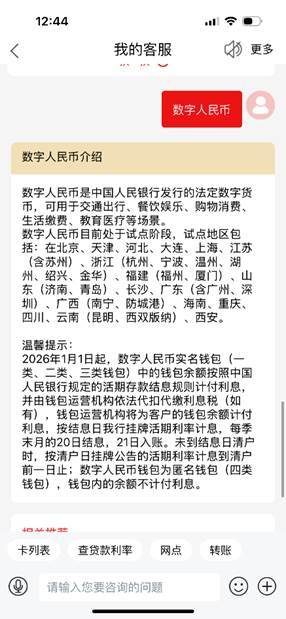
Core Points - Starting from January 1, 2026, interest will be paid on the balances in real-name digital RMB wallets [1] - Ten official designated operating institutions, including major banks like ICBC, ABC, BOC, and CCB, have announced this adjustment [1] - The interest rate will be based on the bank's current deposit benchmark rate, which is currently 0.05% annually [1] Summary by Categories Interest Payment Implementation - The interest payment feature is a result of the People's Bank of China's recent action plan to enhance the management and service system for digital RMB [1] - Banks are required to comply with self-discipline agreements on deposit rate pricing [1] Wallet Classification and Eligibility - The interest payment feature is only available to users of real-name wallets [1] - Digital RMB wallets are categorized into four types based on customer identity verification strength, with only authenticated wallets eligible for interest [1] - Balances in anonymous wallets, which can be opened with just a phone number, will not earn interest [1] Digital RMB App Upgrade - The digital RMB App has been upgraded to version 2.0 to support the new interest payment functionality [1] - Users can check interest details on the wallet asset page after the quarterly interest settlement date [1]
近30笔千万级罚单!2025年银行业罚单大盘点
证券时报· 2026-01-03 05:27
Core Viewpoint - In 2025, the Chinese banking industry is undergoing significant regulatory scrutiny characterized by "strict regulation, strong accountability, and zero tolerance," leading to a notable increase in both the quantity and severity of penalties imposed on banks [1]. Group 1: Regulatory Environment - The number of penalties exceeding 10 million yuan in the banking sector reached nearly 30, affecting various types of institutions including state-owned banks, policy banks, joint-stock banks, city commercial banks, private banks, and bank-affiliated wealth management subsidiaries [2]. - Regulatory focus has expanded beyond traditional areas like credit management to include corporate governance, related party transactions, anti-money laundering, data security, and wealth management business oversight [2][4]. Group 2: Major Penalties - Major state-owned banks such as Bank of China, Industrial and Commercial Bank of China, and Agricultural Bank of China received substantial fines, with Bank of China facing a fine of 97.9 million yuan for issues related to corporate governance and asset quality management [4]. - In December 2025, China Communications Bank was fined 68.07 million yuan for violating multiple regulations, including account management and anti-money laundering obligations [4][5]. Group 3: Compliance and Risk Management - The penalties highlight a trend of inadequate compliance and risk management across various banking operations, including loan management, interbank transactions, and wealth management [7][10]. - The regulatory environment has intensified scrutiny on compliance with anti-money laundering regulations, with significant fines imposed for failures in customer identity verification and transaction reporting [8][9]. Group 4: Emerging Business Areas - New banking business models, such as wealth management subsidiaries and direct banks, are also facing strict regulatory penalties, indicating that the regulatory environment is not limited to traditional banking practices [13]. - For instance, Jiaoyun Wealth Management was fined 17.5 million yuan for non-compliance in product information disclosure and post-investment management [13]. Group 5: Double Penalty System - The implementation of a "double penalty system" has become prevalent, where not only institutions are fined but also individual responsible parties face penalties, enhancing accountability within financial institutions [15]. - This system links the career prospects of involved personnel directly to the compliance performance of their institutions, thereby increasing regulatory pressure [15]. Group 6: Future Outlook - The ongoing trend of strict regulation and accountability is expected to continue, prompting banks to improve their internal governance structures and compliance management systems [16]. - The adjustments in business processes and increased technological investments are anticipated to have a profound impact on the operational models and competitive landscape of the banking industry [16].



见证历史!6万亿之上
Xin Lang Cai Jing· 2026-01-03 04:50
Group 1 - The core theme of the article is the significant growth of the ETF market in China, with the total market size reaching 6.02 trillion yuan by the end of 2025, marking a 61.33% increase from the previous year [4][6][33] - The number of ETF products increased to 1,401, reflecting a growth of 33.93% from the end of 2024, indicating a robust expansion in the market [4][27] - Major players in the ETF market include Huaxia, E Fund, and Huatai-PB, which dominate the management scale, with Huaxia leading at 957.16 billion yuan [23][24] Group 2 - The performance of ETFs showed structural differentiation, with six ETFs achieving a unit net value growth rate exceeding 100%, particularly in sectors like communication, artificial intelligence, and non-ferrous metals [6][7] - Conversely, some ETFs tracking food and beverage indices experienced declines, with the wine ETF dropping by 12.96% [9][6] - The top ten ETFs by net inflow included the Hong Kong Stock Connect Internet ETF, which attracted over 566 billion yuan, highlighting the strong demand for cross-border investment products [17][10] Group 3 - The bond ETF market also saw explosive growth, with the total size surpassing 800 billion yuan, driven by the popularity of the Sci-Tech Bond ETF, which accounted for over 50% of the annual growth in this segment [29][28] - The A500 ETF segment became a focal point of competition, with total assets exceeding 300 billion yuan and significant net inflows recorded in December 2025 [31][32] - The ETF issuance market experienced a historic surge, with 362 new ETFs launched in 2025, surpassing the total from the previous two years combined [27][28] Group 4 - The ETF custody market also expanded, with the top five custodians holding approximately 75% of the total ETF market size, indicating a concentration of assets among leading institutions [33] - A trend towards standardization in ETF naming was observed, with major firms like E Fund completing the renaming of their products to align with new regulatory guidelines [34]



重拳出击!近30笔千万级罚单!2025年银行业罚单大盘点
券商中国· 2026-01-03 03:33
Core Viewpoint - In 2025, the Chinese banking industry is undergoing significant regulatory scrutiny characterized by "strict regulation, strong accountability, and zero tolerance," leading to a notable increase in both the quantity and amount of penalties imposed on various banking institutions [1]. Regulatory Penalties Overview - The number of penalties exceeding ten million yuan has reached nearly 30, affecting a wide range of institutions including state-owned banks, policy banks, joint-stock banks, city commercial banks, private banks, and bank-affiliated wealth management subsidiaries [1]. - Penalties are not limited to traditional areas like credit management but also extend to corporate governance, related party transactions, anti-money laundering, data security, and wealth management [2]. Corporate Governance and Compliance - Major state-owned banks such as Bank of China, Industrial and Commercial Bank of China, and Agricultural Bank of China have received substantial fines for issues related to corporate governance and business management [3]. - The largest penalty of the year was imposed on Bank of China, amounting to 97.9 million yuan for various management issues [3]. - Regulatory focus has shifted to deeper issues such as the effectiveness of board responsibilities and the integrity of internal control processes [3]. Compliance and Anti-Money Laundering - There has been an intensified crackdown on compliance, particularly in the anti-money laundering sector, with significant fines imposed on banks for failing to adhere to basic financial management regulations [4]. - For instance, China Merchants Bank was fined 68.07 million yuan for violating 11 regulations related to account management and anti-money laundering [4]. Business Management Issues - The primary reasons for penalties in the banking sector include: - Inadequate management across various business areas such as loans, interbank transactions, and wealth management [6]. - Non-compliance with anti-money laundering responsibilities, including failure to identify customers and report suspicious transactions [7]. - Violations in foreign exchange and investment operations, including illegal currency transactions and improper investment disclosures [8]. - Insufficient implementation of regulatory requirements, leading to non-compliance in data reporting and employee management [9]. Emerging Business Areas - New banking business models, including wealth management subsidiaries and direct banks, have also faced penalties, indicating strict regulatory oversight in these emerging sectors [11]. - For example, a wealth management subsidiary was fined 17.5 million yuan for non-compliance in product information disclosure and post-investment management [12]. Double Penalty System - The implementation of a "double penalty system" has become a significant aspect of regulatory actions, where both institutions and responsible individuals face penalties [13]. - This system aims to link the career prospects of involved personnel directly to the compliance performance of their institutions, thereby enhancing accountability [14]. Summary of Penalties - A detailed overview of penalties reveals that various banks have faced significant fines for a range of compliance failures, with amounts often exceeding ten million yuan [15][16].


单签最高盈利近40万元,2025年最赚钱十大新股出炉!
Zheng Quan Shi Bao· 2026-01-03 01:48
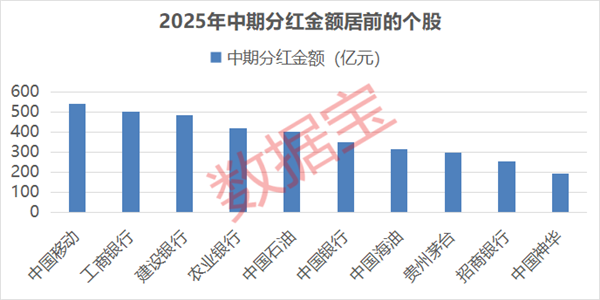
Core Insights - The article highlights that 37 listed companies have distributed dividends exceeding 10 billion yuan, with 5 companies surpassing 100 billion yuan in dividends, marking a historical high for the A-share market [1] - Notably, the "Big Four State-owned Banks" and China Mobile are among the companies that achieved this milestone, with Agricultural Bank of China, Bank of China, and China Mobile each breaking the 100 billion yuan barrier for the first time [1] - The total mid-year dividend distribution for 2025, including Q1, semi-annual, and Q3 reports, has significantly increased, with 1,113 companies participating and a total amount reaching 8,148.82 billion yuan, surpassing approximately 6,700 billion yuan in 2024 [1] - China Mobile, Industrial and Commercial Bank of China, and China Construction Bank lead in mid-year dividend amounts, distributing 540.87 billion yuan, 503.96 billion yuan, and 486.05 billion yuan respectively [1]

国有六大行集团宣布:数字人民币实名钱包余额按活期利率计息
Huan Qiu Wang· 2026-01-03 01:39
Group 1 - The six major state-owned banks in China will start paying interest on the balances of real-name digital RMB wallets at the same rate as current deposit rates, effective January 1, 2026 [1][3] - The current interest rate for current deposits is set at 0.05%, and only real-name wallets (categories one, two, and three) will earn interest, while anonymous wallets (category four) will not [1][3] - The People's Bank of China has introduced a new action plan to enhance the management and service system for digital RMB, which will officially launch on January 1, 2026 [3] Group 2 - The action plan allows banks to manage the assets and liabilities of digital RMB wallet balances independently, while ensuring the same level of security as traditional deposits through deposit insurance [3]
中国银行取得数据处理方法专利提升系统迁移效率
Sou Hu Cai Jing· 2026-01-02 12:04
Core Insights - China Bank Co., Ltd. has obtained a patent for a "data processing method, device, equipment, and storage medium," with the authorization announcement number CN116541375B, and the application date is April 2023 [1] Company Overview - China Bank Co., Ltd. was established in 1983 and is located in Beijing, primarily engaged in monetary financial services [1] - The registered capital of China Bank Co., Ltd. is approximately 29.44 billion RMB [1] Investment and Intellectual Property - The company has made investments in 16 enterprises and participated in 5,000 bidding projects [1] - In terms of intellectual property, China Bank Co., Ltd. holds 1,472 trademark registrations and 5,000 patent records, along with 255 administrative licenses [1]