
BANK OF CHINA(601988)

Search documents
涉嫌严重违纪违法,程军被查
Xin Lang Cai Jing· 2026-01-04 22:08
来源:中央纪委国家监委网站 据中央纪委国家监委驻中国银行纪检监察组、天津市纪委监委消息:中国银行浙江省分行党委书记、行 长程军涉嫌严重违纪违法,目前正接受中央纪委国家监委驻中国银行纪检监察组纪律审查和天津市监察 委员会监察调查。 ...
国有大行新年寄语:锚定价值新坐标 拓展服务新格局
Shang Hai Zheng Quan Bao· 2026-01-04 20:27
Core Viewpoint - The New Year messages from major state-owned banks emphasize their roles as the "main force" and "leading geese" in the financial industry, focusing on risk prevention, strong regulation, and promoting high-quality development while addressing both macroeconomic stability and micro-level public needs [1][2]. Group 1: National Responsibility and Public Service - Major banks highlight their commitment to national priorities and public welfare, with ICBC pledging to support employment and market stability through increased lending and bond investments [1] - Agricultural Bank of China emphasizes its mission in rural development, achieving over 1 trillion yuan in county loans for four consecutive years and a loan balance of 1.8 trillion yuan for farmers [1] - Banks are actively addressing public needs, with initiatives like Bank of China’s tea garden project generating over 100 million yuan in value and Agricultural Bank providing over 1 million home services for the elderly [2] Group 2: Financial Innovation and Globalization - The "Five Major Articles" of financial services—technology finance, green finance, inclusive finance, pension finance, and digital finance—are integrated into the development strategies of major banks, with ICBC leading in manufacturing and green loans [3] - Agricultural Bank has launched an AI innovation framework to enhance customer service and risk management, while ICBC has achieved full coverage of its smart risk control centers [3] - Chinese banks are expanding their global service capabilities, exemplified by Bank of China’s issuance of 4 billion euros in sovereign bonds in Luxembourg and participation in cross-border payment projects [4][5] Group 3: Stability and Long-term Vision - State-owned banks emphasize a focus on stable operations and long-term strategies, with China Bank highlighting the importance of maintaining strategic determination amid market volatility [5][6] - Agricultural Bank stresses the need for a correct performance outlook and the importance of addressing challenges while ensuring high-quality development and risk management [6] - The commitment to employee recognition and appreciation is evident, with banks acknowledging the contributions of their staff in supporting major national events and initiatives [7]






银行今十条:数字人民币1月1日起计付利息;农商行头部阵营形成“五强”格局;新疆银行注册资本增至122亿元...
Jin Rong Jie· 2026-01-04 14:13
Group 1 - The People's Bank of China conducted a 365 billion yuan 7-day reverse repurchase operation, resulting in a net withdrawal of 433.6 billion yuan [1] - The People's Bank of China issued the "Non-Bank Payment Institutions Classification Rating Management Measures" to enhance supervision of non-bank payment institutions, effective from February 1, 2026 [2] - In 2025, the banking sector saw a net increase of 623 physical bank branches, marking the first positive growth in three years despite the closure of 7,871 branches [3] Group 2 - Ten digital RMB operating banks announced that starting January 1, 2026, they will pay interest on digital RMB wallets at the same rate as their demand deposit rates [4] - Chengdu Rural Commercial Bank announced that its total assets have surpassed 1 trillion yuan, becoming the fifth rural commercial bank in China to reach this milestone [5] - Xinjiang Bank received approval to increase its registered capital from 7.906 billion yuan to 12.222 billion yuan [6] Group 3 - Baoding Bank's plan to change its registered capital was approved, allowing it to raise 250 million shares [7] - Ningbo Tongshang Bank was approved to issue capital instruments not exceeding 2 billion yuan, including perpetual bonds and subordinated bonds [8][9] - The Dongguan Financial Regulatory Bureau and other departments will pilot real estate trust property registration in Dongguan to support the transformation of the trust business [10] Group 4 - New Era Trust's 100% equity is being offered for transfer for the third time, with a base price of approximately 1.851 billion yuan, consistent with previous offers [11]

证监会发布!工行、中行、交行、富国基金,最新发声
Zhong Guo Ji Jin Bao· 2026-01-04 12:49
Core Viewpoint - The implementation of the "Regulations on the Management of Sales Expenses for Publicly Raised Securities Investment Funds" marks a significant step in the fee rate reform of the public fund industry, aimed at reducing investor costs and enhancing their experience, thereby promoting high-quality industry development [1][5][10]. Group 1: Industry Impact - The fee rate reform is expected to lower investor costs significantly, with an overall reduction in sales expenses by 34%, potentially saving investors approximately 30 billion yuan annually [10][11]. - The reform encourages a shift from a "sell-side" to a "buy-side" service model, aligning industry development with investor interests [2][5]. - The new regulations include detailed provisions for reducing subscription and service fees, optimizing redemption arrangements, and promoting long-term holding of funds [5][10]. Group 2: Institutional Responses - Industrial and Commercial Bank of China (ICBC) emphasizes enhancing investor satisfaction and service quality through transparent communication and educational initiatives [2][3]. - Bank of China focuses on implementing regulatory requirements to ensure smooth reform execution while enhancing its service system and promoting long-term investment [5][6]. - Bank of Communications highlights the importance of the new regulations in reducing costs and fostering a customer-centric approach in wealth management [7][9]. Group 3: Specific Initiatives - ICBC plans to upgrade its customer service capabilities, including personalized investment advice and improved digital platforms for better user experience [3][4]. - Bank of China has implemented various fee discounts and is committed to improving service quality through training and digital tools [5][6]. - Traffic Bank is launching initiatives like the "Wode Wealth Journey" to enhance financial education and investor engagement [9]. Group 4: Future Directions - The reform is seen as a catalyst for the industry to focus on long-term returns rather than short-term gains, promoting a healthier market environment [10][11]. - The establishment of a direct sales service platform aims to enhance efficiency and service quality for fund management [11].
2025,银行大罚单明显变多了
Xin Lang Cai Jing· 2026-01-04 12:48
Core Insights - A significant trend observed in 2025 is the increase in large fines imposed on banks, reflecting compliance shortcomings and risk points during the transition to high-quality development in the banking industry [2][16] - In 2025, regulatory authorities issued a total of 454 fines exceeding one million yuan to banking institutions and personnel, an increase of 58 from the previous year, with the total amount of fines nearly doubling [2][16] - The main areas of violations in 2025 were concentrated in credit business, anti-money laundering, and internal control systems, with anti-money laundering violations seeing the most notable increase, reaching 894 fines, a rise of 185.09% compared to the previous year [2][16] Summary of Fines Over 20 Million Yuan - In 2025, there were 12 fines disclosed with amounts exceeding 20 million yuan, primarily related to compliance management issues in traditional business areas such as loans and bills, indicating deficiencies in basic business risk control and regulatory cooperation [4][17] - Common violations included issues with account management and anti-money laundering, highlighting flaws in customer identity verification and transaction monitoring processes [3][17] Summary of Fines Between 10 Million and 20 Million Yuan - This category of fines predominantly involved joint-stock banks, reflecting a conflict between business innovation and compliance management [6] - Violations were mainly related to compliance operations (account and anti-money laundering) and business management (internet loans and agency sales), with cross-border foreign exchange violations being a secondary concern [7] Summary of Fines Between 5 Million and 10 Million Yuan - Fines in this range were primarily concentrated among city commercial banks, joint-stock banks, and rural commercial banks [10] - The most common violations included anti-money laundering and customer identity verification issues, alongside traditional problems related to credit "three checks" failures [10]





证监会发布!工行、中行、交行、富国基金,最新发声
中国基金报· 2026-01-04 12:44
中国基金报记者 方丽 李树超 陆慧婧 今年1月1日,《公开募集证券投资基金销售费用管理规定》(以下简称《规定》)正式实施,标志着公募基金行业历经两年多的费率改革 终于全面落地。 【导读】《公开募集证券投资基金销售费用管理规定》正式实施,构建公募行业 高质量发展新生态 加强培训传导。 组织全行基金销售人员、客服人员及运营支持人员进行专题培训,确保一线人员能够准确、清晰地向投资者传达政策变 化。 费率改革对工商银行基金销售业务模式提出了更高要求,也指明了转型方向。工商银行将以提升客户盈利体验为导向,加强专业力量,持 续优化建设科学严谨的基金评价筛选体系,在全市场范围内为投资者甄选真正优质的基金管理人和产品,强化资产配置能力,根据客户风 险承受能力与生命周期需求,提供多元化、个性化的基金投资组合建议。 该《规定》引发市场关注,工行、中行、交行、富国基金等头部机构积极发声。这些机构表示, 公募基金费率改革有助于稳步降低投资者 投资成本,提升投资者获得感,进一步推动行业转型和高质量发展。 工商银行:积极落实公募基金销售费率改革 切实提升投资者获得感 公募基金销售费率改革,是践行金融工作人民性的关键举措,核心在于提升投资 ...

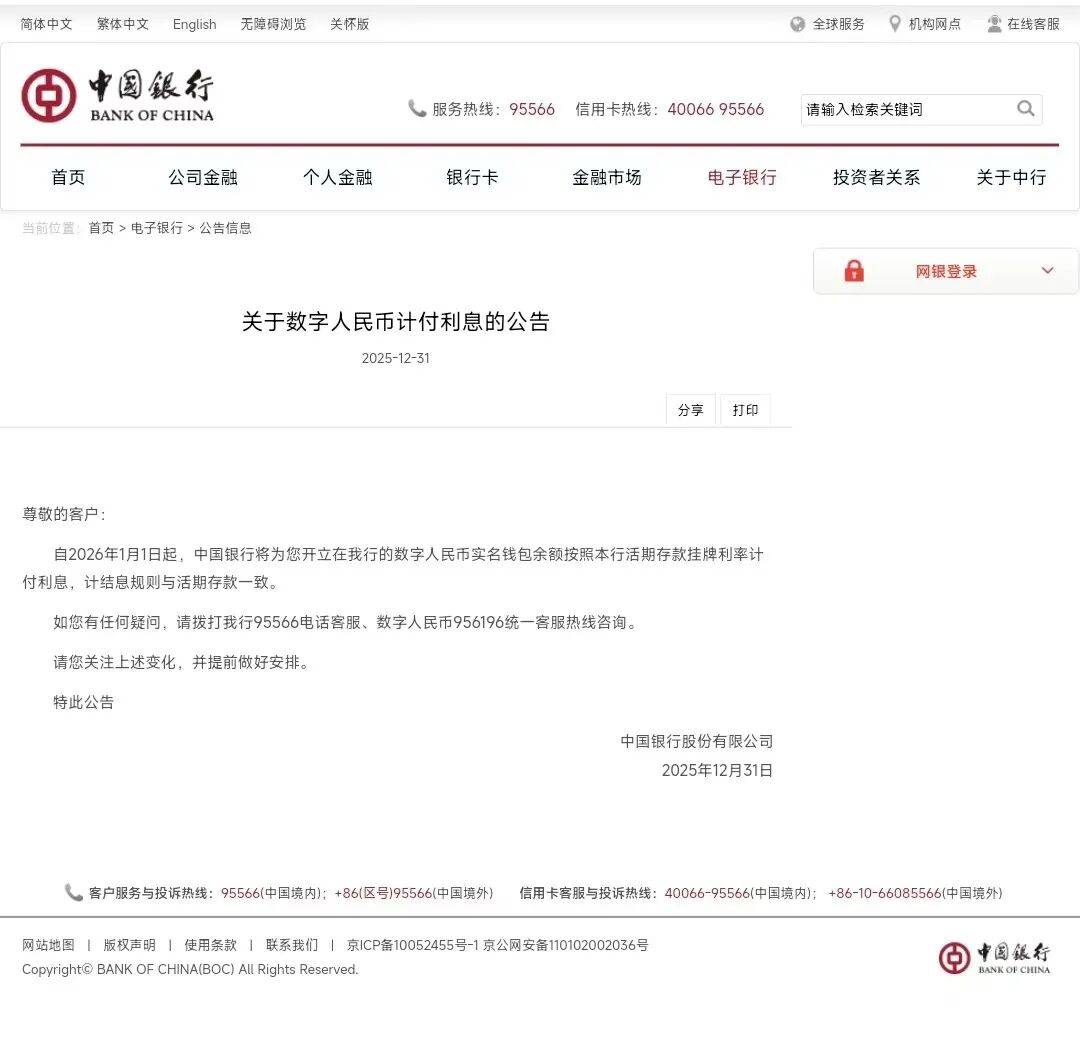
今年1月1日起 六大银行数字人民币计利息收益
Sou Hu Cai Jing· 2026-01-04 11:48
Group 1 - From January 1, 2026, digital RMB real-name wallet balances will earn interest based on the current demand deposit rate set by the respective banks, which is currently 0.05% [1] - The digital RMB is categorized into four types of wallets, with only the first three types (real-name wallets) eligible for interest, while the fourth type (anonymous wallet) will not earn interest [1] - The interest will be calculated according to the People's Bank of China’s demand deposit interest rules, with interest credited on the 20th of each quarter's last month [1] Group 2 - There are currently 10 designated operating institutions for digital RMB, including six state-owned commercial banks, two joint-stock commercial banks, and two internet banks [2] - The central bank is working on expanding the number of operating institutions and has introduced a new action plan to enhance the management and service system for digital RMB, set to be implemented on January 1, 2026 [2] - Banks will manage the digital RMB wallet balances autonomously and provide the same level of security as traditional deposits through deposit insurance [2]
中行宁夏分行迎来新任行长张广华 曾在巴西子行供职多年
Xin Lang Cai Jing· 2026-01-04 07:35
拉美绝大多数国家的官方语言都是西班牙语,巴西则是葡萄牙语国家。作为中国银行内小语种人才储 备,张广华于2011年调至巴西子行,并于2017年起担任该行行长,后当选巴西中资企业协会会长。在任 期间,他带领巴西分行服务中资企业,同时也服务本地企业,促进当地的经济发展。 在今年后半年中行人事调整中,中行宁夏分行行长肖达调任陕西省分行行长,张广华从巴西调回,接替 其职位上任;与此同时,原海口副市长陈劲松,接任中行巴西子行行长一职。 近几年,中行宁夏分行在前任行长肖达的带领下,在绿色金融和业务创新方面取得显著进展。数据显 示,2023年宁夏分行投放绿色贷款55亿元,2024年增至92.49亿元,占宁夏银行业近半数绿色信贷份 额;此外,肖达还主导落地了多项创新业务,包括宁夏首笔设备更新贷款(2024年)、房地产白名单项 目贷款(2024年)等等。 运营商财经网 张运迪/文 在前段时间中行人事变动中,宁夏分行迎来新任"一把手"张广华,吸引了运营商财经网的关注。 公开信息显示,张广华毕业于上海外国语大学葡萄牙语专业。在中国的教育体系中,英语是普遍要求的 第二语言,学习小语种的人较少。即使是在专门的外国语学院,每年招收的西班牙 ...
中行总行支付清算部新增副总胡新元 从波兰分行调回 这是平调?
Xin Lang Cai Jing· 2026-01-04 07:35
Core Viewpoint - The recent personnel adjustment at Bank of China (BOC) has drawn attention, particularly the appointment of Hu Xinyuan, the former head of the Poland branch, to the position of Deputy General Manager of the Payment and Clearing Department at the headquarters, indicating a strategic move to enhance the department's capabilities in international operations and innovation [1][3]. Group 1: Personnel Changes - Hu Xinyuan, a seasoned veteran of BOC with extensive experience in financial investment and international business, has been appointed as Deputy General Manager of the Payment and Clearing Department after serving as the head of the Poland branch [3]. - Liu Ming, the former Deputy General Manager of BOC's Shanxi Province branch, has been assigned to the Poland branch as its new head, marking a significant personnel shift within the bank [3]. Group 2: Departmental Insights - The Payment and Clearing Department is described as the "central nervous system" of BOC, responsible for managing internal and interbank payment and clearing operations, ensuring the safe, accurate, and timely flow of funds [3]. - The department recently underwent a significant personnel change with the former General Manager Fan Yaosheng being appointed as the head of the Macau branch, highlighting ongoing adjustments within the department's leadership [3]. Group 3: Future Implications - Hu Xinyuan's international experience is expected to bring new perspectives to the innovation and international operations of the Payment and Clearing Department, potentially enhancing its strategic direction [3].
2亿元 “耐心资本” 加码绿色创新 中行宁波市分行助力宁波实体经济产业升级
Zhong Guo Jin Rong Xin Xi Wang· 2026-01-04 07:21
Core Insights - China Bank's Ningbo branch successfully facilitated equity financing for a local "unicorn" enterprise, investing 200 million yuan to support the upgrade of the green technology innovation industry [1] - The "unicorn" company is a leading player in technological innovation and green petrochemical, included in the Hurun Research Institute's "2025 Global Unicorn List" [1] - The investment focuses on upgrading green and environmentally friendly chemical products, enhancing the company's research and application of green chemical technology [1] Group 1 - The unicorn enterprise has an integrated production chain and advanced green chemical manufacturing capabilities, with products used across various sectors including chemicals, dyeing, pharmaceuticals, food, precision electronics, and optics [1] - China Bank's Ningbo branch has been increasing financial support in technology innovation, green industries, and manufacturing, leveraging its global and comprehensive advantages to provide integrated services [1] - Following the expansion of the AIC equity investment pilot to Ningbo, the bank established the first AIC chain master merger fund in the country to promote AIC equity investment projects [1] Group 2 - In the next phase, China Bank's Ningbo branch will align with Ningbo's "14th Five-Year" development strategy to accelerate regional equity investment and broaden financial services throughout the enterprise lifecycle [2] - The focus will be on reinforcing the support of "long-term capital" and "patient capital" for local industrial upgrades, contributing to Ningbo's ambition to become a "champion city" in manufacturing [2]