Roborock(688169)

Search documents
财经观察美“扫地机器人鼻祖”破产,谁在重塑行业未来?
Huan Qiu Wang· 2025-12-24 22:39
Core Insights - iRobot, a pioneer in the robotic vacuum industry, has filed for bankruptcy due to rising costs and intensified global competition, leading to its acquisition by Chinese supplier Shenzhen Shanjun Robotics [1][2] - The situation reflects a significant restructuring within the global robotic vacuum industry, highlighting the challenges faced by American companies in the consumer electronics sector [1][3] Company Overview - iRobot, founded in 1990, was once a market leader with over 60% market share, particularly known for its Roomba vacuum [2] - The company has faced financial difficulties, with assets and liabilities between $100 million and $500 million, and has seen a workforce reduction of over 30% in the past three years [2][3] - iRobot's stock price plummeted over 70% following the bankruptcy announcement, with a market value decline of approximately 45% this year [2] Industry Dynamics - The U.S. robotic vacuum industry is experiencing systemic disconnection, with iRobot's management compensation misaligned with performance and increasing competition from more cost-effective and rapidly iterating products [3] - Trade policies, such as a 46% tariff on imports from Vietnam, have added approximately $23 million to iRobot's costs, further straining its operations [3] - Despite Roomba maintaining a 42% market share in the U.S. and 65% in Japan, the competitive landscape is shifting significantly [3] Chinese Market Position - Chinese manufacturers dominate the global robotic vacuum market, with companies like Roborock leading in shipments, accounting for 21.7% of the market [4][5] - The Chinese robotic vacuum industry is characterized by high growth, with exports expected to increase by over 20% this year, and a diverse product range across various price segments [5][6] - Chinese brands are gaining traction in Europe, with high consumer ratings and significant market presence, particularly during the holiday shopping season [7][8] Technological Advancements - The rapid iteration of technologies such as laser navigation and AI in Chinese products has addressed earlier shortcomings in user experience, driving demand [6] - Chinese companies hold over 90% of global patents in the robotic vacuum sector, positioning them as leaders in research and development [6] Consumer Trends - European consumers are increasingly favoring Chinese robotic vacuums for their high technology content and competitive pricing, with many considering them as primary gift options [7][8] - The supply chain efficiency of Chinese manufacturers, coupled with improved logistics, has enhanced their competitiveness in international markets [9]


【财经观察】美“扫地机器人鼻祖”破产,谁在重塑行业未来?
Huan Qiu Shi Bao· 2025-12-24 22:36
Core Insights - iRobot, a pioneer in the robotic vacuum industry, has filed for bankruptcy due to rising costs and intensified global competition, leading to its acquisition by Chinese supplier Shenzhen Shanjun Robotics [1][2] - The situation of iRobot reflects a significant restructuring within the global robotic vacuum industry under consumer electronics logic, highlighting a four-year innovation gap compared to Chinese competitors [1][2] Company Overview - iRobot, co-founded in 1990, launched the Roomba in 2002, establishing itself as a market leader with over 60% market share at its peak [2] - The company has faced financial difficulties, with assets and liabilities between $100 million and $500 million, and has laid off over 30% of its workforce in the past three years [2][3] - iRobot's stock price plummeted over 70% following the bankruptcy announcement, with a market value decline of approximately 45% this year [2] Industry Dynamics - The U.S. robotic vacuum industry is experiencing systemic disconnection, with iRobot's management compensation misaligned with performance and increasing competition from cost-effective, rapidly iterating products [3] - Supply chain issues and high tariffs on imports from Vietnam have added approximately $23 million in costs for iRobot, further straining its operations [3] - Despite Roomba maintaining a market share of about 42% in the U.S. and 65% in Japan, the competitive landscape is shifting significantly [3] Chinese Market Position - Chinese manufacturers dominate the global robotic vacuum market, with companies like Roborock leading in shipments, accounting for 21.7% of the market share [4][5] - The Chinese robotic vacuum industry is characterized by high growth, with exports expected to increase by around 20% this year, and a diverse product range across various price segments [5][6] - Chinese brands are gaining popularity in Europe, with high consumer ratings and significant market presence, particularly during the holiday shopping season [7][8] Technological Advancements - The rise of Chinese robotic vacuum manufacturers is attributed to rapid advancements in laser navigation, AI technology, and a complete supply chain that enhances manufacturing efficiency and cost-effectiveness [6][9] - Chinese companies hold over 90% of global patents in the robotic vacuum sector, positioning them as leaders in research, manufacturing, and market share [6] Consumer Trends - European consumers are increasingly favoring Chinese robotic vacuums for their high technology content and competitive pricing, with many considering them as primary gift options during the holiday season [7][8] - The supply chain maturity of Chinese manufacturers allows for faster delivery times, enhancing their appeal to European distributors [9]
iRobot负债危机背后 中国服务机器人如何破局全球竞争
Nan Fang Du Shi Bao· 2025-12-24 15:57
Core Viewpoint - iRobot has entered into a restructuring support agreement with its lender and major supplier, Shenzhen Sanchuan Robotics, which will acquire iRobot through a court-supervised process, leading to iRobot becoming a wholly-owned private company and delisting from stock exchanges [1] Group 1: iRobot's Decline - At its peak, iRobot held an 80% global market share and sold over 50 million units, but has since lost its dominant position due to over-reliance on a single product category and lack of innovation [2] - iRobot's early patent advantages have diminished as competition from Chinese companies has intensified, leading to significant market pressure [2] - The company has lagged in adopting new technologies, such as laser radar and SLAM, while competitors have introduced innovative features, resulting in a decline in product appeal [2][4] Group 2: Supply Chain and Manufacturing Issues - iRobot's dependence on a single manufacturing partner has weakened its supply chain resilience and quality control, contributing to its operational difficulties [3] - The company's cost structure is adversely affected by its reliance on external suppliers for core components, leading to longer product development cycles and reduced competitiveness [6] Group 3: Competitive Landscape - Chinese companies like Ecovacs and Roborock have adopted a full-stack approach, integrating manufacturing and supply chain capabilities, which has allowed them to maintain cost advantages and higher profit margins compared to iRobot [4][5] - Ecovacs has significantly reduced its bill of materials (BOM) costs to below $110 per unit, while iRobot's costs are around $140 per unit, allowing Ecovacs to price its products more competitively [4] Group 4: Innovation and Market Trends - The shift in the cleaning appliance market is moving from "incremental proliferation" to "stock competition," with emerging categories like floor washing machines and window cleaning robots showing higher growth rates than traditional vacuum robots [6] - Ecovacs and Roborock have expanded their product lines to include various cleaning devices, resulting in substantial revenue growth, while iRobot has struggled to innovate and diversify its offerings [6][8] Group 5: R&D Investment and Technological Advancements - Chinese brands have significantly increased their R&D investments, with Ecovacs and Roborock each planning to spend nearly $1.5 billion in 2024, which is a 56.93% increase year-on-year [7] - The focus on R&D has led to breakthroughs in technology, allowing Chinese companies to file over 5,000 patents related to cleaning robots, establishing a strong technological barrier [8]
内销大盘符合预期,两轮车补库在即
Orient Securities· 2025-12-23 08:16
Investment Rating - The report maintains a "Positive" outlook for the home appliance industry, indicating a relative strength of over 5% compared to the market benchmark index [5]. Core Insights - The domestic sales performance aligns with expectations, with a gradual transition into a post-subsidy era in 2026. In November 2025, home appliance sales reached 10.49 million units, down 31.8%, with domestic sales at 4.05 million units, down 39.8%, and exports at 6.44 million units, down 25.6% [7]. - The new national standard for electric two-wheelers is being implemented, with a significant inventory replenishment expected in the first half of 2026. The new models are being introduced, and a concentrated restocking period is anticipated [7]. - Key players in the cleaning appliance sector are undergoing ownership changes, which may impact market dynamics. iRobot is undergoing bankruptcy restructuring, while the founder of追觅科技 is acquiring a controlling stake in 嘉美包装 [7]. Summary by Sections Domestic Market Performance - The domestic market is experiencing a decline, which was anticipated. The central economic work conference confirmed the continuation of national subsidy policies into 2026, with adjustments expected to enhance service consumption [3][7]. Electric Two-Wheelers - The implementation of the new national standard for electric two-wheelers began on September 1, 2025, leading to the cessation of production and sales of old standard models. A significant inventory depletion is expected by the end of December 2025, with new models set to launch soon [7]. Key Players and Market Changes - iRobot's bankruptcy restructuring is expected to maintain brand operations but may not significantly alter market dynamics. The acquisition of 嘉美包装 by 追觅科技's founder could lead to strategic shifts in the cleaning appliance sector [7].




技术筑壁垒、全球赢口碑,石头科技荣获“年度品牌价值奖”
Ge Long Hui· 2025-12-23 07:31
Core Insights - Stone Technology has won the "Annual Brand Value Award" in the 2025 "Golden Grid Award - Annual Excellence Company" list, highlighting its brand differentiation, market reputation, and user recognition [1] - The award reflects the company's long-term operational capabilities and core competitiveness, especially as the smart cleaning appliance industry shifts from "parameter competition" to "value competition" [1] Group 1: Brand Value Foundation - The brand value of Stone Technology is primarily built on long-term commitment to technological research and development, with a core team from renowned tech companies like Microsoft, Huawei, and Intel [2] - From 2016 to 2024, the company invested a total of 3.238 billion yuan in R&D, with 1.028 billion yuan in the first three quarters of this year, marking a year-on-year increase of 60.56% [2] - The R&D investment as a percentage of revenue has consistently been at a leading level in the industry, resulting in a series of innovative products and technological achievements [2] Group 2: Market Validation of Brand Value - In the domestic market, during the 2025 "Double Eleven" shopping festival, Stone Technology held a 34.75% market share in the robotic vacuum segment and 25.02% in the washing machine segment [3] - From October 9 to November 11 this year, the net sales of the brand's vacuum cleaners increased nearly 23 times year-on-year [3] - Globally, the company’s products are available in over 170 countries and regions, serving more than 20 million households, with a shipment of 3.788 million robotic vacuums in the first three quarters, securing a 21.7% global market share [3] Group 3: Global Expansion and Brand Influence - Stone Technology has expanded its product line to include washing machines and other smart home appliances, enhancing its market position and overall brand value [4] - The company is well-positioned to benefit from the global market's growth, with data indicating a rise in both volume and price for overseas robotic vacuums [5] - The brand's competitive edge is reinforced by its full-channel layout, localized operational strategies, and product innovation, maintaining a leading position in the global robotic vacuum market [6] Group 4: Future Growth Opportunities - Stone Technology is expected to continue growing as a leading Chinese brand in the global market, with its brand value anticipated to rise [7] - The company is poised to enjoy the beta benefits of the expanding global smart home market, balancing brand marketing and R&D investments to maintain its technological advantage [7] - The potential for revaluation of the company’s stock is significant as it transitions from a niche appliance brand to a mainstream technology brand [7]
技术筑壁垒、全球赢口碑,石头科技(688169.SH)荣获“年度品牌价值奖”
Ge Long Hui· 2025-12-23 07:23
Core Insights - Stone Technology has won the "Annual Brand Value Award" in the 2025 "Golden Grid Award - Annual Excellence Company" list, highlighting its brand differentiation, market reputation, and user recognition [1] - The award reflects the company's long-term operational capabilities and core competitiveness, especially as the smart cleaning appliance industry shifts from "parameter competition" to "value competition" [1] Group 1: Brand Value Foundation - The brand value of Stone Technology is primarily built on its long-term commitment to technological research and development, with a core team from renowned tech companies like Microsoft, Huawei, and Intel [3] - From 2016 to 2024, the company invested a total of 3.238 billion yuan in R&D, with 1.028 billion yuan in the first three quarters of this year, marking a year-on-year increase of 60.56% [3] - The R&D investment as a percentage of revenue has consistently been at a leading level in the industry, resulting in a series of innovative products and technological achievements [3] Group 2: Market Validation of Brand Value - In the domestic market, during the 2025 "Double Eleven" shopping festival, Stone Technology held a 34.75% market share in the robotic vacuum segment and 25.02% in the washing machine segment [4] - The company's global product reach extends to over 170 countries and regions, serving more than 20 million households, with a global shipment of 3.788 million smart robotic vacuums in the first three quarters, securing a 21.7% market share [4] - The brand's recognition is further validated by significant sales growth, with vacuum cleaner net sales increasing nearly 23 times from October 9 to November 11 this year [4] Group 3: Global Competitive Landscape - Stone Technology has evolved into a global smart home appliance brand, with a focus on robotic vacuums and washing machines, leveraging core technology and brand influence to meet diverse cleaning needs [6] - The company is positioned to benefit from the competitive landscape as international brands like iRobot exit the market, allowing Chinese brands to capitalize on growth opportunities [6] - The brand's comprehensive channel strategy and localized operations have solidified its leading position in the global robotic vacuum market [7] Group 4: Future Growth Opportunities - Stone Technology's expansion into new product categories is strategic, enhancing its market position and overall brand value [6] - The company is expected to continue enjoying high growth in overseas markets, particularly as consumer preferences shift towards upgrading products [6] - The focus on localized marketing and high-end product differentiation in markets like South Korea demonstrates the company's commitment to meeting regional consumer demands [7][8]
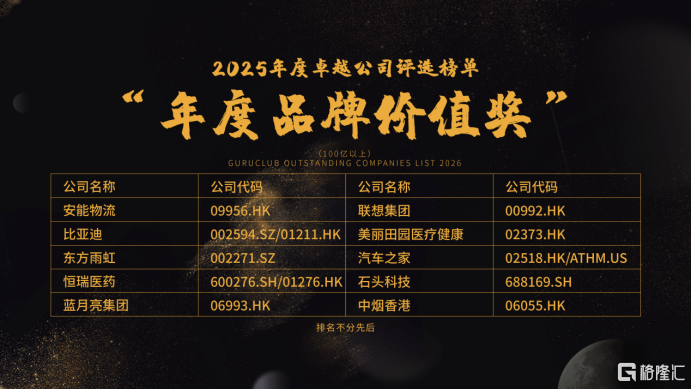
格隆汇“科技赋能·资本破局”线上分享会暨“金格奖”——“年度品牌价值奖(大市值)”奖项揭晓:安能物流(09956.HK)、比亚迪(002594.SZ/01211.HK)、东方雨虹(002271.SZ)等10家企业上榜
Ge Long Hui· 2025-12-22 11:30
Core Insights - The "Golden Award" annual outstanding company selection by Gelonghui will reveal a list of notable companies, including Aneng Logistics, BYD, Oriental Yuhong, and others, recognized for their brand value in the capital market [1] - The "Annual Brand Value Award (Large Market Capitalization)" aims to honor companies with the highest brand value, emphasizing the importance of brand differentiation, recognition, and customer loyalty [1][2] Group 1: Award Recipients - Ten companies received the "Annual Brand Value Award (Large Market Capitalization)" including Aneng Logistics (09956.HK), BYD (002594.SZ/01211.HK), and Lenovo Group (00992.HK) [1] - The award selection process involved quantitative data analysis and expert review to determine the final results [1] Group 2: Evaluation Criteria - The evaluation of brand value considered multiple factors such as brand differentiation, recognition, and customer loyalty [1] - The aim of the award is to create a reference for the most valuable listed companies and unicorns in the investment community [2]




人形机器人参演演唱会“火力全开” 机器人指数ETF(560770)涨近2%
2 1 Shi Ji Jing Ji Bao Dao· 2025-12-22 06:31
Group 1 - The market showed a significant recovery on December 22, with the Robotics Index ETF (560770) rising by 1.84%, and key component stocks such as Siasun Robot & Automation Co., Ltd. increasing by 10.35% [1] - The introduction of the Yushutech G1 humanoid robot at Wang Leehom's concert in Chengdu on December 18 marked the world's first concert featuring a robot on stage, performing "Firepower Fully Open" [1] - Tesla released an annual report video on December 19 showcasing rapid technological advancements of its humanoid robot, Optimus, from basic movements to complex interactions over the past year [1] Group 2 - CITIC Securities highlighted the ongoing overseas capacity planning in the robotics supply chain, suggesting a focus on high-quality segments as mass production approaches [1] - The Trump administration's emphasis on the development of the robotics sector is expected to elevate the strategic importance of the U.S. robotics industry, with potential positive implications for domestic policies [1] - The robotics sector is anticipated to experience a resurgence following previous corrections, with upcoming events such as Gen3 launches, new product releases, and Yushutech's IPO progress being key catalysts to watch [1] Group 3 - The Robotics Index ETF (560770) tracks the CSI Robotics Index, which includes top ten component stocks such as iFlytek, Huichuan Technology, Top Group, Dahua Technology, Roborock, Dazhong Laser, and others, covering various segments of the robotics industry [2]


石头科技跌2.01%,成交额3.90亿元,主力资金净流入552.73万元
Xin Lang Cai Jing· 2025-12-22 06:30
Core Viewpoint - Stone Technology's stock has experienced fluctuations, with a recent decline of 2.01% and a total market value of 39.918 billion yuan. The company primarily focuses on the design, research, development, production, and sales of smart cleaning robots and related hardware [1]. Financial Performance - As of September 30, 2025, Stone Technology reported a revenue of 12.066 billion yuan, reflecting a year-on-year growth of 72.22%. However, the net profit attributable to shareholders decreased by 29.51% to 1.038 billion yuan [2]. - The company has distributed a total of 1.463 billion yuan in dividends since its A-share listing, with 1.052 billion yuan distributed over the past three years [3]. Shareholder Structure - The number of shareholders decreased by 8.77% to 15,900, while the average number of tradable shares per person increased by 9.76% to 16,251 shares [2]. - Among the top ten circulating shareholders, Hong Kong Central Clearing Limited is the second-largest, holding 14.5491 million shares, an increase of 4.4262 million shares from the previous period. Other notable shareholders include E Fund's ETFs, with varying changes in their holdings [3]. Stock Performance - Year-to-date, Stone Technology's stock price has declined by 1.18%, with a recent increase of 0.90% over the last five trading days. However, it has seen a significant drop of 27.15% over the past 60 days [1].
家电行业2025W50周报:家空内外销均有所承压,iRobot官宣破产重组-20251221
GUOTAI HAITONG SECURITIES· 2025-12-21 11:36
Investment Rating - The industry investment rating is "Overweight" [5] Core Insights - The home appliance industry is experiencing pressure in both domestic and international sales, with iRobot announcing bankruptcy restructuring, which will be acquired by Chinese manufacturer Shanjun Robotics [2][5] - In November, the retail sales of home appliances and audio-visual equipment reached 100 billion yuan, a year-on-year decline of 19.4%, while the cumulative annual sales reached 1,074.9 billion yuan, with a year-on-year increase of 14.8% [5] - The production and sales data for home air conditioners in November showed a production of 10.577 million units, a year-on-year decrease of 36.7%, and sales of 10.492 million units, a year-on-year decrease of 31.8% [5] Summary by Sections Investment Recommendations - Key drivers for investment include overseas expansion and smart home technology, recommending leading companies in the robotic vacuum sector: Roborock (21.1X 2025 PE) and Ecovacs (21.5X) [5] - Companies with stable performance and upward potential include Ninebot (20.6X), Anfu Technology (41.7X), Hailong Cold Chain (14.6X), and Beiding Co. (30.4X) [5] - For companies with robust operations and high dividends, recommendations include TCL Electronics (12.2X), Hisense Visual (12.9X), Midea Group (13.5X), and Haier Smart Home (12.2X) [5] - Companies diversifying into new sectors include Rongtai Health (18.7X) and Wanlong Magnetic Plastic (18.9X) [5] Market Performance - The retail sales growth rate further narrowed in November, with the total retail sales of consumer goods reaching 43,898 billion yuan, a year-on-year increase of 1.3% [5] - The domestic market faces pressure from the decline in national subsidies and high base effects, while the export market is constrained by high base effects and inventory reduction in some overseas markets [5] Company Developments - iRobot has announced its bankruptcy and will be acquired by Shanjun Robotics, with the restructuring process expected to be completed by February 2026 [5] - The founder of Chasing Technology, Yu Hao, plans to acquire 54.90% of Jiamei Packaging, with a total transaction value of approximately 2.282 billion yuan [5]