Cambricon(688256)

Search documents
赵健:AI芯片是现代科技与数字经济的核心基石
Xin Lang Cai Jing· 2026-01-29 12:52
Core Viewpoint - The event "China Economic Praise - Entrepreneur Night" held on January 29 in Beijing recognized representatives from the "China Chip Infrastructure" sector, highlighting the importance of AI chips in driving China's economic transformation and high-quality development [1][5]. Group 1: Event Overview - The "China Economic Praise - Entrepreneur Night" took place in Beijing, honoring representatives from AI chip companies [1][5]. - Key figures present included Zhao Jian, President of the China Economic Media Association, and Yang Yudong, Editor-in-Chief of Yicai [1][5]. Group 2: Significance of AI Chips - AI chips are described as the core foundation of modern technology and the digital economy, essential for supporting rapid development in artificial intelligence, high-performance computing, and automotive electronics [2][3]. - The Chinese semiconductor industry aims to establish a self-controlled computing foundation by 2025, which is crucial for driving economic transformation and high-quality development [2][3][8]. Group 3: Characteristics of AI Chip Companies - AI chip companies are characterized by youthful teams, specialized technology, a mission for domestic substitution, and continuous innovation investment [2][3]. - These companies are rapidly emerging through architectural innovation, ecosystem building, and practical application, supported by policies and capital [2][3].


我国发现顶级寒武纪软躯体化石群 揭示显生宙首次生物大灭绝关键转折
Zhong Guo Qing Nian Bao· 2026-01-29 10:44
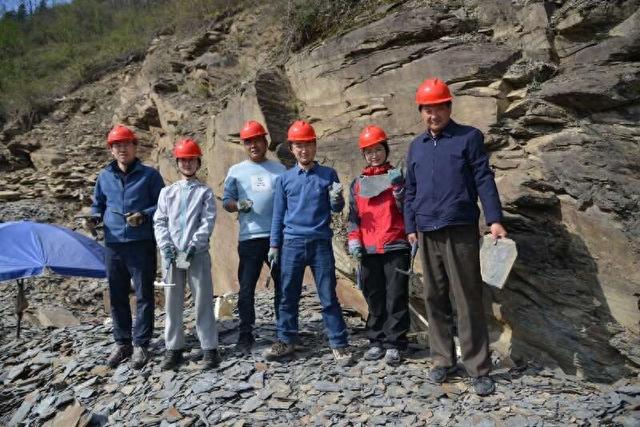
团队从单一采坑中累计采集了超过5万件化石标本,鉴定出153个动物物种,其中59%为前所未见的新物 种,涵盖16个动物门类。尤为珍贵的是,大量化石精美保存了消化、神经、呼吸系统等软躯体生物学结 构。这一化石群展现了一个具有复杂食物网和生物碳循环机制的深水动物群落。其高化石丰富度、高物 种多样性、高软躯体保真度以及复杂的生态系统特征,使其足以媲美著名的云南澄江动物群和加拿大布 尔吉斯页岩生物群,成为全球又一顶级软躯体化石宝库。 "花垣生物群"所处的时代具有特殊意义,它正好位于寒武纪生命大爆发被显生宙第一次生物大灭绝—— 即"辛斯克事件"——打断之后的关键转折期。这使得它成为揭示该次大灭绝事件规模与影响的独一无二 的窗口。 通过将花垣生物群与全球寒武纪软躯体生物群进行大数据对比分析,研究团队发现,在这次大灭绝事件 前后,全球海洋生态系统的动物群组成面貌发生了重大转折。研究表明,大灭绝之后,许多海洋动物曾 进行跨越大半个地球的扩散,更新了科学界对寒武纪生物地理分布的认知。 中国青年报客户端南京1月29日电(中青报·中青网记者 谭思静)中国科学家在湘西发现了一个保存极其 完好、物种丰富的寒武纪软躯体化石库——"花垣生物 ...

字节已开启豆包手机助手正式版项目,AI人工智能ETF(512930)日均成交2.41亿
Xin Lang Cai Jing· 2026-01-29 05:48
Group 1 - The core viewpoint of the news highlights the performance of the AI-themed index and ETF, with notable gains in specific stocks like iFlytek and Kunlun Wanwei, while the AI ETF shows significant trading volume and growth in assets [1][2] - As of January 28, the AI-themed ETF has a total asset size of 34.06 billion yuan, with a recent increase of 2.24 million shares over the past six months, indicating strong investor interest [1][2] - The AI-themed index consists of 50 companies involved in providing resources, technology, and application support for artificial intelligence, with the top ten stocks accounting for 58.08% of the index [2] Group 2 - The storage chip supply tightness and price increases driven by the AI infrastructure boom are expected to persist until 2027, potentially leading to a systematic upcycle in the chip industry [2] - Domestic chip manufacturers are expected to raise prices, reflecting enhanced pricing power and accelerated localization, which may improve gross margins and cash flow, supporting R&D and expansion [2] - The AI ETF closely tracks the performance of the AI-themed index, which is designed to reflect the overall performance of listed companies in the AI sector [2]






阿里自研高端AI芯片“真武”亮相!涨价潮蔓延,“全芯”科创芯片ETF(589190)水下溢价高企,彰显高人气
Xin Lang Cai Jing· 2026-01-29 03:29
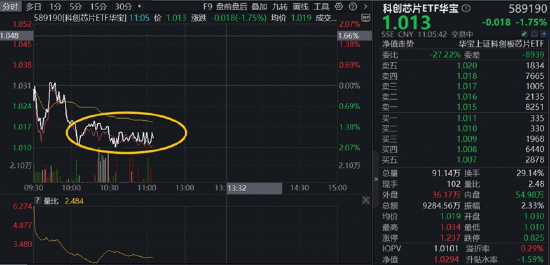
Core Viewpoint - The semiconductor sector is experiencing a short-term pullback, with the Huabao ETF (589190) showing a decline of 1.75% after an initial rise, indicating active buying interest during dips [1][11]. Group 1: Market Performance - The semiconductor sector shows mixed performance, with leading companies like Zhongwei, Lanke Technology, and SMIC experiencing declines of over 4% and 3% respectively [3][11]. - The Huabao ETF tracks the Shanghai Stock Exchange's semiconductor index, which includes 50 companies across various semiconductor sectors, maintaining a high technology barrier and significant weight in core areas [4][14]. Group 2: Price Adjustments - A new wave of price increases in the semiconductor industry has been reported, with Samsung and SK Hynix raising prices for LPDDR memory used in iPhones by over 80% and nearly 100% respectively [3][13]. - Domestic companies like Zhongwei Semiconductor and Guokewai have announced price hikes for MCU and Norflash products ranging from 15% to 50%, and KGD products by 40% to 80% [3][13]. Group 3: Future Outlook - CITIC Securities forecasts a high certainty in computing power development by 2026, highlighting opportunities in super-node technology and the competitive strength of domestic computing power manufacturers [3][13]. - Donghai Securities anticipates significant growth in the performance of domestic A-share companies related to AI by 2025, recommending a focus on computing power chips, semiconductor equipment, and storage [3][13]. Group 4: Index Performance - As of the end of 2025, the annualized return of the Shanghai Stock Exchange's semiconductor index is 17.93%, outperforming similar indices and showing a better risk-return profile [6][16]. - The index has shown varying annual performance, with a notable increase of 61.33% projected for 2025 [6][17].




资金风向标 | 28日两融余额增加192.52亿元 有色金属行业获融资净买入居首
Sou Hu Cai Jing· 2026-01-29 01:50
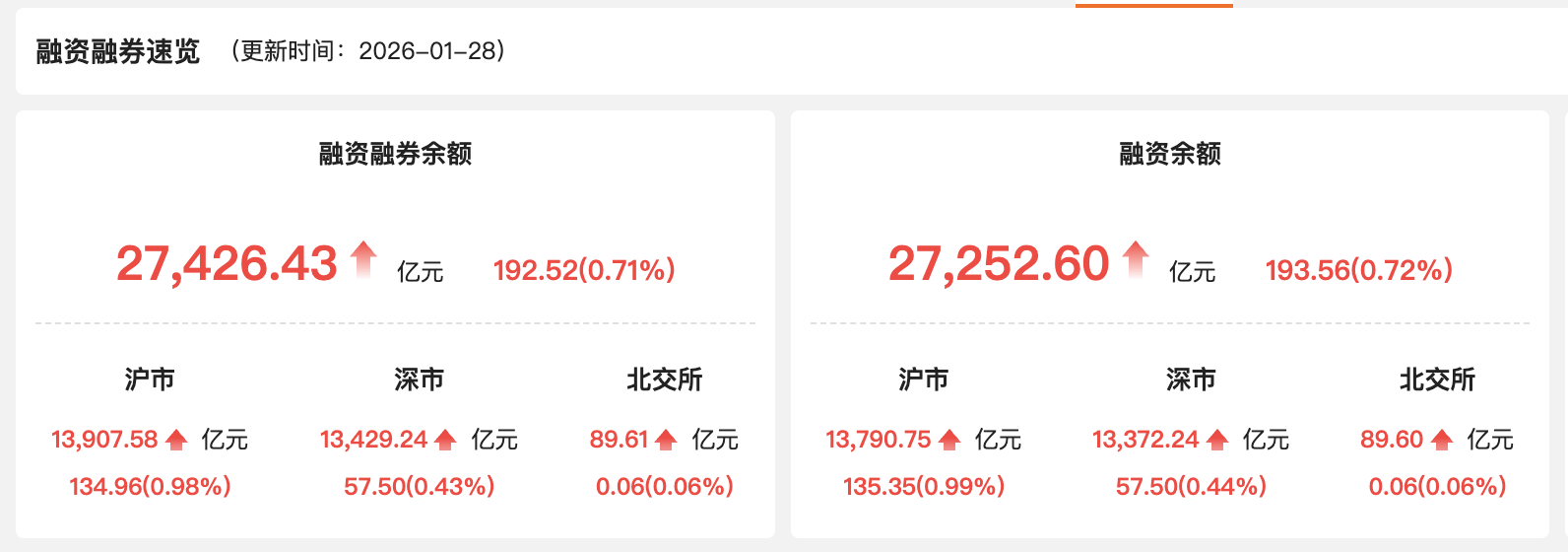
Group 1 - The total margin balance of A-shares reached 27,426.43 billion yuan on January 28, an increase of 192.52 billion yuan from the previous trading day, accounting for 2.63% of the A-share circulating market value [1] - The trading volume of margin financing on the same day was 2,963.24 billion yuan, which is an increase of 168.28 billion yuan from the previous trading day, representing 9.90% of the total A-share trading volume [1] Group 2 - Among the 31 primary industries in Shenwan, 27 industries experienced net financing inflows, with the non-ferrous metals industry leading with a net inflow of 5.968 billion yuan [3] - Other industries with significant net financing inflows include telecommunications, computers, construction decoration, non-bank financials, and pharmaceuticals [3] Group 3 - A total of 64 stocks had net financing inflows exceeding 100 million yuan, with Zijin Mining leading at 1.471 billion yuan [3] - Other notable stocks with high net financing inflows include Tianfu Communication, China Ping An, Wangsu Science and Technology, Hengyun Chang, Changjiang Electric Power, Kweichow Moutai, Jiangxi Copper, Cambricon, and Northern Rare Earth [3] Group 4 - The top stocks by net financing inflow on January 28 are as follows: 1. Zijin Mining: 1,470.57 million yuan 2. Tianfu Communication: 825.18 million yuan 3. China Ping An: 792.95 million yuan 4. Wangsu Science and Technology: 747.54 million yuan 5. Hengyun Chang: 656.63 million yuan 6. Changjiang Electric Power: 429.54 million yuan 7. Kweichow Moutai: 397.22 million yuan 8. Jiangxi Copper: 375.39 million yuan 9. Cambricon: 363.92 million yuan 10. Northern Rare Earth: 340.54 million yuan [4]




公募FOF四季度加仓了哪些基金?【国信金工】
量化藏经阁· 2026-01-29 00:09
Overview of Public FOF Funds in Q4 2025 - As of Q4 2025, there are 549 FOF products in the market with a total scale of 244.188 billion yuan, an increase of 26.20% compared to Q3 2025 [1][2] - FOFs are categorized into three types based on the proportion of equity assets: bond-type FOFs (less than 30%), balanced FOFs (30% to 60%), and equity-type FOFs (more than 60%) [3] - The scale of bond-type FOFs reached 161.113 billion yuan, accounting for 65.98% of the total market FOF scale, which has been increasing since Q1 2024 [4] FOF Fund Manager Preferences - The top three actively managed equity funds with the most FOF holdings are: 1. Fuquan Stable Growth A (31 FOFs) 2. Boda Jiuhang C (22 FOFs) 3. Zhongou Dividend Enjoyment A (21 FOFs) [20] - The largest FOF holdings by scale are: 1. Xingquan Business Model Preferred A (4.77 billion yuan) 2. Yifangda Information Industry Selected C (3.65 billion yuan) 3. Yifangda Kerong (3.59 billion yuan) [20] Changes in FOF Fund Manager Allocations - In Q4 2025, the most net increased actively managed equity funds by FOFs are: 1. Yifangda Reform Dividend (4 FOFs) 2. Jingshun Longcheng Stable Return C (3 FOFs) 3. Zhongou Small Cap Growth C (3 FOFs) [33] - The largest net increase in scale for actively managed equity funds is for Jingshun Longcheng Stable Return C (0.66 billion yuan) [34] FOF Stock Investment Situation - By Q4 2025, 168 FOFs directly invested in stocks, with the highest proportion in balanced FOFs, followed by equity-type FOFs [1] - The top three stocks held by FOFs are: 1. Zijin Mining 2. Ningde Times 3. Hanwujing-U [1] Performance of Different Types of FOFs - In Q4 2025, the median returns for different types of FOFs are: - Bond-type FOFs: 0.33% - Balanced FOFs: -0.64% - Equity-type FOFs: -1.21% [13] - The top-performing bond-type FOFs in Q4 2025 are: 1. Tianhong Pension Target 2030 One-Year Holding (2.92%) 2. Ping An Yingyue Stable Return One-Year Holding A (1.81%) 3. Guotai Ruiyue Three-Month Holding (1.80%) [15][16] FOF Configuration by Fund Managers - The top three fund managers with the most FOF configurations in Q4 2025 are: 1. Yang Meng 2. Fan Yan 3. Liu Jianwei [1] - The most configured bond-type fund is Guangfa Pure Bond A, held by 32 FOFs [27]




去年末上市公司市值中位数同比提升近三成 百亿元以上市值公司新增427家
Zhong Guo Zheng Quan Bao· 2026-01-28 23:58
Group 1 - In 2025, the number of companies with a market capitalization exceeding 1 trillion yuan increased by 1, while those exceeding 100 billion yuan increased by 427, and companies with a market capitalization below 20 million yuan decreased by 379 [1] - By the end of 2025, the median market capitalization of listed companies reached 6.508 billion yuan, reflecting a nearly 30% year-on-year increase [1] - The total number of listed companies in the domestic stock market reached 5,477, with 2,302 on the Shanghai Stock Exchange, 2,887 on the Shenzhen Stock Exchange, and 288 on the Beijing Stock Exchange [1] Group 2 - The proportion of state-controlled listed companies is 27%, while privately controlled companies account for 63%, with manufacturing companies dominating at 3,743 [2] - In 2025, the manufacturing sector saw a net increase of 91 companies, primarily in the electrical, electronic, and communication sectors, while the real estate sector saw a net decrease of 6 companies [2] - By the end of 2025, the total market capitalization of domestic listed companies approached 109 trillion yuan, marking the highest point in the last five years [2]

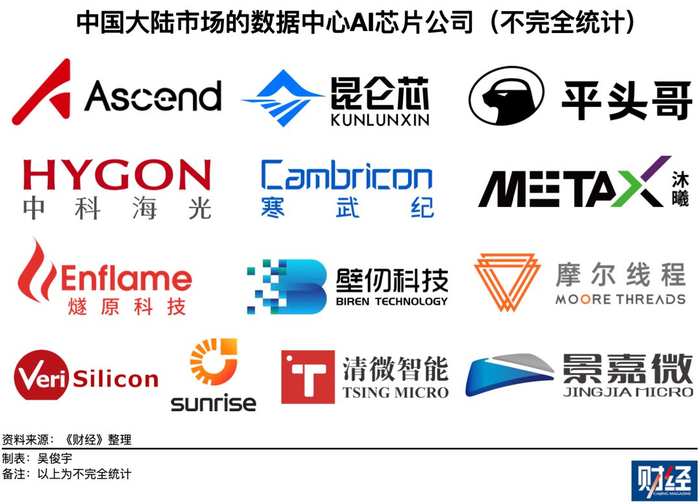
九家中国AI芯片公司出货量超万卡,华为昇腾等领跑
Cai Jing Wang· 2026-01-28 14:05
Core Viewpoint - The self-sufficiency process of domestic AI chips in China is accelerating, with at least nine companies exceeding 10,000 units in shipment or orders [1] Group 1: Company Performance - Domestic AI chip brands include Huawei Ascend, Baidu Kunlun, Alibaba Pingtouge, and Cambricon, among others [1] - Companies with significant shipment volumes have reached a cumulative shipment level of 100,000 units [1] - Smaller AI chip companies, such as Sunrise and Qingwei Intelligent, are projected to exceed 10,000 units in shipment or orders by 2025 [1] Group 2: Market Landscape - The market features a mix of established tech giants and emerging startups in the AI chip sector [1] - Companies like Cambricon, Muxi, Tianshu Zhixin, and Suiruan Technology are either publicly listed or preparing for an IPO [1]


马云李彦宏,把最烧钱的业务送上IPO
3 6 Ke· 2026-01-28 10:27
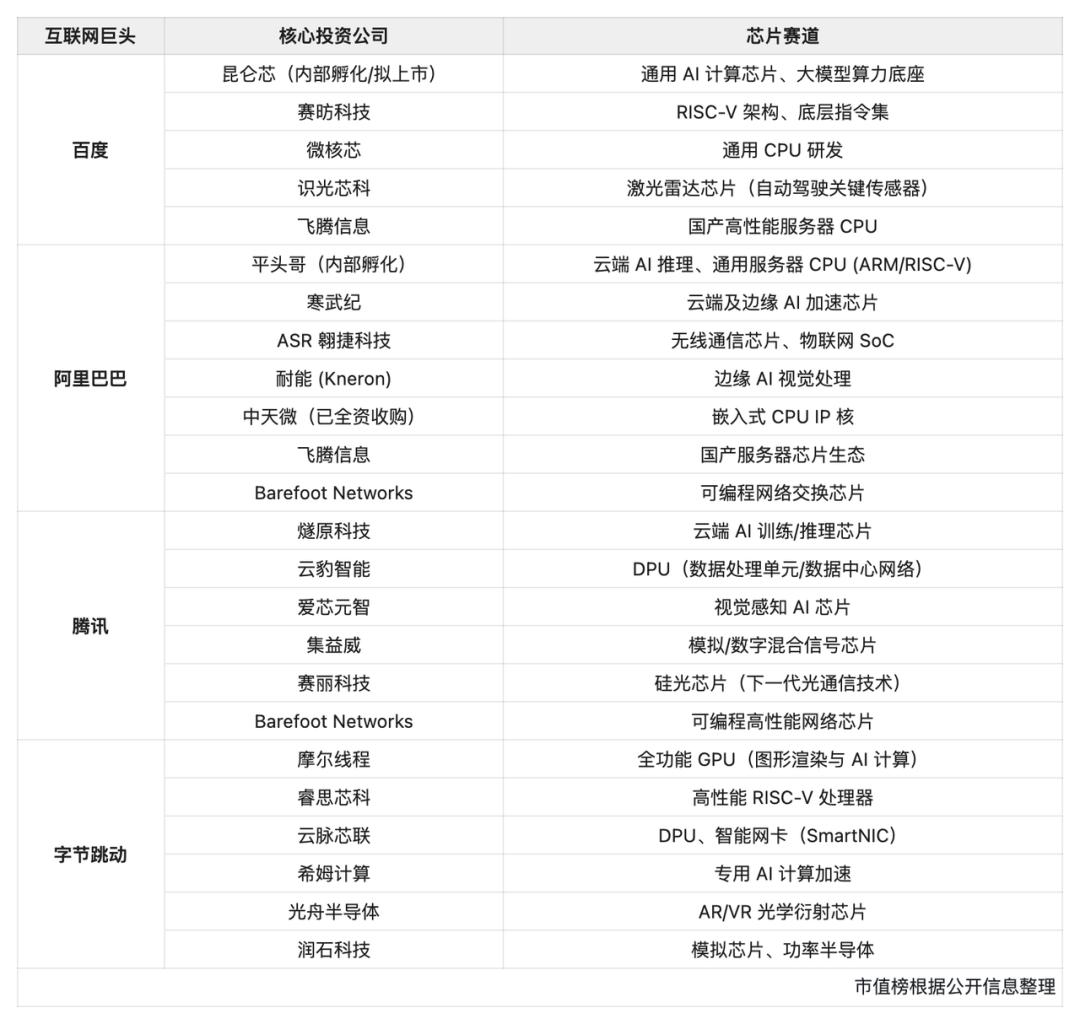
Core Viewpoint - The independent listing process of major internet companies' chip businesses has accelerated, indicating a shift towards commercialization in the chip industry driven by AI demand and geopolitical factors [1][2]. Group 1: Background and Development of Chip Manufacturing - The wave of chip manufacturing by internet giants began in 2018, driven by geopolitical tensions and the surge in AI computing power demand [2][8]. - Major companies like Baidu, Alibaba, and Tencent initially developed chips to support their core businesses but are now transitioning to independent commercial viability [2][3]. - Baidu was the first among internet giants to enter the chip market, establishing a chip R&D team in 2011 and launching its first AI chip, Kunlun, in 2018 [5][4]. Group 2: Current Market Dynamics and Future Prospects - The shift from internal support tools to competitive commercial products is crucial for the valuation and long-term growth of these chip companies post-IPO [3]. - Kunlun is expected to achieve revenue growth from 2 billion RMB in 2024 to over 3.5 billion RMB in 2025, with over half of its revenue coming from external sales [14]. - Alibaba's chip subsidiary, Pingtouge, has developed a comprehensive product line and is expected to continue expanding its market presence [15]. Group 3: Competitive Landscape and Market Share - Domestic AI chip manufacturers are rapidly increasing their market share, with local brands like Huawei's Ascend leading the market [16]. - The domestic AI chip market is projected to see significant growth, with a penetration rate expected to rise from 15% in 2023 to 30% in 2024 [16]. - Companies are moving towards replacing reliance on Nvidia in specific scenarios, indicating a strategic shift in the competitive landscape [17]. Group 4: IPO Trends and Financial Challenges - A new wave of IPOs in the semiconductor sector is anticipated, with 30 semiconductor companies expected to enter the A-share IPO process in 2025, aiming to raise nearly 100 billion RMB [20]. - Despite the enthusiasm in the capital market, many domestic AI chip companies face profitability challenges, with significant projected losses for several firms in 2025 [22][23]. - High R&D expenditures are a common challenge for these companies, necessitating IPOs to secure external funding for sustained development [24].
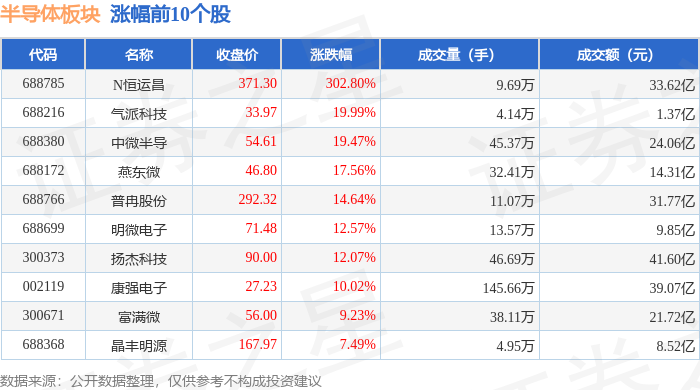
半导体板块1月28日涨1.28%,N恒运昌领涨,主力资金净流出9416.8万元
Zheng Xing Xing Ye Ri Bao· 2026-01-28 08:56
Market Overview - The semiconductor sector increased by 1.28% on January 28, with N Hengyun leading the gains [1] - The Shanghai Composite Index closed at 4151.24, up 0.27%, while the Shenzhen Component Index closed at 14342.9, up 0.09% [1] Top Gainers in Semiconductor Sector - N Hengyun (688785) closed at 371.30, with a remarkable increase of 302.80% and a trading volume of 96,900 shares [1] - Other notable gainers include: - Qipai Technology (688216) at 33.97, up 19.99% [1] - Zhongwei Semiconductor (688380) at 54.61, up 19.47% [1] - Hennian Micro (688172) at 46.80, up 17.56% [1] - Pushen Co. (688766) at 292.32, up 14.64% [1] Top Losers in Semiconductor Sector - Dongxin Co. (688110) decreased by 8.42% to 140.33 [2] - Other significant declines include: - Canxin Co. (688691) down 5.80% to 136.16 [2] - Shengke Communication (688702) down 5.46% to 153.65 [2] - Changsheng Co. (688478) down 4.59% to 38.88 [2] Capital Flow Analysis - The semiconductor sector experienced a net outflow of 94.168 million yuan from institutional investors, while retail investors saw a net inflow of 1.748 billion yuan [2] - The overall capital flow indicates a mixed sentiment, with institutional investors pulling back while retail investors are actively buying [2] Individual Stock Capital Flow - N Hengyun (688785) had a net inflow of 1.855 billion yuan from institutional investors, but a net outflow of 1.788 billion yuan from speculative funds [3] - Other stocks with notable capital flows include: - Zhongxin International (688889) with a net inflow of 1.037 billion yuan from institutional investors [3] - Zhaoyi Innovation (603986) with a net inflow of 685 million yuan from institutional investors [3]