UIH(688271)

Search documents
这支基金“国家队”收获296个IPO
投中网· 2025-06-03 06:36
Core Viewpoint - The article emphasizes the role of the State Investment Fund (国投系基金) in accelerating industrial cultivation through strategic investments in key emerging industries, showcasing its significant contributions to the development of various sectors such as integrated circuits, smart connected vehicles, and biomedicine [2][3][4]. Group 1: Investment Strategy and Achievements - The State Investment Fund has successfully invested in 1,175 projects, aiding 296 companies to go public, including 143 on the Sci-Tech Innovation Board, and has helped break through 323 key core technologies [2]. - The fund has a management scale exceeding 2.7 trillion yuan, with over 50 funds under management, including more than 10 national-level government investment funds [2][4]. - The fund's investments have led to the creation of 319 national-level "little giant" enterprises, demonstrating its effectiveness in nurturing innovative companies [2]. Group 2: Focus Areas and Sectoral Impact - The fund focuses on strategic emerging industries such as integrated circuits, smart connected vehicles, biomedicine, and biomanufacturing, contributing to the construction of a modern industrial system [8][10]. - In the integrated circuit sector, the fund has invested 27.8 billion yuan across 336 projects, supporting companies like Tsinghua Unigroup and Cambricon Technologies to address critical technology bottlenecks [8][9]. - In the smart connected vehicle sector, the fund has invested 29.8 billion yuan in leading companies like CATL and BYD, facilitating the development of a closed-loop ecosystem in electric vehicles [9][10]. Group 3: Support for Private Enterprises - The fund has adopted a "mother fund + direct investment" model, managing over 120 billion yuan, which has mobilized over 1 trillion yuan to support technological innovation and foster around 4,000 innovative technology enterprises [12][13]. - More than two-thirds of the fund's investments are directed towards private enterprises, creating a new pattern of collaboration between state-owned capital and the private economy [13][14]. - The fund provides not only financial support but also resources and advantages to enhance the operational capabilities of invested enterprises, thereby promoting their innovation and growth [13].





科创生物医药ETF(588250)涨1.23%,创新药合作利好催化板块行情
Xin Lang Cai Jing· 2025-06-03 02:00
Group 1 - The core viewpoint highlights the positive market reaction to the collaboration between Bristol-Myers Squibb and BioNTech regarding the new cancer drug BNT327, with milestone payments potentially reaching $11.1 billion, which has boosted the performance of innovative drug concept stocks [1] - The performance of the Kexin Biopharmaceutical ETF (588250.SH) increased by 1.23%, with its associated index Kexin Biopharmaceutical (000683.SH) rising by 0.96%, indicating a favorable market sentiment towards the biopharmaceutical sector [1] - Notable increases in major component stocks include Microchip Biotech rising by 9.44%, Huaxi Biotech by 7.63%, and Rongchang Biotech by 4.92%, reflecting strong investor interest in innovative drug companies [1] Group 2 - Guosen Securities reported significant advancements in domestic innovative drugs, particularly focusing on bispecific antibodies and ADC technologies, with promising clinical data from Innovent Biologics and Mingji Biotech in pancreatic cancer treatments [2] - Shenwan Hongyuan highlighted Huaxi Biotech as a key player in the recombinant collagen market, benefiting from the domestic beauty trend and strong brand recognition, suggesting potential for consumer recovery [2] - Both research institutions' insights align with the performance of innovative drug and medical beauty leading companies within the Kexin Biopharmaceutical ETF [2]



十年之后,复盘“中国制造2025”
Guan Cha Zhe Wang· 2025-05-30 11:10
Group 1 - "Made in China 2025" aims to transform China from a "world factory" to a global high-tech manufacturing leader by 2025, with a target of 70% self-sufficiency in core components and key materials [3][4] - The initiative focuses on ten high-tech sectors, including semiconductors, robotics, new energy vehicles, aerospace, and biomedicine, supported by significant government funding and policy incentives [3][4] - From 2015 to 2022, over $1.3 trillion was invested in priority industries, with nearly 60% allocated to semiconductors and new energy vehicles, indicating a concentrated policy approach [4] Group 2 - The new energy vehicle (NEV) sector has seen remarkable success, with domestic NEVs capturing 80% of the market share in 2022, and companies like BYD ranking second globally in NEV sales [5][6] - High-speed rail has become a textbook success story, with Chinese companies now dominating the market, achieving a 90% share in high-speed rail signaling equipment [6][7] - In the new materials sector, China has significantly increased its production capacity, with a global share of 80% in petrochemical products from 2019 to 2022, and companies like Wanhua Chemical leading in the polyurethane market [7][8] Group 3 - Despite achievements, challenges remain in high-end manufacturing, particularly in semiconductors, where China's market share is only 1.9%, and reliance on imported equipment is high [8][9] - The aerospace sector faces similar issues, with the domestically produced C919 aircraft having only a 60% local content rate, heavily dependent on foreign suppliers for critical components [9][10] - The marine engineering and high-tech shipbuilding sectors also struggle, with less than 30% localization in high-tech ship equipment [10] Group 4 - The rapid advancements have led to some negative consequences, including resource wastage due to excessive government spending, with 30% of semiconductor project funds wasted on inefficient projects [11][12] - Overemphasis on industrial policy has resulted in production capacity outpacing consumer demand, leading to price wars and declining industrial profits [11][12] - In 2022, China's power battery production capacity reached 900 GWh, but actual demand was only 450 GWh, resulting in a 50% surplus [12][13] Group 5 - While China excels in low-end and mid-range markets, it still lags behind international giants in high-end sectors, with R&D investment significantly lower than that of the U.S. [13][14] - Foreign enterprises believe that Chinese competitors will take 5 to 10 years to catch up in technology, particularly in advanced fields like semiconductors and aerospace engines [14][15] - The decline in international scientific collaboration and increased trade tensions pose additional challenges for Chinese companies in sensitive technology areas [15]



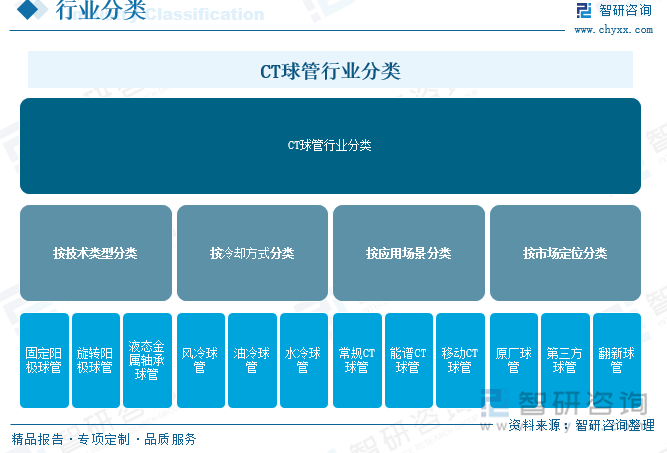
2025年中国CT球管行业相关政策、产业链、市场容量、竞争格局分析及发展趋势研判:需求增长、国产化加速,CT球管行业正迎来关键发展期[图]
Chan Ye Xin Xi Wang· 2025-05-30 01:56
Core Insights - The CT tube, also known as X-ray tube, is a critical component of CT equipment, directly affecting imaging quality, scanning speed, and equipment lifespan [1][9] - The cost of CT tubes accounts for approximately 20% of the total production cost of CT devices, and they have a shorter lifespan compared to the devices themselves, necessitating regular replacements [9][11] - The demand for CT tubes in China is driven by both new installations of CT devices and the maintenance of existing units, with the market capacity expected to grow significantly in the coming years [9][11] Market Capacity and Structure - In 2024, the market capacity for CT tubes in China is projected to be 35,396 units, consisting of 25,835 units from the existing market and 9,561 units from new installations [9][11] - By 2025, the market capacity is expected to reach 40,445 units, with 30,000 units from the existing market and 10,445 units from new installations [9][11] - The demand for replacement tubes due to maintenance will surpass the demand from new installations as the number of CT devices increases [9][11] Industry Development Environment - The Chinese government has implemented supportive policies for the development of high-end medical equipment and key components, including CT tubes, as part of the "14th Five-Year Plan" [4][6] - Policies encourage innovation and the enhancement of manufacturing capabilities in the medical equipment sector, particularly for CT technology [4][6] Current Industry Status - The CT equipment stock in China is expected to reach 51,670 units in 2024, with an increase of 9,561 units, and approximately 60,000 units by 2025, with an increase of 10,445 units [7] - The rapid development of the CT and medical imaging equipment industry is driven by increasing market demand and the need for domestic alternatives to imported products [7][9] Competitive Landscape - Key players in the CT tube market include companies such as United Imaging, Neusoft Medical, and others, with significant investments in R&D for domestic CT tube production [14][15] - Despite advancements in domestic production, there remains a gap between local suppliers and international manufacturers in terms of technology and manufacturing processes [14][15] Industry Trends - The CT tube industry is entering a critical development phase due to accelerated domestic production, technological upgrades, and growing demand [18] - The average lifespan of a CT tube is about 13 months, indicating a high replacement frequency during the lifespan of a CT device, which typically exceeds 10 years [11]


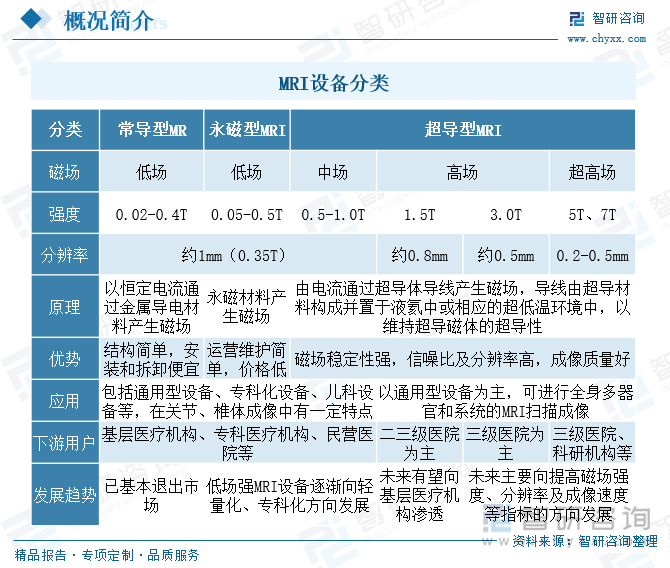
2025年中国磁共振成像设备行业产业链图谱、市场规模、竞争格局及发展趋势研判:人口老龄化趋势加剧,MRI设备应用购买需求日益增长[图]
Chan Ye Xin Xi Wang· 2025-05-30 01:30
内容概要:磁共振成像设备(Magnetic ResonanceImaging),即MRI设备,是一种利用生物体内的磁性 核(多数为氢核)在磁场中表现的共振特性进行成像的技术,磁共振成像的物理基础是核磁共振理论。 随着国家人口老龄化趋势日益明显,以及人们对健康意识的不断提升,医学影像学检查在疾病预防、诊 断和治疗中的作用愈发凸显。MRI技术以其无创、高分辨率、多参数成像等优势,在临床诊断中扮演着 举足轻重的角色。随着医学影像学需求的增长,医疗机构对MRI设备的应用购买需求也随之增加,从而 推动了MRI设备市场的快速发展。据统计,2024年我国MRI设备市场规模已从2017年的90.2亿元增长至 166亿元。 相关上市企业:联影医疗(688271);东软集团(00718);万东医疗(600055)等 相关企业:西门子(深圳)磁共振有限公司;宁波健信超导科技股份有限公司;通用电气(GE)公 司;飞利浦(Philips)公司;苏州朗润医疗系统有限公司;成都世纪奥泰医疗技术有限公司;北京通用 电气华伦医疗设备有限公司;来易特精密机械(青岛)有限公司;西安航天恒星医疗设备有限公司;德 佳设备(河源)有限公司等 关键词:产 ...
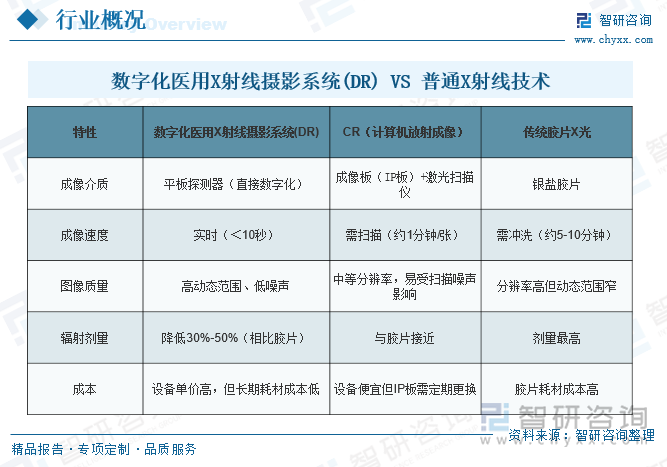
2025年中国数字化X射线诊断系统(DR)行业发展全景分析及未来前景研判:国产化率持续提升,未来三年国产化率有望突破80%[图]
Chan Ye Xin Xi Wang· 2025-05-28 01:38
Core Viewpoint - The digital X-ray diagnostic system (DR) market in China is experiencing rapid growth, with domestic brands increasing their competitive strength and achieving a record high localization rate of 68.78% in 2024. The upcoming "equipment update" projects are expected to drive significant demand for upgrading old systems, creating new growth opportunities in the mid-to-high-end DR market by 2025 [1][5][19]. Industry Definition - Digital X-ray diagnostic systems (DR) utilize X-ray and computer technology for image acquisition and processing, becoming essential equipment in modern radiology. DR systems typically consist of an X-ray imaging system, digital image acquisition plates, and image control workstations, favored for their speed, accuracy, and lower radiation doses [2][5]. Current Industry Status - The medical imaging equipment market in China has historically been dominated by foreign brands like GE, Siemens, and Philips, which held over 90% market share in high-end products. However, domestic brands are increasingly replacing imports, with the DR market showing significant growth and a localization rate reaching 68.78% in 2024 [5][19]. Regional Distribution - In 2024, the procurement of digital X-ray diagnostic systems (DR) in China's eastern regions increased compared to 2023, while the central, western, and northeastern regions saw declines, particularly in the central region [7]. Industry Chain - The upstream of the DR industry includes core components such as X-ray generators, digital detectors, image processing systems, and AI-assisted diagnosis. The midstream involves the manufacturing and system integration of DR equipment, while the downstream applications are primarily in clinical diagnostics, health check centers, and emergency departments [9]. Development Environment - Related Policies - The digital X-ray diagnostic system (DR) is gradually replacing traditional film X-ray photography due to its efficiency and low radiation. Recent government policies have been introduced to support the development of medical imaging equipment, emphasizing the need for equipment updates in rural healthcare settings [11][12]. Competitive Landscape - Major players in the Chinese DR market include United Imaging, Wandong Medical, Siemens Healthineers, and Mindray. Domestic manufacturers like Mindray and Wandong Medical are expanding their market share, with United Imaging and Wandong Medical leading the market in 2024 [13][15]. Development Trends - The maturity of DR technology and decreasing costs are leading to widespread adoption in tertiary hospitals, with gradual expansion into primary hospitals and grassroots medical institutions. The "equipment update" trend is expected to drive the replacement of outdated systems, creating new growth opportunities in the mid-to-high-end DR market by 2025. The industry is transitioning from assembly manufacturing to core component autonomy and intelligent value-added services, with localization rates projected to exceed 80% in the next three years [19].


联影医疗(688271):25Q1扣非业绩增速亮眼,首创类+超声等重磅新品持续加码
Huafu Securities· 2025-05-27 09:28
Investment Rating - The report maintains a "Hold" rating for the company, indicating that the stock is expected to perform in line with the market benchmark over the next six months [4][18]. Core Insights - The company reported a revenue of 10.3 billion in 2024, a decrease of 9.7% year-on-year, and a net profit of 1.262 billion, down 36.1% year-on-year. However, in Q1 2025, the company achieved a revenue of 2.48 billion, reflecting a growth of 5.4% year-on-year, and a net profit of 370 million, up 1.9% year-on-year [2][4]. - The domestic bidding trend is accelerating, leading to a recovery in performance in Q1 2025, supported by policy implementation and market recovery. The company is expected to continue to see growth as installations increase [2][3]. - The company achieved a market share increase of over 3 percentage points in 2024, despite an overall industry slowdown, with high-end products seeing a 5 percentage point increase in market share [3]. Financial Performance Summary - In 2024, the company’s revenue from CT was 3.04 billion (down 25%), MR revenue was 3.19 billion (down 2.7%), MI revenue was 1.3 billion (down 16.3%), XR revenue was 590 million (down 22.8%), and RT revenue was 320 million (up 18.1%). Maintenance revenue grew significantly to 1.356 billion, up 26.8% [3]. - The company’s overseas revenue reached 2.2 billion in 2024, a 34% increase year-on-year, with nearly 300 high-end machines sold globally [2][3]. - The report projects revenues for 2025-2027 to be 12.5 billion, 15 billion, and 17.5 billion respectively, with corresponding year-on-year growth rates of 21%, 21%, and 16% [4][6]. Product Development and Market Strategy - The company is launching several innovative products, including the uMR Jupiter 5T and uLinac HalosTx, which are expected to enhance its competitive edge in the market [3]. - The company is also focusing on AI integration with its imaging devices, which is anticipated to open new avenues for market penetration [3].
5月26日工银医疗保健股票净值下跌1.16%,近1个月累计上涨3.52%
Sou Hu Cai Jing· 2025-05-26 13:02
Core Viewpoint - The article discusses the performance and holdings of the Industrial and Commercial Bank of China Medical Healthcare Stock Fund, highlighting its recent net value, returns, and top holdings [1]. Fund Performance - The latest net value of the ICBC Medical Healthcare Stock Fund is 2.5580 yuan, reflecting a decrease of 1.16% - The fund's return over the past month is 3.52%, ranking 172 out of 940 in its category - Over the last six months, the return is 9.79%, with a ranking of 202 out of 914 - Year-to-date, the return stands at 12.24%, ranking 98 out of 926 [1]. Fund Holdings - The top ten holdings of the ICBC Medical Healthcare Stock Fund account for a total of 39.79%, with the following key positions: - Heng Rui Medicine: 8.90% - WuXi AppTec: 5.12% - Aier Eye Hospital: 4.94% - BeiGene: 3.77% - Zai Lab: 3.52% - New Horizon Health: 3.27% - Mindray Medical: 2.80% - Yuwell Medical: 2.76% - United Imaging Healthcare: 2.47% - Innovent Biologics: 2.24% [1]. Fund Management - The ICBC Medical Healthcare Stock Fund was established on November 18, 2014, and as of March 31, 2025, it has a total scale of 2.724 billion yuan - The fund is managed by Zhao Bei and Ding Yang, both of whom have extensive experience in the healthcare sector [1][2].



每周股票复盘:联影医疗(688271)2024年营收与净利润双双下滑
Sou Hu Cai Jing· 2025-05-24 08:12
Group 1 - Company achieved total operating revenue of 1,030,010.44 million yuan in 2024, a year-on-year decrease of 9.73% [2] - Net profit attributable to shareholders of the listed company was 126,186.95 million yuan, down 36.08% year-on-year [2] - The decline in revenue is primarily due to the impact of domestic equipment update policy implementation, leading to an overall contraction in the industry [2] Group 2 - Company has increased R&D investment, with no significant changes in core competitiveness [2][4] - Company has applied for a total of 11,502 intellectual property rights and has obtained 5,882 [2][4] - There were no violations found in the use of raised funds, and there were no significant changes in the holdings of controlling shareholders and executives during the reporting period [2]
中证全指医疗保健设备与服务指数下跌1.26%,前十大权重包含迈瑞医疗等
Sou Hu Cai Jing· 2025-05-22 16:15
Core Viewpoint - The China Securities Index for Healthcare Equipment and Services has shown a decline of 1.26% recently, reflecting broader market trends in the healthcare sector [1]. Group 1: Index Performance - The China Securities Index for Healthcare Equipment and Services closed at 13,370.1 points with a trading volume of 11.048 billion yuan [1]. - Over the past month, the index has increased by 2.41%, but it has decreased by 7.73% over the last three months and is down 1.09% year-to-date [1]. Group 2: Index Composition - The index is composed of listed companies in the healthcare sector, selected from the broader China Securities Index to reflect the overall performance of healthcare-related securities [1]. - The top ten weighted companies in the index include Mindray Medical (9.6%), Aier Eye Hospital (8.13%), and United Imaging Healthcare (7.77%) among others [1]. - The index's holdings are primarily listed on the Shenzhen Stock Exchange (60.46%) and the Shanghai Stock Exchange (39.54%) [1]. Group 3: Fund Tracking - Several public funds track the China Securities Index for Healthcare Equipment and Services, including Southern China Securities Index Healthcare Equipment and Services Link A, and Tianhong China Securities Index Healthcare Equipment and Services ETF [2].