Ninebot(689009)

Search documents
电驴界爱马仕狂赚12亿,但好日子已经结束了
3 6 Ke· 2025-09-02 10:42
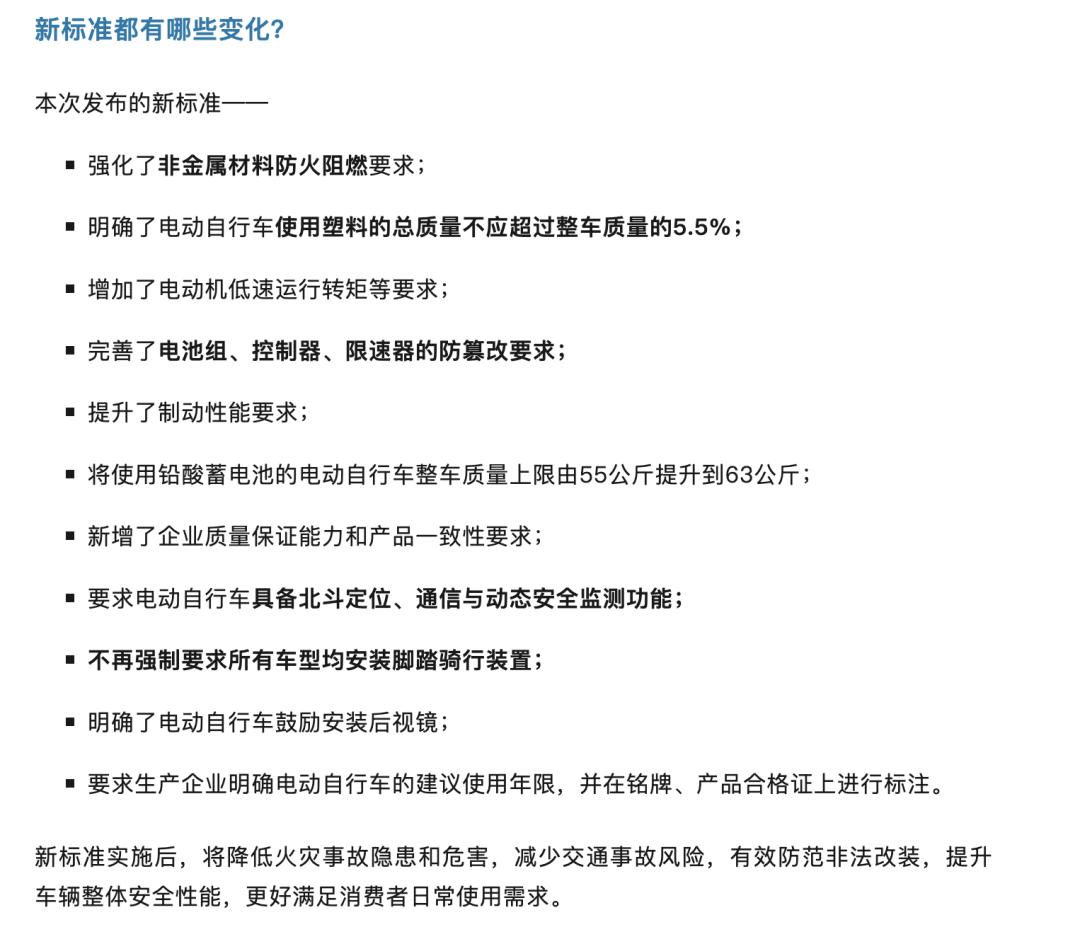
Group 1: New National Standard Impact - The new national standard for electric bicycles, effective from September 1, 2024, imposes strict limits on speed, weight, battery capacity, and overall dimensions, aiming to ensure safety and reduce the "motorization" of bicycles [1][4][7] - The standard represents a significant shift for the industry, with brands that previously relied on "over-standard" vehicles facing major adjustments, leading to a potential reshuffle in market competition [3][4] - Many consumers are purchasing older models before the new regulations take full effect, indicating a rush to acquire vehicles that may soon be phased out [4][7] Group 2: Company Performance and Challenges - Ninebot's revenue for the first half of 2025 reached 11.742 billion yuan, a 76.14% increase year-on-year, with net profit rising by 108.45% to 1.242 billion yuan, driven by strong sales of electric two-wheelers [9][11] - Despite strong performance, Ninebot faces challenges such as limited distribution channels, particularly in lower-tier cities, which hampers its market penetration compared to leading brands like Yadea [9][10] - The company has received over 4,000 complaints related to after-sales service and product quality, highlighting ongoing issues that could affect customer satisfaction and brand reputation [12][13] Group 3: Market Position and Strategic Concerns - Ninebot has established itself as a leader in the high-end electric bicycle market, but the new regulations may diminish its competitive edge by enforcing stricter compliance and reducing the appeal of high-performance models [9][10][13] - The company has seen a significant reduction in shareholding by its core management, raising concerns about the sustainability of its business model and market trust, especially given its reliance on the electric two-wheeler segment [16][17] - The introduction of the new standard may lead to increased production costs, with uncertainty about whether these costs will be passed on to consumers or absorbed by dealers [1][16]

如何看待两轮车高端升级机会?
Changjiang Securities· 2025-08-31 07:11
Investment Rating - The report maintains a "Positive" investment rating for the electric two-wheeler industry [10]. Core Insights - The electric two-wheeler market is experiencing a high-end upgrade, with companies like Niu, Ninebot, and Jike leveraging technology and user needs to capture market share. Niu focuses on urban user demands for convenience, security, and safety, while Ninebot capitalizes on the 3C certification transition to enhance its market position. Jike emphasizes product reliability through extreme testing and community engagement [4][8][41]. Summary by Sections Review of the High-End Electric Two-Wheeler Journey - Niu Electric has effectively identified and addressed three key pain points: charging convenience, theft prevention, and safety. By utilizing Panasonic lithium batteries, Niu has reduced weight and improved performance, leading to significant revenue growth from 769 million yuan in 2017 to 3.288 billion yuan in 2024, with a CAGR of 23.07% [19][33]. Niu: Redefining High-End Electric Two-Wheelers - Niu's strategy includes using high-quality components like Bosch motors and advanced battery management systems to enhance performance and safety. The company has also implemented a user-friendly app for remote vehicle control, contributing to its brand recognition and market penetration [20][27]. Current Competitive Landscape of High-End Two-Wheelers - The competitive landscape features new brands like Jike, Ninebot, and Niu, which focus on community engagement and product reliability. Traditional brands like Yadi and Aima are improving core technologies but lag in smart features compared to new entrants [7][70]. Ninebot: Differentiated Positioning in the Mid-High-End Market - Ninebot has rapidly grown its revenue, reaching 14.196 billion yuan in 2024, with a 38.87% year-on-year increase. The company has successfully transitioned to a major player in the electric two-wheeler market, with a focus on smart technology and user engagement [44][41]. Investment Recommendations: New Force Brands Stand Out - The report recommends focusing on new force leaders like Ninebot and Chuncheng Power, which have demonstrated significant advantages in technology and market positioning. These companies are well-positioned to capture the growing demand for high-end electric two-wheelers [8][11].

A股千亿分红来了,最高每手派现660元
21世纪经济报道· 2025-08-29 08:58
Core Viewpoint - The A-share market is experiencing a significant transformation in its dividend distribution patterns, with an increasing number of companies announcing mid-term dividend plans, reflecting a stronger focus on shareholder returns [1][2]. Group 1: Dividend Distribution Trends - As of August 28, 2025, 713 A-share companies have disclosed mid-term dividend plans, surpassing last year's 704, indicating a continuous upward trend in dividend distribution [4]. - The number of companies distributing mid-term dividends has increased from under 200 annually to several hundred, showcasing a shift towards prioritizing shareholder returns [1][4]. - The scale of mid-term dividends has significantly increased since 2024, with notable growth in the number of companies offering substantial dividends per share [4][9]. Group 2: Industry Insights - Traditional high cash flow sectors such as finance, energy, and telecommunications remain the primary contributors to dividends, while consumer and manufacturing sectors are rapidly unlocking their dividend potential [1][12]. - Leading companies like China Mobile and JiBit have established a stable and predictable high-dividend style, with China Mobile's dividend per share increasing from 222.47 yuan in 2023 to 250.25 yuan in 2025 [10][12]. - The introduction of new policies linking dividend behavior to refinancing and shareholding actions has significantly enhanced companies' motivation to distribute dividends [2][4]. Group 3: Future Outlook - The A-share dividend system is expected to evolve towards greater stability, transparency, and efficiency, driven by market and regulatory collaboration [2][11]. - More companies are adopting long-term dividend plans, enhancing predictability and investor confidence, with firms like Mindray Medical committing to distribute at least 65% of their distributable profits over the next three years [12][14]. - The increasing focus on dividends is also reflected in the performance of dividend-linked financial products, which have seen net value increases in 2025, highlighting the growing appeal of high-dividend assets [13][14].




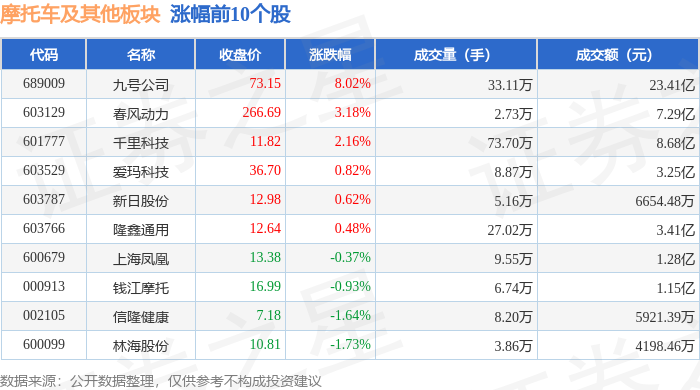
摩托车及其他板块8月29日涨2.19%,九号公司领涨,主力资金净流入2.47亿元
Zheng Xing Xing Ye Ri Bao· 2025-08-29 08:41
Market Performance - The motorcycle and other sectors rose by 2.19% on August 29, with Ninebot leading the gains [1] - The Shanghai Composite Index closed at 3857.93, up 0.37%, while the Shenzhen Component Index closed at 12696.15, up 0.99% [1] Stock Performance - Ninebot Company (code: 6000689) closed at 73.15, with an increase of 8.02% and a trading volume of 331,100 shares, amounting to a transaction value of 2.341 billion yuan [1] - Other notable stocks included: - Chunfeng Power (code: 603129) at 266.69, up 3.18% [1] - Qianli Technology (code: 601777) at 11.82, up 2.16% [1] - Aima Technology (code: 603529) at 36.70, up 0.82% [1] - New Vision Co. (code: 603787) at 12.98, up 0.62% [1] Capital Flow - The motorcycle and other sectors saw a net inflow of 247 million yuan from main funds, while retail investors experienced a net outflow of 140 million yuan [3][4] - Ninebot Company had a main fund net inflow of 178 million yuan, representing 7.59% of its total [4] - Qianli Technology experienced a net inflow of 85 million yuan from main funds, accounting for 9.80% [4] ETF Overview - The Food and Beverage ETF (code: 515170) tracked the sub-index with a recent five-day change of 0.50% and a P/E ratio of 20.74 [6] - The Gaming ETF (code: 159869) tracked the animation and gaming index with a five-day change of 3.39% and a P/E ratio of 44.92 [6] - The Semiconductor ETF (code: 588170) tracked the semiconductor materials and equipment index with a five-day change of 10.78 and a net inflow of 2.3759 million yuan [6]
九号公司首发两轮电动车专属系统凌波OS,股价上涨超13%
Zheng Quan Zhi Xing· 2025-08-29 06:43
Core Viewpoint - The release of NimbleOS by Ninebot represents a revolutionary advancement in the two-wheeled transportation industry, integrating various core modules for enhanced performance and user experience [1][2]. Group 1: Product Innovation - NimbleOS is the first comprehensive operating system designed specifically for short-distance two-wheeled travel in China, breaking the traditional hardware isolation model [1]. - The system integrates motor control, battery management, multi-sensor perception, and vehicle interaction, achieving system-level collaboration in hardware performance [1]. - Features such as seamless unlocking, mouse control, and hill assist provide millisecond-level response times, significantly improving vehicle stability in complex road conditions [1]. Group 2: Market Performance - Ninebot's stock price surged over 13% to 73.5 yuan, with a trading volume of 19.65 billion yuan and a turnover rate of 5.02% [1]. - The company reported a revenue of 11.742 billion yuan for the first half of 2025, a year-on-year increase of 76.14%, and a net profit of 1.242 billion yuan, up 108.45% year-on-year [2]. Group 3: Industry Impact - The launch of NimbleOS is seen as a milestone, addressing the fragmentation of underlying technologies in the two-wheeled vehicle sector and introducing a "software-defined hardware" model [2]. - Future functionalities such as vehicle-road collaboration, smart traffic light control, and AI adaptive riding scenarios are expected to evolve from this platform, promoting a collaborative and intelligent two-wheeled transportation ecosystem [2]. - The OTA upgrade capability allows all models to receive continuous updates, transforming the traditional notion of two-wheeled vehicles as fixed products upon delivery [2].
聚焦科创板长期价值!科创信息技术ETF摩根(证券代码:588770)一键高效分享中国科技红利
Xin Lang Cai Jing· 2025-08-29 03:46
Core Viewpoint - The A-share market is experiencing a strong performance, particularly in the technology sector, with significant trading volume and a notable rise in the Sci-Tech Innovation Board [1][2] Market Performance - The A-share market indices collectively strengthened, with a trading volume reaching 29,708 billion yuan [1] - The Sci-Tech Innovation Board has shown robust performance, with the Shanghai Sci-Tech Innovation Board New Generation Information Technology Index achieving a one-year increase of 129.41%, outperforming the Sci-Tech 50 Index and Sci-Tech 100 Index, which recorded increases of 103.30% and 100.41% respectively [2] Index Performance - Historical performance data indicates that over the past three years, the Shanghai Sci-Tech Innovation Board New Generation Information Technology Index has increased by 94.64%, while the Sci-Tech 50 Index and Sci-Tech 100 Index have increased by 30.46% and 3.77% respectively [2] - The index's performance over the past five years shows an increase of 26.98%, contrasting with declines in the Sci-Tech 50 Index and Sci-Tech 100 Index, which decreased by 3.47% and 13.08% respectively [2] Key Holdings - As of July 31, 2025, the top ten weighted stocks in the Shanghai Sci-Tech Innovation Board New Generation Information Technology Index include SMIC (10.1%), Cambricon (10%), and Haiguang Information (8.8%) [2] Future Outlook - The Sci-Tech Innovation Board is viewed as a "testing ground" for capital market reforms, with long-term investment value supported by the ongoing push for technology-driven high-quality growth in China [1] - The index is expected to provide an efficient way for investors to share in China's technological dividends, particularly in key areas such as semiconductors, software, and AI [1]




科创50指数ETF(588870)开盘跌2.97%,重仓股中芯国际跌4.38%,海光信息跌2.58%
Xin Lang Cai Jing· 2025-08-29 01:40
Core Viewpoint - The ChiNext 50 Index ETF (588870) opened with a decline of 2.97%, indicating a bearish trend in the market for technology stocks [1] Group 1: ETF Performance - The ChiNext 50 Index ETF (588870) opened at 1.373 yuan, reflecting a significant drop [1] - The ETF's performance benchmark is the Shanghai Stock Exchange ChiNext 50 Index return rate [1] - Since its establishment on January 20, 2025, the ETF has achieved a return of 39.76%, with a one-month return of 29.12% [1] Group 2: Major Holdings Performance - Major holdings in the ETF include: - SMIC (中芯国际) down 4.38% - Haiguang Information (海光信息) down 2.58% - Cambricon (寒武纪) down 6.80% - Lattice Semiconductor (澜起科技) down 2.00% - Zhongwei Company (中微公司) down 2.44% - Kingsoft Office (金山办公) up 0.30% - United Imaging (联影医疗) unchanged - Transsion Holdings (传音控股) down 0.08% - Ninebot (九号公司) down 0.31% [1]

开源证券吕明: 政策红利下行业分化凸显 关注科技家电赛道投资机遇
Zhong Guo Zheng Quan Bao· 2025-08-28 22:06
Core Insights - The home appliance industry is experiencing significant differentiation, with the "trade-in" policy stimulating consumption and driving the sector towards smart and green transformation [1][2] - White goods and tech appliances are showing strong profit growth, while kitchen appliances are facing revenue declines due to the sluggish real estate market [1][2] Industry Performance - The overall revenue of the home appliance industry has improved significantly due to the expansion of the trade-in policy to 12 product categories, with notable differences across segments [2] - The white goods sector has demonstrated resilience, benefiting from national subsidies and improved cost structures, leading to revenue and profit growth exceeding expectations for 2024 [2] - The TV industry has become a benchmark for policy benefits, with profit improvements driven by domestic subsidies and increased export shares, alongside technological upgrades like Mini LED [2] - The kitchen appliance sector is under pressure, with expected revenue declines in the first half of 2025, although leading companies are gaining market share through high-end product offerings [2] - The tech appliance sector continues to grow rapidly, with companies like Roborock and Ninebot leading the charge, particularly in the robot vacuum segment, which is projected to exceed 15 billion yuan in online sales in 2024 [2] Policy Impact - The trade-in policy has engaged over 66 million consumers, directly stimulating consumption by over 270 billion yuan, with retail sales of major appliances increasing by 30.7% year-on-year [3] - The competitive landscape is undergoing profound changes, with platforms shifting from price-driven to value-driven models, benefiting leading companies while squeezing smaller players [3] Transformation Strategies - The home appliance industry is in a transition phase, requiring breakthroughs through technology, supply chain optimization, and strategic balance to achieve sustainable development [4] - AI technology is reshaping product design and functionality, particularly in cleaning appliances, enhancing user experience through features like spatial mapping and obstacle recognition [4][5] - Supply chain efficiency and scenario-based solutions are becoming core competitive advantages, with companies encouraged to build digital supply chains for real-time data sharing and production adjustments [5] Growth Opportunities - The growth momentum of the home appliance industry is shifting from traditional categories to tech-driven segments, with emerging categories like robot vacuums and lawn mowers expected to see explosive growth [6] - Investment opportunities lie in tech appliance sectors with low penetration rates and high growth potential, particularly in smart cleaning devices [6][7] - The competitive landscape in the smart cleaning appliance sector is evolving from price wars to differentiation, with leading companies enhancing their market share through product innovation and cost control [7]

政策红利下行业分化凸显关注科技家电赛道投资机遇
Zhong Guo Zheng Quan Bao· 2025-08-28 20:17
Core Viewpoint - The home appliance industry is experiencing significant differentiation, driven by the expansion of the trade-in policy, which stimulates consumption and promotes a shift towards smart and green technologies [1][2]. Industry Performance - The overall revenue of the home appliance industry has improved compared to last year, with notable differences across segments [1]. - The white goods sector shows strong resilience, benefiting from national subsidies and improved cost structures, leading to revenue and profit growth exceeding expectations for 2024 [2]. - The television sector has become a benchmark for policy benefits, with profit improvements driven by domestic subsidies and increased export shares, alongside technological upgrades like Mini LED [1][2]. Kitchen Appliances - The kitchen appliance sector faces significant pressure, with revenues expected to decline in the first half of 2025 due to a lack of recovery in the real estate market [2]. - Leading companies are gaining market share despite the downturn, indicating a trend towards increased industry concentration and enhanced risk resilience [2]. Technology-Driven Growth - The technology appliance sector continues to grow rapidly, with companies like Roborock and Ninebot leading the charge through robotics and international expansion [2]. - The online sales of robotic vacuum cleaners are projected to exceed 15 billion yuan in 2024, marking a nearly 50% year-on-year increase [2]. Policy Impact - Over 66 million consumers have participated in the trade-in policy, directly stimulating consumption by over 270 billion yuan, with retail sales of major appliances increasing by 30.7% year-on-year [2]. - The policy has not only activated the existing market but also pushed the industry towards smart and green upgrades, with significant sales growth in high-end products like energy-efficient air conditioners and built-in refrigerators [2]. Competitive Landscape - The competitive landscape is undergoing profound changes, with platforms like Douyin shifting from price-driven to value-driven models, benefiting leading companies [3]. - The implementation of e-commerce tax policies is squeezing the survival space for small enterprises, favoring larger companies with higher operational efficiency [3]. Transformation Strategies - The home appliance industry is in a transformation phase, requiring strategies focused on technology, supply chain optimization, and strategic balance to achieve sustainable development [3][4]. - AI technology is being integrated into product design, enhancing functionality and user interaction, particularly in cleaning appliances [3][4]. Future Trends - AI's role in the home appliance industry is expected to deepen, with vertical AI models becoming a key direction for product development [4]. - Supply chain efficiency and scenario-based capabilities are emerging as core competitive advantages, with digital supply chain systems enabling real-time data sharing and production adjustments [4]. Investment Opportunities - The growth momentum in the home appliance industry is shifting from traditional categories to technology-driven sectors, with emerging categories like robotic vacuums and lawn mowers showing explosive growth potential [6][7]. - Investment focus should be on technology appliance leaders with growth potential and high dividend yields, particularly in the white goods sector, which remains stable and supported by favorable policies [7].
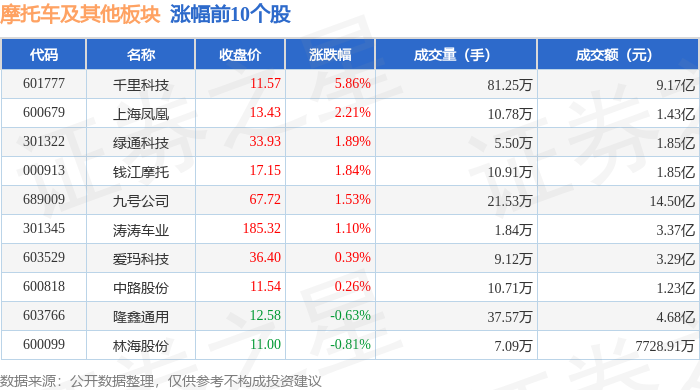
摩托车及其他板块8月28日涨1.2%,千里科技领涨,主力资金净流出942.75万元
Zheng Xing Xing Ye Ri Bao· 2025-08-28 08:43
Market Performance - On August 28, the motorcycle and other sectors rose by 1.2%, with Qianli Technology leading the gains [1] - The Shanghai Composite Index closed at 3843.6, up 1.14%, while the Shenzhen Component Index closed at 12571.37, up 2.25% [1] Stock Performance - Qianli Technology (601777) closed at 11.57, up 5.86%, with a trading volume of 812,500 shares and a turnover of 917 million yuan [1] - Other notable stocks included Shanghai Phoenix (600679) at 13.43, up 2.21%, and Qianjiang Motorcycle (000913) at 17.15, up 1.84% [1] Capital Flow - The motorcycle and other sectors experienced a net outflow of 9.4275 million yuan from institutional investors, while retail investors saw a net outflow of 26.3126 million yuan [2] - Conversely, speculative funds recorded a net inflow of 35.7401 million yuan [2] Individual Stock Capital Flow - Qianli Technology had a net inflow of 81.5791 million yuan from institutional investors, while it faced a net outflow of 49.9741 million yuan from retail investors [3] - Nine companies, including Qianli Technology and Jiuhua Company (689009), showed varying degrees of net inflow and outflow from different investor categories [3]