
Ninebot(689009)

Search documents
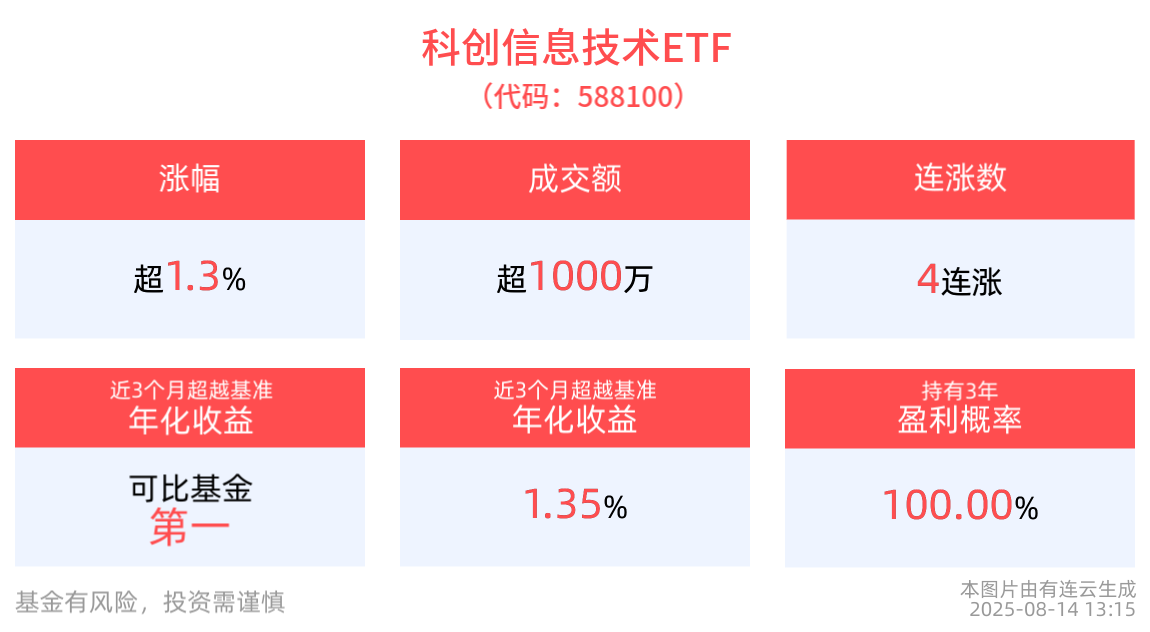
科创信息技术ETF(588100)连续4日上涨,机构:国产AI算力芯片迎来黄金发展期
Xin Lang Cai Jing· 2025-08-14 05:49
Group 1 - The core viewpoint highlights the strong performance of the Sci-Tech Information Technology ETF, which has seen a 65.77% increase in net value over the past year, ranking in the top 11.43% among comparable funds [3] - As of August 13, 2025, the ETF has an average monthly return of 8.19% since its inception, with the highest single-month return reaching 26.31% [3] - The AI sector remains a focus for investment, with leading companies in AI occupying the top positions in market capitalization, indicating potential growth in the computer industry supported by national policies [3] Group 2 - The top ten weighted stocks in the new generation information technology index on the Sci-Tech Innovation Board include major players like SMIC and Cambricon, collectively accounting for 55.76% of the index [4] - The semiconductor equipment and components sector in China is still relatively low in domestic production rates, suggesting opportunities for companies that can achieve breakthroughs in advanced processes [3][4] - The Sci-Tech Information Technology Index covers a wide range of fields including chips, software, cloud computing, big data, and artificial intelligence, positioning it to benefit from trends in AI computing power and domestic chip upgrades [6]







快讯|哈工程新成果登国际顶刊;Figure人形机器人首秀灵巧手叠衣服;2025世界机器人大会促产业发展销售额超2亿元等
机器人大讲堂· 2025-08-14 04:11
Group 1 - The core achievement of Harbin Engineering University is the development of an electro-hydraulic deep-sea soft robot, which has been tested in various deep-sea environments, including depths of 1369 meters and 4070 meters [2] - The robot utilizes a miniaturized energy control system for electro-hydraulic unit coordination, enabling it to perform various movements in deep-sea conditions [2] - The soft robot is equipped with a micro deep-sea optical perception system, allowing it to sense its motion state and environmental targets in extreme underwater conditions [2] Group 2 - Figure Company showcased its humanoid robot, Figure 02, which can autonomously fold clothes, utilizing the Helix model for visual language action [5] - The Helix model allows the robot to learn directly from real-world scenarios without relying on rigid fabric models, enhancing its operational capabilities [5] - The robot's neural network has transitioned from merely moving boxes to accurately picking up clothes and folding them through a data-driven approach [5] Group 3 - The 2025 World Robot Conference in Beijing resulted in significant industry promotion, with over 19,000 robots and related products sold, generating sales exceeding 200 million yuan [9] - The conference featured 220 renowned domestic and international robot companies, showcasing 1569 products and securing a total financing amount of 1.481 billion yuan [9] - New initiatives were launched during the conference, including talent cultivation plans and the release of research reports on the development trends of embodied intelligent robots [9] Group 4 - A new data-driven framework called Bioinspired Predictive Slip Control (BPSC) was proposed to enhance robotic manipulation by actively suppressing slip during operations [12] - The BPSC framework integrates neural network predictions with model predictive control, significantly improving stability and adaptability in complex handling tasks [12] - Experimental results indicate that the slip suppression efficiency of this method is 82% higher than traditional gripping force control methods [12] Group 5 - Ninebot Company reported a 76.14% year-on-year increase in revenue, reaching 11.742 billion yuan, and a net profit growth of 108.45%, amounting to 1.242 billion yuan [15] - The company has accumulated 3,790 patents and is actively involved in standardization activities, filling several industry gaps across various technology fields [15] - Key technologies developed by Ninebot include sensorless drive technology and autonomous navigation systems, which have been widely applied across multiple product lines [15]

“被动安全+主动智能”双重守护,九号两轮电动车安全进化论
Cai Fu Zai Xian· 2025-08-14 04:02
Core Viewpoint - The company emphasizes that safety is a fundamental aspect of its two-wheeled electric vehicles, integrating both passive and active safety features throughout the design, manufacturing, and user experience processes [1][9][10]. Passive Safety - Passive safety is described as the foundation of the safety system, with the vehicle's structure and materials being critical to ensuring user safety during rides [2][5]. - The latest model, the Orion 2, utilizes HC420 alloy steel, enhancing torsional rigidity by 48% and longitudinal rigidity by 61%, which improves the vehicle's ability to maintain control under stress [2][3]. - For heavier electric motorcycle models, the M3 95C MAX features a reinforced frame made of QSTE420 high-strength alloy steel, increasing wall thickness from 2.0mm to 3.5mm to enhance stability and lifespan [3]. Brake System - The brake system is highlighted as a crucial component of safety, with larger disc brakes being implemented across various models to improve braking performance and reduce stopping distances [3][4]. - The MMAX110 mk2 and Mz 110 models feature a front disc diameter of 220mm and a rear of 180mm, while the M3 95C MAX has a front disc of 240mm and a rear of 200mm [3]. Lighting System - The company is advancing its lighting systems, with plans to standardize the ALC panoramic lighting system in new products by 2025, providing high brightness standards for improved visibility and safety [4]. Active Safety - Active safety features are being integrated into the product line, including the RideyFUN function for real-time navigation and alerts, enhancing user awareness and reducing distraction [6]. - The ABS anti-lock braking system is being made standard across mid-range products, preventing wheel lock-up during emergency braking [6][7]. - The TCS traction control system and CBS linked braking system are also being introduced to improve vehicle stability and simplify operation [6]. Battery Safety - The company has developed the BMS6.0 battery management system, which includes over 30 safety protections, ensuring comprehensive safety for electric components [7]. Emergency Features - A one-button SOS emergency call system has been introduced, allowing users to contact emergency contacts automatically in case of an incident, particularly benefiting solo or female riders [7]. - The AHRS attitude sensing system triggers an alarm in the event of a severe collision or fall, enhancing user safety [7]. User-Centric Safety Innovations - The seat cushion sensing feature prevents accidental acceleration by ensuring the vehicle only unlocks when a weight of over 15 kilograms is detected [8]. Industry Leadership - The company positions itself as a leader in promoting safety standards within the industry, advocating for "safety as a standard" across all product lines [9][10].
外资大幅加仓 QFII上半年末持仓汽车行业市值最高
Zhong Guo Zheng Quan Bao· 2025-08-13 21:55
Group 1 - As of August 12, 2025, 264 listed companies have disclosed their mid-year reports, with 64 companies having QFII as a major shareholder [1][2] - QFII's total shareholding in these companies amounts to 365 million shares, valued at 6.399 billion yuan [2] - The top three companies by QFII's shareholding value are Ninebot Company (11.69 billion yuan), Dongfang Yuhong (10.17 billion yuan), and Haida Group (5.03 billion yuan) [2] Group 2 - QFII has newly entered the top ten shareholders of 28 companies in the second quarter, with significant investments in Zhongchong Co. and Zhuyue Group, each exceeding 1 billion yuan [2] - QFII increased its holdings in 18 stocks during the second quarter, with Ninebot Company seeing the largest increase of 9.6855 million shares [2][3] - The top three stocks by QFII's shareholding quantity are Dongfang Yuhong (94.7355 million shares), Jinpu Titanium Industry (32.219 million shares), and Satellite Chemical (23.5339 million shares) [3] Group 3 - QFII's holdings are concentrated in three main sectors: automotive (1.308 billion yuan), building materials (1.118 billion yuan), and electrical equipment (1.070 billion yuan) [4] - Abu Dhabi Investment Authority has the highest QFII holding value at 1.918 billion yuan, followed by Schroder Global Fund and Barclays Bank [4] - The A-share market has seen a rebound since the third quarter, with the Shanghai Composite Index rising by 6.94% and the Shenzhen Component Index by 10.38% [4] Group 4 - Analysts suggest focusing on new sectors and low-position niche products, particularly in brain-computer interfaces and liquid cooling technologies, which have significant growth potential [5]

已披露2025年中报上市公司中QFII持股数前十股


Zhong Guo Zheng Quan Bao· 2025-08-13 21:11
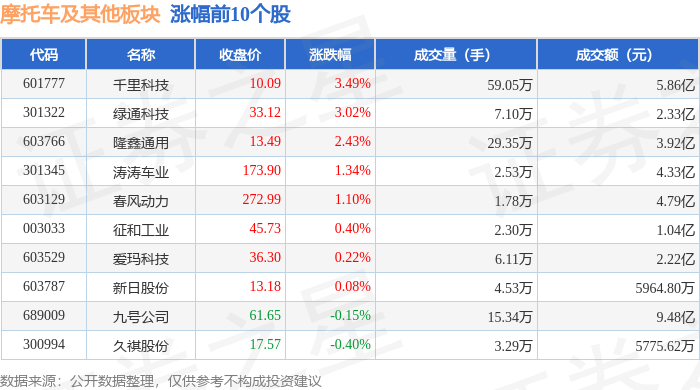
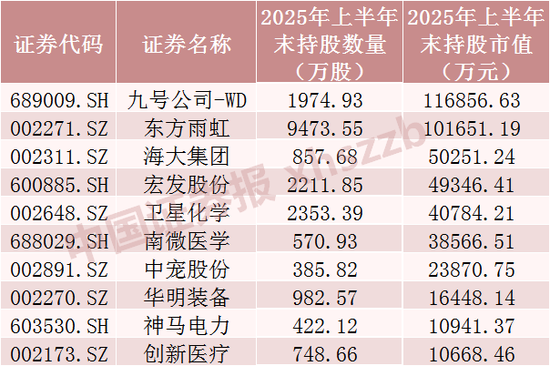
Core Insights - The report provides a summary of stock holdings and market values for various companies as of the end of the first half of 2025, highlighting significant investments in specific firms [1]. Group 1: Company Holdings - Dongfang Yuhong (证券代码: 002271.SZ) holds 9,473.55 million shares with a market value of 101,651.19 million yuan [1]. - Jinpai Titanium Industry (证券代码: 000545.SZ) has 3,221.90 million shares valued at 8,924.67 million yuan [1]. - Satellite Chemical (证券代码: 002648.SZ) possesses 2,353.39 million shares with a market value of 40,784.21 million yuan [1]. - Hongfa Technology (证券代码: 600885.SH) holds 2,211.85 million shares valued at 49,346.41 million yuan [1]. - Ninebot (证券代码: 689009.SH) has 1,974.93 million shares with a market value of 116,856.63 million yuan [1]. - Huaming Equipment (证券代码: 002270.SZ) holds 982.57 million shares valued at 16,448.14 million yuan [1]. - Weixing New Materials (证券代码: 002372.SZ) has 982.04 million shares valued at 10,173.90 million yuan [1]. - Zhuhai Group (证券代码: 600961.SH) possesses 903.02 million shares with a market value of 10,095.81 million yuan [1]. - Haida Group (证券代码: 002311.SZ) holds 857.68 million shares valued at 50,251.24 million yuan [1]. - Shaanxi Jinye (证券代码: 000812.SZ) has 793.19 million shares valued at 3,720.05 million yuan [1].
中证文体指数报1922.68点,前十大权重包含岩山科技等
Jin Rong Jie· 2025-08-13 16:15
Group 1 - The core viewpoint of the news is the performance of the China Securities Cultural and Sports Index, which has shown significant growth over the past month, three months, and year-to-date [1] - The China Securities Cultural and Sports Index has increased by 3.64% in the last month, 8.59% in the last three months, and 14.72% year-to-date [1] - The index reflects the overall performance of listed companies related to cultural and sports sectors, including media, entertainment, and sports services [1] Group 2 - The top ten weighted companies in the index include: Focus Media (7.79%), Giant Network (3.67%), Ninebot (3.37%), Yanshan Technology (3.2%), Kaiying Network (3.19%), Kunlun Wanwei (3.04%), Light Media (2.74%), Shenzhou Taiyue (2.67%), Leo Group (2.62%), and 37 Interactive Entertainment (2.5%) [1] - The market share of the index's holdings is 73.49% from Shenzhen Stock Exchange and 26.51% from Shanghai Stock Exchange [1] - The industry composition of the index shows that communication services account for 81.10%, consumer discretionary for 11.78%, consumer staples for 2.03%, industrials for 2.00%, information technology for 1.61%, and materials for 1.48% [2] Group 3 - The index samples are adjusted semi-annually, with adjustments occurring on the next trading day after the second Friday of June and December each year [2] - Weight factors are adjusted in accordance with the sample changes, and generally remain fixed until the next scheduled adjustment [2] - Special circumstances may lead to temporary adjustments of the index, such as delisting of samples or corporate actions like mergers and acquisitions [2]





QFII最新重仓股曝光!买了这些股票
Zhong Guo Zheng Quan Bao· 2025-08-13 08:38
Core Insights - QFII has significantly increased its presence in the A-share market, with 64 companies reporting QFII as a top ten shareholder, holding a total of 3.65 billion shares valued at 6.399 billion yuan as of August 12, 2025 [2][3] Company Summaries - The top holding by QFII is Ninebot Company-WD, with a holding value of 1.169 billion yuan, followed by Oriental Yuhong and Haida Group with holdings of 1.017 billion yuan and 503 million yuan respectively [2][3] - QFII has newly entered the top ten shareholders of 28 companies in the second quarter, with notable entries including Zhongchong Co. and Zhuhai Group, each exceeding 100 million yuan in holding value [3][4] Industry Insights - QFII's holdings in the automotive sector exceed 1.308 billion yuan, while holdings in the building materials and electrical equipment sectors are over 1.118 billion yuan and 1.070 billion yuan respectively [7][8] - The top ten industries by QFII holdings include automotive, building materials, and electrical equipment, indicating a strong focus on these sectors [8] Changes in Holdings - QFII increased its holdings in 18 stocks during the second quarter, with Ninebot Company-WD seeing the largest increase of 9.686 million shares [4][6] - Other significant increases in holdings include Hongfa Technology and Jitai Co., with increases of 5.373 million shares and 4.381 million shares respectively [4][6]
摩托车及其他板块8月13日涨1.16%,千里科技领涨,主力资金净流出1.03亿元
Zheng Xing Xing Ye Ri Bao· 2025-08-13 08:31
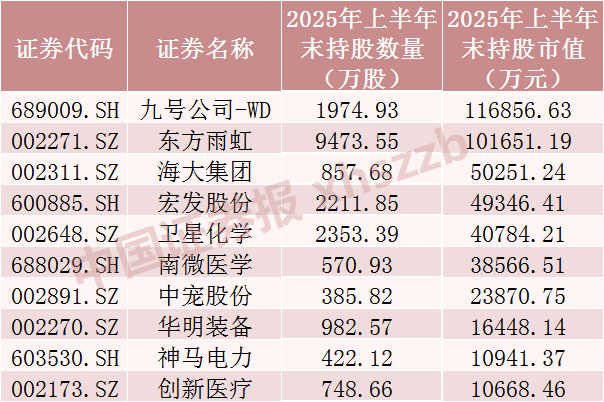
证券之星消息,8月13日摩托车及其他板块较上一交易日上涨1.16%,千里科技领涨。当日上证指数报收 于3683.46,上涨0.48%。深证成指报收于11551.36,上涨1.76%。摩托车及其他板块个股涨跌见下表: | 代码 | 名称 | 收盘价 | 涨跌幅 | 成交量(手) | 成交额(元) | | | --- | --- | --- | --- | --- | --- | --- | | 601777 | 千里科技 | 10.09 | 3.49% | 59.05万 | | 5.86亿 | | 301322 | 绿通科技 | 33.12 | 3.02% | 7.10万 | | 2.33亿 | | 603766 | 降葵通用 | 13.49 | 2.43% | 29.35万 | | 3.92亿 | | 301345 | 涛涛车业 | 173.90 | 1.34% | - 2.53万 | | 4.33亿 | | 603129 | 春风动力 | 272.99 | 1.10% | 1.78万 | | 4.79亿 | | 003033 | 征和工业 | 45.73 | 0.40% | 2.30万 | | 1.04亿 ...


QFII最新重仓股曝光(附名单)
Zhong Zheng Wang· 2025-08-13 06:28
Group 1 - As of August 12, 2025, a total of 264 A-share listed companies have disclosed their semi-annual reports, with 64 of these companies having QFII (Qualified Foreign Institutional Investor) as part of their top ten circulating shareholders, holding a total of 365 million shares valued at 6.399 billion yuan [1] - The top three companies by QFII holding value are Nine Company with 1.169 billion yuan, followed by Oriental Yuhong at 1.017 billion yuan, and Haida Group at 503 million yuan [1] - QFII's holdings in Hongfa Technology and Satellite Chemical exceed 400 million yuan each [1] Group 2 - The top three industries by QFII holding value are Automotive at 1.308 billion yuan, Building Materials at 1.118 billion yuan, and Electric Equipment at 1.070 billion yuan [3] - Other notable industries include Agriculture, Forestry, Animal Husbandry, and Fishery at 790 million yuan, and Pharmaceutical and Biological sectors at 698 million yuan [3]
九号公司(689009):财报点评:各业务线多点开花,业绩持续高增
East Money Securities· 2025-08-12 11:37
Investment Rating - The report initiates coverage with an "Add" rating for the company [5] Core Views - The company has demonstrated strong growth across multiple business lines, with a significant increase in revenue and net profit in the first half of 2025 [4][5] - The electric two-wheeler segment continues to perform exceptionally well, with sales reaching 1.3887 million units, a year-on-year increase of 77% [4] - The company is expanding its product matrix and enhancing its competitive advantage through product innovation and market penetration, particularly in the European market [5] Financial Summary - For the first half of 2025, the company reported revenue of 11.742 billion yuan, up 76.14% year-on-year, and a net profit attributable to shareholders of 1.242 billion yuan, up 108.45% year-on-year [4] - The gross margin for the electric two-wheeler business was 25.21%, an increase of 1.48 percentage points year-on-year [4] - The company expects revenues of 21.83 billion yuan, 27.41 billion yuan, and 32.59 billion yuan for 2025, 2026, and 2027 respectively, with corresponding net profits of 1.903 billion yuan, 2.647 billion yuan, and 3.431 billion yuan [6][11] Growth Projections - The company anticipates a revenue growth rate of 53.79% in 2025, followed by 25.56% in 2026 and 18.89% in 2027 [6][12] - The net profit growth rate is projected at 75.58% for 2025, 39.05% for 2026, and 29.66% for 2027 [6][12] Market Position - The company has established a strong presence in the electric two-wheeler and service robot markets, with a focus on product differentiation and brand value [5] - The company is also expanding its international market reach, particularly in Europe, which is expected to contribute to sustained revenue growth [4][5]