
PAB(000001)

Search documents
银行“反内卷”到底是在“反”什么?
3 6 Ke· 2025-07-28 00:09
Core Viewpoint - The banking industry is experiencing a shift towards "anti-involution" as banks face intense competition, leading to a focus on high-quality development, cost reduction, and retail transformation [1][2][21]. Group 1: Industry Trends - The term "anti-involution" has gained popularity in the banking sector, indicating a move away from excessive competition that harms profitability [2][12]. - The Guangdong Banking Association has initiated a comprehensive rectification of "involutionary" competition, proposing a regulatory framework to address negative practices [2][4]. - The current competitive landscape is characterized by asymmetric declines in deposit and loan interest rates, resulting in a narrowing net interest margin [4][10]. Group 2: Competitive Practices - Banks are engaging in aggressive pricing strategies, with some offering consumer loan rates as low as 2.6% and business loan rates between 2.3% and 3% [4][10]. - The competition has led to a situation where some banks are offering loans at rates below their cost of funds, which is unsustainable [10][11]. - The People's Bank of China has noted significant discrepancies between policy interest rate adjustments and actual loan rates, highlighting the impact of fierce competition [10]. Group 3: Regulatory and Self-Regulatory Measures - The banking industry is implementing self-regulatory agreements aimed at promoting rational pricing and curbing unethical marketing practices [5][21]. - The focus on self-regulation is seen as essential for maintaining a healthy competitive environment and ensuring sustainable growth in the banking sector [4][19]. Group 4: Future Outlook - The "anti-involution" movement is expected to positively impact the banking sector's profitability, with projections indicating an 8% potential increase in earnings by 2026, particularly benefiting joint-stock banks [21][22]. - The emphasis on high-quality development and service to the real economy is expected to drive banks' performance in the coming years [19][21].


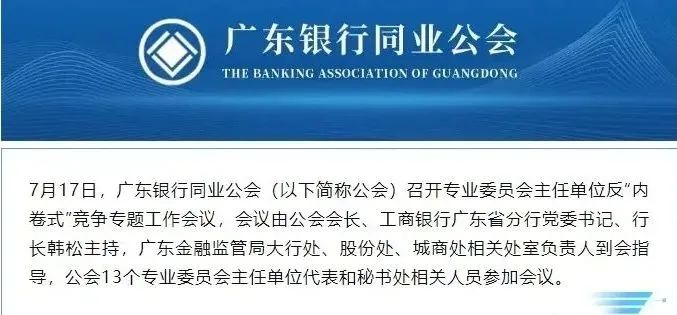
金融业也反“内卷”,首先抵制恶性价格战
Nan Fang Du Shi Bao· 2025-07-27 23:13
Core Viewpoint - The financial industry is increasingly focusing on resisting "involution" competition, with institutions like Ping An Bank taking steps to promote self-discipline and strategic adjustments to combat this issue [3][5][10]. Group 1: Company Actions - Ping An Bank held a mid-year meeting to outline its business development plan and promote anti-"involution" competition efforts, with over 2,000 employees required to sign a commitment letter [3]. - In the first quarter, Ping An Bank reported a revenue of 33.709 billion, a year-on-year decrease of 13.1%, and a net profit of 14.096 billion, down 5.6% [3]. - The bank's total assets reached 5.78 trillion at the end of the first quarter, reflecting a slight increase of 0.1% from the end of the previous year [3]. Group 2: Industry Trends - The Guangdong Banking Association has established a "1+3+N" system to combat "involution" competition, which includes a negative list from regulatory bodies and self-discipline agreements [5]. - The call for resisting "involution" is echoed nationwide, with provinces like Fujian and Anhui issuing self-discipline agreements to prevent malicious competition [6]. - The financial sector is facing pressure from low interest rates and low spreads, with banks like China Merchants Bank reporting a revenue decline of 3.09% and a net profit drop of 2.08% in the first quarter [9]. Group 3: Regulatory Environment - Regulatory bodies are actively opposing "involution" competition, with measures including the issuance of negative lists and guidance for industry associations to create self-discipline agreements [5][6]. - The implementation of the "reporting and operation unity" policy in the insurance sector aims to standardize market practices and curb malicious competition, resulting in a 30% reduction in average commission levels [8]. Group 4: Challenges and Perspectives - The banking industry is experiencing a critical point with net interest margins dropping to around 1.43%, leading to concerns about profitability and sustainability [9]. - Some industry professionals argue that the focus on commission rates and fees is merely a superficial response to deeper issues of homogeneity in the market, suggesting that true reform requires addressing these underlying problems [10].

争夺按揭贷款
经济观察报· 2025-07-26 09:49
Core Viewpoint - The competition in the mortgage loan market is intensifying, with banks focusing on improving service and efficiency to attract business, especially among smaller banks that lack the marketing budgets of larger institutions [4][11][12]. Group 1: Market Dynamics - The mortgage loan business is seen as a critical driver for the sustained growth of retail credit by banks [3][4]. - The current competitive landscape is driven by the banks' desire to secure quality credit assets, as mortgage loans have low default rates and stable repayment cycles [4][5]. - Large banks are leveraging partnerships with real estate agencies to secure a stable volume of mortgage loans, while smaller banks are forced to compete on service and efficiency due to limited budgets [5][11]. Group 2: Operational Strategies - Banks are adopting aggressive strategies to enhance their mortgage loan business, including rapid response to loan applications and improving approval times [11][12]. - Some banks are reallocating funds from consumer loans to mortgage loans to boost their mortgage business volume [12][14]. - Smaller banks are also relaxing their loan approval criteria to gain favor with real estate agencies and increase their mortgage loan referrals [14][15]. Group 3: Competitive Pressure - Internal performance metrics and competitive pressures are driving bank employees to work harder to secure mortgage loan business [17][19]. - There is a trend of banks offering kickbacks to real estate agents to increase mortgage loan volumes, despite regulatory risks associated with such practices [20][21]. - The need for differentiation in financial services is emphasized, suggesting that banks should offer tailored products to meet diverse customer needs [21].

银行业“反内卷”反什么?怎么反?
Zhong Guo Jing Ying Bao· 2025-07-25 09:56
Core Viewpoint - The financial industry is experiencing a shift towards "anti-involution" competition, with banks being urged to adopt more rational and healthy competitive practices to enhance operational capabilities and contribute to sustainable economic development [1][2][4]. Group 1: Industry Response - Ping An Bank's Guangzhou branch has initiated a meeting to implement "anti-involution" strategies, aiming for high-quality and sustainable development [2]. - Various financial regulatory bodies and banking associations across regions are advocating for adherence to self-regulatory mechanisms and the establishment of a reasonable industry evaluation and incentive system [1][4]. - The Guangdong Financial Regulatory Bureau has explicitly opposed "involution" competition and has issued a negative list to guide the banking and insurance sectors [4]. Group 2: Current Challenges - The financial industry is facing intensified "involution" competition, characterized by high-interest deposit promotions and aggressive customer acquisition strategies [5][6]. - The core issues stem from a narrowing interest margin (1.43% in 2024), digital lag in smaller banks, and a shift in corporate financing towards direct market channels [6]. - The negative impacts of "involution" include compressed profit margins, distorted risk preferences, and limited capital replenishment for banks [6]. Group 3: Future Directions - The central economic work conference has called for comprehensive measures to address "involution" competition, emphasizing the need for banks to abandon scale and speed obsessions [7]. - Banks, particularly smaller ones, are encouraged to adopt differentiated competition strategies and improve asset-liability management to enhance profitability and sustainability [7][8]. - The importance of self-regulation and avoiding price wars has been highlighted, with large commercial banks urged to lead by example [8].
银行“新规”出台后,这“2类”业务被叫停,多家银行已行动
Sou Hu Cai Jing· 2025-07-25 06:41
Core Viewpoint - The Chinese financial industry is undergoing a profound transformation driven by new regulatory measures aimed at tightening monetary policy and mitigating systemic financial risks, particularly in the areas of internet lending and shadow banking [1][4]. Group 1: Regulatory Changes - The People's Bank of China (PBOC) issued guidelines on July 15 to strengthen financial risk prevention, marking a new phase of tightened monetary policy [1]. - New regulations significantly increase the required contribution of banks in joint lending from 30% to 70%, effectively reducing the leverage of internet platforms [2]. - The regulations also target shadow banking, which had a scale of approximately 25.3 trillion yuan at the end of 2024, accounting for 19.7% of GDP [4]. Group 2: Impact on Financial Institutions - Major banks like Industrial and Commercial Bank of China (ICBC) and China Construction Bank are adjusting their strategies, with ICBC halting joint lending with 10 internet platforms [2]. - Smaller banks are particularly affected, with internet loan income constituting an average of 17.3% of their operating revenue, and some exceeding 30% [5]. - Banks are responding by tightening their investment in non-standard assets and focusing on compliance and risk management [4][5]. Group 3: Long-term Outlook - The adjustments are expected to lead to a healthier and more sustainable financial ecosystem, with improved transparency in fund flows and more reasonable risk pricing [5]. - Analysts predict that the overall non-performing loan ratio in the banking sector will decrease to around 1.2% by 2026 following the adjustment period [5]. - The regulatory changes are part of a broader systemic effort to reduce financial leverage and prevent risks, with 23 significant policy documents issued since 2021 [4][5]. Group 4: Balancing Act - The new regulations reflect the regulatory authorities' commitment to balancing financial openness with risk prevention amid increasing global economic uncertainties [7]. - The adjustment process is expected to be ongoing, requiring adaptation from all market participants [7].



银行股配置重构系列六:哪些顺周期银行股值得关注?
Changjiang Securities· 2025-07-25 05:15
Investment Rating - The industry investment rating is "Positive" and maintained [12] Core Viewpoints - In 2023, cyclical bank stocks have generally lagged in performance and are at historically low valuations. The market is beginning to focus on which cyclical bank stocks currently offer attractive value for investment [2][6] - The report highlights three categories of banks worth attention: stable performance small and medium-sized rural commercial banks, city commercial banks with improving retail asset quality, and undervalued joint-stock banks [2][6] Summary by Sections Small and Medium-Sized Rural Commercial Banks - Changshu Bank has significantly lagged behind the sector in 2023, with a valuation of 0.77x 2025 PB, at a historical percentile of 24%. Despite concerns over retail credit demand, the bank's operational performance remains strong, with a revenue growth of 10.1% and a net profit growth of 13.6% in the first half of 2025 [7] - Ruifeng Bank, another leading rural commercial bank in Zhejiang, has a valuation of 0.56x 2025 PB, also under pressure from pessimistic economic expectations. However, it is expected to maintain double-digit credit growth under its strategic initiatives [8] City Commercial Banks - Ningbo Bank, with a valuation of 0.80x 2025 PB, has seen a significant decline in its stock price since 2023. The bank's retail loan quality is improving, and if economic expectations rise, there is potential for valuation recovery [9] - Changsha Bank, which focuses on consumer finance, has a low valuation of 0.56x 2025 PB and has underperformed compared to peers. A recovery in economic expectations could enhance its valuation [9] Joint-Stock Banks - Ping An Bank's valuation is at 0.52x 2025 PB, significantly lower than its peers. The bank has experienced a decline in performance due to strategic adjustments by its new management. If real estate policies improve and economic expectations rise, there is potential for revaluation [10]

山东胜利股份有限公司董事会关于公司股东部分股份解除质押的公告
Zhong Guo Zheng Quan Bao - Zhong Zheng Wang· 2025-07-25 00:38
Group 1 - The core point of the announcement is that the controlling shareholder, Zhongyou Gas Investment Group, has partially lifted the pledge on its shares in Shandong Shengli Co., Ltd. to optimize asset structure and reduce financing costs [1][2] - Zhongyou Gas Investment Group has lifted the pledge on 22,928,497 shares out of a total of 177,000,000 shares pledged to Ping An Bank for merger loan financing [1] - As of the announcement date, the total pledged shares held by Zhongyou Gas Investment Group and its concerted parties are disclosed, indicating a significant portion of shares are still under pledge [1] Group 2 - Zhongyou Gas Investment Group is reported to have a good credit and financial status, with stable production and operations, and the risks associated with the pledged shares are considered controllable [2]

金融业出拳整治“内卷式”竞争,价格恶战首当其冲
Nan Fang Du Shi Bao· 2025-07-24 10:56
Core Viewpoint - The financial industry is increasingly focusing on resisting "involution-style" competition, with institutions like Ping An Bank taking proactive measures to address this issue and promote sustainable business practices [2][4]. Group 1: Ping An Bank's Actions - On July 22, Ping An Bank held a meeting to outline its business development plan and promote the signing of commitment letters against "involution-style" competition among its over 2,000 employees [2]. - In Q1 2025, Ping An Bank reported a revenue of 33.709 billion, a year-on-year decrease of 13.1%, and a net profit of 14.096 billion, down 5.6% [2]. - The bank's total assets reached 57.8 trillion at the end of Q1, reflecting a slight increase of 0.1% compared to the end of the previous year [2]. Group 2: Industry-Wide Trends - The Guangdong Banking Association has established a "1+3+N" system to combat "involution-style" competition, which includes a negative list from regulatory bodies and self-regulatory measures from various business sectors [4]. - The Guangdong Financial Regulatory Bureau has publicly opposed "involution-style" competition and is working on self-regulatory agreements to guide the industry [4]. Group 3: Broader Industry Context - The call for resisting "involution" is gaining traction nationwide, with provinces like Fujian and Anhui issuing self-regulatory agreements to prevent malicious competition and ensure compliance with regulatory requirements [5]. - In Shenzhen, despite being a major financial hub, there has been no clear stance from local regulators on "involution" competition, although the banking sector's total assets reached 13.57 trillion, growing by 1.37% year-on-year [5]. Group 4: Regulatory Measures and Market Impact - The implementation of the "reporting and execution consistency" policy in the insurance sector aims to standardize market practices and curb harmful competition, resulting in a 30% reduction in average commission levels in certain channels [6]. - The banking sector is facing significant pressure on profitability, with net interest margins declining to approximately 1.43% in Q1 2025, leading to concerns about the sustainability of business models [7]. Group 5: Responses to Challenges - Strategies proposed by industry leaders include international expansion, diversification of revenue sources, and the use of artificial intelligence to enhance operational efficiency [8]. - There are differing opinions on the effectiveness of "anti-involution" measures, with some industry professionals arguing that the root cause of the issue lies in the high degree of market homogeneity rather than just pricing strategies [8].

上市银行年中工作会,“关键词”曝光
券商中国· 2025-07-24 06:42
Core Viewpoint - The article discusses the mid-year work meetings of various listed banks in 2025, highlighting their operational achievements in the first half of the year and outlining key tasks for the second half, with a focus on the "Five Major Articles" and risk management strategies [1][2][3]. Group 1: Operational Achievements - Banks reported a steady improvement in performance, summarizing their results as "steady progress" and "continuously improving," while acknowledging that these achievements were hard-earned [2]. - The emphasis was placed on the effectiveness of key work initiatives, indicating a positive outlook for the banking sector [2]. Group 2: Key Focus Areas for the Second Half - The "Five Major Articles" became a common theme across banks, focusing on deepening reforms, reducing costs and increasing efficiency, and risk prevention [3][5]. - Specific initiatives include enhancing technology-driven financial services, developing a sustainable green finance mechanism, improving inclusive financial services, leveraging advantages in pension finance, and accelerating digital finance development [6][7]. Group 3: Reform and Innovation - Banks are adopting reforms to escape reliance on existing paths in a highly competitive low-interest environment, aiming to enhance operational vitality and resilience [15]. - For instance, Ping An Bank highlighted achievements in strategic restructuring, risk resolution, team building, and operational stability [16]. Group 4: Risk Management - With narrowing interest margins, the risk tolerance space for banks has diminished, making risk compliance management crucial for success [23]. - Agricultural Bank emphasized the importance of balancing development and safety, focusing on credit risk resolution and market risk prevention [24]. - Other banks, such as Everbright Bank and Huaxia Bank, also stressed the need for robust risk management and compliance to safeguard operational safety [25][26].


调结构、控风险、促转型 多家银行明确下半年工作重点
Shang Hai Zheng Quan Bao· 2025-07-23 18:08
Core Viewpoint - The banking sector is facing significant operational pressure due to narrowing interest margins, prompting banks to focus on revenue growth, cost reduction, and innovation while enhancing risk management and digital transformation efforts [1][2][3][4][6][7] Group 1: Operational Strategies - Banks are prioritizing the optimization of their asset-liability structures to counteract the pressure from narrowing interest margins, with a focus on high-yield, low-risk assets and increasing the proportion of intermediary business income [2][3] - Retail transformation is being emphasized, with banks like Ping An Bank implementing reforms to enhance risk-adjusted returns and improve operational efficiency through a clear market positioning and customer segmentation strategy [2][3] - Smaller banks are concentrating on their business positioning, particularly in supporting agriculture and small enterprises, by integrating industry, product, process, technology, and risk control to enhance their core competitiveness [2][3] Group 2: Risk Management - Risk management has become a critical focus for banks, with many adopting innovative risk control measures and strengthening compliance management to mitigate non-performing loan risks [3][4] - Banks are urged to maintain a balance between supporting the real economy and risk prevention, with a particular emphasis on monitoring risks in traditional industries and specific regions [3][4] - Enhanced risk awareness and compliance are being prioritized, with banks like Ping An Bank increasing scrutiny of financial innovation products to reduce legal and reputational risks [4] Group 3: Digital Transformation - The integration of financial technology is seen as a key competitive area, with banks aiming to deepen the fusion of technology and business to create a new ecosystem of intelligent and digital financial services [6][7] - Investment in technology is being ramped up to optimize personnel structures and improve operational efficiency, with a focus on embracing artificial intelligence, big data, and cloud computing [6][7] - Agricultural Bank is pushing forward with its smart banking projects to enhance efficiency and customer satisfaction, aiming to streamline processes and reduce burdens on grassroots operations [6] Group 4: Future Outlook - Despite challenges, the banking sector's fundamentals remain solid, with opportunities for sustainable development through continuous reform, innovation, risk management, and digital transformation [7]