PAB(000001)

Search documents
信用卡汇兑变革:人民币直接入账如何影响你的境外消费?
Xin Lang Cai Jing· 2025-09-22 01:04
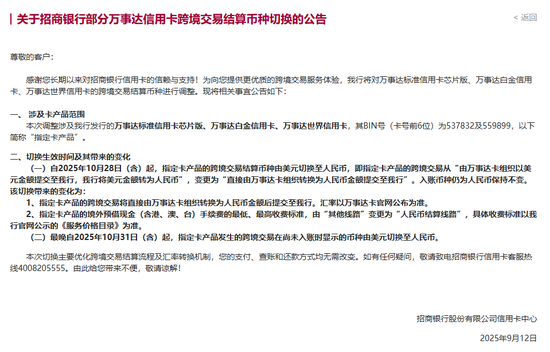
Core Viewpoint - The recent changes in credit card foreign currency transaction settlement methods by Ping An Bank and China Merchants Bank are set to enhance the cross-border payment experience for millions of consumers by allowing direct settlement in RMB, eliminating the previous USD intermediary step [1][4][10]. Group 1: Changes in Credit Card Settlement Mechanism - China Merchants Bank announced that starting from October 28, 2025, cross-border transactions for specific Mastercard credit cards will be settled directly in RMB instead of going through USD [2][4]. - Ping An Bank implemented a similar change earlier, allowing credit card foreign currency transactions to be settled in RMB starting from September 25, 2023, covering multiple card types including Mastercard, Visa, and JCB [4][5]. Group 2: Impact on Consumer Experience - The new direct RMB settlement model simplifies the transaction process, reducing the number of currency conversions from two to one, which may lower costs associated with multiple exchanges [6][9]. - Consumers will see RMB amounts displayed for cross-border transactions before they are settled, enhancing transparency and allowing for direct RMB repayments without the need for currency exchange [6][7]. Group 3: Exchange Rate Pricing Mechanism - Ping An Bank's pricing mechanism for RMB settlement is based on the previous day's exchange rate, which introduces a time lag and potential exchange rate risk for consumers [7][9]. - In contrast, China Merchants Bank will use the exchange rate published by Mastercard, providing real-time pricing and increasing transparency for consumers [9]. Group 4: Market Competition and Innovation - The opening of China's bank card clearing market has fostered competition, leading to innovations in cross-border payment services [10][11]. - The introduction of direct RMB settlement services by banks in collaboration with card organizations reflects both technological advancements and competitive market dynamics, ultimately benefiting consumers with improved services and options [10][11].



平安理财破局:“工业化+平台化”筑牢回撤防线
Zheng Quan Shi Bao· 2025-09-21 17:06
Core Viewpoint - The article emphasizes the importance of stable returns and effective risk management in the banking wealth management sector, particularly through the practices of Ping An Wealth Management, which aims to provide a robust investment experience for clients amidst market volatility [1][2][3]. Group 1: Investment Performance - As of the end of July this year, Ping An Wealth Management's fixed income and fixed income+ products achieved an average annualized return of 3.46% over the past three years, ranking among the top in the industry [2]. - The probability of positive returns for investors holding fixed income and fixed income+ products until maturity is 98% and 99%, respectively [2]. - The proportion of products with negative returns is only 0.55%, significantly lower than the industry average, indicating effective management of drawdowns [2][3]. Group 2: Risk Management Strategy - Ping An Wealth Management has established a strong focus on drawdown management, aiming to control net value fluctuations while maintaining competitive returns [3][4]. - The company has adopted an "industrialization + platformization" investment management model to enhance efficiency and consistency in risk-return characteristics across its product offerings [4][5]. Group 3: Product Development and Branding - The company has launched a new product system called "An+Xin Stable and Long-term," which includes four product series: "Anxin" for cash management, "Anwen" for absolute return fixed income products, "Anzhi" for multi-asset strategies, and "Anyuan" for mixed products aimed at long-term value appreciation [7]. - This product upgrade aims to better meet the increasingly diverse wealth management needs of investors by providing clearer product positioning and richer functional scenarios [7]. Group 4: Strategic Growth and Market Position - Ping An Bank is focusing on enhancing its asset management scale (AUM) through a strategic shift towards wealth management, particularly in basic wealth management products, which are seen as a reservoir for high-quality AUM growth [6]. - The bank is adjusting its structure to increase the proportion of basic wealth management products, aligning with trends in resident wealth allocation preferences and enhancing the resilience of its AUM structure [6].
理性看待单一板块调整
Bei Jing Shang Bao· 2025-09-21 15:57
Group 1 - The recent pullback in the banking sector is seen as a rational correction following a period of significant short-term price increases, indicating a return to intrinsic value [1][2] - The banking sector, while having a high weight in the A-share market, does not significantly influence the long-term trend of the overall market, as its performance is just a small part of the broader market dynamics [1][2] - The fundamental value of banking stocks remains intact despite short-term price declines, as banks play a crucial role in the financial system with stable business models and robust risk management [1][2] Group 2 - Investors should avoid overemphasizing the performance of a single sector, as this can lead to impulsive decisions driven by market emotions, such as panic selling or blind buying [2][3] - A diversified investment approach across multiple promising sectors can mitigate risks associated with the volatility of any single sector, aligning with the ultimate goal of value investing [2][3] - Long-term value of listed companies should be prioritized over short-term market fluctuations, as economic growth and company performance are the primary drivers of stock price increases [3]
券商年内科创债发行规模已超570亿元
Zheng Quan Ri Bao Zhi Sheng· 2025-09-21 15:39
Core Insights - The issuance of bonds by securities firms has been active this year, with a total issuance scale reaching 1.23 trillion yuan as of September 21 [1] - Technology innovation bonds (referred to as "Sci-Tech Bonds") have played a crucial role in supporting the development of technology innovation enterprises due to their precise funding allocation and flexible financing models [1] - The issuance of Sci-Tech Bonds by securities firms has exceeded 57 billion yuan this year, driven by both policy guidance and market demand [1] Group 1: Issuance and Market Dynamics - As of September 21, 40 securities firms have issued Sci-Tech Bonds totaling 57.17 billion yuan since May 7, with both leading and mid-sized firms participating [1][2] - Leading securities firms dominate the issuance scale, with China Merchants Securities at the forefront, having issued 10 billion yuan, followed by CITIC Securities and Guotai Junan with 9.7 billion yuan and 5.9 billion yuan respectively [2] - The bonds exhibit flexible terms and lower interest rates, with rates ranging from 1.64% to 2.29%, significantly lower than ordinary corporate bonds [2] Group 2: Underwriting and Strategic Focus - In the first half of the year, 68 securities firms acted as lead underwriters for Sci-Tech Bonds, underwriting a total of 380 bonds, which represents a year-on-year increase of 82.69% [3] - The total underwriting amount reached 381.39 billion yuan, marking a 56.48% increase year-on-year [3] - Securities firms are focusing on providing comprehensive financial services throughout the lifecycle of technology enterprises, with firms like CITIC Securities and Zhongyin Securities emphasizing the integration of technology innovation and industrial innovation [3] Group 3: Future Outlook - The market for Sci-Tech Bonds is expected to see increased supply in the second half of the year, presenting further opportunities for investors [4]





侃股:理性看待单一板块调整
Bei Jing Shang Bao· 2025-09-21 12:04
Group 1 - The recent pullback in the banking sector is seen as a rational correction following a period of significant short-term price increases, indicating a return to intrinsic value [1][2] - The banking sector, while having a high weight in the A-share market, does not significantly influence the long-term trend of the overall market, as its performance is just a small part of the broader market dynamics [1][2] - The fundamental value of banking stocks remains intact despite short-term price declines, as banks play a crucial role in the financial system with stable business models and robust risk management [1][3] Group 2 - Investors should avoid overemphasizing the performance of a single sector, as this can lead to impulsive decisions driven by market emotions, such as panic selling or blind buying [2][3] - A diversified investment approach across multiple promising sectors can mitigate risks associated with the volatility of any single sector, aligning with the ultimate goal of value investing [2][3] - Long-term value of listed companies should be prioritized over short-term market fluctuations, as economic growth and company performance are the primary drivers of stock price increases [3]
海外宏观周报:降息兑现,“降息交易”降温-20250921
Ping An Securities· 2025-09-21 11:09
Group 1: U.S. Economic Policy - The Federal Reserve lowered the federal funds rate by 25 basis points to a range of 4.00%-4.25%, marking the first rate cut in nine months[1] - Initial jobless claims fell to 231,000, the largest drop in nearly four years, against an expectation of 240,000[1] - The New York Fed manufacturing index dropped 21 points to -8.7, significantly below the market expectation of 5[1] Group 2: European Economic Policy - The Bank of England maintained its interest rate at 4% and reduced its quantitative tightening scale from £100 billion to £70 billion over the next 12 months[1] - The European Central Bank's executive board member Schnabel indicated that inflation risks remain tilted to the upside, suggesting a hold on current interest rates[1] - The UK's August CPI remained steady at 3.8%, matching market expectations[1] Group 3: Japanese Economic Policy - The Bank of Japan kept its benchmark interest rate unchanged at 0.5% for the fifth consecutive time, with some members advocating for a 25 basis point increase[1] - Japan's exports fell by 0.1% year-on-year in August, marking the fourth consecutive month of decline, with exports to the U.S. down 13.8%[1] - The elderly population (aged 65 and above) in Japan reached 36.19 million, accounting for 29.4% of the total population, a record high[1] Group 4: Global Market Trends - Global stock market optimism has cooled, with the S&P 500, Dow Jones, and Nasdaq rising by 1.2%, 1.0%, and 2.2% respectively[1] - The 10-year U.S. Treasury yield rose by 8 basis points to 4.14%, reflecting investor concerns about future economic uncertainty[1] - Gold prices increased by 0.3% to $3,663.2 per ounce, while Brent crude oil prices fell by 0.5% to $66.7 per barrel[1]
本周聚焦:三阶段视角:银行资产质量及拨备计提力度如何?
GOLDEN SUN SECURITIES· 2025-09-21 10:34
Investment Rating - The report maintains a positive outlook on the banking sector, suggesting potential investment opportunities due to favorable policy catalysts and improving fundamentals in certain banks [12]. Core Insights - The report highlights the adequacy of loan loss provisions among listed banks, with a provision coverage ratio of 70.8% for Stage 3 loans, indicating limited future impact on profits [2][12]. - It emphasizes the improvement in asset quality, particularly in Stage 3 loans, with notable reductions in the proportion of such loans for several banks compared to the end of Q4 2024 [1][2]. - The report suggests a focus on banks with positive fundamental changes and continuous improvement in financial statements, recommending specific banks for investment [12]. Summary by Sections 1. Loan Quality and Provisioning - The proportion of Stage 3 loans is relatively low for banks like Chengdu Bank (0.66%) and Ningbo Bank (0.76) [1]. - Significant improvements in Stage 3 loan ratios were observed for Chongqing Bank (-61bp) and Guiyang Bank (-48bp) compared to Q4 2024 [1]. - The provision coverage for Stage 3 loans is high, with leading banks like Qingnong Bank (4.35%) and Yunan Bank (4.16%) showing strong provisioning ratios [2]. 2. Financial Assets - The proportion of Stage 3 financial assets is low, with most banks not exceeding 0.05%, indicating manageable asset quality pressure [4]. - The report notes that the provision coverage for financial investments is also robust, with Zhejiang Bank (3.16%) and Qingdao Bank (2.85%) leading in provisioning ratios [8]. 3. Sector Outlook - The report anticipates that expansionary policies aimed at stabilizing the economy will benefit the banking sector, with a focus on banks like Ningbo Bank and Jiangsu Bank for potential investment [12]. - It highlights the ongoing economic recovery and the potential for interest rate cuts, suggesting a sustained dividend strategy for certain banks [12].




这场圆桌论坛,信息量很大!
中国基金报· 2025-09-20 03:19
Core Viewpoint - The article discusses the transformation of the wealth management industry in China, emphasizing the shift from a product-selling model to a client-centered approach in the era of buyer wealth management [1][4]. Group 1: Buyer Thinking Evaluation Standards - The core evaluation standard for determining whether an institution or advisor possesses buyer thinking is based on the revenue model, specifically focusing on "earning retention fees" rather than "sales commissions" [6][8]. - Institutions must prioritize customer interests and provide value through quality service and stable returns to encourage long-term product holding [8][10]. - The recognition of the buyer fee model by clients is crucial for the transformation process, as many still prefer traditional commission-based structures [10][12]. Group 2: Challenges and Breakthroughs in Transformation - The necessity for transformation is driven by declining commission levels and changing client demands for sustainable returns through professional investment [16][17]. - Institutions must overcome the "license dependency" mindset and create real, sustainable value for clients to gain their trust and loyalty [17][18]. - A successful transformation requires a collaborative approach involving consensus on direction, a buyer-oriented assessment system, and a focus on professional service [18][19]. Group 3: Importance of Asset Allocation Services - Asset allocation is highlighted as a critical component of wealth management, with a focus on long-term returns [20][21]. - Institutions need to enhance their asset allocation capabilities by expanding product offerings, developing core methodologies, and ensuring effective communication of strategies to clients [21][22]. Group 4: Building Differentiated Competitive Advantages - To establish core competitiveness, firms must have clear strategic insights and maintain a long-term commitment to building unique services and brands [23][24]. - Collaboration across departments and a focus on customer needs are essential for creating a service-oriented culture [24][25]. - Transparency and clear communication of product risks and benefits are vital to addressing information asymmetry in the wealth management industry [25].



8月证券App活跃用户数创年内新高 同比增长27.26% 两家券商月活超千万
Mei Ri Jing Ji Xin Wen· 2025-09-19 14:43
Core Insights - The A-share market experienced a strong rally in August 2025, significantly increasing market activity and user engagement in securities apps [1][2]. User Engagement - In August 2025, the number of active users for securities apps reached 173 million, marking a year-on-year increase of 27.26% and a month-on-month increase of 4%, setting a new monthly record for the year [2]. - The top-performing securities apps included Huatai Securities' Zhangle Wealth and Guotai Junan Junhong, both achieving over 10 million active users in August [1][2]. Growth Trends - The monthly active users for Guojin Securities' Commission Treasure reached 792,400, with a month-on-month growth of 11.86%. Other notable increases were seen in Industrial Securities' Yuli Treasure, Dongfang Winner, and China Galaxy Securities, with growth rates of 6.2%, 5.74%, and 5.44% respectively [3]. - The number of securities apps with over 5 million monthly active users remained stable at 11 in August [3]. Daily Active Users - The top ten securities apps by daily active users remained unchanged, with Huatai Securities leading at 4.14 million, followed by Ping An Securities and Guangfa Securities with 3.35 million and 3.26 million respectively [4]. - Despite a decline in daily active users in August compared to previous months, there was a clear growth trend compared to January 2025 [4]. Strategic Shifts - The recent "8.18 Financial Festival" highlighted a strategic shift among brokerages from short-term promotions to long-term customer value management, characterized by extended operational cycles and deeper integration of AI technology [4][5]. - Major brokerages are transitioning from single-event promotions to continuous engagement strategies, with some extending their promotional activities to 1-2 months, effectively transforming the "Financial Festival" into a "Financial Season" [5].


该放弃银行股,去追科技股吗?
集思录· 2025-09-19 13:05
Group 1 - The article discusses the recent performance of technology stocks and bank stocks, highlighting that technology stocks have been rising while bank stocks have been declining, leading to losses for bank stock holders [1] - There is speculation about whether bank stocks have entered a technical bear market, with suggestions to sell bank stocks and invest in sectors like semiconductors, PCB, chips, and artificial intelligence [1] - The article mentions that institutional investors are unable to exit the technology sector, which may lead to pressure on bank stocks as funds shift towards technology investments [1] Group 2 - The article emphasizes the importance of high technology for a country to become a global leader, arguing that reliance on traditional sectors like banking and infrastructure is insufficient [4] - It points out that the current bull market in technology stocks is structurally driven by the need for countries to compete in high-tech fields, especially in the context of US-China competition [4] - Concerns are raised about the sustainability of low-profit technology companies, particularly those that do not generate free cash flow, suggesting that they may not be able to maintain their valuations in the long term [5] Group 3 - The article draws parallels between the current situation of bank stocks and the past performance of sectors like healthcare, consumer goods, and liquor, questioning whether bank stocks will follow a similar downward trend [6] - It highlights the disappointing long-term returns of bank stocks, using Beijing Bank as an example, which has only seen a 26% increase over 15 years, suggesting that investing in bank stocks may not be as rewarding as other investment options [7] - There is a mention of bank-related funds shifting to popular sectors mid-year, with expectations that they will return to bank stocks by year-end, indicating a cyclical investment strategy [8]