Midea Group(000333)

Search documents
2025-2031全球及中国智能宠物自动饮水器行业环境评估及前景动态分析报告
Sou Hu Cai Jing· 2025-08-11 15:47
Market Overview - The smart pet automatic water dispenser market is categorized into various product types, including basic filter types and multi-purification filter types, with growth trends projected from 2020 to 2031 [3][4]. - The market is also segmented by different levels of smart functionalities, such as basic sensing types and fully smart remote control types, with expected growth trends [3][4]. Industry Development Status - The overall development of the smart pet automatic water dispenser industry includes key characteristics and influencing factors, both favorable and unfavorable [4][5]. - The report outlines the supply and demand status of the global smart pet automatic water dispenser market from 2020 to 2031, including production capacity, output, and utilization rates [5][6]. Regional Analysis - The market size analysis for major regions, including North America, Europe, Asia-Pacific, Latin America, and the Middle East & Africa, is provided, with sales revenue and market share data from 2020 to 2025 and forecasts for 2026 to 2031 [5][6]. - Specific insights into the Chinese market, including production capacity, output, and market demand trends, are also detailed [6][10]. Competitive Landscape - The competitive landscape of the global market is analyzed, highlighting the market share and sales performance of major manufacturers from 2020 to 2025 [6][10]. - The report includes a ranking of the top manufacturers by revenue for 2024, along with their production capacities and sales revenue [6][10]. Product Type Analysis - A detailed analysis of different product types within the smart pet automatic water dispenser market is presented, including sales volume and revenue forecasts from 2020 to 2031 [6][10]. - The report also discusses the pricing trends for various product types over the same period [6][10]. Application Analysis - The report examines the sales and revenue trends of smart pet automatic water dispensers across different applications, including commercial and household uses, with projections for future growth [6][10]. - Insights into the market share for various applications are also provided [6][10]. Industry Trends and Drivers - The report identifies key trends and driving factors influencing the smart pet automatic water dispenser industry, including technological advancements and changing consumer preferences [7][10]. - A SWOT analysis of Chinese enterprises in the industry is included, along with an overview of the policy environment affecting the market [7][10].






2025年家用洗碗机行业词条报告
Tou Bao Yan Jiu Yuan· 2025-08-11 14:59
Investment Rating - The report indicates a significant growth potential in the household dishwasher industry, with a current low penetration rate of 4.8% in China, compared to over 70% in mature markets like North America, suggesting a strong investment opportunity [10][19]. Core Insights - The household dishwasher market in China is characterized by low penetration but substantial growth potential, primarily driven by younger consumers who favor smart solutions and embedded dishwashers [3][9][11]. - The market is currently facing challenges due to consumer perception issues, product adaptability, and a downturn in the real estate market, which affects demand [10][19]. - The industry is transitioning from a phase of imitation to one of independent innovation, with domestic brands gaining market share and improving their competitive edge [13][53]. Summary by Sections Industry Definition - Household dishwashers are integrated appliances that utilize chemical, mechanical, thermal, and electrical technologies for automated cleaning, rinsing, and drying of tableware [4]. Market Characteristics - The market penetration rate for household dishwashers in China is low at 4.8%, indicating significant growth potential [10]. - The primary consumer demographic is younger individuals, particularly those born in the 1980s and 1990s, who are increasingly reliant on smart home solutions [11]. Product Types - The market is dominated by embedded dishwashers, which accounted for 57.8% of purchases in 2023, reflecting consumer preferences for larger capacity and aesthetic integration with kitchen cabinetry [12]. Industry Development Stages - The industry has evolved through several stages, from its inception in the early 1990s to a rapid growth phase starting in 2016, with significant technological advancements and market expansion [13][17]. Market Size and Growth - The market size of the household dishwasher industry in China grew from 5.16 billion RMB in 2018 to 11.22 billion RMB in 2024, with a compound annual growth rate (CAGR) of 16.8% [41]. Competitive Landscape - The competitive landscape is becoming increasingly concentrated, with domestic brands surpassing foreign brands in market share for the first time in 2023 [51][53]. - The top five brands hold a significant market share, indicating a trend towards market consolidation [51]. Policy Environment - Recent policies aimed at promoting green appliances and enhancing consumer awareness are expected to further stimulate market growth [49][50]. Supply Chain Analysis - The supply chain consists of upstream component suppliers, midstream manufacturers, and downstream sales channels, with midstream brands holding significant bargaining power [22][21]. Consumer Behavior - Consumer preferences are shifting towards embedded dishwashers, which are favored for their space efficiency and functionality, leading to a transformation in the market structure [40]. Future Outlook - The market is expected to continue growing, driven by the increasing demand from younger consumers and the ongoing shift towards smart home technologies [48].


关税冲击几何?——美墨加协定下家电企业的风险评估和应对
Huachuang Securities· 2025-08-11 14:56
Investment Rating - The report maintains a recommendation for the home appliance industry [2] Core Viewpoints - The report analyzes the impact of the USMCA (United States-Mexico-Canada Agreement) and the potential risks posed by the U.S. government's tariff policies on Chinese home appliance companies operating in Mexico [6][8] - It emphasizes that the concerns regarding the USMCA's risks are primarily focused on two aspects: the potential for the U.S. government to invoke national security clauses and the upcoming review of the agreement in 2026 [6][8] - The report suggests that the short-term impact of the USMCA's implementation is limited, as many leading Chinese home appliance companies have already established significant production capacities in Mexico that comply with the agreement's rules [6][7] Summary by Sections Industry Basic Data - The home appliance industry consists of 80 listed companies with a total market value of 185.1 billion yuan and a circulating market value of 165.1 billion yuan [2] Relative Index Performance - The absolute performance of the industry over the past 1 month, 6 months, and 12 months is 0.3%, 1.1%, and 21.4% respectively, while the relative performance is -3.2%, -5.6%, and 3.0% [3] USMCA Agreement Analysis - The USMCA is designed to encourage regional production and supply chain integration, with specific rules for determining the origin of products [12][14] - The agreement provides trade benefits only to goods certified as originating from the USMCA region [12][14] - The report outlines two potential scenarios for the future of the USMCA: the continuation of the current tariff framework and the tightening of origin certification rules [55][58] Company Strategies - Leading Chinese home appliance companies like Haier, Midea, Hisense, and TCL have established substantial production capacities in Mexico, which allows them to mitigate tariff risks effectively [6][7][56] - The report highlights that these companies have the capability to meet the USMCA's origin certification requirements, thus reducing potential tariff impacts [6][7][57] - The white goods sector, particularly Haier, is expected to strengthen its market position in North America due to its localized production and supply chain flexibility [7][60] Market Dynamics - The report notes that while black goods manufacturers face challenges due to the concentration of LCD panel supply chains in Asia, they can still expand their market share through product upgrades [7][61] - The overall competitive landscape for Chinese home appliance companies has shifted from relying on cost advantages to focusing on brand development, operational efficiency, and product innovation [60]


深度求索系列 - 牛市思维看白电
2025-08-11 14:06
Summary of Key Points from the Conference Call on the White Goods Industry Industry Overview - The white goods industry is currently experiencing low valuations, with leading companies like Midea, Gree, and Haier trading below the 1/3 percentile of their historical valuation since 2010, contrasting with the rising valuations of the CSI 300 index [1][3] - Future growth in the white goods sector is expected to be driven primarily by overseas markets, particularly in emerging regions such as Asia, Africa, and Latin America, where Chinese appliance companies are likely to expand their market share through channel development and brand optimization [1][5] Valuation and Market Sentiment - Current valuations of leading white goods companies are at historically low levels, with Midea's price-to-earnings (P/E) ratio dropping from 15.3 to around 13, Gree from 8.4 to 7.6, and Haier from 14.2 to approximately 12 [3][4] - Despite concerns about short-term market conditions, historical trends indicate that the white goods sector has potential for price recovery, especially in the context of new public fund regulations and increased institutional investment [1][7] Financial Health and Shareholder Returns - Leading white goods companies have a high proportion of cash assets, approximately 35% of total assets, which provides them with the capacity and motivation to increase cash dividends and dividend yields [6][10] - The decline in government bond yields is expected to support a temporary recovery in the valuations of the white goods sector, making investments in this sector more attractive compared to government bonds [11] Growth Opportunities - The expansion of production capacity in Thailand is seen as beneficial for global stability in the white goods market, with long-term growth trends remaining reliable despite cyclical fluctuations in profitability [9] - The white goods sector is expected to benefit from a gradual recovery in U.S. real estate demand starting in 2026, which could positively impact companies like Haier [18] Regulatory and Market Dynamics - New public fund regulations are likely to enhance the preference for competitive assets in the white goods sector, as they emphasize long-term performance metrics [14] - Insurance capital is expected to increasingly invest in the A-share market, with the white goods sector being attractive due to its high dividend yields [15] Dividend Performance - The dividend yields of leading white goods companies, such as Gree (6.8% to 7%) and Midea (4.8% to 5%), are significantly higher than those of the banking and non-banking sectors, indicating a favorable investment environment [16] Price Competition and Profitability - Concerns regarding price competition in the air conditioning segment have been found to be overstated, as price reductions were limited to specific online SKUs and have since stabilized [17] Conclusion - Despite market concerns about the white goods industry's performance, it remains a relatively stable sector with potential for recovery and growth, particularly in light of favorable valuation conditions and emerging market opportunities [18]

推动AI技术发展!美的蓝橙实验室面向全球发布联合开放课题
Nan Fang Du Shi Bao· 2025-08-11 13:58
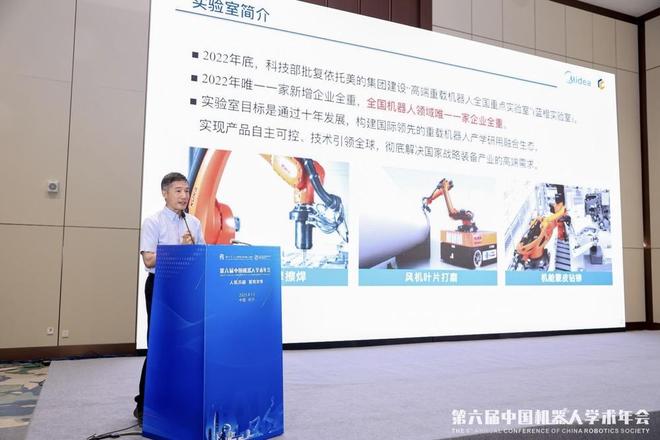
蓝橙实验室于2022年底依托美的集团成立,是机器人领域唯一一家依托企业平台的全国重点实验室。实 验室定位是以战略装备产业高端需求为牵引,开展高端重载机器人的前沿技术研究。今年3月,蓝橙实 验室发布了本年度第一批开放课题指南,获得众多关注和好评。刘前进博士透露,为了推动AI技术在 科学与工程方面的发展,蓝橙实验室联合美的集团中央研究院、广东省家用电器基础技术重点实验室, 面向全球发布"AI for Science and Engineering"专题联合开放课题,邀请全球科研团队申报。 本次联合开放课题征集AI技术在机器人(核心部件、整机设计、智能控制、智能感知与应用、人形机 器人等)、家用电器/新能源/医疗器械等基础技术(电气与电子、储能与材料、机械与动力等)领域的 基础科学研究、前瞻科学探索或工程应用实践的相关课题,本次课题共涉及12个子方向,资助额度约为 20万元人民币/项,课题申报截止时间为2025年9月3日18:00。 8月1日-8月3日,主题为"以人机共融,智向未来"的第六届中国机器人学术年会在湖南长沙举办。高端 重载机器人全国重点实验室(美的蓝橙实验室)主办"美的重载机器人·工业机器人论坛",论坛 ...
美的集团(00300.HK)8月11日耗资520万元回购7.28万股A股
Ge Long Hui· 2025-08-11 10:28
格隆汇8月11日丨美的集团(00300.HK)公告,8月11日耗资520万元回购7.28万股A股。 ...
美的集团8月11日斥资520.19万元回购7.28万股A股
Zhi Tong Cai Jing· 2025-08-11 10:26
美的集团(000333)(00300)发布公告,于2025年8月11日该公司斥资人民币520.19万元回购7.28万股A 股,回购价格为每股人民币71.26-71.56元。 ...
美的集团(00300)8月11日斥资520.19万元回购7.28万股A股
智通财经网· 2025-08-11 10:22
智通财经APP讯,美的集团(00300)发布公告,于2025年8月11日该公司斥资人民币520.19万元回购7.28万 股A股,回购价格为每股人民币71.26-71.56元。 ...
家电行业周报(25年第30周):7月家电零售需求淡季不淡,出口降幅收窄至3%-20250811
Guoxin Securities· 2025-08-11 09:43
Investment Rating - The report maintains an "Outperform" rating for the home appliance industry [6][4]. Core Viewpoints - Retail demand in July for home appliances remains strong despite the seasonal downturn, with air conditioning retail sales growing over 30% [1][18]. - The decline in home appliance exports has narrowed to 3% in July, with expectations for a return to stable growth as tariff policies ease [2][29]. - The U.S. housing market shows resilience, with expectations for recovery following anticipated interest rate cuts by the Federal Reserve in 2024, which could positively impact home appliance demand [3][34]. Summary by Sections 1. Key Recommendations - Recommended companies include Midea Group, Gree Electric Appliances, Haier Smart Home, TCL Smart, and Hisense Home Appliances for white goods; Boss Electric for kitchen appliances; and Bear Electric, Roborock, and Ecovacs for small appliances [4][12][13]. 2. Retail and Export Performance - July retail performance shows strong growth in air conditioners (+39.4% online, +36.5% offline), washing machines (+21.6% online, +15.7% offline), and significant growth in small kitchen appliances like rice cookers (+17.6% online, +12.0% offline) [1][18]. - Home appliance exports in July reached 59.55 billion yuan, a 3% year-on-year decline, with a slight increase in export prices [2][29]. 3. Market Data Tracking - The home appliance sector achieved a relative return of +1.14% this week, outperforming the broader market [42]. - Raw material prices for copper and aluminum increased by 1.1% and 2.5% respectively, while cold-rolled steel prices rose by 0.8% [45][56]. - Shipping indices for routes to the U.S. and Europe showed a decline, indicating potential cost pressures in logistics [57]. 4. Company Earnings Forecasts - Earnings per share (EPS) estimates for key companies include Midea Group at 5.62 yuan for 2025, Gree Electric at 6.34 yuan, and Haier Smart Home at 2.26 yuan [5][67].

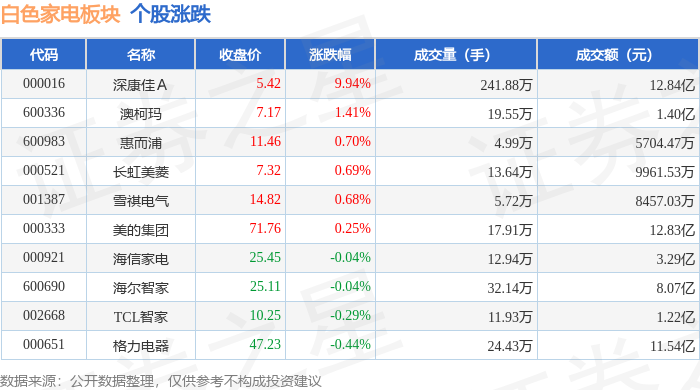
白色家电板块8月11日涨0.1%,深康佳A领涨,主力资金净流入5.03亿元
Zheng Xing Xing Ye Ri Bao· 2025-08-11 08:40
Market Overview - The white goods sector increased by 0.1% on August 11, with Shenzhen Kangjia A leading the gains [1] - The Shanghai Composite Index closed at 3647.55, up 0.34%, while the Shenzhen Component Index closed at 11291.43, up 1.46% [1] Stock Performance - Shenzhen Kangjia A saw a significant rise of 9.94%, closing at 5.42, with a trading volume of 2.4188 million shares and a transaction value of 1.284 billion [1] - Other notable performers included Aucma (+1.41%), Whirlpool (+0.70%), and Changhong Meiling (+0.69%) [1] - Conversely, Haier Smart Home and Gree Electric experienced slight declines of 0.04% and 0.44%, respectively [1] Capital Flow - The white goods sector experienced a net inflow of 503 million from institutional investors, while retail investors saw a net outflow of 346 million [1] - Detailed capital flow data indicates that Shenzhen Kangjia A had a net inflow of 421.14 million from institutional investors, while retail investors had a net outflow of 217 million [2] - Midea Group also attracted a net inflow of 89.62 million from institutional investors, despite a net outflow of 133 million from retail investors [2]