CHANGAN AUTOMOBILE-B(000625)

Search documents
明年起购置税将减半征收,17家汽车品牌承诺兜底
Di Yi Cai Jing· 2025-11-13 08:07
Core Viewpoint - The end of the full exemption policy for new energy vehicle (NEV) purchase tax in 2025 has triggered a competitive order-seizing battle among car manufacturers, with many offering tax subsidy schemes to lock in consumers before the policy change [2][3]. Group 1: Policy Changes and Impacts - From January 1, 2026, the NEV purchase tax will be halved, with a maximum tax reduction of 15,000 yuan per vehicle [2]. - The current exemption policy allows for a maximum tax exemption of 30,000 yuan for NEVs purchased between January 1, 2024, and December 31, 2025 [2]. - The urgency among consumers to purchase vehicles has increased due to the impending policy changes, influencing their choice of models based on delivery timelines [3]. Group 2: Manufacturer Responses - 17 mainstream automotive brands have introduced purchase tax subsidy schemes to cover the tax difference for consumers whose vehicles are delivered after the policy change [2][3]. - The subsidy schemes include various forms such as tax difference vouchers, cash reductions on final payments, and direct cash subsidies, with a maximum subsidy of 15,000 yuan [3]. - The competition among manufacturers is expected to intensify as they aim to capture market share amid the changing tax policies [4]. Group 3: Market Trends and Performance - In October, NEV production and sales reached 1.772 million and 1.715 million units, respectively, both showing over 20% year-on-year growth, with a market penetration rate surpassing 50% [3]. - The cumulative production and sales of NEVs in the first ten months of the year exceeded 13 million units, marking a year-on-year increase of approximately 33% [3]. - The automotive market continues to show strong growth, with new models being launched and production rates maintained to meet demand [4]. Group 4: Future Outlook - The technical threshold for NEV purchase tax exemptions will increase starting in 2026, as plug-in hybrid vehicles with an electric range of less than 100 kilometers will no longer qualify for tax reductions [4]. - This change is expected to lead to a clearer market differentiation, with companies possessing core technological competitiveness likely to gain a larger market share [4].






明年起购置税将减半征收,17家汽车品牌承诺兜底
第一财经· 2025-11-13 07:49
Core Viewpoint - The article discusses the impending end of the full exemption from purchase tax for new energy vehicles (NEVs) in China, leading to a competitive order-seizing battle among car manufacturers as they introduce tax subsidy plans to attract consumers before the policy changes take effect [3][4]. Group 1: Policy Changes and Impacts - Starting January 1, 2026, the purchase tax for NEVs will be halved, with a maximum tax reduction of 15,000 yuan per vehicle [3]. - From January 1, 2024, to December 31, 2025, NEVs will continue to be exempt from purchase tax, with a maximum exemption of 30,000 yuan per vehicle [3][4]. - The adjustment in tax policy has intensified consumer urgency to purchase vehicles, influencing their choice of models based on delivery timelines [4]. Group 2: Manufacturer Responses - 17 major automotive brands, including Li Auto, NIO, and BYD, have introduced purchase tax subsidy plans to cover the tax difference for consumers whose vehicles are delivered after the policy change [3][4]. - The subsidy methods include tax difference vouchers, cash reductions on final payments, and direct cash subsidies, with a maximum subsidy of 15,000 yuan [4]. - The competition among manufacturers is expected to increase as they strive to maintain market share amid changing tax incentives [5]. Group 3: Market Trends and Performance - In October, NEV production and sales reached 1.772 million and 1.715 million units, respectively, with year-on-year growth exceeding 20% and a market penetration rate surpassing 50% [4][5]. - Cumulative NEV production and sales for the first ten months of the year exceeded 13 million units, reflecting a year-on-year growth of approximately 33% [4]. - The market is witnessing a shift as consumers, influenced by the availability of popular models, are increasingly opting for less popular models, contributing to sustained sales growth [4].


福田5.6万领跑!重汽/解放涨超五成 江淮连跳 10月商用车销36万辆 | 头条
第一商用车网· 2025-11-13 07:44
Core Viewpoint - The commercial vehicle market in China has shown a fluctuating trend in 2025, with a notable increase in sales during the latter part of the year, achieving a cumulative sales volume of over 3 million units by September, reflecting a net increase of over 220,000 units compared to the previous year [1]. Sales Performance - In October 2025, the commercial vehicle market sold 360,700 units, representing a month-on-month decrease of 2% but a year-on-year increase of 21%. The growth rate compared to the previous month narrowed by 9 percentage points [4][5]. - The cumulative sales from January to October 2025 reached 3,478,700 units, marking a year-on-year growth of 9%, with an increase of nearly 290,000 units compared to the same period last year [9][17]. Market Share and Rankings - In October 2025, the top ten companies in the commercial vehicle market accounted for a combined market share of 76.19%, with the top five companies exceeding 50% [15]. - Foton led the sales with 56,100 units, followed by China National Heavy Duty Truck with 38,500 units, and Changan with 33,300 units [11][13]. Competitive Landscape - The competitive landscape remains intense, with small differences in market share among neighboring companies. For instance, the market share difference between Jianghuai and Jiangling was only 0.06% [25]. - The rankings of the top ten companies remained stable, with Jianghuai moving up three positions to seventh place [16]. Cumulative Sales by Company - Foton's cumulative sales exceeded 500,000 units, reaching 530,800 units, while China National Heavy Duty Truck, Dongfeng, and Changan all surpassed 300,000 units [19][23]. - The growth rates of major companies varied, with China National Heavy Duty Truck, Shaanxi Automobile, and SAIC Maxus showing significant increases of 25%, 20%, and 28% respectively [19].





中国汽车从泰国出口欧洲,要“火”?
Zhong Guo Qi Che Bao Wang· 2025-11-13 07:25
Core Insights - Changan Automobile has announced its strategy to establish a presence in Thailand and serve the local market, launching three new models and planning to export over 1,000 DEEPAL S05 SUVs to Europe by December 2023 [2] - BYD has also begun exporting electric vehicles from its Thai factory to Europe, with over 900 units shipped to countries like the UK, Germany, and Belgium, marking a significant step in its global expansion [2] Export Strategy - Chinese automakers are increasingly choosing to export vehicles from Thailand to Europe to avoid high EU anti-subsidy tariffs, which can reach up to 45.3% for electric vehicles produced in China [2][5] - The EU has imposed a maximum anti-subsidy tax of 35.3% on electric vehicles produced in China since October 2022, prompting companies like BYD, Geely, and SAIC to seek alternative production bases [2][5] Market Performance - Chinese brand vehicles in Europe are experiencing significant growth, with sales expected to reach 90,571 units by September 2025, a 149% increase year-on-year, capturing a market share of 7.4% [3] - MG, BYD, and Chery are leading the sales rankings among Chinese brands in Europe, with MG achieving a 62% year-on-year increase in September sales [3] Production Capacity - Chinese automakers have established substantial production capacity in Thailand, exceeding 600,000 units, which allows them to meet both local and export demands [6][7] - The Thai automotive market is projected to face challenges in 2024, with total new car sales expected to decline by 26%, highlighting the importance of exports for Chinese brands [6][7] Government Support - The Thai government is actively promoting the country as a regional electric vehicle manufacturing hub, offering incentives that encourage Chinese automakers to establish production facilities [8] - Recent adjustments to Thailand's electric vehicle support policies allow locally manufactured electric vehicles intended for export to count towards domestic production quotas, further incentivizing exports [8] Global Strategy - Chinese automakers are adopting a flexible global strategy, allowing them to navigate trade barriers and optimize production resources across different markets [9][10] - The shift from product export to a global brand presence signifies a maturation in the operational capabilities of Chinese automakers, enhancing their competitiveness on the world stage [11]

长安汽车携手阿联酋Yango Group拓展非洲市场
Shang Wu Bu Wang Zhan· 2025-11-13 03:21
ZAWYA新闻网11月10日消息,中国长安汽车与阿联酋科技公司Yango Group签署战略合作协议, Yango Motors将成为长安官方分销商,首站为科特迪瓦,并拓展非洲其他市场。双方将为网约车市场提 供高效、低碳车型,推动绿色出行。Yango Ride业务遍及非洲、中东、南亚及拉美,累计出行超12亿 次,合作将助力区域可持续交通发展。 (原标题:长安汽车携手阿联酋Yango Group拓展非洲市场) ...
央企ETF(159959)开盘涨0.44%,重仓股澜起科技跌0.55%,中芯国际跌0.53%
Xin Lang Cai Jing· 2025-11-13 03:19
Core Viewpoint - The Central Enterprise ETF (159959) opened with a slight increase of 0.44%, priced at 1.602 yuan, reflecting the performance of its underlying assets and market conditions [1] Group 1: ETF Performance - The Central Enterprise ETF (159959) has a benchmark performance index of the CSI Central Enterprise Structural Adjustment Index [1] - Since its establishment on October 22, 2018, the fund has achieved a return of 59.39% [1] - The fund's return over the past month has been -0.19% [1] Group 2: Major Holdings - Key stocks in the ETF include: - 澜起科技 (Lianqi Technology) down 0.55% - 中芯国际 (SMIC) down 0.53% - 海康威视 (Hikvision) down 0.10% - 国电南瑞 (Guodian NARI) down 0.29% - 招商银行 (China Merchants Bank) up 0.09% - 宝钢股份 (Baosteel) up 0.26% - 中国神华 (China Shenhua) up 0.21% - 长安汽车 (Changan Automobile) up 0.16% - 中国电信 (China Telecom) unchanged - 中国建筑 (China State Construction) unchanged [1]




锂电板块继续上行,新能车ETF(515700)涨超6.0%冲击年内新高
Xin Lang Cai Jing· 2025-11-13 03:13
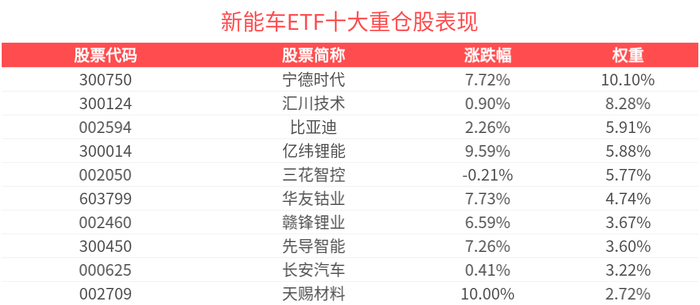
Group 1 - The China Securities New Energy Vehicle Industry Index (930997) has surged by 5.96% as of November 13, 2025, with significant gains in constituent stocks such as Xinzhou Bang (300037) up 17.19%, Wukuang New Energy (688779) up 16.90%, and Tianhua New Energy (300390) up 12.50% [1] - The New Energy Vehicle ETF (515700) increased by 5.89%, reaching a latest price of 2.61 yuan, benefiting from the recovery in lithium battery demand and advancements in solid-state batteries [1] - The New Energy Vehicle ETF closely tracks the China Securities New Energy Vehicle Industry Index, reflecting the overall performance of leading listed companies in the new energy vehicle sector [1] Group 2 - As of October 31, 2025, the top ten weighted stocks in the China Securities New Energy Vehicle Industry Index include CATL (300750), Huichuan Technology (300124), and BYD (002594), collectively accounting for 53.56% of the index [2] - The weightings of the top stocks are as follows: CATL at 10.10% with a rise of 7.72%, Huichuan Technology at 8.28% with a rise of 0.90%, and BYD at 5.91% with a rise of 2.26% [4] - Other notable stocks include EVE Energy (300014) at 5.88% with a rise of 9.59%, and Ganfeng Lithium (002460) at 3.67% with a rise of 6.59% [4]





涨超4.4%,新能车ETF(515700)近6个月强势上涨
Xin Lang Cai Jing· 2025-11-13 03:02
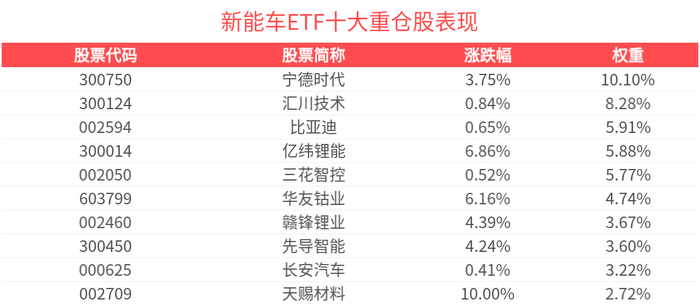
Core Insights - The China Securities New Energy Vehicle Industry Index (930997) has seen a strong increase of 4.49% as of November 13, 2025, with significant gains in constituent stocks such as Xinzhou Bang (300037) up 14.43%, Wukuang New Energy (688779) up 14.23%, and Xingyuan Material (300568) up 12.25% [1] Group 1 - The New Energy Vehicle ETF (515700) rose by 4.47%, with the latest price at 2.57 yuan, and has accumulated a 0.53% increase over the past week as of November 12, 2025 [1] - The New Energy Vehicle ETF closely tracks the China Securities New Energy Vehicle Industry Index, which includes 50 listed companies involved in various sectors of the new energy vehicle industry [1] Group 2 - As of October 31, 2025, the top ten weighted stocks in the China Securities New Energy Vehicle Industry Index are CATL (300750), Huichuan Technology (300124), Sanhua Intelligent Control (002050), BYD (002594), Yiwei Lithium Energy (300014), Huayou Cobalt (603799), Ganfeng Lithium (002460), Xian Dao Intelligent (300450), Changan Automobile (000625), and Tianqi Lithium (002466), collectively accounting for 53.56% of the index [2] - The weightings of the top stocks are as follows: CATL at 10.10%, Huichuan Technology at 8.28%, BYD at 5.91%, Yiwei Lithium Energy at 5.88%, Sanhua Intelligent Control at 5.77%, Huayou Cobalt at 4.74%, Ganfeng Lithium at 3.67%, Xian Dao Intelligent at 3.60%, Changan Automobile at 3.22%, and Tianqi Lithium at 2.72% [3]




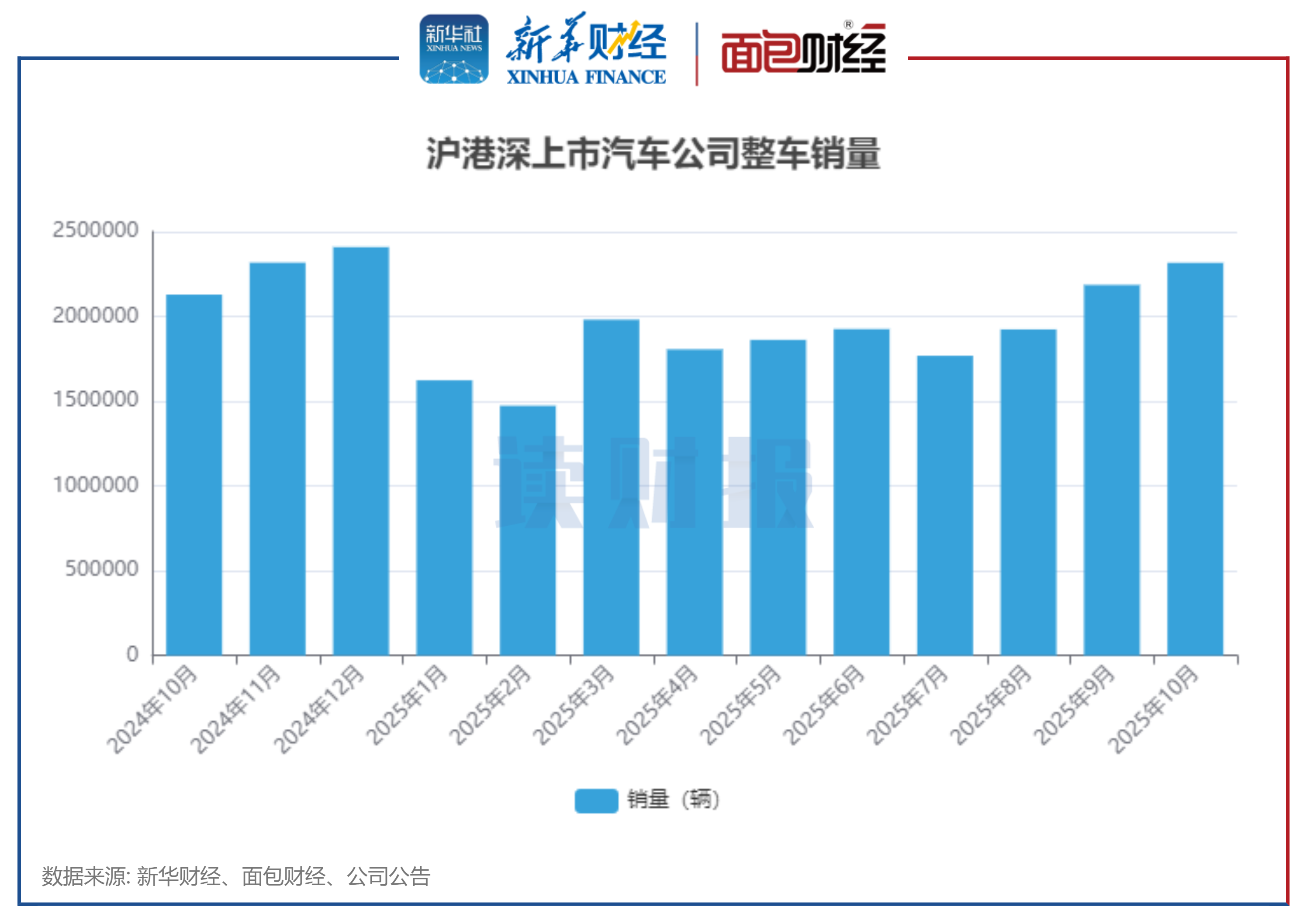
上市车企10月销量:整车销量超231万辆北汽蓝谷、蔚来等销量增速加快
Xin Lang Cai Jing· 2025-11-13 00:05
Core Insights - In October 2025, 20 major A and H-share listed automotive manufacturers reported a total vehicle sales of 2.3166 million units, representing a year-on-year increase of 8.82% and a month-on-month increase of 5.97% [1][2] - The total sales of new energy vehicles (NEVs) reached approximately 1.3078 million units, marking a year-on-year increase of 15.63% and a month-on-month increase of 9.68%, with a penetration rate of about 57.48% [1][3] Group 1: Overall Vehicle Sales - The top-selling company in October 2025 was SAIC Motor, with sales of 454,000 units, reflecting a year-on-year growth of 12.96% [2] - Other notable manufacturers included BYD, Geely, and Changan, which followed closely in sales figures [2] - Companies like Beiqi Blue Valley and Qianli Technology saw their sales growth exceed 100% year-on-year, while NIO and XPeng also experienced significant growth [2] Group 2: New Energy Vehicle Sales - The leading companies in NEV sales for October 2025 were BYD, SAIC Motor, and Geely, with sales of 441,700 units, 206,700 units, and 177,900 units respectively [3] - Beiqi Blue Valley's NEV sales growth exceeded 100% year-on-year, while NIO and XPeng also saw substantial increases in their sales growth rates compared to September [3] - BYD's total sales for the year up to October reached 3.7019 million units, showing a year-on-year increase of 13.88% [3]




读财报上市车企10月销量:整车销量超231万辆 北汽蓝谷、蔚来等销量增速加快
Zhong Guo Jin Rong Xin Xi Wang· 2025-11-12 23:48
Core Insights - In October 2025, 20 A and H-share listed automotive manufacturers reported a total vehicle sales of 2.3166 million units, representing a year-on-year increase of 8.82% [1][4] - Among these, 16 companies disclosed their new energy vehicle (NEV) sales, totaling approximately 1.3078 million units, which is a year-on-year increase of 15.63% and a penetration rate of about 57.48% [1][8] Group 1: Overall Vehicle Sales - The total vehicle sales for October 2025 reached 2.3166 million units, marking a month-on-month growth of 5.97% [1][4] - SAIC Motor led the sales with 454,000 units, followed by BYD with 441,706 units and Geely with 307,133 units [5][6] - Notable growth was observed in companies like BAIC Blue Valley and NIO, with sales growth exceeding 100% year-on-year, while companies like Ideal Auto and NIO experienced a decline of over 30% [4][8] Group 2: New Energy Vehicle Sales - The total NEV sales for October 2025 were approximately 1.3078 million units, with a month-on-month increase of 9.68% [8][11] - Leading NEV manufacturers included BYD, SAIC Motor, and Geely, with sales of 441,706 units, 206,692 units, and 177,882 units respectively [11][15] - Companies such as BAIC Blue Valley and NIO saw their NEV sales growth exceed 50%, while Ideal Auto and BYD reported a year-on-year decline in sales [11][15]