
NEW HOPE(000876)

Search documents
研判2025!中国种养加一体化行业相关概述、政策汇总、发展现状及发展趋势分析:政策护航可持续农业,种养加一体化行业加速发展[图]
Chan Ye Xin Xi Wang· 2025-11-06 01:13
Core Viewpoint - The integration of planting, breeding, and processing industries, known as the "plant-breed-process integration," is gaining traction in China, projected to reach a market value of 3.2 trillion yuan in 2024 and 6.8 trillion yuan by 2030, driven by increasing consumer demand for healthy and organic products and government support for sustainable agriculture [1][10]. Industry Overview - The plant-breed-process integration model combines planting, breeding, and processing to achieve ecological and economic benefits through resource recycling and efficient industry chain connections [3][9]. - The model enhances resource utilization efficiency, reduces costs, and promotes sustainable agricultural development [1][9]. Industry Policies - Recent government policies support the integration model as a means to boost agricultural transformation and rural prosperity, including guidelines for optimizing livestock development and promoting ecological farms [4][5]. - The Ministry of Agriculture and Rural Affairs has issued directives to encourage standardized and ecological farming practices [4][5]. Current Industry Status - The total sown area of crops in China has been increasing, reaching 173 million hectares by 2024, driven by rising consumer demand for staple agricultural products [6][7]. - The livestock sector has also seen growth, with the pig population reaching 424.47 million heads in the first half of 2025, a 2.2% increase year-on-year [7][8]. Competitive Landscape - The industry features a diverse competitive landscape, including large enterprises, small and medium-sized enterprises, and farmer cooperatives, each leveraging unique strengths to capture market share [10]. - Key players include China Shengmu Organic Milk, Hunan New Wufeng, and Modern Farming Group, which are integrating various stages of the agricultural value chain [10][11]. Industry Development Trends - The rapid advancement of modern agricultural technologies, such as biotechnology and smart equipment, is expected to enhance production efficiency and product quality within the integration model [14]. - Increasing market demand for high-quality, organic agricultural products is anticipated to drive further adoption of the integration model, as it aligns with consumer preferences for safety and sustainability [16].


生猪产业又陷深度调整 产业大会呼吁控产能、强自律
Shang Hai Zheng Quan Bao· 2025-11-05 18:41
Core Insights - The pig farming industry in China is undergoing a significant adjustment period, with declining prices and widespread losses among listed companies, driven by overcapacity and high debt levels [1][2][3] Industry Overview - Since 2021, China's pig production capacity has rapidly returned to normal levels, leading to increased scale in pig farming and improved disease control and production efficiency, but also rising financial risks and intensified competition [2] - The proportion of large-scale farms (over 500 pigs) has exceeded 70%, with a significant increase in pork supply amid weak consumer demand, resulting in a new cycle of losses [2] Financial Performance - Among 22 listed pig farming companies, 19 reported a year-on-year decline in net profits for Q3, with 9 companies incurring losses [3] - Notable declines include: - Wens Foodstuffs Group: Revenue of 25.937 billion yuan, down 9.76%, and net profit of 1.781 billion yuan, down 65.02% [3] - Da Bei Nong: Net profit of 21.691 million yuan, down 92.50% [3] - New Hope Liuhe: Net profit of 512,550 yuan, down 99.6% [3] - Muyuan Foods: Net profit of 4.249 billion yuan, down 55.98% [3] - By the end of Q3, several companies had debt ratios exceeding 70%, indicating financial strain [3] Industry Challenges - The current overcapacity is reflected in the high number of breeding sows, with 40.35 million sows reported, suggesting a need for capacity control [3] - The rapid increase in output from large farms (up nearly 30% year-on-year) poses risks of financial strain and potential bankruptcy [3] Proposed Solutions - Industry representatives advocate for capacity control and self-discipline to avoid prolonged losses and promote high-quality development [4][5] - The government has initiated discussions on capacity control policies, including reducing the number of breeding sows and adjusting production practices [4] - Companies are encouraged to enhance management and efficiency while adhering to market principles for orderly capacity regulation [4] Actions Taken by Leading Companies - Leading firms are actively implementing capacity control measures: - Wens has closed seven pig farms nationwide [7] - Guangxi Yangxiang plans to reduce its output target from 5.65 million to 5.3 million pigs [7] - Muyuan has reduced its breeding sows to 3.305 million, cutting potential supply by 9 million pigs [7] - The company has also lowered the average weight of pigs at sale, reducing it by 10 kg [7] Future Outlook - Industry leaders believe that controlling production capacity is essential to prevent deep losses and that effective measures will yield results in the medium term [5][8] - The current period is seen as an opportunity to adjust the pig population structure and optimize products, which could lead to improved production performance and profitability in the future [8]




农业农村部推行农业电子证照!农牧渔ETF(159275)微涨0.2%!
Xin Lang Ji Jin· 2025-11-05 05:24
Group 1 - The Agricultural, Animal Husbandry, and Fishery ETF (159275) showed stable performance with a 0.2% increase in price and a trading volume of 6.91 million yuan, bringing the fund's total size to 203 million yuan as of November 5 [1] - Among the constituent stocks, Shennong Seed Industry had the highest increase at 6.4%, followed by Luoniushan at 5.24%, and Zhongxing Junye at 3.46%. Conversely, Tianma Technology experienced the largest decline at 1.79%, with Meihua Biological and Tianma Technology also showing declines of 1.92% and 1.57% respectively [1] - The Ministry of Agriculture and Rural Affairs will implement six types of agricultural electronic certificates nationwide starting November 1, 2025, including feed import registration certificates and agricultural transgenic biological safety certificates, transitioning to full electronic certification by 2026 [1] Group 2 - According to Tianfeng Securities, the egg-laying chicken industry is expected to see a significant reduction in domestic breeding volume to 41,200 birds by 2025, indicating a shift from surplus to tight supply. The white chicken industry is also experiencing a contraction in production capacity due to three years of bottoming out and overseas breeding disruptions [2] - The pig farming sector is anticipated to undergo capacity reduction due to low prices and policy guidance, while dairy cow inventory has decreased by 8%, nearing the end of the reduction phase. Beef prices may see unexpected increases [2] - The planting sector is accelerating the commercialization of transgenic corn, enhancing the competitiveness of leading seed companies. The aquaculture feed sector is recovering from a downturn, with leading companies increasing their market share [2] Group 3 - The Agricultural, Animal Husbandry, and Fishery ETF (159275) and its linked funds (Link A: 013471, Link C: 013472) passively track the Agricultural, Animal Husbandry, and Fishery Index, with the top ten weighted stocks including Muyuan Foods, Wens Foodstuff Group, Haida Group, Meihua Biological, New Hope Liuhe, Dabeinong, Bio-Stock, Shennong Development, Beidahuang, and Longping High-Tech [3]


ESG解读|三季度净利暴跌99.6%,频收环保罚单,新希望经营双重承压
Sou Hu Cai Jing· 2025-11-04 10:18
Core Viewpoint - New Hope's net profit plummeted by 99.63% in Q3 2025, indicating significant challenges in profitability and financial stability [4][5]. Financial Performance - The company's operating revenue for the reporting period was approximately 28.88 billion yuan, an increase of 4.51% year-on-year [5]. - Net profit attributable to shareholders was approximately 5.13 million yuan, a decrease of 99.63% compared to the same period last year [5]. - The net profit after deducting non-recurring gains and losses was approximately 16.30 million yuan, down 98.8% year-on-year [5]. - As of the end of Q3, the company's cash and cash equivalents stood at 7.42 billion yuan, while interest-bearing liabilities reached 56.46 billion yuan, indicating a weak cash coverage for short-term debts [5]. Industry Challenges - The sharp decline in profits is largely attributed to a significant drop in pig prices, with the average price in September falling to 12.89 yuan per kilogram, a year-on-year decrease of 31% [6]. - The company faces additional challenges from environmental issues and food safety concerns related to its subsidiaries, which have impacted its reputation and financial performance [6][14]. Environmental and Compliance Issues - New Hope's subsidiaries have faced multiple environmental violations, with at least 15 subsidiaries penalized over 20 times, accumulating fines exceeding 2 million yuan [7][8]. - The company's environmental management system has been criticized for systemic flaws, as violations continue despite commitments to "zero pollution" [7][9]. - The company has pledged to enhance supply chain environmental responsibility audits, but compliance appears to be superficial [11]. Product Quality Concerns - New Hope has been criticized for product quality issues, particularly in its dairy products, with reports of spoilage and contamination [14][15]. - Recent incidents include complaints about milk products showing signs of spoilage within their shelf life and a serious food safety issue involving student meals [14][15].

行业点评报告:2025Q3生猪开启去化,饲料动保后周期经营改善
KAIYUAN SECURITIES· 2025-11-03 14:12
Investment Rating - The investment rating for the agriculture industry is "Positive" (maintained) [1] Core Viewpoints - The agriculture sector's profit has contracted significantly due to the unexpected decline in pig prices, leading to a year-on-year profit drop of 58.8% in Q3 2025 [17] - The overall revenue for the agriculture industry in Q1-Q3 2025 reached 872.718 billion, with a year-on-year increase of 6.44%, while the net profit attributable to shareholders was 35.477 billion, up 10.63% year-on-year [5][17] - The average price of pigs in Q3 2025 was 13.81 yuan/kg, down 28.89% year-on-year, with the lowest price of 10.84 yuan/kg recorded on October 13, 2025 [5][17] Summary by Sections Overall Industry - In Q3 2025, the agriculture sector's profit contracted by 58.8% due to falling pig prices [17] - The industry's sales gross margin for Q1-Q3 2025 was 11.79%, up 0.12 percentage points year-on-year, while the net profit margin was 4.21%, up 0.21 percentage points year-on-year [20] - The industry’s net asset return rate was 6.75%, an increase of 0.28 percentage points year-on-year [20] Subsector Analysis - The pig farming sector has entered a de-stocking cycle, while the feed and animal health sectors are experiencing post-cycle operational improvements [6][25] - In Q1-Q3 2025, the revenue growth rates for pet food, animal health, feed, and planting were 20.34%, 17.69%, 12.38%, and 9.50% respectively [6][25] - The net profit growth rates for animal health, agricultural product processing, and feed sectors were 69.40%, 59.33%, and 54.17% respectively [6][25] Pig Farming - In Q1-Q3 2025, pig farming enterprises achieved revenue of 341.269 billion, a year-on-year increase of 8.32%, with a net profit of 22.175 billion, up 14.29% year-on-year [7][28] - The overall pig output from 12 enterprises was 123.9948 million heads, a year-on-year increase of 19.45% [41] - The profitability of the pig farming sector has declined due to falling prices, with average gross margin, net margin, and ROE at 12.25%, 4.08%, and 5.87% respectively [31] Poultry Farming - In Q1-Q3 2025, revenue for poultry farming reached 40.215 billion, a year-on-year increase of 6.92%, while net profit was 1.646 billion, down 9.52% year-on-year [44] - The profitability metrics for poultry farming were a gross margin of 12.61%, a net margin of 2.83%, and a return on equity of 4.18% [46] Feed Industry - The feed sector generated revenue of 152.955 billion in Q1-Q3 2025, reflecting a year-on-year increase of 11.69%, with a net profit of 4.505 billion, up 8.72% year-on-year [8][57] - The average gross margin, net margin, and ROE for feed enterprises were 9.41%, 1.17%, and 3.65% respectively [57] Animal Health - The animal health sector achieved revenue of 9.977 billion in Q1-Q3 2025, a year-on-year increase of 14.08%, with a net profit of 1.265 billion, up 45.51% year-on-year [63] - The average gross margin, net margin, and ROE for animal health enterprises were 53.42%, 17.77%, and 4.35% respectively [63] Seed Industry - The seed sector reported revenue of 6.814 billion in Q1-Q3 2025, down 5.82% year-on-year, with a net profit of -880 million, a decline of 53.87% year-on-year [68]

第五届新希望乡村振兴“村长班”开班 刘永好:乡村振兴需要“软”和“硬”两手抓
Zheng Quan Ri Bao Wang· 2025-11-03 12:12
Core Viewpoint - The "Village Chief Class" for rural revitalization aims to enhance the capabilities of rural leaders and improve governance through a combination of financial investment and skill development [1][2][3] Group 1: Program Overview - The fifth session of the "Village Chief Class" was officially launched in Beijing, co-hosted by several organizations including China Postal Savings Bank and New Hope Group [1] - The program has been running for five years, with over 4,000 village officials applying and more than 500 participants trained [2] - The initiative is recognized as an excellent case in the national "Ten Thousand Enterprises Helping Ten Thousand Villages" program [3] Group 2: Educational Philosophy and Structure - The program emphasizes an open and pragmatic educational philosophy, aiming to create a platform for rural managers to learn and exchange ideas [2] - It integrates resources from various sectors, including government, industry, academia, and research, to enhance the training scale and depth [2] - The curriculum includes practical training materials covering agriculture, livestock, and e-commerce operations [1] Group 3: Continuous Improvement and Innovation - The "Village Chief Class" is evolving by incorporating feedback from past participants and best practices from other training programs [3] - The program is transitioning from short-term training to long-term empowerment, creating a closed loop of training, practice, and capacity building [3] - New initiatives like the "Seed Plan" are being implemented to further enhance the effectiveness of the training [3]
新 希 望(000876) - 关于归还临时补充流动资金的募集资金的公告
2025-11-03 08:15
特此公告 本公司及董事会全体成员保证信息披露内容的真实、准确、完整,没有虚假 记载、误导性陈述或重大遗漏。 新希望六和股份有限公司(以下简称 "公司")于 2024 年 11 月 7日召开第九届董事会第三十八次会议和第九届监事会第二十五次会 议,会议分别审议通过了《关于使用部分闲置募集资金临时补充流动 资金的议案》,决定将闲置募集资金中的不超过人民币 39,600.00 万 元临时用于补充公司流动资金,使用期限自董事会审议通过之日起不 超过 12 个月。具体情况详见公司 2024 年 11 月 8 日在《中国证券报》 《证券日报》《证券时报》《上海证券报》和巨潮资讯网上刊登的《关 于使用部分闲置募集资金临时补充流动资金的公告》。 在使用期间内,公司实际使用闲置募集资金 39,600.00 万元人民 币临时补充流动资金。截至 2025 年 11 月 3 日,公司已将上述用于临 时补充流动资金的募集资金全部归还至募集资金专户,并将上述募集 资金的归还情况通知了保荐机构及保荐代表人。 | 证券代码:000876 | 证券简称:新希望 | 公告编号:2025-108 | | --- | --- | --- | | 债 ...
新希望 续新力不足
Xin Lang Cai Jing· 2025-11-03 01:59
Core Viewpoint - New Hope Liuhe Co., Ltd. continues to struggle in its traditional business, showing insufficient recovery from the financial downturn experienced in 2021, despite reporting a significant increase in net profit for the first half of 2023 [2][4]. Financial Performance - For the first three quarters of 2023, the company achieved a revenue of 80.50 billion yuan, a year-on-year increase of 4.27%, while the net profit attributable to shareholders was 760 million yuan, a substantial increase of 395.89% [2][3]. - In the third quarter alone, revenue was 28.88 billion yuan, up 4.51% year-on-year, but net profit dropped to 512.55 thousand yuan, a staggering decline of 99.63% [2][3]. - The company reported a basic and diluted earnings per share of 0.00 yuan for the third quarter, reflecting a 100% decrease compared to the previous year [3]. Debt and Financial Health - The asset-liability ratio decreased to 69.49% in the third quarter of 2025, down 1.36 percentage points from the previous year, but still significantly higher than the industry average of 57.82% [5][6]. - The company has faced a continuous rise in its asset-liability ratio, which reached 74.03% in the first quarter of 2024, up from 58% in 2020 [5]. Strategic Challenges - New Hope's recovery in 2023 is attributed to both industry cycle recovery and operational improvements, including the divestment of eight subsidiaries and associated companies, which generated approximately 1 billion yuan in cash [6]. - The company’s strategic focus on "feed + pig industry" and overseas expansion has yet to translate into clear growth metrics, leading to market skepticism regarding the sustainability of its profitability [8][9]. Market Sentiment - The stock price of New Hope has fluctuated between 9.56 and 10.58 yuan since the second half of 2023, indicating market doubts about the sustainability of its performance improvements [8]. - The dynamic PE ratio stands at approximately 43.23 times, significantly higher than the industry average of 18.56 times, suggesting that the market may be overvaluing the company relative to its peers [8]. Industry Context - The agricultural sector, particularly in pig farming, has faced significant challenges, including a downturn in pig prices since 2021, which has severely impacted New Hope's financial performance [4][9]. - The company must navigate the pressures of rising costs in the feed industry, which constitutes about 68.72% of its revenue, and concerns over consumer demand affecting pork prices [8][9].

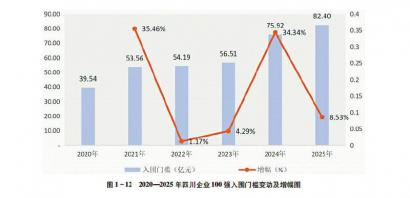
川企百强榜五年间入围门槛高了近30亿元
Si Chuan Ri Bao· 2025-11-02 21:50
Core Insights - The threshold for entering the top 100 enterprises in Sichuan has significantly increased from 39.54 billion yuan in 2020 to 82.40 billion yuan in 2025, indicating a robust growth in the province's economy [3][4] - The number of billion-dollar enterprises in Sichuan has doubled from 4 in 2021 to 8 in 2025, highlighting the emergence of strong players in the energy, agriculture, and manufacturing sectors [3][4] - New entrants in the hundred-billion level enterprises are primarily from emerging industries such as renewable energy, smart manufacturing, and finance, reflecting a shift in the economic landscape [3][4] Group A: Billion-Dollar Enterprises - The eight billion-dollar enterprises in Sichuan include Tongwei Co., Ltd., Yibin Wuliangye Group Co., Ltd., Sichuan Changhong Electric Co., Ltd., and others, contributing significantly to employment and industrial stability [3] - Tongwei Co., Ltd. has achieved remarkable growth, with revenues increasing from under 100 billion yuan in 2021 to over 240 billion yuan in 2025, driven by the global photovoltaic industry's expansion [3][4] - The emergence of new players like Xiya Group, which focuses on non-ferrous metals, showcases the dynamic nature of the Sichuan economy [3] Group B: Hundred-Billion Enterprises - Over 70% of the hundred-billion enterprises are new entrants, indicating a strong middle force in the economy, with significant contributions from sectors like new energy and artificial intelligence [3][4] - Companies like Yibin Meijie Communication Technology Co., Ltd. and Sichuan Highview Solar Technology Co., Ltd. have made their debut in the rankings, reflecting the growth of the smart terminal and photovoltaic industries [3][4] - The rise of companies in the new energy and AI sectors demonstrates a proactive approach to industry transformation and differentiation [3] Group C: Market Dynamics - Traditional industries are facing challenges, with companies like Sichuan Blu-ray Development Co., Ltd. dropping out of the rankings due to the downturn in the real estate sector [4] - The construction and food and beverage industries are also experiencing volatility, with several companies failing to meet the entry threshold for the top 100 list [4] - The lithium industry has seen significant fluctuations, with companies like Chengdu Bamo Technology Co., Ltd. and Sichuan Yahua Industrial Group Co., Ltd. exiting the rankings due to market oversupply [4] Group D: Regional Distribution - The majority of the top 100 enterprises are concentrated in Chengdu, which reflects the city's dominant economic position in Sichuan [4] - Other cities like Mianyang and Luzhou are also seeing growth in their number of top enterprises, but the overall regional development remains uneven [4] - The state-owned enterprises dominate the rankings, comprising over 70% of the top 100, while private enterprises, though fewer, are showing strong market vitality and operational efficiency [4]



私募EB每周跟踪(20251027-20251031):可交换私募债跟踪-20251102
Guoxin Securities· 2025-11-02 11:48
Report's Investment Rating for the Industry - No information about the industry investment rating is provided in the report. Core Viewpoints of the Report - The report regularly tracks the latest information on private exchangeable bond (private EB) projects from public channels, including basic elements such as issuance scale, underlying stocks, and main underwriters, while noting that issuance terms may change and advising to consult the final prospectus and relevant lead underwriters for issuance progress [1]. Summary by Related Catalog New Project Information Last Week - The private exchangeable bond project of Yingfeng Group Co., Ltd. in 2025 was approved by the exchange, with a proposed issuance scale of 1 billion yuan (down from the previous scale), underlying stocks being Yingfeng Environment/Baina Qiancheng (000967.SZ/300291.SZ), and main underwriters being Shen港 Securities, CICC, and Huafu Securities (CICC and Huafu were newly added compared to before), updated on October 30, 2025 [1]. - The private exchangeable bond project of Guangdong Guangxin Holdings Group Co., Ltd. in 2025 was approved by the exchange, with a proposed issuance scale of 3 billion yuan, underlying stocks being Shengyi Technology/Xinghu Technology (600183.SH/600866.SH), and the main underwriter being CITIC Securities, updated on October 30, 2025 [1]. - The private exchangeable bond project of Fujian State - owned Assets Management Co., Ltd. in 2025 was approved by the exchange, with a proposed issuance scale of 200 million yuan, the underlying stock being Fuguang Co., Ltd. (688010.SH), and the main underwriter being Guoxin Securities, updated on October 29, 2025 [1]. - The private technology - innovation exchangeable bond project of Chongqing Xiaokang Holdings Co., Ltd. in 2025 was approved by the exchange, with a proposed issuance scale of 3 billion yuan, the underlying stock being Seres (601127.SH), and the main underwriter being Hongta Securities, updated on October 28, 2025 [1]. - The private technology - innovation exchangeable bond project of New Hope Group Co., Ltd. in 2025 received feedback from the exchange, with a proposed issuance scale of 4.5 billion yuan, the underlying stock being New Hope (000876.SZ), and the main underwriter being CICC, updated on October 31, 2025 [1]. - The private technology - innovation exchangeable bond project of Sichuan Jiuzhou Investment Holdings Group Co., Ltd. in 2025 received feedback from the exchange, with a proposed issuance scale of 1 billion yuan, the underlying stock being Sichuan Jiuzhou (000801.SZ), and the main underwriter being CITIC Securities, updated on October 28, 2025 [1]. - The private exchangeable bond project of Haixia Innovation Internet Co., Ltd. in 2025 was accepted by the exchange, with a proposed issuance scale of 300 million yuan, the underlying stock being Fengzhushou (301382.SZ), and the main underwriter being Dongguan Securities, updated on October 31, 2025 [1]. Overall Project Status (Table 1) - There are multiple private exchangeable bond projects in different statuses (approved, received feedback, accepted), including details such as bond names, main underwriters, issuance scales, underlying stocks, project statuses, and update dates [3].


