
SANHUA(002050)

Search documents
固态电池全球首个标准出炉!电池板块大涨,先导智能涨7%,电池50ETF(159796)涨2%,连续4日净流入!天赐材料净利最多增长2倍!
Xin Lang Cai Jing· 2026-01-05 06:33
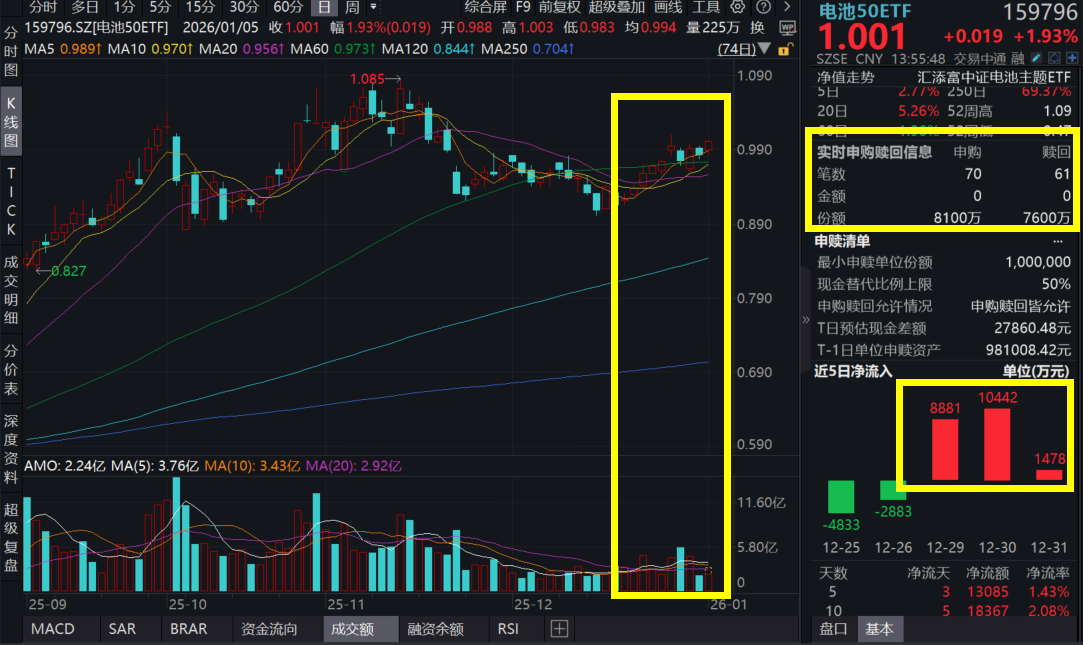
1月5日,A股市场普涨,两市超4000股上冲,沪指涨超1%,重回4000点上方!截至13:56,同类规模领先、费率最低档的电池50ETF(159796)上涨1.93%, 盘中获500万元净申购,加上今日已连续4日强势吸金! 电池50ETF(159796)标的指数成分股多数冲高,道氏技术(300409)20%大号涨停,先导智能涨近7%,亿纬锂能涨超4%,国轩高科、宁德时代涨超2%,三花 智控、阳光电源等跟涨。 | 【电池50ETF(159796)标的指数前十大成分股】 | | --- | | 序号 | 代码 | 名称 | 申万一级行业 | 涨跌幅 | 估算权重 | | --- | --- | --- | --- | --- | --- | | 1 | 300274 | 阳光电源 | 电力设备 | 0.44% | 8.97% | | 2 | 002050 | 三花智控 | 家用电器 | 1.45% | 8.70% | | 3 | 300750 | 宁德时代 | 电力设备 | 2.40% | 7.71% | | 4 | 300014 | 亿纬锂能 | 电力设备 | 4.93% | 5.52% | | 5 | 002 ...






2025年A股融资净买入超6700亿元,这些行业和个股被大幅加仓!
Sou Hu Cai Jing· 2026-01-05 06:00
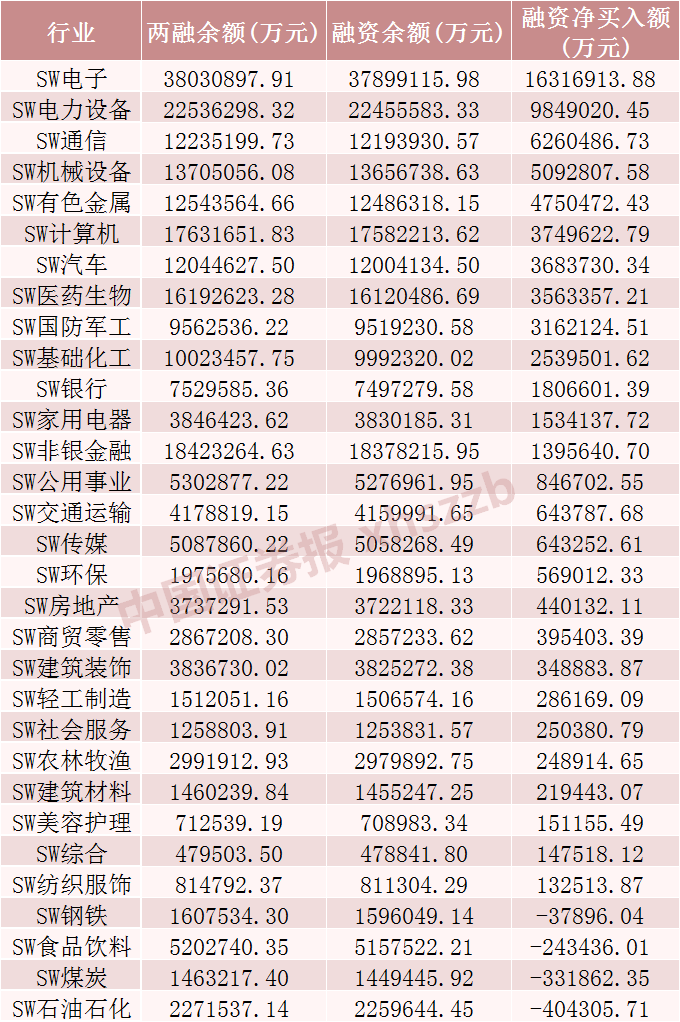
Core Insights - As of December 31, 2025, the A-share margin financing balance reached 25,406.82 billion yuan, with a financing balance of 25,241.56 billion yuan, marking an increase of 6700.11 billion yuan for the year [1] - Both the margin financing balance and the financing balance hit historical highs on December 30, 2025 [1] - In 2025, the financing balance increased in 9 out of 12 months, with significant net purchases exceeding 1200 billion yuan in February, July, August, and September [1] Industry Summary - Out of 31 industries in the Shenwan classification, 27 saw an increase in financing balance, with the electronics, power equipment, and communication sectors leading in net purchases at 1,631.69 billion yuan, 984.90 billion yuan, and 626.05 billion yuan respectively [1] - The only sectors experiencing net sales were oil and petrochemicals, coal, food and beverage, and steel, with net sales of 40.43 billion yuan, 33.19 billion yuan, 24.34 billion yuan, and 3.79 billion yuan respectively [1] Individual Stock Performance - In 2025, 130 stocks saw an increase in investment exceeding 1 billion yuan, with the top ten stocks being Xinyi Technology, Zhongji Xuchuang, Shenghong Technology, CATL, Sungrow Power, Cambricon, Industrial Fulian, Sanhua Intelligent Controls, Zijin Mining, and SMIC, with net purchases of 177.36 billion yuan, 154.62 billion yuan, 154.04 billion yuan, 151.90 billion yuan, 111.14 billion yuan, 110.73 billion yuan, 72.43 billion yuan, 63.39 billion yuan, 52.61 billion yuan, and 51.09 billion yuan respectively [5] - All top ten stocks with increased investment saw price increases, with Shenghong Technology experiencing the highest growth of over 580% [5] Financing Data Summary - The financing balance and net purchase amounts for the top industries are as follows: - Electronics: 38,030,897.91 million yuan, net purchase of 16,316,913.88 million yuan - Power Equipment: 22,536,298.32 million yuan, net purchase of 9,849,020.45 million yuan - Communication: 12,235,199.73 million yuan, net purchase of 6,260,486.73 million yuan - Other notable industries include machinery, non-ferrous metals, and automotive, all showing positive net purchases [2]




机器人概念股午后跌幅扩大 宇树科技澄清称未涉及申请“绿色通道”相关事宜
Zhi Tong Cai Jing· 2026-01-05 05:44
Group 1 - The core viewpoint of the article indicates a significant decline in robotics concept stocks, with notable drops in companies such as 德昌电机控股 (Dechang Motor Holdings) down 4.77% to 29.52 HKD, 越疆 (Yuejiang) down 4.09% to 36.58 HKD, and 三花智控 (Sanhua Intelligent Control) down 1.8% to 39.32 HKD [1] - There are rumors in the market regarding 宇树科技 (Yuzhu Technology) having its green channel for listing halted, but investment banking sources clarify that 宇树科技 has not applied for such a green channel and is following the standard listing process [1] - 宇树科技 has also stated that the reports regarding its listing status are inaccurate and that it has not engaged in any application related to the "green channel" [1] Group 2 - 银河证券 (Galaxy Securities) has released a report forecasting that Tesla's third-generation Optimus robot is expected to be launched in 2026, with mass production of tens of thousands of units anticipated next year [1] - The report highlights that the production of Tesla's robots is closely tied to domestic supply chains, suggesting that investors should actively monitor companies that have previously engaged with Tesla's robotics and have the capacity for mass production [1]

万和财富早班车-20260105
Vanho Securities· 2026-01-05 01:54
Core Insights - The report emphasizes the importance of proactive discovery in the financial market rather than merely relaying information [2] Macro News Summary - The first batch of 625 billion yuan of ultra-long special government bonds for supporting the consumption upgrade plan has been allocated ahead of schedule for 2026 [6] - In 2026, continued support for new energy city buses and battery updates has been announced by two departments [7] - Four departments are promoting the large-scale application of intelligent robots in welding, spraying, and assembly in the automotive industry [7] Industry Latest Developments - The Ministry of Education will systematically promote artificial intelligence education and applications, with related stocks including Dou Shen Education (300010) and Kede Education (300192) [9] - Four departments are pushing for the large-scale application of intelligent robots in various segments of the automotive industry, with related stocks including Junsheng Electronics (600699) and Sanhua Intelligent Control (002050) [9] - A new type of simulation computing chip has been successfully developed in China, achieving a thousand-fold increase in energy efficiency, with related stocks including Shengbang Co., Ltd. (300661) and Tulan Micro (600460) [9] Focus on Listed Companies - Lexin Technology (688018) announced a partnership with Bosch Sensortec to jointly launch an innovative human-machine interaction solution based on motion perception and large model capabilities [11] - Robotec (300757) stated on its interactive platform that the world's first 300mm double-sided wafer testing platform, developed in collaboration with TSMC and NVIDIA, has completed reliability testing [11] - Xicai Testing (301306) has officially signed a strategic cooperation agreement with Shaanxi Huada, moving from single business cooperation to a new stage of comprehensive and in-depth collaborative development [11] Market Review and Outlook - On December 31, the total trading volume of the two markets was 20,451 billion yuan, with 2,359 stocks rising and 2,608 stocks falling. The net capital outflow was 546.32 billion yuan, with a decrease in trading volume of 972 billion yuan compared to the previous day [13] - The Shanghai Composite Index opened slightly higher but showed a narrow range of fluctuations, forming a doji candlestick pattern, while the Shenzhen Component Index opened higher but closed lower [13] - Market hotspots included satellite navigation, AI agents, and commercial aerospace sectors, which saw significant capital inflows, while sectors like pharmaceuticals and liquor experienced declines [13] - The report indicates that if the Shanghai Composite Index cannot maintain volume to absorb profit-taking pressure, it may test the strong support level of 3,930 points [14]


电力设备行业跟踪周报:锂电价格快速联动,太空光伏远期空间大-20260105
Soochow Securities· 2026-01-05 01:45
Investment Rating - The report maintains an "Accumulate" rating for the electric power equipment industry [1] Core Views - The lithium battery prices are rapidly linked, and there is significant long-term potential in space photovoltaic technology [1] - The energy storage sector is expected to see substantial growth, with a projected increase of over 60% in 2026 due to rising demand and supply constraints [3][7] - The electric vehicle market is anticipated to grow by 15% in 2026, supported by continued subsidies and a strong export contribution [26] Industry Trends - The electric power equipment sector experienced a decline of 2.18%, underperforming the market, with specific segments like wind power and new energy vehicles showing slight increases [3] - The report highlights the release of independent energy storage capacity compensation in Hubei Province at 165 RMB/kW·year, indicating government support for energy storage development [3] - The report notes that the global energy storage market is expected to grow significantly, with the U.S. projected to see a 60% increase in energy storage installations in 2025 [7] Market Prices and Changes - Lithium carbonate prices are reported at 112,500 RMB/ton, showing a slight decrease of 0.9% [3] - The average price of polysilicon is reported at 53.00 RMB/kg, with no change, while N-type silicon wafers have seen a price increase of 20% [3] - The report indicates that the average bidding price for onshore wind power is 1,800 RMB/kW, reflecting a competitive market environment [3] Company Performance - Companies like Ningde Times and BYD are highlighted for their strong performance, with Ningde Times expected to see a net profit of 11-16 billion RMB in 2025, representing a year-on-year increase of 127%-230% [3] - Tianqi Lithium and Ganfeng Lithium are noted for their strategic partnerships and production capacity expansions, positioning them well in the lithium supply chain [3] - The report emphasizes the strong growth potential for companies involved in energy storage and lithium battery production, recommending investments in leading firms such as Ningde Times and Yiwei Lithium Energy [3][6]




2025年港股IPO募资额超2800亿港元,诞生8家百亿级融资企业
Huan Qiu Wang· 2026-01-05 01:35
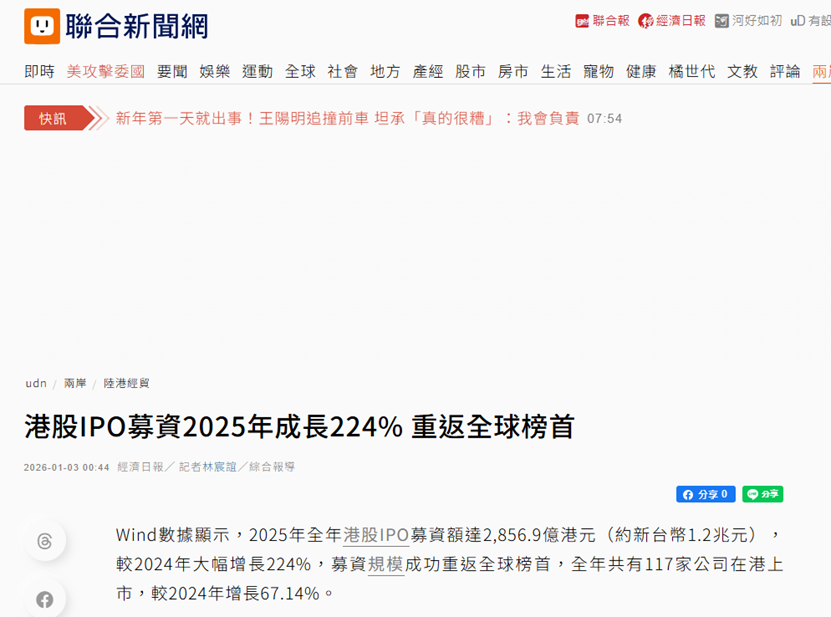
报道还提到,港股市场2025年全年诞生8家百亿级港元融资企业,分别为宁德时代、紫金黄金国际、三一重工、赛力 斯、恒瑞医药、三花智控、海天味业、奇瑞汽车。8家企业合计募资达1424.6亿港元,占全年募资总额的52.75%,龙头 效应显著,成为港股IPO市场复苏的"压舱石"。 另据港交所数据显示,截至2025年12月31日,共有逾612件上市申请,其中包括549家主板、11家GEM(原创业板), 还有52家根据"主板上市规则"第20章及第21章递交的上市申请,仍在排队处理的还有321件。 【环球网财经综合报道】据Wind资讯初步统计,截至2025年12月末,包括聚辰股份、天孚通信等在内的超20家A股上 市公司,披露赴港上市相关公告。对此有机构认为,港股"含A量"提高,释放出两地市场协同发力的积极信 号,"A+H"模式预计将持续火热。 联合新闻网近日发文称,2025年全年港股IPO募资额达2856.9亿港元,较2024年大幅增长224%,募资规模成功重返全 球榜首,排名超越纽交所、纳斯达克及印度股市;全年共有117家公司在港上市,较2024年增长67.14%。 ...




双融日报-20260105
Huaxin Securities· 2026-01-05 01:25
Core Insights - The report indicates that the current market sentiment is rated at 61, categorized as "relatively hot," suggesting a strong investor confidence in the market [2][10] - Key themes identified include robotics, banking, and brokerage sectors, with significant developments and investment opportunities highlighted in each area [6] Group 1: Robotics Sector - The establishment of a national standard organization for humanoid robots and embodied intelligence on December 26, 2025, marks a transition from "technical exploration" to "industrial collaboration" and "scale implementation," which is expected to accelerate technology deployment and ecosystem formation [6] - Related investment opportunities include companies such as Sanhua Intelligent Control (002050) and Wolong Electric Drive (600580) [6] Group 2: Banking Sector - Banking stocks are characterized by high dividend yields, with the China Securities Banking Index yielding 6.02%, significantly higher than the 10-year government bond yield, making them attractive for long-term investors like insurance and social security funds [6] - Notable banking stocks include Agricultural Bank of China (601288) and Ningbo Bank (002142) [6] Group 3: Brokerage Sector - The China Securities Regulatory Commission's chairman emphasized on December 6 the need for differentiated regulation, which aims to support high-quality institutions while limiting weaker ones, thus enhancing capital efficiency [6] - The focus is shifting from mere scale and growth to high-quality development, with recommendations for brokerage firms to differentiate their operations [6] - Relevant brokerage stocks include CITIC Securities (600030) and Guotai Junan Securities (601211) [6]





A股股票回购一览:今日59家公司披露回购进展
Mei Ri Jing Ji Xin Wen· 2026-01-04 23:51
Group 1 - On January 5, 59 companies announced a total of 59 stock repurchase updates, with 3 companies disclosing repurchase plans for the first time, 54 companies reporting on the implementation of repurchase plans, and 2 companies completing their repurchase plans [1] - Among the newly disclosed repurchase plans, 2 companies announced repurchase amounts exceeding 10 million, with Century Huatong planning to repurchase up to 600 million, Dongcheng Pharmaceutical up to 200 million, and Guojijinggong up to 657,200 [1] - In terms of repurchase implementation progress, Haier Smart Home, COSCO Shipping Holdings, and Youngor reported the highest repurchase amounts, with 1.08 billion, 825 million, and 779 million respectively [1] Group 2 - Two companies, Xinhengcheng and Sanhua Intelligent Control, have completed repurchases exceeding 10 million, with completed repurchase amounts of 556 million and 303 million respectively [1] - As of January 5, two repurchase plans have been completed this year, involving two companies, both of which have completed repurchase amounts exceeding 100 million [1]






浙江三花智能控制股份有限公司关于回购公司股份进展暨回购完成的公告
Xin Lang Cai Jing· 2026-01-04 21:06
登录新浪财经APP 搜索【信披】查看更多考评等级 证券代码:002050 证券简称:三花智控 公告编号:2026-001 浙江三花智能控制股份有限公司 关于回购公司股份进展暨回购完成的公告 本公司及董事会全体成员保证信息披露内容的真实、准确和完整,没有虚假记载、误导性陈述或重大遗 漏。 浙江三花智能控制股份有限公司(以下简称"公司")于2024年12月30日召开的第七届董事会第三十次临 时会议,审议通过了《关于回购公司股份方案的议案》。同意公司使用自有资金及股票回购专项贷款资 金以集中竞价交易方式回购公司股份,回购的价格不超过人民币36.00元/股,回购的资金总额为不低于 人民币30,000万元且不超过人民币60,000万元,回购股份的实施期限为自公司董事会审议通过回购股份 方案之日起不超过12个月。2025年1月8日,公司披露了《回购股份报告书》(公告编号:2025-002)。 2025年5月15日,公司披露了《关于调整回购股份价格上限的公告》(公告编号:2025-043)。2024年 度权益分派实施后,公司回购股份价格上限由不超过人民币36.00元/股调整为不超过人民币35.75元/ 股。 二、回购股份实 ...
券商推荐212只首月金股
Zheng Quan Ri Bao· 2026-01-04 16:51
Group 1 - Investors are focusing on potential investment opportunities and market dynamics as the new year begins, with brokerages recommending a total of 212 stocks for January [1] - The "spring market rally" is anticipated, supported by policy initiatives and capital inflows, leading analysts to have an optimistic outlook for the A-share market in January [3][4] Group 2 - Among the recommended stocks, Zijin Mining received the highest attention with 8 joint recommendations from brokerages, while Zhongji Xuchuang received 7, and China Duty Free, Sanhua Intelligent Control, and China Pacific Insurance each received 4 [2] - The bullish outlook for Zijin Mining is based on the rising copper cycle driven by demand in new energy and the significant investment value of gold [2] Group 3 - Analysts predict that the "spring market rally" will be supported by ongoing policy efforts and a favorable economic environment, with expectations of a sustained upward trend in the market [3] - The macroeconomic environment is in a marginal recovery phase, with a neutral to loose financial environment, and the technology sector is expected to continue strengthening [3] Group 4 - New investment themes are emerging, with four key allocation directions identified: AI investments aligned with global manufacturing recovery, Chinese equipment exports, consumer recovery driven by inbound tourism and income growth, and non-bank financials benefiting from market expansion [4] Group 5 - In 2025, the performance of stocks recommended by brokerages was notable, with some stocks seeing monthly gains exceeding 150%, indicating strong market interest in these recommendations [5][6] - The number of recommended stocks remained stable, with a significant percentage of them achieving price increases in several months, particularly in August where 82% of recommended stocks rose [6] Group 6 - The performance of brokerage stock indices in 2025 was positive, with all 34 brokerage indices showing increases, and the Guoyuan Securities index leading with a 106% gain [7]


