Sinoma Science & Technology (002080)

Search documents
中材科技:苏州市姑苏区人民政府对苏州非矿院三香路大楼实施征收
Ge Long Hui· 2025-12-18 11:27
格隆汇12月18日丨中材科技(002080.SZ)公布,根据2025年11月13日苏州市姑苏区人民政府发布的《苏 州市姑苏区人民政府关于国有土地上房屋征收决定的公告》,因公共利益建设项目需要,根据国务院 《国有土地上房屋征收与补偿条例》的相关规定,苏州市姑苏区人民政府决定对中材科技股份有限公司 之全资子公司苏州中材非金属矿工业设计研究院有限公司之全资子公司苏州非金属矿工业设计研究院有 限公司(简称"苏州非矿院")位于苏州市三香路999号的房屋资产(简称"三香路大楼")实施征收,国 有土地使用权同时收回。2025年12月18日,苏州非矿院与征收实施单位苏州市姑苏区人民政府金阊街道 办事处(简称"金阊街道办事处")签订了《苏州市姑苏区房屋征收补偿安置协议书(货币补偿)》及 《苏州市姑苏区房屋征收补偿安置补充协议书》,苏州非矿院预计获得征收补偿18,140.86万元。 ...

中材科技:12月18日召开董事会会议
Mei Ri Jing Ji Xin Wen· 2025-12-18 11:22
Group 1 - The company, China National Materials Technology (中材科技), announced a temporary board meeting on December 18, 2025, to discuss the proposal regarding the expropriation of a building in Suzhou by the local government [1] - For the first half of 2025, the company's revenue composition is entirely from special fiber composite materials, accounting for 100% [1] - As of the report date, the market capitalization of China National Materials Technology is 57.4 billion yuan [1]
中材科技(002080) - 关于苏州市姑苏区人民政府对苏州非矿院三香路大楼实施征收的公告
2025-12-18 11:15
证券代码:002080 证券简称:中材科技 公告编号:2025-064 中材科技股份有限公司 关于苏州市姑苏区人民政府对苏州非矿院三香路大楼实施征收的公告 本公司及董事会全体成员保证信息披露内容的真实、准确和完整,没有 虚假记载、误导性陈述或重大遗漏 一、交易概述 根据 2025 年 11 月 13 日苏州市姑苏区人民政府发布的《苏州市姑苏区人民 政府关于国有土地上房屋征收决定的公告》,因公共利益建设项目需要,根据国 务院《国有土地上房屋征收与补偿条例》的相关规定,苏州市姑苏区人民政府决 定对中材科技股份有限公司(以下简称"公司")之全资子公司苏州中材非金属 矿工业设计研究院有限公司之全资子公司苏州非金属矿工业设计研究院有限公 司(以下简称"苏州非矿院")位于苏州市三香路 999 号的房屋资产(以下简称 "三香路大楼")实施征收,国有土地使用权同时收回(以下简称"本次征收")。 2025 年 12 月 18 日,苏州非矿院与征收实施单位苏州市姑苏区人民政府金 阊街道办事处(以下简称"金阊街道办事处")签订了《苏州市姑苏区房屋征收 补偿安置协议书(货币补偿)》及《苏州市姑苏区房屋征收补偿安置补充协议书》, 苏州 ...
中材科技(002080) - 董事会决议公告
2025-12-18 11:15
会议审议并通过了以下议案: 1、经与会董事投票表决,以 7 票赞成、0 票反对、0 票弃权的表决结果通过 了《关于苏州市姑苏区人民政府对苏州非矿院三香路大楼房屋实施征收的议案》。 《中材科技股份有限公司关于苏州市姑苏区人民政府对苏州非矿院三香路 大楼实施征收的公告》(公告编号:2025-064)全文刊登于 2025 年 12 月 19 日 的《中国证券报》、《上海证券报》和巨潮资讯网(http://www.cninfo.com.cn), 供投资者查阅。 证券代码:002080 证券简称:中材科技 公告编号:2025-063 中材科技股份有限公司 第七届董事会第二十七次临时会议决议公告 本公司及董事会全体成员保证信息披露的内容真实、准确和完整,没有 虚假记载、误导性陈述或者重大遗漏。 一、董事会会议召开情况 中材科技股份有限公司(以下简称"公司")第七届董事会第二十七次临时会 议于 2025 年 12 月 12 日以书面形式通知全体董事、高级管理人员,于 2025 年 12 月 18 日上午 9 时 30 分在中国北京市海淀区东升科技园北街 6 号院 7 号楼 12 层公司会议室以现场与通讯相结合的方式召开。本 ...
山西证券:AI服务器快速发展 拉动高频高速PCB需求
智通财经网· 2025-12-18 08:24
Core Insights - The domestic PCB market is projected to grow from $41.213 billion to $49.704 billion from 2024 to 2029, with a CAGR of 3.8% [1] - The fastest-growing downstream sector for PCBs is servers/data storage, expected to have a CAGR of 11.6% during the same period [1] Group 1: PCB Market Growth - The demand for PCBs is driven by explosive growth in computing power, particularly in AI servers and switches, which require higher performance [1] - The requirements for PCB materials are evolving, with a focus on low Dk/Df properties for core materials like resin, fiberglass, and copper foil [1] Group 2: Resin Demand and Supply - PPO and hydrocarbon resins are ideal for high-frequency and high-speed applications, with expected global demand reaching 4,558 tons and 1,216 tons by 2025, reflecting year-on-year growth of 41.89% and 41.62% respectively [2] - Major global suppliers of PPO and hydrocarbon resins include Sabic, Asahi Kasei, and Mitsubishi Gas, while domestic companies like Dongcai Technology and Shengquan Group are rapidly improving their product performance and production capabilities [2] Group 3: Low-DK Electronic Fabrics - Low-DK electronic fabrics are essential for M7 and above CCL, with the market expected to reach $2.3 billion by 2033, growing at a CAGR of 7.50% from 2024 to 2033 [3] - The supply of low-DK electronic fabrics is concentrated among Japanese, Taiwanese, and domestic companies, with domestic firms accelerating their production capabilities [3] Group 4: HVLP Copper Foil - HVLP copper foil is a core material for high-frequency PCBs, with a projected market growth from $2 billion to $5.95 billion between 2024 and 2032, achieving a CAGR of 14.6% [4] - The high-end copper foil market is currently dominated by Japanese and Korean companies, but domestic firms like Defu Technology and Tongguan Copper Foil are making significant advancements [4] Group 5: Key Companies - Notable companies to watch include Shengquan Group (605589.SH), Dongcai Technology (601208.SH), Zhongcai Technology (002080.SZ), Honghe Technology (603256.SH), International Composite Materials (301526.SZ), Defu Technology (301511.SZ), Tongguan Copper Foil (301217.SZ), and Longyang Electronics (301389.SZ) [5]


PCB材料行业报告:乘AI之风,PCB材料向高频高速升级
Shanxi Securities· 2025-12-18 06:57
Investment Rating - The report maintains a rating of "B" for the new materials PCB materials industry, indicating a positive outlook for the sector [1]. Core Insights - The demand for PCBs is expected to grow significantly due to the rapid development of AI servers, with the domestic PCB market projected to increase from $41.213 billion in 2024 to $49.704 billion by 2029, reflecting a CAGR of 3.8% [2][18]. - The fastest-growing downstream sector for PCBs is the server and data storage market, with a projected CAGR of 11.6% from 2024 to 2029 [23]. - The transition to PCIe 5.0 standards is driving the need for high-frequency and high-speed PCBs, necessitating improvements in dielectric properties of core materials [27][34]. Summary by Sections PCB Market Overview - The global PCB market is expected to reach $94.7 billion by 2029, with a CAGR of 5.2% from 2024 to 2029, driven by AI, data centers, and smart automotive applications [18]. - In 2024, the domestic PCB market is anticipated to grow by 9.0%, reaching $41.213 billion, while the global market is projected to grow by 5.8% [18][23]. Material Demand and Supply - The demand for electronic-grade PPO and hydrocarbon resins is expected to reach 4,558 tons and 1,216 tons respectively by 2025, with growth rates of 41.89% and 41.62% [3][50]. - The global HVLP copper foil market is projected to grow from $2 billion to $5.95 billion between 2024 and 2032, with a CAGR of 14.6% [5][6]. Key Companies - Shengquan Group is expanding its PPO resin production capacity to over 2,000 tons and is involved in multiple expansion projects [7]. - Dongcai Technology is investing 700 million yuan to build a project with an annual capacity of 20,000 tons of electronic materials for high-speed communication [7]. - Zhongcai Technology is the first domestic supplier to achieve mass production of second-generation low-dielectric products [7]. - Honghe Technology has reached international leading quality levels for some high-end electronic fabrics and will begin mass supply in the first half of 2025 [7]. Material Innovations - Low-DK electronic fabrics are essential for M7 and above CCLs, with a projected global market size of $2.3 billion by 2033, growing at a CAGR of 7.5% [4]. - The transition to low Dk/Df materials is critical for PCB performance, with core materials like PPO, hydrocarbon resins, and HVLP copper foils expected to see significant demand growth [37][40].
预见2025:《2025年中国玻璃纤维行业全景图谱》(附供需情况、竞争格局、发展前景等)
Qian Zhan Wang· 2025-12-18 02:13
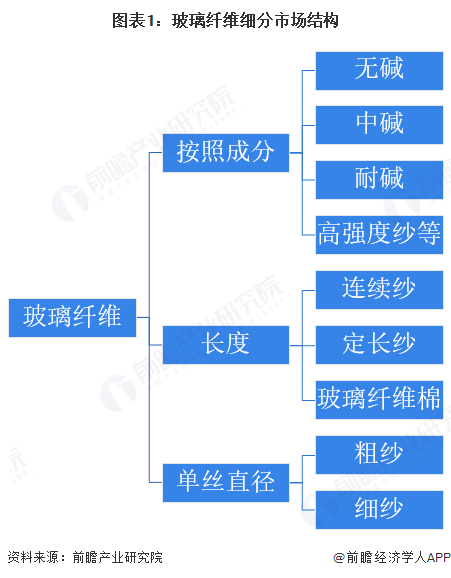
Industry Overview - Glass fiber is an inorganic non-metallic material primarily composed of silica, alumina, and calcium oxide, known for its insulation, heat resistance, and corrosion resistance, widely used in construction, transportation, wind power, and electronics [1] - The glass fiber industry has strong linkages with upstream (minerals, chemicals, energy) and downstream sectors (transportation, construction, electronics, and emerging industries) [4] Industry Development - The history of China's glass fiber industry dates back to the late 1940s, with significant growth occurring in the late 1990s, leading to China holding over 50% of global glass fiber production capacity by the 21st century [7] - As of mid-2025, China's glass fiber production capacity is expected to reach 8.7 million tons, indicating ongoing capacity expansion [14] Policy Background - In 2023, various policies were introduced to encourage the development of high-performance glass fiber products, including the "Green Building Materials Industry High-Quality Development Implementation Plan" and "Guidance on Promoting the Recycling of Retired Wind Power and Photovoltaic Equipment" [11][13] Supply and Demand - China's glass fiber production capacity reached over 7.5 million tons in 2022, with a projected increase to 8.7 million tons by mid-2025, indicating a slowdown in capacity expansion [14] - The total production of glass fiber is expected to reach 7.56 million tons in 2024, reflecting a year-on-year growth of 4.6% [15] - The apparent consumption of glass fiber in China is projected to reach 5.64 million tons in 2024, with a year-on-year increase of 1.6% [24] Export and Import Trends - China's glass fiber export volume is expected to reach 2.02 million tons in 2024, the highest in a decade, while imports are projected to decline to 100,000 tons, indicating improved self-sufficiency [21] Revenue Trends - The main business revenue of large-scale glass fiber enterprises in China was approximately 114.8 billion yuan in 2023, with a slight decrease of 0.5% expected in 2024 [26] Competitive Landscape - China Jushi is the leading company in the glass fiber sector, with a revenue of 15.48 billion yuan from glass fiber-related businesses in 2024, while other companies like China National Materials, International Composites, and Changhai Co. also report revenues exceeding 1.5 billion yuan [29] - The major glass fiber companies are concentrated in Jiangsu, Shandong, Shanghai, Zhejiang, and Chongqing, with China Jushi located in Zhejiang [31] Future Development Trends - The industry is expected to phase out low-end capacities while high-end products like electronic-grade glass fiber will see increased demand due to advancements in technologies such as 5G and AI [34] - By 2030, the demand for glass fiber in China is projected to reach 6.54 million tons, driven by sectors like new energy vehicles, wind power, and advanced communication technologies [37]


逼近11万元/吨 碳酸锂期货大涨 高增长潜力股出炉
Zheng Quan Shi Bao Wang· 2025-12-18 00:30
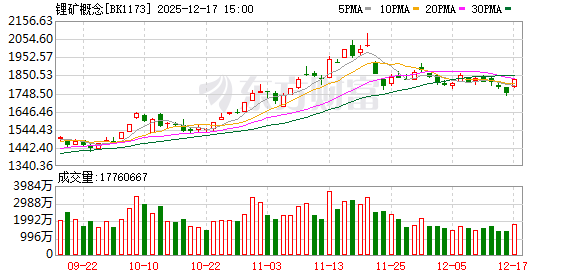
Core Insights - Lithium carbonate futures prices have surged, approaching 110,000 yuan/ton, indicating a recovery cycle in the industry [2][3] - The A-share lithium mining sector has seen significant gains, with leading companies like Tianqi Lithium and Ganfeng Lithium experiencing notable stock price increases [3] - The domestic lithium carbonate spot price has also risen sharply, with battery-grade lithium carbonate quoted at 97,100 yuan/ton, marking a 62.18% increase from the year's low [3] Market Performance - On December 17, A-share lithium battery concept stocks collectively surged, with companies like Shengxin Lithium Energy and Dazhong Mining hitting their daily price limits, and over 10 billion yuan of net capital inflow into the lithium battery sector [5] - The announcement of the cancellation of 27 mining licenses in Yichun has raised concerns, although the specific impact on lithium mines remains unclear [5] Industry Trends - The lithium battery industry is experiencing a recovery cycle, driven by the high cost-performance ratio of lithium iron phosphate technology in the electric vehicle market and the push for solid-state batteries [7] - The energy storage battery sector is entering a phase of large-scale expansion, with demand expected to grow significantly due to the increasing share of renewable energy and the need for grid stability [7] Production and Export Growth - In the first 11 months of the year, China's production and sales of power and other batteries reached 1,468.8 GWh and 1,412.5 GWh, respectively, representing year-on-year growth of 51.1% and 54.7% [7] - Exports of power and other batteries totaled 260.3 GWh, a 44.2% increase year-on-year, with power batteries accounting for 65.2% of total exports [7] Future Outlook - Analysts are optimistic about the recovery of the lithium battery industry chain, with expectations of continued growth in overseas markets and robust demand for energy storage batteries [8] - Forecasts suggest that global sales of new energy vehicles will grow by approximately 17% by 2026, with a corresponding 20% increase in demand for power batteries [8] Financial Performance - A-share lithium battery concept stocks have shown significant recovery in performance, with a total net profit of 117.2 billion yuan in the first three quarters, a year-on-year increase of 26.97% [9] - Among the lithium battery concept stocks, several companies have reported over 100% growth in net profit, including Guoxuan High-Tech and Daosheng Technology [9][10]




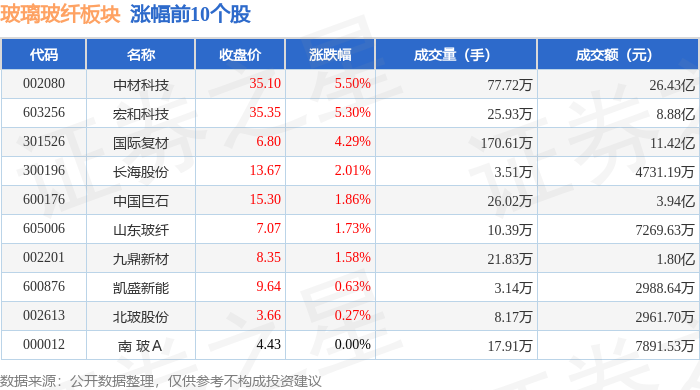
玻璃玻纤板块12月17日涨2.59%,中材科技领涨,主力资金净流入4.28亿元
Zheng Xing Xing Ye Ri Bao· 2025-12-17 09:07
Market Overview - The glass fiber sector increased by 2.59% on December 17, with Zhongcai Technology leading the gains [1] - The Shanghai Composite Index closed at 3870.28, up 1.19%, while the Shenzhen Component Index closed at 13224.51, up 2.4% [1] Stock Performance - Zhongcai Technology (002080) closed at 35.10, up 5.50%, with a trading volume of 777,200 shares and a turnover of 2.643 billion [1] - Honghe Technology (603256) closed at 35.35, up 5.30%, with a trading volume of 259,300 shares and a turnover of 888 million [1] - International Composite (301526) closed at 6.80, up 4.29%, with a trading volume of 1,706,100 shares and a turnover of 1.142 billion [1] - Other notable stocks include China Jushi (600176) at 15.30, up 1.86%, and Shandong Glass Fiber (605006) at 7.07, up 1.73% [1] Capital Flow - The glass fiber sector saw a net inflow of 428 million from institutional investors, while retail investors experienced a net outflow of 379 million [2] - The main stocks with significant net inflows include Zhongcai Technology with 313 million and International Composite with 151 million [3] - Retail investors showed a notable outflow from stocks like Honghe Technology, with a net outflow of 98.43 million [3]


建材行业2026年度投资策略:向内看“反内卷”显效,向外拓“新市场”机遇
CMS· 2025-12-16 09:04
Group 1 - The report highlights that the building materials industry has shown a strong performance since 2025, particularly in fiberglass, cement, and refractory materials, benefiting from significant price increases and improved supply-demand dynamics [1][12][14] - The consensus on "anti-involution" among companies has led to supply reductions or maintenance, while structural demand growth is observed in specific segments such as specialty electronic fabrics in fiberglass and overseas market expansion in cement [1][12] - The report anticipates that the building materials industry will continue to present structural opportunities in 2026, with specific focus on segments like float glass, tiles, pipes, and sanitary ware, which are still in the process of bottoming out [1][12] Group 2 - The report indicates that the cement industry is expected to see a profit recovery in 2025, with the profit turning point occurring before revenue, driven by capacity management and a decrease in coal prices [5][6][12] - The overseas market for cement is highlighted as a key growth area, with significant projects expected to contribute to earnings in 2026, such as Huaxin Cement's project in Malawi and West Cement's project in Uganda [5][6][12] - The fiberglass sector is projected to experience significant profit recovery, with multiple rounds of price increases and expanding demand from downstream applications, particularly in wind energy and electric vehicles [5][6][12] Group 3 - The report notes that the float glass sector continues to face challenges, with high inventory levels and weak demand leading to price pressures, while the industry is expected to undergo a reshuffling due to cost differentiation [6][12][25] - The report emphasizes the importance of focusing on leading companies in the building materials sector that possess strong brand competitiveness, scale advantages, and well-established distribution channels to capture dual benefits of market share growth and profit improvement [6][12][25] - Investment recommendations include focusing on leading companies in various segments such as waterproof materials, coatings, pipes, and tiles, as well as cement companies with strong cash flow and dividend commitments [6][12][25]