
Bank of Ningbo(002142)

Search documents
大A的荣耀不再属于“性价比”投资者
虎嗅APP· 2025-10-09 23:56
Core Viewpoint - The article discusses the performance of deep value fund managers during different market conditions, highlighting their underperformance in the current bull market compared to growth-style fund managers, particularly in sectors like technology and innovation [4][20]. Group 1: Performance Comparison - In the past three years of bear markets, deep value fund managers performed relatively well, with many managing over 10 billion in assets [5]. - As of September 24, 2023, mainstream deep value fund managers like Xu Yan and Jiang Cheng had annual returns below 20%, while the average return of the CSI Active Equity Fund Index reached 34.11% [6][12]. - The article notes that deep value fund managers typically focus on low-valuation, stable companies, which leads to lower returns in bull markets but better performance in bear markets [14][19]. Group 2: Investment Philosophy - Deep value fund managers invest from an owner's perspective, focusing on long-term intrinsic value rather than short-term market fluctuations [16]. - They emphasize "quality and price," seeking high-quality companies that are undervalued due to market sentiment [17]. - Safety margins are crucial in their investment decisions, as they aim to protect against errors and downside risks [17][18]. Group 3: Market Trends and Strategies - The current bull market has favored growth-style funds, particularly those heavily invested in technology, with some achieving over 200% annual returns [7]. - Deep value fund managers often hold significant positions in traditional sectors like finance and real estate, which have underperformed in the current market [14][19]. - The article suggests that deep value funds should be considered for core portfolio allocations, especially for conservative investors [23][24]. Group 4: Selection Criteria - Not all low-valuation stocks represent deep value; some may belong to contrarian or cyclical strategies [29]. - Investors should focus on the stability of deep value fund managers' styles, as many have shifted towards growth or other strategies over time [36][38]. - The article advises that deep value funds can serve as a bottom-layer allocation in a diversified portfolio, balancing risk and return [24][26].







中航月月鑫30天持有期债券型证券投资基金基金份额发售公告
Shang Hai Zheng Quan Bao· 2025-10-09 18:33
Fund Overview - The fund is named "AVIC Monthly Xin 30-Day Holding Period Bond Fund" and has been registered with the China Securities Regulatory Commission [10] - The fund is a bond-type open-ended fund with a 30-day holding period [11] Fund Subscription Details - The subscription period is from October 13, 2025, to October 24, 2025, through direct sales and other sales institutions [4][17] - Each investor can subscribe up to 10 million RMB per day, with specific exceptions for certain types of investors [3][13] - The total fundraising target is capped at 5 billion RMB, with a minimum fundraising amount of 200 million RMB [15][39] Fund Management and Custody - The fund is managed by AVIC Fund Management Co., Ltd., and the custodian is Ningbo Bank Co., Ltd. [1][40] Investor Eligibility - The fund is open to individual investors, institutional investors, qualified foreign investors, and other investors permitted by law [13][15] - Financial institutions' proprietary accounts are currently not eligible for subscription [3][13] Subscription Process - Investors must open a fund account with the management company to subscribe [19] - Subscription applications must be fully paid according to the sales institution's regulations [20] - The fund allows multiple subscriptions during the fundraising period, but applications cannot be withdrawn once accepted [20][26] Fund Share and Fees - The fund shares are issued at a par value of 1.00 RMB [12] - A subscription fee applies to Class A shares, while Class C shares do not incur a subscription fee but charge a service fee [21][24] Fund Operation and Confirmation - The fund operates on a contract basis with a minimum holding period of 30 days, during which investors cannot redeem or transfer shares [11][17] - Subscription confirmations depend on the registration institution's results, and investors should verify their subscription status [25]

区域银行冲向科技金融
券商中国· 2025-10-09 11:16
Core Viewpoint - The article emphasizes the importance of fintech as a leading business segment for banks and financial institutions, highlighting the proactive approach of these entities in embracing technological advancements [1]. Group 1: Development of Fintech in Regional Banks - Many regional banks, particularly city and rural commercial banks, are following the lead of larger banks in developing fintech, although their progress may be limited by resources [2]. - Zhejiang Rural Commercial Bank has reported that since launching its fintech pilot in Jiaxing, the proportion of technology enterprise loans has exceeded 30% of corporate loans, covering 7,200 tech enterprises [2]. - Various county-level rural commercial banks in Jiaxing have begun to establish specialized mechanisms for fintech, such as dedicated departments and service models [3]. Group 2: Challenges and Strategies - The development of fintech is challenging for regional banks, which need to root their efforts in local economic structures and overcome internal limitations [5]. - A listed rural commercial bank indicated that it had been considering fintech since 2017, but only completed team formation in 2021, reflecting the long-term commitment required [4]. Group 3: Growth in Technology Loans - Despite smaller loan scales compared to larger banks, regional banks are accelerating their technology loan offerings, with significant growth rates reported [6]. - For instance, Jiangsu Bank's technology loan balance reached 2,740 billion yuan, growing by 17.80% year-on-year, while Hangzhou Bank's technology loans increased by 21.77% [7]. - Other regional banks, such as Qilu Bank and Qingdao Bank, also reported substantial growth in technology loans, with increases of 17.60% and 20.85% respectively [7]. Group 4: Organizational Structure and Specialization - Banks are adapting their organizational structures to support fintech, with many establishing dedicated departments and specialized branches [9]. - For example, Ningbo Bank has set up a technology finance department to provide comprehensive services to tech enterprises, while Qingdao Bank has developed a specialized mechanism for fintech [10]. - Hangzhou Bank has created a well-structured fintech system with multiple regional centers and specialized institutions [11].




全球十年复盘:哪些银行可以跑出超额收益
Guoxin Securities· 2025-10-09 11:07
Investment Rating - The report suggests a positive investment outlook for quality banks in China, indicating significant valuation recovery potential [2][3]. Core Insights - The core conclusion emphasizes not to underestimate the resilience of China's economy, with a substantial space for bank valuation recovery. The investment focus should be on quality banks with stable operations and those with specialized business models [2][3]. - The report highlights that the investment in the banking sector is primarily driven by macroeconomic factors, with a strong correlation between bank profitability and economic performance [33][56]. Summary by Sections Global Banking Index Performance - The report outlines the performance of various banking indices over the past decade, noting that the Indian CNX Nifty Bank Index has seen a cumulative increase of 196%, while the Shenyin Wanguo Bank Index has only increased by 18% [5][19]. - It indicates that the Shenyin Wanguo Bank Index has lagged behind other global indices, primarily due to the economic pressures faced in China since 2022 [57][58]. Investment Recommendations - The report recommends focusing on high-quality cyclical stocks that are expected to outperform as the economic fundamentals improve, particularly in the fourth quarter and early next year [3]. - Specific banks such as Ningbo Bank and China Merchants Bank are highlighted as key investment opportunities, along with a recommendation to monitor banks like Changshu Bank and Chongqing Rural Commercial Bank [3][82]. Bank Performance Analysis - Among the 154 sample banks analyzed, 102 outperformed the domestic market index, with notable performances from banks in strong economic growth regions such as the UAE and Vietnam [82]. - The report notes that the performance of banks varies significantly based on their economic environment, governance, and market conditions, with private banks in India showing better performance compared to state-owned banks [89].


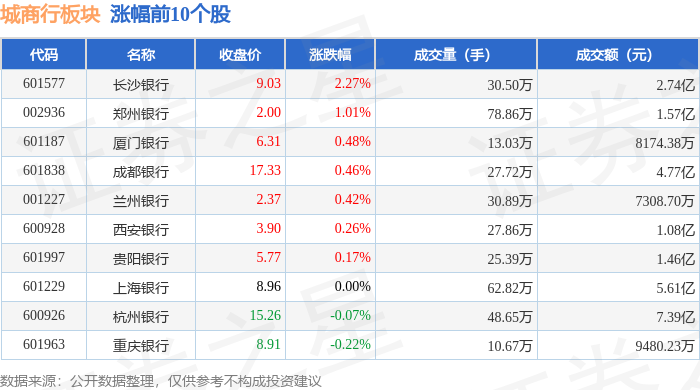
城商行板块10月9日跌0.34%,苏州银行领跌,主力资金净流出7.64亿元
Zheng Xing Xing Ye Ri Bao· 2025-10-09 09:03
Core Insights - The city commercial bank sector experienced a decline of 0.34% on October 9, with Suzhou Bank leading the drop [1] - The Shanghai Composite Index closed at 3933.97, up 1.32%, while the Shenzhen Component Index closed at 13725.56, up 1.47% [1] Stock Performance - Notable gainers included: - Changsha Bank: Closed at 9.03, up 2.27% with a trading volume of 305,000 shares and a turnover of 274 million yuan [1] - Zhengzhou Bank: Closed at 2.00, up 1.01% with a trading volume of 788,600 shares and a turnover of 157 million yuan [1] - Notable decliners included: - Suzhou Bank: Closed at 8.07, down 1.10% with a trading volume of 512,100 shares and a turnover of 413 million yuan [2] - Ningbo Bank: Closed at 26.18, down 0.95% with a trading volume of 391,800 shares and a turnover of 1.024 billion yuan [2] Capital Flow - The city commercial bank sector saw a net outflow of 764 million yuan from institutional investors, while retail investors contributed a net inflow of 230 million yuan [2][3] - Specific stock capital flows indicated: - Ningbo Bank: Institutional net inflow of 25.45 million yuan, retail net inflow of 30.74 million yuan [3] - Qingdao Bank: Institutional net inflow of 21.20 million yuan, but retail net outflow of 32.20 million yuan [3]

散户要注意了!节后A股三大动力已经到位,这3类股将引发行情
Sou Hu Cai Jing· 2025-10-09 02:35
Group 1 - Nikkei 225 index surged 4.75% to reach a historical high, while Hang Seng Index rose 9.3% during the holiday, indicating strong performance in overseas markets [1] - A-share market has a historical trend of over 70% probability of rising in the first week after National Day, with three main drivers identified for a potential rebound [3] - The probability of a Federal Reserve rate cut in November has risen to 94%, leading to a shift of global funds from high-yield assets to emerging markets, with Chinese assets becoming a focal point [3] Group 2 - Domestic policies and liquidity are crucial for stabilizing the A-share market, with the central bank injecting 300 billion yuan in liquidity through reverse repos [5] - Various policy measures have been implemented, including tax refunds for semiconductor equipment purchases and consumer subsidies, creating a supportive environment for market recovery [5] - Industrial profits showed a significant turnaround, with a 20.4% year-on-year increase in August, ending three months of negative growth [5] Group 3 - The AI sector is experiencing growth, with AMD and OpenAI entering a multi-billion dollar partnership, driving global demand for computing power [7] - The penetration rate of domestic AI chips is expected to rise from 12% in 2024 to 28% in 2025, with private equity firms showing strong confidence in the technology sector [7] - Historical data indicates a 60% probability of the Shanghai Composite Index rising in the first five trading days after National Day, with an average increase of 1.41% [7] Group 4 - Analysts suggest the market has entered a "fundamentally driven bull market phase," with technology leading the way, while consumer and financial sectors are expected to catch up [9] - Semiconductor equipment companies are likely to benefit from policy subsidies, with firms like North Huachuang and Changchuan Technology showing strong profit growth [9] - The valuation of technology stocks remains low, with the computer industry PE at 38 times, below the 50th percentile since 2015 [9] Group 5 - Consumer sectors such as liquor and new energy are expected to benefit from seasonal demand and foreign capital inflow, supported by fiscal subsidies [11] - Financial sectors, including brokerage firms and banks, are positioned to gain from improved market sentiment and increased trading volumes [11] - Concerns exist regarding whether high valuations in technology stocks have already priced in future growth, especially if foreign capital takes profits [11]


城商行板块9月30日跌1%,苏州银行领跌,主力资金净流出4.62亿元
Zheng Xing Xing Ye Ri Bao· 2025-09-30 08:51
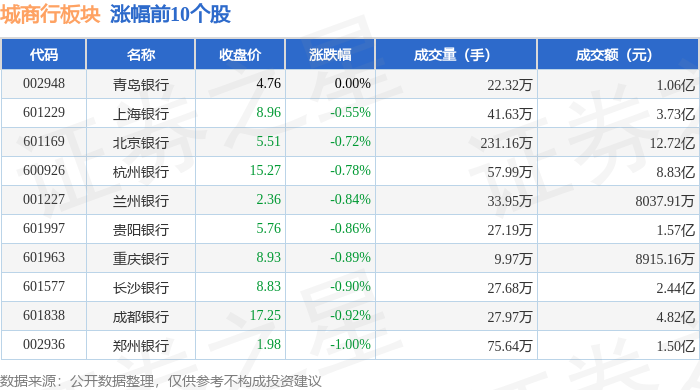
Core Insights - The city commercial bank sector experienced a decline of 1.0% on September 30, with Suzhou Bank leading the drop [1] - The Shanghai Composite Index closed at 3882.78, up 0.52%, while the Shenzhen Component Index closed at 13526.51, up 0.35% [1] Stock Performance Summary - Qingdao Bank: Closed at 4.76, unchanged; trading volume of 223,200 shares, turnover of 106 million [1] - Shanghai Bank: Closed at 8.96, down 0.55%; trading volume of 416,300 shares, turnover of 373 million [1] - Beijing Bank: Closed at 5.51, down 0.72%; trading volume of 2,311,600 shares, turnover of 1.272 billion [1] - Hangzhou Bank: Closed at 15.27, down 0.78%; trading volume of 157,990 shares, turnover of 883 million [1] - Lanzhou Bank: Closed at 2.36, down 0.84%; trading volume of 339,500 shares, turnover of 80.379 million [1] - Guiyang Bank: Closed at 5.76, down 0.86%; trading volume of 271,900 shares, turnover of 157 million [1] - Chongqing Bank: Closed at 8.93, down 0.89%; trading volume of 99,700 shares, turnover of 89.151 million [1] - Changsha Bank: Closed at 8.83, down 0.90%; trading volume of 276,800 shares, turnover of 244 million [1] - Chengdu Bank: Closed at 17.25, down 0.92%; trading volume of 279,700 shares, turnover of 482 million [1] - Zhengzhou Bank: Closed at 1.98, down 1.00%; trading volume of 756,400 shares, turnover of 150 million [1] Capital Flow Analysis - The city commercial bank sector saw a net outflow of 462 million from main funds, while speculative funds had a net inflow of 331 million, and retail investors had a net inflow of 131 million [2] - Suzhou Bank: Main fund net inflow of 55.9396 million, speculative fund net outflow of 11.5337 million, retail net outflow of 44.4059 million [3] - Changsha Bank: Main fund net inflow of 33.8793 million, speculative fund net outflow of 13.6525 million, retail net outflow of 20.2268 million [3] - Qilu Bank: Main fund net inflow of 8.6825 million, speculative fund net outflow of 2.7980 million, retail net outflow of 5.8846 million [3] - Hangzhou Bank: Main fund net inflow of 7.6881 million, speculative fund net inflow of 44.2474 million, retail net outflow of 51.9354 million [3] - Guiyang Bank: Main fund net inflow of 4.8665 million, speculative fund net outflow of 1.6412 million, retail net outflow of 3.2254 million [3]
机构密集“踩点”银行股 息差与资产质量等成焦点
Zhong Guo Zheng Quan Bao· 2025-09-29 22:14
Core Insights - The focus of institutional research has shifted towards regional banks in economically developed areas, particularly in the Yangtze River Delta, due to their strong performance and resilience [1][2][5] Group 1: Institutional Research Activity - As of September 29, A-share listed banks have been researched 326 times this year, with over 2000 institutions participating [2] - Regional city commercial banks and rural commercial banks in the Yangtze River Delta, such as Changshu Bank and Ningbo Bank, have been the most frequently researched [2][3] - Changshu Bank reported a revenue of 6.062 billion yuan, a 10.10% year-on-year increase, and a net profit of 1.969 billion yuan, up 13.51% year-on-year [2] Group 2: Key Concerns of Institutions - Institutions are primarily concerned with the stability of net interest margins, potential risks to asset quality, and future credit allocation strategies [3][4] - Shanghai Bank aims to enhance its credit allocation to key sectors and regions, focusing on technology, green finance, and inclusive finance [4] Group 3: Investment Value of Bank Stocks - The investment logic for bank stocks is evolving from valuation recovery to deep value discovery in high-quality banks amid industry differentiation [5][6] - The banking sector is expected to benefit from increased inflows of incremental capital, particularly from insurance funds, due to its high dividend returns and stable earnings [6]


机构密集“踩点”银行股息差与资产质量等成焦点
Zhong Guo Zheng Quan Bao· 2025-09-29 20:45
Core Viewpoint - The article highlights the increasing interest of institutional investors in regional banks, particularly in the Yangtze River Delta, due to their strong performance and resilience in a developed economic region [1][2]. Group 1: Institutional Research Focus - As of September 29, 2023, A-share listed banks have been surveyed over 300 times by more than 2000 institutions, with regional banks in the Yangtze River Delta receiving significant attention [1]. - Institutions are particularly focused on net interest margin stability, potential asset quality risks, and future credit allocation strategies during their research [2][3]. Group 2: Financial Performance of Regional Banks - Changshu Bank reported a revenue of 6.062 billion yuan, a year-on-year increase of 10.10%, and a net profit of 1.969 billion yuan, up 13.51% [2]. - The bank also declared its first interim cash dividend since its listing, distributing 0.15 yuan per share, totaling 499 million yuan [2]. Group 3: Investment Trends in Banking Sector - The investment logic for bank stocks is shifting from valuation recovery to deep value discovery of high-quality banks amid industry differentiation [3]. - As of September 29, 2023, the Shenwan Primary Bank Index closed at 4000.30 points, with a year-to-date increase of 2.33%, while individual stocks like Agricultural Bank, Qingdao Bank, and Pudong Development Bank rose over 20% [4]. - Institutional investments in bank stocks have increased, with insurance funds actively purchasing shares in various banks, indicating a preference for high dividend returns and stable earnings [4].

宁波银行将在10月1日-10月2日暂停个人养老金理财业务
Jin Tou Wang· 2025-09-29 03:17
2025年9月28日,宁波银行(002142)发布公告称,因系统维护升级,宁波银行将于2025年10月1日8 时-10月2日12时暂停个人养老金理财业务,届时个人养老金理财投资账户开户、产品购买及赎回等均将 暂时停止服务。 ...