Humon Share(002237)

Search documents
恒邦股份:公司在产金矿有腊子沟金矿和辽上金矿
Zheng Quan Ri Bao Wang· 2026-02-25 09:44
证券日报网讯2月25日,恒邦股份(002237)在互动平台回答投资者提问时表示,公司在产金矿有腊子 沟金矿和辽上金矿。辽上金矿扩界、扩能采选建设工程项目目前处于基建期,预计将于2027年下半年正 式投产,正式投产时间受安全政策、建设进度、项目施工条件等多种因素影响,难以准确预计,如有相 关进展,公司会严格按照相关法律法规的要求及时履行信息披露义务,请关注后期公司在巨潮资讯网上 披露的相关公告。 ...

恒邦股份:截至2026年2月13日公司股东人数为85522户
Zheng Quan Ri Bao Wang· 2026-02-25 09:44
证券日报网讯2月25日,恒邦股份(002237)在互动平台回答投资者提问时表示,截至2026年2月13日, 公司的股东人数为85522户。 ...
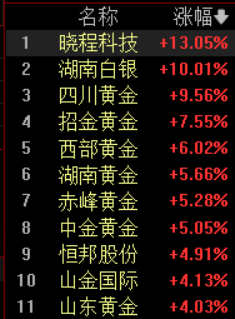
贵金属板块走强,湖南白银涨停、晓程科技涨超13%,瑞银上调黄金目标价至6200美元
Jin Rong Jie· 2026-02-24 02:06
贵金属概念快速拉升,晓程科技涨超13%,湖南白银涨停,四川黄金涨超9%,招金黄金涨超7%,西部 黄金涨超6%,湖南黄金、赤峰黄金、中金黄金涨超5%,恒邦股份、山金黄金、山东黄金涨超4%。消息 面上,早盘现货黄金向上突破5200美元/盎司,为1月30日以来首次,日内涨近2%。此外,上期所沪银 主力合约一度涨13%,报22366元/千克。 宏源期货分析指出,美国部分经济与就业数据表现良好,部分美联储官员担忧通胀反弹,使美联储降息 预期时点推迟至7月;美国持续威胁军事打击伊朗以促其在核问题谈判中妥协,美乌与俄罗斯之间和平 协议谈判取得部分进展且开始触及领土问题,地缘政治风险此起彼伏引发避险需求;美国最高法院裁定 特朗普政府部分关税措施违法,但随后特朗普政府依据其他法律条款推出新的关税措施,引发美国对外 贸易政策不确定性担忧;候任美联储主席凯文·沃什或降息易缩表难,财政部长贝森特表示美联储或不 会迅速缩表,叠加多国央行持续购买黄金,中长期或支撑贵金属价格。 光大期货分析称,春节期间,外盘贵金属行情可分为两个阶段。上半场,市场沉浸在对美联储政策转向 的重新定价之中。美国1月非农就业数据的意外强劲与CPI数据显示的通胀粘 ...


马年首个交易日 贵金属一马当先
Sou Hu Cai Jing· 2026-02-24 01:56
扬子晚报网2月24日讯(记者 范晓林)今天是马年首个交易日,A股沪指高开1.15%,深成指高开1.52%,创业板指高开1.70%,贵金属、油气、算力等板 块指数涨幅居前。 趋势顶底 分时 | 页展 09:38 4 暗盘资金 涨停揭秘 开盘后,贵金属概念快速拉升,晓程科技涨超13%,湖南白银逼近涨停,四川黄金、湖南黄金、盛达资源、兴业银锡、招金黄金、赤峰黄金跟涨。消息面 上,现货黄金向上触及5200美元/盎司,为1月30日以来首次,日内涨近2%。此外,上期所沪银主力合约一度涨13%,报22366元/千克。 .Il 5G C 贵金属 6082.57 +369.21 +6.46% | 成分股 | 资金 | 分析 | 资讯 | 基金 盘口 | | | --- | --- | --- | --- | --- | --- | | 设置 ◎ 分析 ○ | | | 最新 ◆ | 幅度 ◆ | 流通市值 ◆ | | 晓程科技 | | | 64.19 | 12.46% | 149.99亿 | | 300139 | | | | | | | 湖南白银 | | | 15.05 | 10.01% | 349.89亿 | | 002716 ...


期货工具护航实体企业永续发展
Qi Huo Ri Bao Wang· 2026-02-12 01:35
Core Viewpoint - Shandong Hengbang Smelting Co., Ltd. (Hengbang) has successfully integrated futures and derivatives into its business strategy, creating a robust risk management system that has enabled the company to achieve stable revenue and profit growth over more than a decade despite market volatility in gold and non-ferrous metals [1][2]. Group 1: Strategic Integration of Hedging - Futures hedging has played a critical role as a "stabilizer" and "protector" in Hengbang's strategic execution, allowing the company to manage price risks effectively while expanding its business [2]. - The company covers various commodities in its hedging strategy, including gold, silver, copper, and lead, aligning these tools with its strategic goals at different stages of development [2][5]. - Hengbang plans to deepen the integration of futures derivatives into all aspects of its operations, from strategic planning to production and sales, achieving comprehensive risk management [3]. Group 2: Operational Framework - Hengbang has established a leadership group for hedging operations, ensuring alignment between hedging strategies and overall business strategies [4]. - The company adheres to a strict management system for hedging, which includes defined business scope, approval authority, funding limits, and risk management protocols [4]. Group 3: Market Resilience - Hengbang's hedging logic is straightforward: it locks in processing profits through sell hedges during raw material procurement and manages sales price risks with buy hedges [5]. - The company has successfully navigated significant market disruptions, such as the 2008 financial crisis and the COVID-19 pandemic, by leveraging its hedging mechanisms to stabilize operations [5]. Group 4: Value Beyond Risk Management - The integration of futures markets has driven technological innovation within Hengbang, as the company aligns its production processes with high standards required for futures delivery [7]. - The successful certification of the "Humon" brand has enhanced brand value and market recognition, allowing Hengbang to command a premium in the market [8]. Group 5: Industry Empowerment - Hengbang actively shares its hedging experiences with small and medium-sized enterprises (SMEs) in the industry, helping them overcome barriers to using futures tools [9][10]. - The company provides tailored guidance to SMEs, assisting them in developing hedging strategies and risk management systems [11]. - As Hengbang's operational scale grows, its hedging activities are expanding to cover a broader range of products, reflecting its commitment to integrating futures tools into its future development [11].
恒邦股份涨2.03%,成交额3.00亿元,主力资金净流入1547.52万元
Xin Lang Zheng Quan· 2026-02-11 03:02
Core Viewpoint - Hengbang Co., Ltd. has shown significant stock performance with a year-to-date increase of 30.85%, despite a recent decline of 3.73% over the last five trading days [1] Group 1: Stock Performance - As of February 11, Hengbang's stock price reached 17.56 CNY per share, with a trading volume of 3.00 billion CNY and a market capitalization of 251.10 billion CNY [1] - The stock has experienced a 20.11% increase over the past 20 days and a 31.34% increase over the past 60 days [1] - The company has appeared on the trading leaderboard twice this year, with the most recent occurrence on February 3 [1] Group 2: Financial Performance - For the period from January to September 2025, Hengbang achieved a revenue of 764.44 billion CNY, reflecting a year-on-year growth of 31.44%, and a net profit attributable to shareholders of 5.62 billion CNY, up by 20.89% [2] - The company has distributed a total of 7.60 billion CNY in dividends since its A-share listing, with 3.17 billion CNY distributed over the last three years [3] Group 3: Shareholder Information - As of January 30, the number of shareholders for Hengbang reached 104,600, an increase of 48.13% from the previous period, while the average number of circulating shares per shareholder decreased by 32.49% to 11,401 shares [2] - Among the top ten circulating shareholders, Hong Kong Central Clearing Limited holds 11.46 million shares, an increase of 1.46 million shares from the previous period, while the Golden Stock ETF is a new entrant with 9.43 million shares [3]
【干货】锑产业链全景梳理及区域热力地图
Qian Zhan Wang· 2026-02-10 03:09
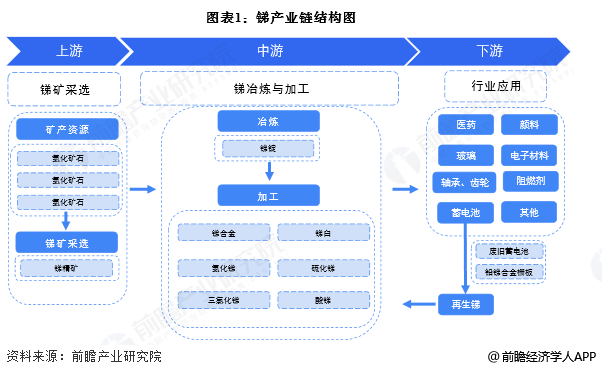
Core Insights - The antimony industry is characterized by its high industrial value and strategic importance, with antimony being used as an additive in various industrial applications [1] - The antimony supply chain includes upstream mining and selection, midstream smelting and processing, and downstream applications such as flame retardants and batteries [1][3] Group 1: Industry Overview - Antimony is a scarce resource with significant industrial applications, classified as a strategic mineral resource by the government [1] - The antimony supply chain consists of three main segments: upstream (mining and selection), midstream (smelting and processing), and downstream (applications) [1][3] - Key applications of antimony include flame retardants, glass, electronic materials, bearings, gears, and batteries, with the latter allowing for the recycling of antimony [1] Group 2: Key Companies and Production Data - Major upstream companies in the antimony mining sector include Hunan Gold, Huaxi Nonferrous, and Huayu Mining [3] - In 2024, Hunan Gold is projected to produce 29,209 tons of antimony, a decrease of 6.15% year-on-year, while Huaxi Nonferrous expects a production increase of 9.17% to 15,417.7 tons [10] - Midstream companies such as Hengbang Co. and Zhuhai Group are involved in smelting and processing, with Hengbang Co. reporting revenue of 957 million yuan from related operations in 2024 [10] Group 3: Regional Distribution - The antimony industry is predominantly concentrated in Hunan province, followed by Guangxi, Guangdong, and Jiangxi, with a significant disparity in the number of companies compared to other regions [5][7] - The majority of upstream, midstream, and recycling companies are located in Hunan, with other provinces like Tibet and Guangxi having fewer enterprises [7] Group 4: Investment Trends - Investment activities in the antimony sector from 2022 to 2025 highlight ongoing developments and strategic initiatives by key players [11] - Companies are focusing on enhancing production capabilities and exploring new product developments, particularly in high-precision alloys and recycling processes [10]


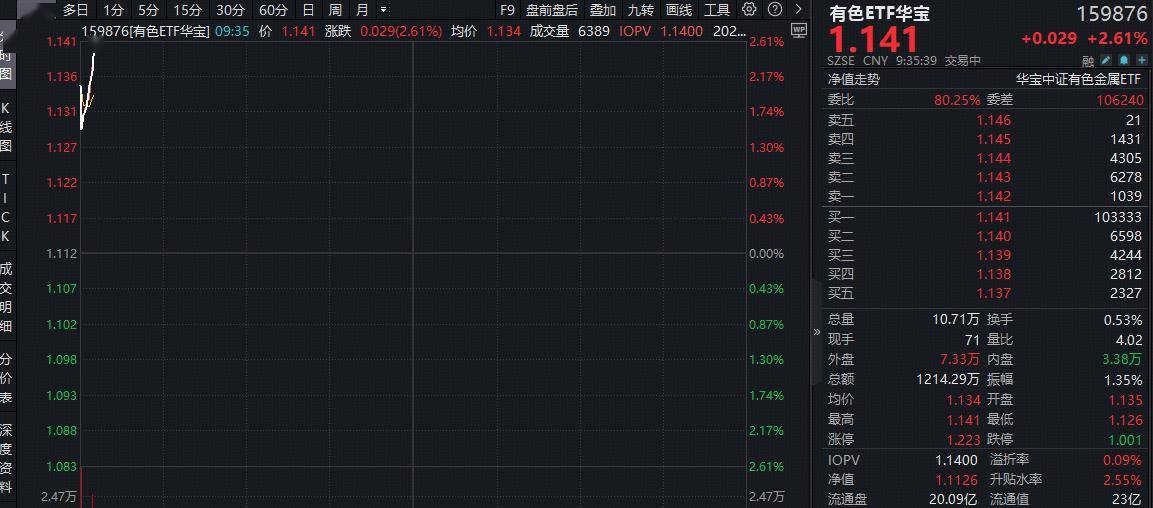
ETF盘中资讯|央行连续15个月增持黄金!现货黄金重返5000美元,有色ETF华宝(159876)强势拉升2.6%,盘中收复5日均线!
Sou Hu Cai Jing· 2026-02-09 01:58
Core Viewpoint - The continuous increase in gold reserves by the People's Bank of China (PBOC) for 15 consecutive months has positively impacted the performance of the non-ferrous metals sector, particularly the Huabao Non-Ferrous ETF, which saw a strong rise of 2.61% on February 9 [1][4]. Group 1: Market Performance - The Huabao Non-Ferrous ETF (159876) experienced a price increase of 2.61%, recovering above the 5-day moving average [1]. - The ETF's trading volume reached 63,890, with an average price of 1.134 [2]. - Key stocks in the non-ferrous sector, such as Hunan Silver, Shenghe Resources, and Northern Rare Earth, saw gains exceeding 3% [3]. Group 2: Central Bank Actions - The PBOC's gold reserves stood at 74.19 million ounces as of January 2026, up from 74.15 million ounces in December 2025, marking the 15th consecutive month of increases [3]. - The demand for gold from central banks remains strong, providing a supportive foundation for gold prices [4]. Group 3: Industry Outlook - Analysts predict that the non-ferrous metals sector will maintain a strong performance due to supply-demand mismatches, macroeconomic easing, and industrial upgrades, with high profitability expected to last 3-5 years [4]. - The Huabao Non-Ferrous ETF covers a wide range of metals, including copper, aluminum, gold, rare earths, and lithium, making it an efficient tool for investors to gain exposure to the sector [5].



山东恒邦冶炼股份有限公司关于2021年度员工持股计划股票出售完毕的公告
Xin Lang Cai Jing· 2026-02-06 18:56
Group 1 - The company has completed the sale of all shares under the 2021 employee stock ownership plan by February 6, 2026, ahead of the plan's expiration on February 10, 2026 [1][2] - The employee stock ownership plan was approved during board meetings on August 18, 2021, and September 8, 2021, and involved the purchase of 5.0761 million shares at an average price of 11.40 yuan per share, totaling approximately 57.84 million yuan, which represents 0.44% of the company's total share capital [2] - The company adhered to market trading rules and regulations during the implementation of the employee stock ownership plan, ensuring no insider trading occurred [2]
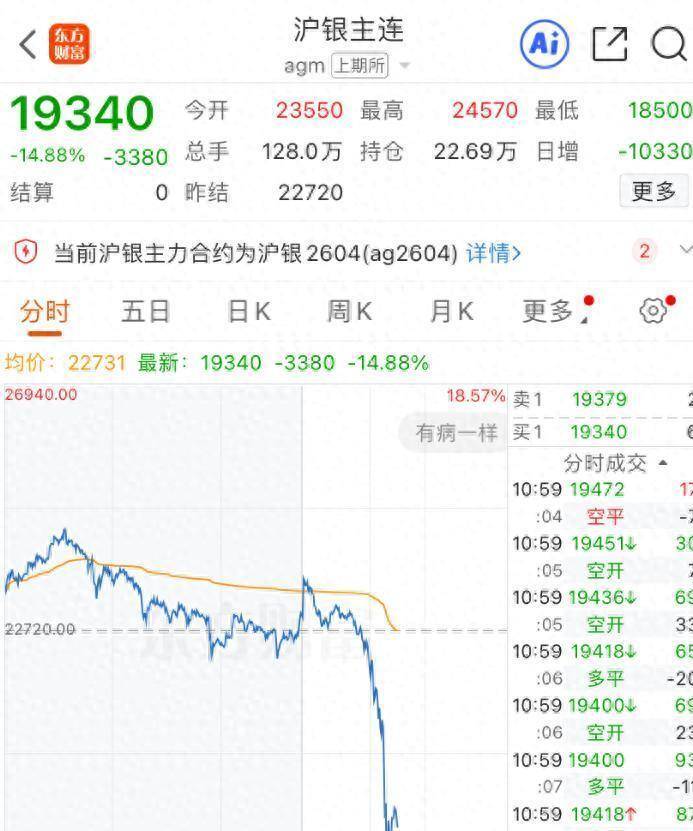
金银市场遭遇黑色星期三,白银价格暴跌近15%,黄金也跌超3%,黄金股多股跌停,一些投资者却开始疯狂扫货
Sou Hu Cai Jing· 2026-02-06 17:08
Core Viewpoint - The precious metals market experienced a dramatic decline on February 5, 2026, with silver prices plummeting over 14% and gold dropping more than 3%, leading to significant losses in related stocks and a stark contrast between capital market panic and physical market demand [1][3][4]. Market Performance - On February 5, silver prices fell to a low of $75.83 per ounce, while the Shanghai Futures Exchange saw silver contracts drop nearly 15% to 19,340 yuan per kilogram. Gold prices fell below the critical psychological level of $4,800 [1][4]. - A significant number of stocks related to gold and silver, such as Hunan Gold and Sichuan Gold, hit their daily limit down, reflecting a widespread sell-off in the sector [1][4][5]. Market Dynamics - The decline was preceded by a strong performance in January, where gold prices reached nearly $5,600 per ounce and silver exceeded $120 per ounce, resulting in gains of over 25% for gold and 60% for silver in just a month [3][4]. - The sell-off on February 5 was characterized by a lack of liquidity and a surge in stop-loss orders, creating a downward spiral in prices [4][6]. Regulatory Changes - Prior to the crash, exchanges raised margin requirements for silver contracts, which forced leveraged traders to either add funds or face forced liquidation, exacerbating the price decline [6][12]. - Major banks issued risk warnings to clients regarding the heightened volatility in the precious metals market, advising caution and stricter trading rules [12]. Institutional Behavior - Large investment institutions began to adjust their portfolios, with noticeable outflows from major gold ETFs during the price drop, indicating a shift in institutional sentiment [7][12]. - Analysts noted that the market's reaction was influenced by macroeconomic factors, including potential changes in U.S. Federal Reserve leadership and interest rate expectations, which could strengthen the dollar and negatively impact gold and silver prices [6][12]. Physical Market Response - Despite the turmoil in the capital markets, physical gold and silver demand surged in places like Shenzhen, where customers flocked to purchase gold bars, viewing the price drop as an opportunity [9][10]. - Retail gold prices adjusted downward in response to falling wholesale prices, making gold jewelry more attractive to consumers [10]. Analyst Perspectives - Analysts from various firms expressed differing views on the causes of the market decline, with some attributing it to technical adjustments and profit-taking, while others pointed to macroeconomic uncertainties stemming from U.S. Federal Reserve personnel changes [12][13]. - The overall sentiment in the market shifted from extreme optimism to fear, with many investors now closely monitoring support levels and physical demand to gauge future price stability [13].