避险溢价

Search documents
美联储偏鹰按兵不动,贵?属延续调整
Zhong Xin Qi Huo· 2026-03-19 00:55
Report Summary 1. Report Industry Investment Rating No relevant information provided. 2. Core Viewpoints - The Fed's hawkish stance in the March meeting, including maintaining interest rates, raising growth and inflation forecasts, and slightly revising up the long - term neutral interest rate, has led to a strengthening of the US dollar and US Treasury yields. Precious metals have entered a stage of high - volatility adjustment, shifting from being dominated by "safe - haven premiums" to a situation where "safe - haven support remains, but interest rates and the US dollar impose stronger constraints" [1]. - Gold is currently in a stage where "safe - haven support and interest - rate suppression" coexist. Short - term trends may feature high - level adjustments and mood swings. Its medium - term allocation value remains if the market's pricing of stagflation intensifies, but it may face further valuation pressure if US Treasury yields and the US dollar continue to rise [2]. - Silver is likely to continue high - volatility adjustments in the short term. Its performance depends on the marginal changes in the US dollar, interest rates, and risk appetite. If the market turns to stagflation trading and the risk appetite for industrial metals stabilizes, its elasticity relative to gold may recover, but the recovery pace may be slower during the Fed's hawkish phase [3]. 3. Summary by Related Content Precious Metals Market Overview - The Fed's March meeting sent hawkish signals, causing the market to reduce bets on rate cuts within the year. As a result, the US dollar and US Treasury yields strengthened, leading to a continuous decline in gold prices and putting pressure on silver [1]. Gold Analysis - **Logic**: The Fed's policies are not loose as it maintains the median of one rate cut this year while raising GDP and PCE forecasts and the long - term interest rate center. Powell's remarks on oil - price impacts on inflation and the need for restrictive interest rates have weakened rate - cut expectations, directly suppressing gold. However, due to ongoing Middle - East tensions and energy - supply risks, there is still buying support for gold [2]. - **Outlook**: In the short term, gold will experience high - level adjustments and mood swings. If oil prices rise and affect growth, the market's stagflation pricing may strengthen, enhancing gold's medium - term value. If US Treasury yields and the US dollar continue to rise, gold may face more valuation pressure [2]. Silver Analysis - **Logic**: In a hawkish Fed environment with a strong US dollar and volatile risk assets, silver is more elastic and has larger回调幅度 than gold. Oil - price shocks may drag on silver's industrial attributes if they suppress global demand. The current market trading theme makes silver more vulnerable to capital re - balancing [3]. - **Outlook**: Silver will likely continue high - volatility adjustments in the short term. Its performance depends on the US dollar, interest rates, and risk appetite. If the market turns to stagflation trading and industrial - metal risk appetite stabilizes, its elasticity relative to gold may recover, but the recovery may be slower [3]. Commodity Index - On March 18, 2026, the comprehensive commodity index was 2581.98, down 0.38%; the commodity 20 index was 2916.20, down 0.36%; the industrial products index was 2557.35, down 0.31% [40]. - The precious metals index on March 18, 2026, was 4226.30, with a daily decline of 0.84%, a 5 - day decline of 4.51%, a 1 - month decline of 0.81%, and a year - to - date increase of 10.51% [42].
ZFX山海证券:避险买盘推升金价重回5190
Xin Lang Cai Jing· 2026-02-25 15:20
Core Viewpoint - The gold market has regained upward momentum due to global trade environment shocks and rising risk aversion, despite a short-term adjustment [1][3] Group 1: Gold Market Dynamics - Following a 1.6% pullback due to profit-taking, gold prices rebounded by 1% to $5,192.68 per ounce after the U.S. implemented a 10% global import tariff [1][3] - The policy-driven risk premium is offsetting concerns over profit-taking, providing crucial support for precious metals [1][3] - The dramatic shift in trade policy is becoming a core logic for commodity pricing, with expectations of inflation rising due to potential increases in tariffs [1][3] Group 2: Geopolitical Influences - The evolving geopolitical situation, particularly the upcoming nuclear agreement negotiations between the U.S. and Iran, is heightening investor caution and increasing demand for safe-haven metals [1][3] Group 3: Other Metals Performance - The dollar index fell by 0.2%, allowing for a nearly 4% rebound in silver prices, reaching $90.55 per ounce, and a nearly 5% increase in platinum prices to $2,277.60 [2][5] - Copper prices also showed resilience, with London copper rising to $13,294.63 per ton, reflecting a broad interest in metals with both industrial and safe-haven attributes [2][5] Group 4: Interest Rate Environment - Despite the prevailing risk aversion, pressure from the interest rate environment remains significant, with expectations of "long-term high rates" persisting due to recent statements from Federal Reserve officials [2][5] - This environment typically imposes valuation limits on non-yielding assets, indicating that gold prices will continue to seek balance between risk aversion and interest rate pressures as they approach the $5,200 mark [2][5]


【UNforex财经事件】政策鹰派与避险溢价交织 市场进入双线博弈
Sou Hu Cai Jing· 2026-02-25 09:30
Group 1 - The core viewpoint of the articles highlights the complex dynamics affecting gold prices, driven by geopolitical tensions, trade policy uncertainties, and shifting Federal Reserve interest rate expectations [1][2][3] - Gold is approaching the key resistance level of $5200, supported by strong demand for safe-haven assets amid ongoing geopolitical risks and trade tensions [1][3] - The U.S. military presence in the Middle East is creating a tense atmosphere ahead of the upcoming U.S.-Iran nuclear negotiations, which could lead to new sanctions or regional conflicts, further boosting gold's appeal as a safe haven [1][2] Group 2 - Technically, gold prices have found support around $5100, which has now become a defensive level, while the mid-term upward trend remains intact above the 200-day simple moving average [2] - The market's expectations for the Federal Reserve's interest rate policy have shifted to a more hawkish stance, with the probability of a rate cut in June dropping to 52%, the lowest for the year [2] - The yield on 2-year U.S. Treasury bonds has risen to 3.46%, reflecting increased expectations for sustained high policy rates, while the 10-year yield remains around 4.03% [2][3] Group 3 - The performance of major currency pairs shows divergence, with the euro and pound recovering, while the dollar struggles to maintain a strong upward trend due to macro risks from tariff policies and a recovering stock market attracting risk capital [3] - The market is experiencing a "dual-track game" where rising short-term yields favor the dollar, while ongoing geopolitical risks and trade tensions support gold and limit the dollar's upside potential [3] - Gold's strong performance above $5100 indicates that market sensitivity to risk variables is greater than to short-term interest rate fluctuations, suggesting limited upside for the dollar until uncertainties dissipate [3]
OEXN:美元走强压制贵金属
Xin Lang Cai Jing· 2026-02-19 11:55
Core Viewpoint - The global commodity market is weakening amid a rebound in the US dollar, with gold prices falling below the $4900 mark due to a strong dollar index and a shift in macro risk sentiment [1][4]. Group 1: Market Dynamics - The decline in gold prices is attributed to the strengthening of the dollar index (DXY) and a lack of new positive support, leading to profit-taking by short-term investors [1][4]. - The reduction in risk premium is identified as a significant factor for the recent pullback in gold prices, as geopolitical tensions have eased following the consensus reached in US-Iran negotiations [5]. Group 2: Federal Reserve Influence - The market is closely monitoring upcoming policy signals from the Federal Reserve, with expectations that the January meeting minutes and the PCE price index will clarify the pace of potential interest rate cuts in the first half of 2026 [2][5]. - The nomination of a new Federal Reserve chair perceived as non-dovish has heightened anxiety in the metals market, leading to a defensive positioning among high-net-worth clients across various metals, including industrial copper [2][5]. Group 3: Long-term Outlook for Gold - Despite short-term selling pressure, the underlying logic for gold remains robust, with central banks, particularly in emerging markets, accounting for over one-third of global gold demand in 2025 [6]. - The expansion of federal fiscal spending in 2026 is expected to continue diluting fiat currency credit, reinforcing the value preservation attributes of physical assets [6]. - The current pullback in gold prices is viewed as a technical correction from an overbought condition, with the $4800 to $4900 range potentially serving as a critical support level for bullish positions after the release of PCE data and GDP initial estimates [6].
金银市场遭遇黑色星期三,白银价格暴跌近15%,黄金也跌超3%,黄金股多股跌停,一些投资者却开始疯狂扫货
Sou Hu Cai Jing· 2026-02-06 17:08
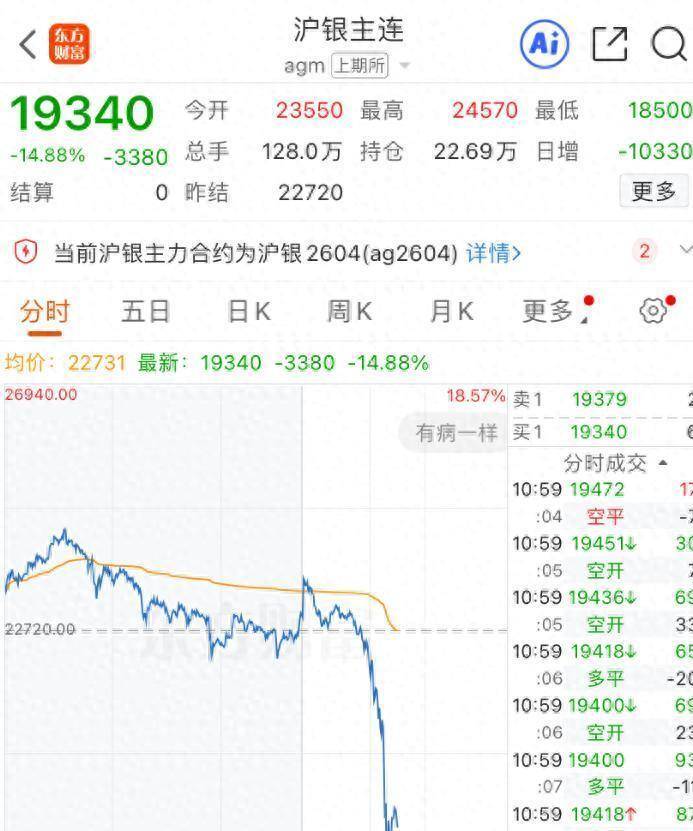
Core Viewpoint - The precious metals market experienced a dramatic decline on February 5, 2026, with silver prices plummeting over 14% and gold dropping more than 3%, leading to significant losses in related stocks and a stark contrast between capital market panic and physical market demand [1][3][4]. Market Performance - On February 5, silver prices fell to a low of $75.83 per ounce, while the Shanghai Futures Exchange saw silver contracts drop nearly 15% to 19,340 yuan per kilogram. Gold prices fell below the critical psychological level of $4,800 [1][4]. - A significant number of stocks related to gold and silver, such as Hunan Gold and Sichuan Gold, hit their daily limit down, reflecting a widespread sell-off in the sector [1][4][5]. Market Dynamics - The decline was preceded by a strong performance in January, where gold prices reached nearly $5,600 per ounce and silver exceeded $120 per ounce, resulting in gains of over 25% for gold and 60% for silver in just a month [3][4]. - The sell-off on February 5 was characterized by a lack of liquidity and a surge in stop-loss orders, creating a downward spiral in prices [4][6]. Regulatory Changes - Prior to the crash, exchanges raised margin requirements for silver contracts, which forced leveraged traders to either add funds or face forced liquidation, exacerbating the price decline [6][12]. - Major banks issued risk warnings to clients regarding the heightened volatility in the precious metals market, advising caution and stricter trading rules [12]. Institutional Behavior - Large investment institutions began to adjust their portfolios, with noticeable outflows from major gold ETFs during the price drop, indicating a shift in institutional sentiment [7][12]. - Analysts noted that the market's reaction was influenced by macroeconomic factors, including potential changes in U.S. Federal Reserve leadership and interest rate expectations, which could strengthen the dollar and negatively impact gold and silver prices [6][12]. Physical Market Response - Despite the turmoil in the capital markets, physical gold and silver demand surged in places like Shenzhen, where customers flocked to purchase gold bars, viewing the price drop as an opportunity [9][10]. - Retail gold prices adjusted downward in response to falling wholesale prices, making gold jewelry more attractive to consumers [10]. Analyst Perspectives - Analysts from various firms expressed differing views on the causes of the market decline, with some attributing it to technical adjustments and profit-taking, while others pointed to macroeconomic uncertainties stemming from U.S. Federal Reserve personnel changes [12][13]. - The overall sentiment in the market shifted from extreme optimism to fear, with many investors now closely monitoring support levels and physical demand to gauge future price stability [13].




每日期货全景复盘2.6:沪银几近跌停,煤焦补库入尾声,油价随地缘逻辑随风摇摆
Xin Lang Cai Jing· 2026-02-06 11:27
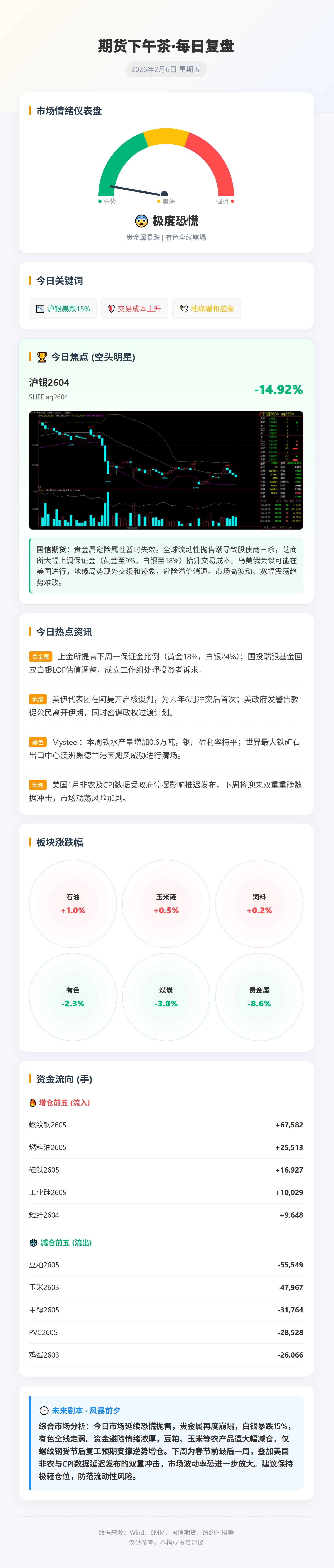
Market Sentiment - The market sentiment is currently weak, with significant volatility observed in precious metals and non-ferrous metals [3][4][7]. Precious Metals - Silver futures experienced a drastic drop, with SHFE silver contracts falling by 15%, while gold also saw a decline of over 5% at one point during the trading session [15][31]. - The recent sell-off in precious metals is attributed to a combination of profit-taking by investors and increased trading costs due to margin hikes (gold to 9%, silver to 18%) [7][23]. - Analysts suggest that the macroeconomic environment remains bearish, with the Federal Reserve maintaining a tightening stance to control inflation, which diminishes support for precious metal prices [31][30]. Coal and Coke - The main contract for coking coal fell by 3.68% to 1138.5 yuan/ton, while coke prices decreased by 2.64% to 1698.5 yuan/ton, reflecting weak demand and ongoing inventory accumulation at steel mills [16][17]. - The market is expected to continue facing weak demand post-holiday, with a focus on inventory digestion rather than new purchases [32][17]. Crude Oil - Crude oil prices are experiencing significant fluctuations due to geopolitical tensions, particularly related to Iran, with WTI and Brent crude both dropping over 3% recently [33][34]. - The SC crude oil contract showed relative resilience, closing down only 0.37% at 465.4 yuan/barrel, despite initial larger declines [33][34]. - Market analysts note that while geopolitical risks remain, concerns about direct military conflict in the Middle East have eased, leading to a complex interplay of supply and demand factors affecting oil prices [34][18].
金价暴跌后反弹,行情逻辑变了吗
Sou Hu Cai Jing· 2026-02-03 23:51
Core Viewpoint - The precious metals market experienced significant volatility in early 2026, with gold prices reaching a historical high of $5,598.75 per ounce and then experiencing a 9% drop, marking the largest single-day decline in nearly 40 years. However, the market has since stabilized, with gold rebounding to around $4,900 per ounce and silver to approximately $87 per ounce, indicating a recovery from extreme panic [1][2]. Group 1: Market Dynamics - The precious metals market saw a remarkable rise in January, with gold prices nearing $5,600 per ounce and silver exceeding $120 per ounce, resulting in cumulative increases of 24% and 62% respectively by January 29 [2]. - The recent sharp declines in gold and silver prices were attributed to three main factors: profit-taking, increased margin requirements by the Chicago Mercantile Exchange (CME), and market sentiment affected by the nomination of a new Federal Reserve chairman [2][3]. - Analysts believe that the recent market fluctuations are more a result of profit-taking after a heated market rather than panic selling, with the long-term price support for precious metals remaining intact until the U.S. dollar's credit issues are resolved [1][4]. Group 2: Valuation and Future Outlook - Current gold prices may have deviated from traditional valuation frameworks, with analysts suggesting that the ongoing market dynamics are fundamentally different from past trends, driven by factors such as global central bank gold purchases and a weakening dollar [5][6]. - The pricing of gold is influenced by three layers: its monetary attribute, financial attribute, and safe-haven attribute, with current prices being significantly above what is considered reasonable based on historical valuations [6]. - Future trends in gold prices will depend on the U.S. addressing issues related to low inflation, low interest rates, and the dollar's dominance, with specific conditions needed to restore investor confidence in U.S. debt [7]. Group 3: Investment Sentiment - Analysts remain optimistic about the future of gold, with expectations that geopolitical tensions and economic data could trigger renewed buying interest in precious metals [8]. - Key support levels for gold are identified around $5,000 per ounce, with predictions for potential price targets ranging from $4,600 to $7,200 per ounce depending on market conditions [8]. - Despite the long-term bullish outlook for gold, short-term investors are advised to be cautious of downward risks, as current prices may have already priced in nearly a decade of potential gains [9].
黄金1小时暴跌440美元,现在是抄底良机还是逃顶时刻?
Sou Hu Cai Jing· 2026-01-30 12:17
Core Viewpoint - The international gold and silver prices experienced a significant drop, with gold falling below $5200 per ounce and silver below $110 per ounce, leading to panic selling among investors [3][4][6]. Group 1: Market Reaction - On January 30, following the price drop, several gold and silver stocks hit their daily limit down, including Sichuan Gold and Silver, which saw its stock price drop to 66.18 yuan per share [4]. - Investors expressed mixed feelings, with some feeling lucky for selling at the peak while others were left with losses [4]. Group 2: Price Movements - Since the beginning of 2026, gold prices have risen over 20%, while silver prices have surged over 60% before the recent drop [6]. - On January 29, gold prices peaked at over $5500 per ounce, and silver prices exceeded $120 per ounce before the sharp decline [6]. Group 3: Causes of Volatility - The recent volatility is attributed to a combination of technical factors, market sentiment, and significant profit-taking after a period of rapid price increases [4][8]. - The price drop was triggered by algorithmic trading and a shift in margin requirements by exchanges, leading to a feedback loop of selling pressure [8]. Group 4: Investment Strategy - Experts recommend that ordinary investors should avoid trying to "catch the bottom" and instead focus on long-term investment strategies, emphasizing the importance of using the right tools and maintaining a disciplined approach [4][12]. - The current market conditions suggest a transition to a high-volatility phase, where investors should be cautious and avoid over-leveraging [9][12]. Group 5: Gold vs. Silver Dynamics - The drop in silver prices was more pronounced than that of gold, reflecting the different market structures and pricing mechanisms of the two metals [10][12]. - Silver's market is smaller and more speculative, leading to greater volatility during sell-offs compared to gold, which is viewed as a stable store of value [12]. Group 6: Future Outlook - The long-term outlook for gold remains positive due to ongoing global demand and geopolitical risks, despite short-term fluctuations [8][13]. - Historical patterns suggest that after sharp declines, markets often enter a phase of consolidation before making a new directional move [9].
金价暴跌!
Sou Hu Cai Jing· 2026-01-30 11:14
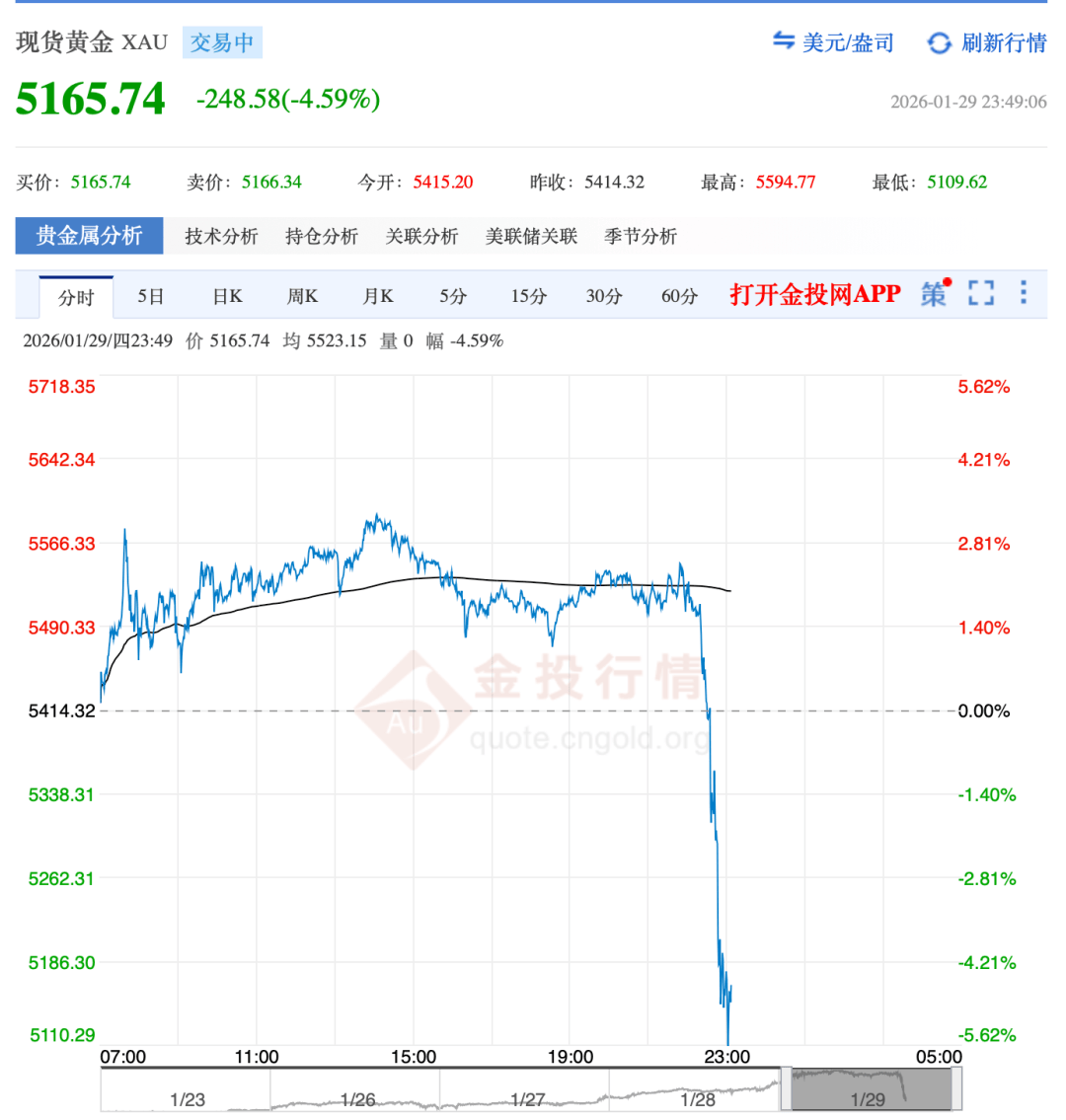
Core Viewpoint - The international gold and silver prices experienced a significant drop on January 29, with gold falling below $5200 per ounce and silver below $110 per ounce, leading to panic selling among investors [2][4][11]. Market Reaction - Following the price drop, the precious metals sector opened lower on January 30, with several companies, including Zhongjin Gold and Silver Nonferrous, hitting their daily limit down [2][5]. - The market saw a collective decline, with gold reported at $5146 per ounce and silver at $105 per ounce during the morning session on January 30 [2]. Price Movements - The gold price had previously surged over 20% since the beginning of the year, while silver prices had increased by over 60% [6]. - On January 29, silver prices briefly exceeded $120 per ounce, and gold prices surpassed $5500 per ounce before the sharp decline [6]. Fund Responses - Several gold and silver funds announced suspensions and purchase limits due to the rapid price increases, including Guotou Silver LOF and Huatai-PineBridge Gold LOF [6][7]. - The Guotou Silver LOF fund indicated it would suspend trading if the market price did not stabilize [6]. Market Dynamics - The sharp decline was attributed to a combination of technical factors, market sentiment, and changes in margin requirements by exchanges, leading to a feedback loop of selling pressure [8][9]. - The volatility was exacerbated by algorithmic trading and a high level of speculative investment in silver, which is more sensitive to market fluctuations compared to gold [14]. Investment Strategy - Experts recommend that ordinary investors should avoid trying to time the market and instead focus on a disciplined investment approach, emphasizing long-term strategies and risk management [3][15]. - The importance of using appropriate investment tools, avoiding leverage, and maintaining a balanced portfolio allocation to precious metals is highlighted [15].
华泰期货:沪金持续上涨,黄金或延续偏强格局
Xin Lang Cai Jing· 2026-01-22 01:57
Core Viewpoint - Gold prices have shown strong performance, driven by increased geopolitical tensions leading to a rise in safe-haven demand, with the main contract for gold (Au2604) opening at 1063.00 CNY/g and closing at 1092.30 CNY/g, marking a 3.69% increase and surpassing the 1100 CNY/g threshold [2][7]. Geopolitical Factors - The surge in gold prices is primarily attributed to escalating geopolitical conflicts, including comments from U.S. President Trump regarding potential alternative measures if current tariff tools are limited, and the European Parliament's decision to freeze the approval process of a trade agreement with the U.S. [2][8]. - Trump's threats to impose tariffs on eight European countries until an agreement regarding the purchase of Greenland is reached have further intensified market concerns [8]. - Additionally, Canadian military officials have simulated a response to a hypothetical U.S. military invasion, marking a significant escalation in defense preparedness [8]. Market Outlook - Given the current market sentiment leaning towards risk aversion, demand for gold investments is expected to strengthen, with the Au2604 contract anticipated to fluctuate within a range of 1050 CNY/g to 1150 CNY/g in the near term [3][8].