
NAURA(002371)

Search documents
「数据看盘」多路资金联手抢筹深南电路,顶级游资扎堆通源石油
Sou Hu Cai Jing· 2026-02-24 10:27
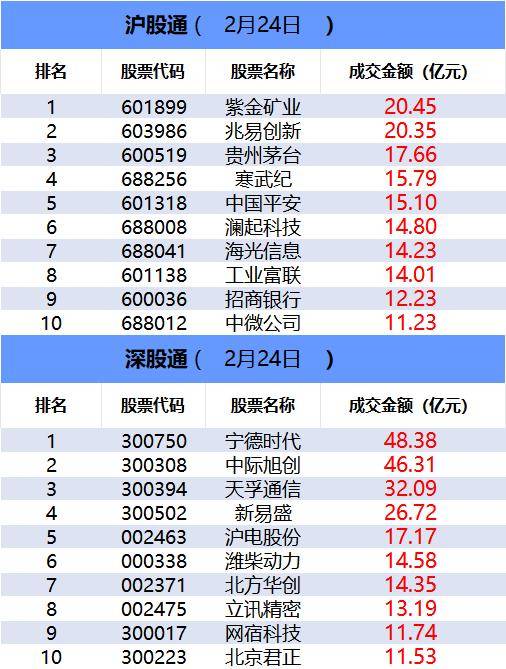
Market Overview - The stock market saw significant activity with deep South Circuit's strong performance, closing at the daily limit with institutional purchases totaling 96.32 million and a deep stock connection buying 413 million [1][12] - Oil and gas stocks led the market, with Tongyuan Petroleum hitting the daily limit and attracting a total of 154 million from three major institutional investors [1][13] Trading Volume - The total trading volume for the Shanghai Stock Connect was 145.275 billion, while the Shenzhen Stock Connect reached 171.886 billion [2] Top Stocks by Trading Volume - In the Shanghai Stock Connect, the top traded stocks included Zijin Mining at 2.045 billion, followed by Zhaoyi Innovation at 2.035 billion and Kweichow Moutai at 1.766 billion [3] - In the Shenzhen Stock Connect, the leading stocks were CATL at 4.838 billion, followed by Zhongji Xuchuang at 4.631 billion and Tianfu Communication at 3.209 billion [3] Sector Performance - The oil and gas, precious metals, cultivated diamonds, and chemical sectors showed the highest gains, while the film and television, AI applications, and other sectors experienced declines [4] Fund Flow Analysis - The non-ferrous metals sector saw the highest net inflow of funds, while the computer sector experienced the largest net outflow, totaling -12.407 billion [6] - The top stocks with net inflows included Zhongji Xuchuang at 2.218 billion and Huagong Technology at 1.33 billion [7] - Conversely, the stocks with the highest net outflows included Huasheng Tiancai at -1.638 billion and Dazhi Technology at -1.532 billion [8] ETF Trading - The top ETFs by trading volume included A500 ETF Fund at 8.3719 billion, Gold ETF at 8.2416 billion, and A500 ETF Huatai at 7.9285 billion [9] - The ETFs with the highest growth in trading volume compared to the previous trading day included S&P Oil and Gas ETF at 1.5465 billion, showing a 367.86% increase [10] Futures Market - In the futures market, the main contracts for IH, IF, and IC saw both long and short positions decrease, while the IM contract saw an increase in short positions [11]




半导体ETF(159813)开盘涨1.53%,重仓股中芯国际涨0.94%,海光信息涨3.00%
Xin Lang Cai Jing· 2026-02-24 05:40
Group 1 - The semiconductor ETF (159813) opened with a gain of 1.53%, priced at 1.260 yuan [1] - Key holdings in the semiconductor ETF include: - SMIC up 0.94% - Haiguang Information up 3.00% - Cambricon up 1.39% - Northern Huachuang up 1.17% - Zhaoyi Innovation up 2.85% - Zhongwei Company up 1.26% - Lanke Technology up 3.27% - OmniVision up 1.02% - Tuojing Technology up 0.92% - Changdian Technology up 1.67% [1] - The performance benchmark for the semiconductor ETF is the National Securities Semiconductor Chip Index return rate [1] Group 2 - The ETF is managed by Penghua Fund Management Co., Ltd., with the fund manager being Luo Yingyu [1] - Since its establishment on April 17, 2020, the ETF has achieved a return of 86.00%, with a return of 3.62% over the past month [1]




芯片ETF天弘(159310)开盘涨1.12%,重仓股寒武纪涨1.39%,中芯国际涨0.94%
Xin Lang Cai Jing· 2026-02-24 03:22
Group 1 - The core viewpoint of the article highlights the performance of the Tianhong Chip ETF (159310), which opened with a gain of 1.12% at 2.342 yuan on February 24 [1] - The major holdings of the Tianhong Chip ETF include companies such as Cambricon, which rose by 1.39%, SMIC with a 0.94% increase, and Haiguang Information, which saw a 3.00% rise [1] - The Tianhong Chip ETF has a performance benchmark of the CSI Chip Industry Index return rate, managed by Tianhong Fund Management Co., Ltd., with a return of 131.72% since its establishment on April 18, 2024, and a 3.46% return over the past month [1]

未知机构:持续强call存储设备重视机器人催化华西机械11春节-20260224
未知机构· 2026-02-24 02:35
Summary of Key Points from the Conference Call Industry Overview - The conference call focused on the storage device industry, particularly highlighting the performance of major companies such as SK Hynix and Samsung, as well as semiconductor equipment leaders like ASML, AMAT, LAM, and Teradyne [1][2]. Core Insights and Arguments - **Market Performance**: During the Spring Festival holiday, overseas indices saw widespread gains, with many European and East Asian indices reaching new highs [1]. - **Strong Demand in Storage Sector**: The storage sector has shown robust performance, with SK Hynix and Samsung's stock prices hitting new highs. The optimism is driven by a surge in real demand due to AI advancements and disciplined capacity expansion by manufacturers, alongside cleanroom limitations leading to supply imbalances [1][2]. - **Valuation Shift**: The global storage market is currently priced as a typical cyclical asset. However, there is an expectation that it will transition to a growth phase, with valuations potentially increasing from 5X-6X to 10X, 15X, or even 20X [1]. Additional Important Content - **Domestic Expansion**: The expansion of domestic storage capabilities in China is expected to resonate with both market conditions and domestic substitution. Companies like Jin Hua are projected to have expansion plans exceeding one million units, significantly outpacing overseas competitors [2]. - **Investment Recommendations**: Suggested investments include: - Front-end equipment: Precision Electronics, Tuo Jing Technology, Northern Huachuang, Jingyi Equipment, Zhongke Feicai, and Zhongwei Company. - Back-end testing equipment and materials were also mentioned, although specific companies were not detailed in the provided text [2].




芯片ETF(159995)开盘涨1.86%,重仓股中芯国际涨0.94%,海光信息涨3.00%
Xin Lang Cai Jing· 2026-02-24 01:39
Group 1 - The chip ETF (159995) opened with a gain of 1.86%, priced at 1.972 yuan [1] - Major holdings in the chip ETF include: - SMIC up 0.94% - Haiguang Information up 3.00% - Cambricon up 1.39% - Northern Huachuang up 1.17% - GigaDevice up 2.85% - Zhongwei Company up 1.26% - Lattice Technology up 3.27% - OmniVision up 1.02% - Tuojing Technology up 0.92% - Changdian Technology up 1.67% [1] - The performance benchmark for the chip ETF is the National Securities Semiconductor Chip Index return, managed by Huaxia Fund Management Co., Ltd. [1] Group 2 - Since its establishment on January 20, 2020, the chip ETF has achieved a return of 93.54% [1] - The return over the past month for the chip ETF is 3.60% [1]
招银国际焦点股份
Zhao Yin Guo Ji· 2026-02-23 10:50
Group 1: Stock Recommendations - 吉利汽车 (Geely Auto) has a market cap of $23.4 billion, with a target price of $25.00, indicating an upside potential of 48%[5] - 正力新能 (Zhengli New Energy) has a market cap of $2.8 billion, with a target price of $18.00, indicating an upside potential of 113%[5] - 极兔速递 (Jitu Express) has a market cap of $12.2 billion, with a target price of $13.40, indicating an upside potential of 25%[5] - 三一国际 (Sany International) has a market cap of $6.2 billion, with a target price of $20.60, indicating an upside potential of 37%[5] - 瑞幸咖啡 (Luckin Coffee) has a market cap of $11.0 billion, with a target price of $54.68, indicating an upside potential of 41%[5] Group 2: Performance Overview - The basket of 26 long positions had an average return of -2.3%, outperforming the MSCI China Index, which returned -2.4% by 0.1 percentage points[10] - Out of the 26 stocks, 11 had returns exceeding the benchmark[10] - The report includes a new addition of Datadog (DDOG US) to the buy list, while Salesforce (CRM US) has been removed[7]




2026年中国ALD设备行业发展历程、市场规模、重点企业及行业趋势分析:后摩尔时代,ALD技术凭原子级精度跃居芯片制造核心[图]
Chan Ye Xin Xi Wang· 2026-02-23 01:38
Core Insights - The article highlights the rising importance of Atomic Layer Deposition (ALD) technology in the semiconductor industry, transitioning from a supporting process to a core technology for manufacturing advanced 3D chip structures. [1] - The Chinese ALD equipment market is projected to reach approximately 4.522 billion yuan in 2024, reflecting a year-on-year growth of 7.23%. This growth is driven by the increasing complexity of semiconductor manufacturing processes and the expanding applications of ALD technology beyond traditional semiconductor fields. [1][9] Industry Overview - ALD (Atomic Layer Deposition) is an advanced thin-film deposition technology that utilizes alternating gas pulses of two precursors to create highly uniform and dense nanometer-scale films on substrates. [4] - The ALD equipment industry in China has evolved from reliance on imported technology to achieving significant breakthroughs through domestic innovation over several decades. [4][5] Industry Development History - The development of the ALD equipment industry in China began in the 1970s, with early reliance on imports until domestic companies like North Huachuang and Weidao Nano initiated independent research and development efforts around 2010. [4][5] - From 2019 to 2022, significant industrialization breakthroughs were achieved, with domestic companies successfully delivering ALD equipment for various applications, including semiconductor production. [5] Industry Value Chain - The upstream of the ALD equipment industry includes raw materials such as metal-organic precursors, oxidizers, and reaction gases, as well as key systems like high-precision mass flow controllers and vacuum pumps. The midstream focuses on the R&D and production of ALD equipment, while the downstream applications span semiconductor manufacturing, photovoltaics, new energy, and more. [7] Market Size - The ALD equipment market in China is expected to grow significantly, driven by advancements in semiconductor manufacturing and the adoption of ALD technology in new applications such as high-efficiency solar cells and flexible OLED displays. [1][9] Key Companies' Performance - Weidao Nano reported a revenue of 1.722 billion yuan in the first three quarters of 2025, marking an 11.48% year-on-year increase, with a net profit of 248 million yuan, up 64.83%. [11] - North Huachuang achieved a revenue of 27.301 billion yuan in the same period, reflecting a 32.97% increase, with a net profit of 5.130 billion yuan, up 14.83%. [11][12] Industry Trends - The ALD technology is transitioning from a supporting role to a core manufacturing process as semiconductor manufacturing moves towards 3nm nodes and 3D structures. [12] - Domestic manufacturers are increasingly focusing on independent development and have begun to lead in the market, particularly in the production of advanced chips. [13] - The expansion of application scenarios for ALD technology is expected to drive growth in new fields beyond traditional semiconductor applications, including powder atomic layer deposition technology and specialized ALD equipment for emerging applications. [15]


2025年光伏设备行业发展现状分析 行业规模突破1300亿元【组图】
Qian Zhan Wang· 2026-02-22 04:07
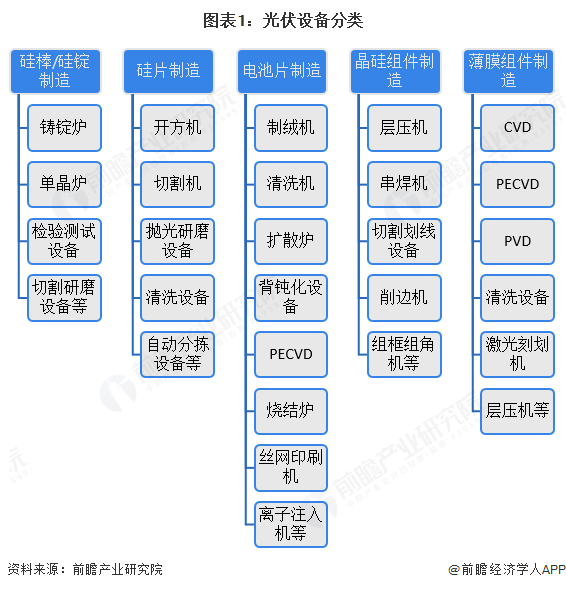
Core Insights - The Chinese photovoltaic equipment industry has evolved from reliance on imports to self-innovation and now leads globally, undergoing several stages including technological exploration, domestic breakthroughs, and high-quality leadership [7]. Industry Overview - The photovoltaic equipment industry includes various types of equipment used in the production of raw materials, batteries, and components, categorized into five main types: silicon rod/ingot manufacturing equipment, wafer manufacturing equipment, cell manufacturing equipment, crystalline silicon module manufacturing equipment, and thin-film module manufacturing equipment [1][12]. Company Landscape - Key companies in the silicon rod/ingot manufacturing segment include Jingcheng Machinery (晶盛机电), Liancheng CNC (连城数控), Robotech (罗博特科), and Shuangliang Energy (双良节能) [3][6]. - In the wafer manufacturing segment, notable companies are Jingcheng Machinery, Jincheng Co. (金辰股份), and Dier Laser (帝尔激光) [4][6]. - For cell manufacturing, leading firms include Jiejia Weichuang (捷佳伟创), Jingcheng Machinery, and Liancheng CNC [4][6]. - In the module manufacturing segment, key players are Jingcheng Machinery, Jincheng Co., and Xian Dao Intelligent (先导智能) [4][6]. Industry Development - The industry has achieved a complete supply capability, covering the entire photovoltaic production chain from silicon material production to module manufacturing, including water purification, environmental treatment, and related testing equipment [9][11]. - High domestic substitution rates have been observed in products such as cleaning equipment, texturing machines, diffusion furnaces, and various automation devices, with some products already exported [11]. Market Size - Since 2018, the scale of the Chinese photovoltaic equipment industry has been on a continuous rise, projected to exceed 130 billion yuan in 2024, reflecting an 18.2% year-on-year growth [12].



美国1750亿美元关税退税,对A股的影响(附50股)
Sou Hu Cai Jing· 2026-02-21 11:41
Group 1 - The core point of the article is that the recent US Supreme Court ruling on the $175 billion tariff refund has significant implications for both China and the A-share market, despite the refund being an internal US matter [2][6][28] - The $175 billion in tariffs was primarily collected from imports, including a 10% tariff on Chinese goods, and is now being refunded to US importers [8][10] - The refund will indirectly benefit Chinese companies as US importers, who have been financially strained by tariffs, will use the refunded money to pay off debts to Chinese suppliers and resume orders [12][14][28] Group 2 - The immediate impact on the A-share market is expected to be positive, with a potential "opening red" for A-shares as market sentiment improves following the ruling [40][46] - The ruling is seen as a signal that the previous high tariffs on Chinese goods may not be a permanent state, which could lead to a more favorable environment for Chinese exports [20][48] - Structural opportunities in the A-share market are identified, focusing on five main lines: export-oriented sectors, domestic substitution, strategic resources, domestic consumption, and new energy [51][62][88] Group 3 - Export-oriented sectors, particularly those with high exposure to the US market, are expected to benefit directly from the tariff refunds, with companies like Midea Group and Haier expected to see improved performance [52][72][73] - Domestic substitution and self-sufficiency in sectors like semiconductors and military equipment are highlighted as long-term strategic focuses, with companies like SMIC and AVIC Shenyang Aircraft being key players [53][78][86] - Strategic resources such as rare earths and gold are also expected to see price support due to ongoing global supply chain disruptions, benefiting companies like Northern Rare Earth and Shandong Gold [56][87]



瑞银深度调研报告:2026年中国两大产业主线:自主可控与海外扩张
Zhi Tong Cai Jing· 2026-02-13 13:31
Group 1: Core Insights - UBS's in-depth research in China identifies two main industry themes for 2026: self-sufficiency and overseas expansion [1] - The research covered various sectors including technology, industrial, healthcare, consumer, and utilities, visiting over 100 companies and industry experts [1] - The report highlights a shift in investor interest, with capital goods, media entertainment, and real estate development seeing increased research focus, while semiconductor and automotive parts sectors experienced a decline [1] Group 2: Technology Sector Insights - The technology sector is a key focus, with advancements in self-sufficiency moving from isolated breakthroughs to industry-wide collaboration [2] - AI capital expenditure is expected to grow steadily in 2026, driven by strong demand for AI applications and local semiconductor production [3] - Despite uncertainties regarding H200 GPU imports, domestic supply chains are adapting through technology substitution and demand upgrades [3] Group 3: Semiconductor Developments - The localization of China's semiconductor industry is accelerating, with significant progress in advanced etching/ deposition equipment, advanced packaging, and high-end analog chips [4] - Capital expenditure for wafer fabrication equipment (WFE) is projected to grow by 10-15% annually, driven by capacity expansion in advanced logic and memory wafer fabs [4] - Domestic manufacturers anticipate a substantial increase in storage capital expenditure in 2026, aligning with a global upcycle in the storage industry [4] Group 4: Overseas Expansion Trends - Multiple industries, including industrial, biopharmaceuticals, and consumer goods, are focusing on overseas expansion as a key growth strategy [6] - In the industrial sector, overseas orders for AIDC and renewable energy storage equipment are increasing significantly [7] - The healthcare sector is also prioritizing global expansion, with biopharmaceutical companies actively pursuing international collaborations and local sales team development [9] Group 5: Key Recommendations - UBS recommends several core stocks in the technology and semiconductor sectors, including Northern Huachuang (advanced etching/ deposition), Changdian Technology (advanced packaging), and Horizon Robotics (edge AI) [5][12] - In the healthcare sector, companies like WuXi AppTec (CRO/CDMO) and 3SBio (biopharmaceuticals) are highlighted as key beneficiaries of global expansion [12] - The consumer sector sees recommendations for Jason Furniture (overseas expansion) and Leap Motor (new energy vehicles), while Gree Electric Appliances is advised to sell due to margin pressures [12] Group 6: Overall Industry Outlook - The report concludes that China's industrial development in 2026 will be characterized by a dual focus on self-sufficiency in technology and overseas expansion in various sectors [13] - The integration of these two themes is expected to enhance China's economic globalization, with technology supporting overseas expansion and vice versa [13] - Investment opportunities are identified in sectors with low crowding and improving fundamentals, as well as in high-growth areas like AI and semiconductors [13]

