
Guosen Securities(002736)

Search documents
秋田微: 国信证券股份有限公司关于深圳秋田微电子股份有限公司使用闲置募集资金进行现金管理的核查意见
Zheng Quan Zhi Xing· 2025-08-21 05:39
Core Viewpoint - The company plans to utilize idle raised funds for cash management to enhance fund efficiency while ensuring that it does not affect the normal operation of fundraising investment projects and the safety of the raised funds [1][5][7] Fundraising Basic Situation - The company raised a total of RMB 743.6 million by issuing 20 million shares at a price of RMB 37.18 per share, with a net amount of RMB 693.83 million after deducting issuance costs [1][2] Fundraising Usage and Idle Situation - The company has a total investment plan of RMB 895 million for its projects, with RMB 693.83 million allocated from the raised funds. Due to the construction cycle, some funds will be temporarily idle [2][3] Cash Management Plan - The company intends to use up to RMB 500 million of idle funds for cash management, with a maximum investment period of 12 months, ensuring that the funds are not pledged and are used solely for cash management purposes [3][4][5] Implementation and Approval Process - The plan requires approval from the board of directors, the supervisory board, and the shareholders' meeting. The management team will be authorized to make investment decisions within the approved limits [4][6] Opinions from the Board and Supervisory Board - The board and supervisory board agree that using idle funds for cash management will not affect the company's normal operations or fundraising projects, and it is expected to generate additional returns for the company and its shareholders [5][6][7]


7月沪市期权成交放量近五成
Zhong Guo Zheng Quan Bao· 2025-08-20 20:17
Core Viewpoint - The Shanghai options market experienced significant trading activity in July, with a total trading volume of 115.51 million contracts, reflecting a month-on-month increase of 48.92% [1] Group 1: Market Performance - In July, the trading volume for the Shanghai options market reached 11550.66 million contracts, with notable increases in various ETFs: - SSE 50 ETF options: 29.40 million contracts, up 49.25% - CSI 300 ETF options: 29.43 million contracts, up 68.31% - CSI 500 ETF options: 32.35 million contracts, up 22.91% - Huaxia Sci-Tech 50 ETF options: 20.04 million contracts, up 81.23% - E Fund Sci-Tech 50 ETF options: 4.29 million contracts, up 42.75% [1] Group 2: Participant Data - As of July 2025, the total number of investor accounts in the Shanghai options market reached 705,868, with 4,323 new brokerage accounts added in July. A total of 91 securities firms and 34 futures companies have opened stock options brokerage business trading permissions [2] - The top three securities firms by trading volume in July were: - CITIC Securities: 5.08% market share - Guotai Junan Securities: 4.34% market share - Huabao Securities: 4.23% market share [2] Group 3: Wealth Management and Risk Management - The low interest rate environment has made standardized, high liquidity, and low-risk options increasingly popular among retail investors. The implementation of the Futures and Derivatives Law has provided a legal framework for the over-the-counter derivatives market, enhancing investor interest [2] - The main products in the over-the-counter derivatives business include OTC options and total return swaps, which serve both risk management and wealth management functions. OTC options can hedge market risks for various assets, while total return swaps help manage risks related to prices, interest rates, and exchange rates [3] Group 4: Market Opportunities - The over-the-counter derivatives market is poised for unprecedented growth opportunities due to the gradual improvement of regulatory frameworks and accelerated business innovations, highlighting its value in serving the risk management needs of the real economy and meeting diverse investment demands [4]



国信证券:国内餐饮行业从追求规模扩张过渡至效率提升增长新阶段
智通财经网· 2025-08-20 09:33
Core Insights - The overall growth momentum in the restaurant industry is weak, with a reported cumulative restaurant revenue growth of 4.3% year-on-year for the first half of 2025, and a mere 0.9% growth in June, indicating a decline in growth rates [1] - The new growth engines for the industry are the lower-tier markets and the rapidly growing takeaway business, as consumer preferences shift towards value for money and health-conscious options [1][2] - Domestic restaurant leaders are transitioning from scale expansion to efficiency improvement, focusing on optimizing single-store operations and enhancing supply chain value [3] Industry Trends - Trend 1: The industry is experiencing a slowdown in growth, with lower-tier markets and online services emerging as new growth engines. The June data shows a negative growth of 0.4% for large-scale restaurants, highlighting the overall weak growth momentum [1] - Trend 2: Health-conscious dining and value for money are becoming key consumer trends, necessitating adjustments in restaurant branding and operations to meet the evolving demands of consumers [1] Lessons from Japan - The experience of Japanese restaurant leaders post-bubble economy shows that even in a declining market, strong companies can expand and provide substantial returns to investors. The focus on cost-effectiveness and supply chain efficiency is crucial for success [2] Domestic Leaders' Strategies - Domestic restaurant leaders are adopting strategies similar to those of Japanese counterparts, such as improving operational efficiency and enhancing supply chain management. However, they also benefit from the potential of the takeaway market and the strong consumption vitality in lower-tier cities [3] Investment Value of Leading Brands - Companies like Xiaocaiyuan, Green Tea Group, Guoquan, and Jiumaojiu are expected to show significant profit growth from 2025 to 2027, with projected net profits of 7.7 billion, 5.1 billion, 4.3 billion, and a focus on same-store revenue growth, respectively [4][5] - The investment outlook for these brands is positive, as they are positioned for healthy growth through operational innovation and market expansion [5]
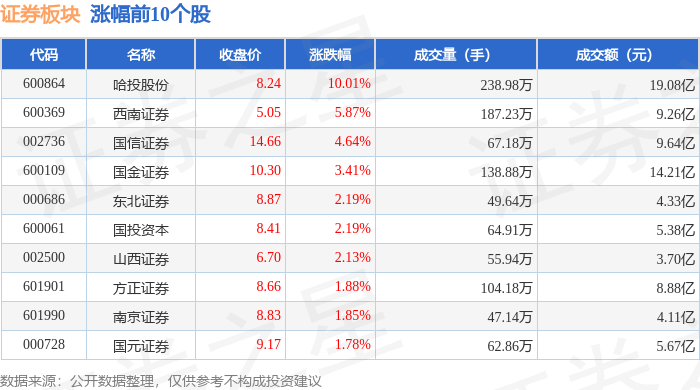
证券板块8月20日涨1.07%,哈投股份领涨,主力资金净流出24.23亿元
Zheng Xing Xing Ye Ri Bao· 2025-08-20 08:44
Market Overview - On August 20, the securities sector rose by 1.07%, with Haotou Co., Ltd. leading the gains [1] - The Shanghai Composite Index closed at 3766.21, up 1.04%, while the Shenzhen Component Index closed at 11926.74, up 0.89% [1] Individual Stock Performance - Haotou Co., Ltd. (600864) closed at 8.24, up 10.01% with a trading volume of 2.39 million shares and a turnover of 1.908 billion [1] - Southwest Securities (600369) closed at 5.05, up 5.87% with a trading volume of 1.87 million shares and a turnover of 926 million [1] - Guosen Securities (002736) closed at 14.66, up 4.64% with a trading volume of 671,800 shares and a turnover of 964 million [1] - Other notable performers include Guojin Securities (600109) up 3.41%, Dongbei Line (000686) up 2.19%, and Guotou Capital (600061) also up 2.19% [1] Fund Flow Analysis - The securities sector experienced a net outflow of 2.423 billion from institutional funds, while retail investors saw a net inflow of 2.438 billion [2] - Notable net inflows from retail investors were observed in Haotou Co., Ltd. and Guojin Securities, while significant outflows were noted in Southwest Securities and CITIC Securities [3] Summary of Key Stocks - Haotou Co., Ltd. had a net inflow of 266.1 million from institutional funds, while retail investors had a net outflow of 1.16 billion [3] - Guojin Securities saw a net inflow of 1.62 billion from institutional funds, with retail investors experiencing a net outflow of 1.06 billion [3] - CITIC Securities had a net inflow of 1.74 billion from retail investors, despite a net outflow of 3.13 billion from institutional funds [3]


策略解读:“慢长牛”需要具备哪些条件
Guoxin Securities· 2025-08-20 07:28
Group 1 - The report identifies the conditions necessary for a "slow bull market," emphasizing that a moderate increase in both volume and price is essential rather than high growth and low inflation as an ideal combination [4] - The common characteristics of slow bull markets in the US, India, and Japan include long holding periods for residents' stock assets and low turnover rates, with companies injecting funds into the market through stable dividends and buybacks exceeding IPOs and other financing methods [4][5] - The US stock market has shown a significant slow bull trend since 2013, with the S&P 500 index rising from approximately 1400 points in 2000 to 6380 points by August 2025, reflecting an annualized growth rate of about 8% [5] Group 2 - The Indian Sensex index has demonstrated extreme slow bull characteristics, starting from 3000 points in 2002 and reaching 80687 points by August 2025, resulting in a cumulative increase of 26 times and an annualized return of 15% [6] - Japan's Nikkei 225 index has also experienced a slow bull market since 2014, rising from 16000 points to 42050 points by August 2025, with an 11-year increase of 163% [6] - Economic growth rates during the slow bull periods show that India had the highest real GDP growth at 6.91% and nominal GDP growth at 12.39%, while the US and Japan had lower growth rates, indicating that high economic growth is not the sole necessary condition for a long bull market [8][10] Group 3 - The report highlights that inflation levels during slow bull markets vary, with India experiencing higher inflation rates compared to the US and Japan, suggesting that moderate inflation can be beneficial for stock markets [14] - The transition from a financing market to an investment market is crucial for the prosperity of long-term slow bull markets, with earnings growth and dividend income becoming increasingly significant over time [21][22] - The report emphasizes the importance of residents' asset allocation preferences and willingness to invest in stocks, noting that these factors are closely linked to the performance of stock markets in developed economies like the US and Japan [15][18]
金麒麟最佳投顾评选周榜丨股票组国信证券廖子槐周收益超20%居首位(全名单)
Xin Lang Zheng Quan· 2025-08-20 05:33
Core Insights - The second "Golden Unicorn Best Investment Advisor" selection has officially commenced, aiming to identify outstanding investment advisors in wealth management [1] - The competition includes various categories such as stock simulation trading, ETF simulation trading, public fund simulation allocation, and social service evaluation [1] - The weekly ranking data from August 11 to August 17 shows significant performance among investment advisors, with top performers achieving high weekly returns [1] Stock Simulation Trading - The top three investment advisors in stock simulation trading are: - Liao Zihai from Guo Xin Securities with a weekly return of 20.72% - Zhu Hongpei from Guo Jin Securities with a weekly return of 20.65% - Fan Yinan from Heng Tai Securities with a weekly return of 20.32% [2] ETF Simulation Trading - In the ETF simulation trading category, the top three advisors are: - Wu Yinchao from Cai Tong Securities with a weekly return of 10.36%, marking his third consecutive week at the top - Wang Wenyu from Zhong Tai Securities with a weekly return of 9.64% - Chen Jiecun from Yue Kai Securities with a weekly return of 9.62% [3][4] Public Fund Simulation Allocation - The leading advisors in public fund simulation allocation are: - Yang Hanhui from Zhong Yin Securities with a weekly return of 9.70% - Hong Xiaowei from Fang Zheng Securities with a weekly return of 8.53% - Wu Dayao from Guo Yuan Securities with a weekly return of 8.50% [5][6] Social IP Service Evaluation - In the social IP service evaluation, the top three advisors are: - Li Hui from Xi Bu Securities - Lin Doucan from Hua Yuan Securities - Wang Hantang from Hua An Securities [7]

国信证券李斌:投顾业务应把握当下多元化资产配置与AI赋能趋势
Xin Lang Zheng Quan· 2025-08-20 03:06
Group 1 - The "Second Jin Qilin Best Investment Advisor Selection" event is organized by Sina Finance and exclusively partnered with Yinhua Fund, highlighting the growing resilience of China's capital market and the high growth cycle of the wealth management industry [1] - Investment advisors play a crucial role in wealth management, impacting the asset allocation process for the public through their ability to reach, communicate with, and serve clients [1] - The event aims to provide a platform for investment advisors to showcase their capabilities, expand their services, and enhance their skills, thereby promoting the healthy development of China's wealth management industry [1] Group 2 - Li Bin, General Manager of the Wealth Management and Institutional Business Department at Guosen Securities, emphasizes the long-term opportunities in equity market allocation and the historical transformation from single stock trading to diversified asset allocation [2] - The investment advisory industry is experiencing both total expansion and structural adjustment, with a call for professionals to embrace opportunities and leverage AI while focusing on client-centered services [2] - The goal is to achieve significant advancements in the wealth management and investment advisory sectors, creating more value for investors and contributing to a new chapter in the industry [2]
国信证券张立超、王开:构筑新质生产力投资框架体系
Zhong Guo Zheng Quan Bao· 2025-08-19 23:29
Group 1: Core Concepts of New Quality Productivity - New quality productivity is a key engine driving high-quality economic development in China, representing a deep integration of technological innovation and industrial upgrading [1][2] - The concept emphasizes the cultivation of strategic emerging industries such as new energy, new materials, advanced manufacturing, and electronic information, aiming to enhance new development momentum [2][3] - The transition to new quality productivity marks a significant improvement in total factor productivity, driven by technological innovation and the restructuring of industrial value chains [3][4] Group 2: Development Pathways for Enterprises - Enterprises are the main practitioners of new quality productivity, focusing on upgrading traditional industries and strategically positioning emerging industries [4][5] - Traditional industries are essential for economic development and serve as a fertile ground for new quality productivity, while emerging industries inject new momentum into economic growth [7][8] - The development of commercial aerospace exemplifies the transition from government-led initiatives to commercial operations, highlighting the rapid growth of the industry in China [7][9] Group 3: Regional Development Strategies - Different regions in China should adopt tailored approaches to develop new quality productivity based on their resource endowments and industrial foundations [8][9] - The Guangdong-Hong Kong-Macao Greater Bay Area is a key region for cultivating new quality productivity, characterized by a complete industrial system and strong economic complementarity [9][10] - Major cities like Beijing, Shanghai, and Guangdong are focusing on specific industries such as integrated circuits, smart connected vehicles, and advanced manufacturing to drive regional economic growth [8][9] Group 4: Investment Opportunities - Investment strategies should focus on sectors that integrate digital and traditional economies, emerging industries with rapid market penetration, and future industries with technological breakthroughs [10] - The importance of selecting the right market segments is emphasized, with attention to opportunities in information technology, finance, and industrial sectors [10]
菲菱科思: 国信证券股份有限公司关于深圳市菲菱科思通信技术股份有限公司2025年半年度持续督导跟踪报告
Zheng Quan Zhi Xing· 2025-08-19 16:34
关于发行人股份锁定、减持意向的承诺 是 不适用 关于稳定公司股价的承诺 是 不适用 关于首次公开发行股票并上市招股说明书不存在 是 不适用 虚假记载、误导性陈述或者重大遗漏的承诺函 关于欺诈发行上市的股份回购承诺 是 不适用 关于填补被摊薄即期回报的措施及承诺 是 不适用 关于利润分配政策的承诺 是 不适用 关于规范和减少关联交易的承诺函 是 不适用 关于公司经营管理有关事项的声明承诺函 是 不适用 关于履行公开承诺约束措施的承诺 是 不适用 关于避免同业竞争的承诺函 是 不适用 股东信息披露专项承诺 是 不适用 关于发行申请文件真实性、准确性、完整性的承诺 是 不适用 函 其他承诺 是 不适用 四、其他事项 报告事项 说明 人或者其保荐的公司采取监管措施的事 无 项及整改情况 (本页无正文,为《国信证券股份有限公司关于深圳市菲菱科思通信技术股份有 限公司 2025 年半年度持续督导跟踪报告》之签字盖章页) 保荐代表人: 周 浩 杨家林 国信证券股份有限公司 年 月 日 施 公司及股东承诺事项 原因及解决措 承诺 | 国信证券股份有限公司 | | --- | | 关于深圳市菲菱科思通信技术股份有限公司 | | ...
基金托管牌照热度骤降:券商申请潮退,市场格局生变
Sou Hu Cai Jing· 2025-08-19 16:19
Core Viewpoint - The enthusiasm for fund custody licenses has significantly decreased, with only three institutions currently applying for such qualifications, indicating a shift from a broad accessibility to a focus on leading players in the securities industry [1][2][3]. Summary by Sections Current Applications and Trends - As of now, only three institutions are in line to apply for fund custody qualifications: Mongolian Merchants Bank, Guangzhou Bank, and Dongwu Securities, with the latter being the only remaining brokerage firm [2]. - Previously, there were seven brokerages, including Western Securities, Caixin Securities, and others, that had applied for fund custody qualifications, but six have withdrawn their applications within a year [2][3]. Regulatory Changes - The decline in applications is attributed to new regulatory measures that have raised the entry barriers for fund custody licenses, making it difficult for smaller brokerages to meet the requirements [3][4]. - The new regulations, set to be implemented in 2025, include stricter compliance and risk management standards, requiring applicants to have a regulatory rating of at least level 2 or A class and a minimum net asset requirement of 50 billion RMB for banks and 30 billion RMB for securities firms [4]. Market Dynamics - The fund custody business is undergoing a transformation from a focus on scale to a focus on quality, with resources increasingly concentrating among leading firms [3][5]. - The number of qualified institutions has been reported at 66, with a significant portion being larger brokerages, indicating a trend where smaller firms may struggle to compete [6]. Future Outlook - The market is expected to see increased concentration, with stronger firms gaining market share due to higher entry barriers and a more rigorous exit mechanism [7]. - The business model for fund custody is anticipated to evolve from basic services to high-value comprehensive services, emphasizing technology and risk management capabilities [7]. - A differentiated market structure is likely to emerge, where leading brokerages may establish specialized subsidiaries for refined operations, while smaller firms may pivot to providing outsourced services [7].


