
YanKershop(002847)

Search documents
休闲食品板块7月31日跌2.25%,西麦食品领跌,主力资金净流出1.41亿元
Zheng Xing Xing Ye Ri Bao· 2025-07-31 08:36
| 代码 | 名称 | 收盘价 | 涨跌幅 | 成交量(手) | 成交额(元) | | --- | --- | --- | --- | --- | --- | | 002956 | 西麦食品 | 20.51 | -6.39% | 8.22万 | 1.73亿 | | 002695 | 煌上煌 | 13.18 | -6.33% | 34.35万 | 4.69 Z | | 300973 | 立高食品 | 44.90 | -3.57% | 2.12万 | 9647.17万 | | 002847 | 盐津铺子 | 68.08 | -3.36% | - 3.02万 | 2.08亿 | | 002719 | 麦脚尔 | 9.36 | -2.70% | 12.44万 | 1.18亿 | | 003000 | 劲仔食品 | 12.65 | -2.54% | 13.40万 | 1.71亿 | | 002991 | 甘源食品 | 55.80 | -2.53% | 1.59万 | 8967.29万 | | 603866 | 桃李面包 | 5.49 | -2.49% | 21.41万 | 1.18亿 | | 603517 | 绝味食品 ...




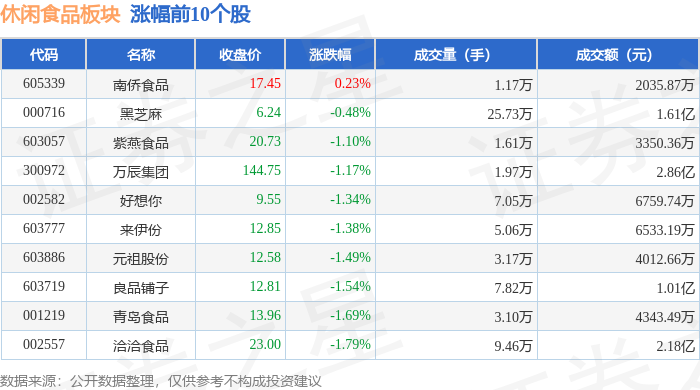
休闲食品板块7月30日涨1.6%,西麦食品领涨,主力资金净流入9564.51万元
Zheng Xing Xing Ye Ri Bao· 2025-07-30 08:26
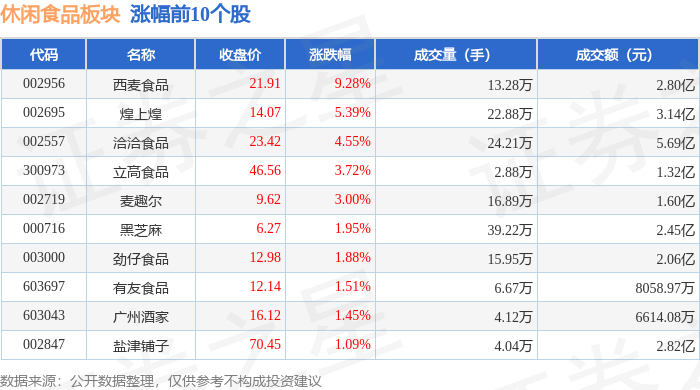
证券之星消息,7月30日休闲食品板块较上一交易日上涨1.6%,西麦食品领涨。当日上证指数报收于 3615.72,上涨0.17%。深证成指报收于11203.03,下跌0.77%。休闲食品板块个股涨跌见下表: | 代码 | 名称 | 收盘价 | 涨跌幅 | 成交量(手) | 成交额(元) | | | --- | --- | --- | --- | --- | --- | --- | | 002956 | 西麦食品 | 21.91 | 9.28% | 13.28万 | | 2.80 Z | | 002695 | 煌上煌 | 14.07 | 5.39% | 22.88万 | | 3.14亿 | | 002557 | 治治食品 | 23.42 | 4.55% | 24.21万 | | 5.69 Z | | 300973 | 立高食品 | 46.56 | 3.72% | 2.88万 | | 1.32亿 | | 002719 | 麦脚尔 | 9.62 | 3.00% | 16.89万 | | 1.60亿 | | 000716 | 黑芝麻 | 6.27 | 1.95% | 39.22万 | | 2.45亿 | | 00300 ...


短线防风险 89只个股短期均线现死叉
Zheng Quan Shi Bao Wang· 2025-07-29 08:53
Core Points - The Shanghai Composite Index closed at 3609.71 points, with a change of 0.33%, and the total trading volume of A-shares reached 1829.309 billion yuan [1] Group 1: Stock Performance - A total of 89 A-shares experienced a death cross, where the 5-day moving average fell below the 10-day moving average [1] - Notable stocks with significant distance between their 5-day and 10-day moving averages include Ruibeika (-1.54%), Haida Group (-0.92%), and Yanjinpuzi (-0.86%) [1] Group 2: Individual Stock Data - Ruibeika (600439) saw a decline of 2.10% with a trading turnover of 7.07%, and its 5-day moving average was 3.51 yuan, while the 10-day moving average was 3.57 yuan, showing a distance of -1.54% [1] - Haida Group (002311) decreased by 0.63%, with a 5-day moving average of 55.65 yuan and a 10-day moving average of 56.16 yuan, indicating a distance of -0.92% [1] - Yanjinpuzi (002847) experienced a drop of 6.22%, with a 5-day moving average of 73.59 yuan and a 10-day moving average of 74.23 yuan, reflecting a distance of -0.86% [1]


休闲食品板块7月29日跌1.22%,盐津铺子领跌,主力资金净流出1.73亿元
Zheng Xing Xing Ye Ri Bao· 2025-07-29 08:34
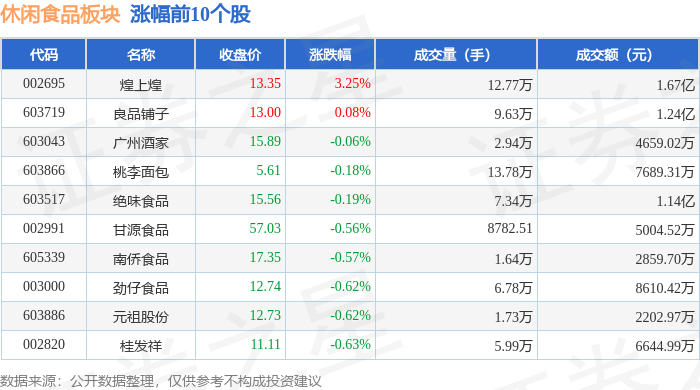
Market Overview - The leisure food sector experienced a decline of 1.22% on July 29, with Yanjinpuzi leading the drop [1] - The Shanghai Composite Index closed at 3609.71, up 0.33%, while the Shenzhen Component Index closed at 11289.41, up 0.64% [1] Individual Stock Performance - Huangshanghuang (002695) saw a price increase of 3.25%, closing at 13.35, with a trading volume of 127,700 shares and a turnover of 167 million yuan [1] - Yanjinpuzi (002847) reported a significant decline of 6.22%, closing at 69.69, with a trading volume of 50,100 shares and a turnover of 355 million yuan [2] - Other notable declines included Maquuer (002719) down 2.61% and Lihigh Food (300973) down 2.18% [2] Capital Flow Analysis - The leisure food sector saw a net outflow of 173 million yuan from institutional investors, while retail investors experienced a net inflow of 212 million yuan [2] - The capital flow for individual stocks showed varied trends, with Lihigh Food receiving a net inflow of 9.36 million yuan from institutional investors [3] - Conversely, Yanjinpuzi experienced a net outflow of 3.56 million yuan from institutional investors [3]


食饮:二季报前瞻及当前如何看待板块投资机会?
2025-07-29 02:10
Summary of Key Points from Conference Call Records Industry Overview - **Food and Beverage Sector**: The overall situation in the food and beverage sector is currently at a historical low in institutional holdings, with the food and beverage index declining for four consecutive years since 2021. The fundamentals and expectations are also at low levels, making it a potential time for bottom-fishing opportunities [2][3][4]. Key Insights and Arguments - **Snack Sector**: The snack sector is expected to rebound as new products are launched and the third quarter enters a peak sales season. Short-term data is anticipated to improve, with a significant verification point in Q1 2026 during the Chinese New Year, which is expected to show impressive growth due to a low base [1][3]. - **Konjac Products**: The konjac category continues to grow, with companies like Wei Long and Yan Jin adjusting their SKUs and channels, leading to short-term performance pressure. Yan Jin is expected to maintain a growth rate of 20-25% in the second half of the year [1][4]. - **Wan Chen Company**: The resignation of the chairman and the appointment of new management is seen as a positive development. The company is expected to open 1,000 to 2,000 new stores in the first half of the year, with a projected net profit of around 250 million RMB [1][5]. - **Frozen Food Sector**: The frozen food sector is under pressure, with Anji experiencing single-digit revenue growth and profit decline due to various factors including a ban on alcohol and price fluctuations. The company aims for close to 10% revenue growth in the second half of the year [1][7]. Additional Important Content - **Diverse Performance Among Snack Companies**: Companies like Yan Jin and Wei Long are performing well, while others like Gan Yuan are facing challenges due to channel changes. Gan Yuan's revenue is expected to remain flat or slightly decline, and the company is focusing on new product promotions [1][6]. - **Beer and Seasoning Sectors**: The beer sector faced challenges in Q2 due to external factors and a ban on alcohol, but cost reductions have helped maintain overall industry profits. Recommended companies include Yanjing, Zhujiang, and China Resources [2][9]. - **Dairy Sector**: The dairy sector is experiencing a high level of activity, driven by travel and hot weather. Companies like Yili and Mengniu are expected to show improved performance, with Yili's liquid milk revenue expected to remain stable [2][20]. - **Market Dynamics**: The market for soft drinks and dairy products is competitive, with companies like Nongfu Spring recovering from a low base and showing significant growth. The decline in PET prices is beneficial for profit margins [2][16][17]. Conclusion The food and beverage sector is currently navigating through a challenging environment, with varying performances across different categories. Opportunities for investment exist, particularly in the snack and dairy sectors, while caution is advised in the frozen food and beer sectors due to ongoing pressures.
食品饮料行业周报:板块情绪改善,关注潜在催化-20250728
Donghai Securities· 2025-07-28 15:34
Investment Rating - The report assigns an "Overweight" rating to the food and beverage industry, indicating that the industry index is expected to outperform the CSI 300 index by 10% or more over the next six months [1]. Core Insights - The food and beverage sector saw a 0.74% increase last week, underperforming the CSI 300 index by 0.95 percentage points, ranking 26th among 31 first-level sectors [12]. - The report highlights a rebound opportunity in the liquor sector, particularly for high-end and regional leading brands, as market sentiment improves and policy catalysts emerge [7][12]. - The beer sector is expected to recover this year, despite short-term disruptions from delivery platforms, with low inventory levels and favorable cost trends [7][12]. - The snack segment shows high growth potential, driven by strong categories and new channels, with specific products like konjac gaining popularity [7][12]. - The report emphasizes the importance of monitoring the dairy sector, where prices are stabilizing, and a potential turning point in raw milk prices is anticipated [7][12]. Summary by Sections 1. Market Performance - The food and beverage sector's performance last week was characterized by a 0.74% increase, with pre-processed foods and health products performing relatively well, rising by 1.97% and 1.88% respectively [12][17]. - The top five gainers included *ST Xifa, Jiaoda Anli, Huang Shang Huang, Tianyou Dejiu, and Tianrun Dairy, with increases ranging from 5.92% to 9.89% [12][17]. 2. Price Trends - As of July 27, 2024, the batch price for 2024 Moutai (scattered) was 1900 yuan, reflecting a weekly increase of 10 yuan and a monthly increase of 50 yuan [21]. - The beer production for June 2025 was reported at 4.12 million kiloliters, showing a year-on-year decrease of 0.2% [26]. 3. Industry Dynamics - The beverage manufacturing sector's profit decreased by 2.1% year-on-year in the first half of 2025, with total revenue reaching 814.69 billion yuan, a 1.9% increase [53]. - Jiangsu province's liquor production in the first half of 2025 was 81,700 kiloliters, down 15% year-on-year [53]. 4. Company Updates - Yanjing Beer announced a cash dividend of 1.90 yuan per 10 shares, totaling 536 million yuan, with the record date set for July 28 [55]. - Jiu Gui Jiu declared a cash dividend of 6.00 yuan per 10 shares, amounting to 195 million yuan, with the record date on July 30 [55].






光大证券食品饮料行业周报:白酒已处于深度价值区间,大众品积极变革-20250728
EBSCN· 2025-07-28 11:17
Investment Rating - The report maintains a "Buy" rating for the food and beverage industry [5]. Core Viewpoints - The liquor sector is currently in a deep value zone, with the CITIC liquor index showing a rebound and a dividend yield of 3.72% as of July 25, 2025, indicating strong profitability and willingness to distribute dividends [1][13]. - The restaurant supply chain is undergoing active transformation, with companies like Weizhi Xiang expanding their product categories and enhancing their sales channels, particularly in lower-tier cities [2][14]. - The snack food sector is focusing on steady growth in store openings and exploring new product categories, with companies like Wancheng Group adapting to market demands [3][15]. Summary by Sections Liquor Industry - The CITIC liquor index has seen a rebound, with a dividend yield of 3.72% as of July 25, 2025, placing it in a deep value zone [1][13]. - The cumulative net profit for the liquor sector is projected to reach 166.6 billion yuan in 2024, with a dividend payout ratio of 71% [1][13]. - The proportion of actively managed equity public funds holding liquor stocks has decreased to 5.1%, indicating significant clearing of positions [1][13]. - The market price of Moutai has dropped over 10% since the announcement of austerity measures, impacting confidence in the market [1][13]. Restaurant Supply Chain - Weizhi Xiang is actively transforming its channels, expanding product categories, and enhancing its online presence to boost sales [2][14]. - The company is also focusing on expanding into lower-tier cities and encouraging franchisees to open multiple stores [2][14]. - The B-end group meal channel has shown significant growth, with expectations for further expansion [2][14]. Snack Food Sector - Wancheng Group is maintaining a steady pace of store openings, with an increase in customer traffic despite a slight decline in average transaction value [3][15]. - The company is transitioning from rapid expansion to improving operational efficiency and brand building [3][15]. - New product categories are being explored, including collaborations with local suppliers for baked goods [3][15]. Investment Recommendations - The report suggests maintaining positions in dairy and snack sectors, recommending companies like Yili and Yanjinpuzi for core holdings [4][43]. - It also advises flexible trading in underperforming sectors with potential for recovery, such as Lihai Food and New Dairy [4][43]. - For the liquor sector, it recommends focusing on companies with better competitive positioning, such as Kweichow Moutai and Wuliangye [4][43].

食品饮料周报(25年第30周):第二季度白酒超配比例环比下降,关注板块中报业绩情况-20250728
Guoxin Securities· 2025-07-28 08:54
Investment Rating - The investment rating for the food and beverage sector is "Outperform the Market" [5][6][78]. Core Views - The report indicates a decrease in the allocation ratio for the liquor sector, reflecting weak fundamental expectations. The second quarter performance is expected to show demand pressure, with companies focusing on market health and inventory reduction [2][12][14]. - The beer and beverage sectors are entering a peak season, with stable performance from leading companies in basic condiments. The report recommends companies that are accelerating nationalization and platformization, such as Dongpeng Beverage [3][15][20]. - The report highlights three investment lines in the liquor sector: leading companies with strong risk resistance, companies showing digital transformation feedback, and those with market share growth potential [2][14]. Summary by Sections Liquor Sector - The liquor sector's allocation ratio has decreased, with the white liquor index rising by 1.0%. The allocation ratio for actively managed equity funds fell by 2.07 percentage points to 4.50% [2][14]. - Key recommendations include Guizhou Moutai, Shanxi Fenjiu, and Wuliangye, which have shown strong dividend yields and growth potential [2][14]. Consumer Goods - The beer sector is experiencing a slight decrease in fund allocation, with Yanjing Beer seeing an increase in its fund holding ratio. The report recommends Yanjing Beer due to its ongoing internal reforms [3][15]. - The snack sector has seen a significant increase in fund allocation, particularly for Salted Fish and Wancheng Group. The report recommends products with high growth potential, such as those from Weilong and Salted Fish [3][16]. - In the condiment sector, leading companies like Haitian Flavoring are expected to perform steadily, with a focus on mid-year performance [3][17]. Frozen Foods and Dairy - The frozen food sector is stable, with companies actively developing new products to adapt to market demands. Recommendations include Anjui Foods and Qianwei Central Kitchen [3][18]. - The dairy sector is expected to recover gradually, with policies stimulating demand. The report suggests focusing on leading dairy companies with a safety margin in valuations [3][19]. Beverage Sector - The beverage sector is entering a peak season, with significant growth in no-sugar tea and energy drinks. Dongpeng Beverage is highlighted for its strong performance, with a reported revenue increase of 36% year-on-year [3][20].


食品饮料行业专题:新消费研究之二:中国餐饮供应链效率革命:食材预制化与餐饮零食化的双轮驱动
Guoxin Securities· 2025-07-25 11:48
Investment Rating - The report maintains an "Outperform" rating for the food and beverage industry [4][5]. Core Insights - The Chinese restaurant supply chain is undergoing an efficiency revolution driven by the pre-preparation of ingredients and the snackification of dining [1][14]. - The market for the restaurant supply chain is substantial, estimated at approximately 2.4 trillion yuan, with a projected compound annual growth rate (CAGR) of about 9% from 2019 to 2023 [2][50]. - The report highlights the need for a more efficient supply chain system to address the challenges faced by traditional food supply chains, which include high costs, low quality, and lack of standardization [1][23]. Summary by Sections 1. Industry Overview - The restaurant industry in China is expected to reach a market size of 5.57 trillion yuan by 2024, with a year-on-year growth of 5.3% [13]. - The current restaurant market is predominantly composed of small and medium-sized operators, with a chain rate of approximately 20.1% projected for 2024 [1][16]. 2. Direction One: Ingredient Pre-Preparation - Ingredient pre-preparation is seen as a key driver for standardization in the restaurant supply chain, with a market size of around 2.39 trillion yuan in 2023 [2][50]. - The industry is in the early stages of development, with a projected 890,000 production and processing enterprises by April 2025 [2][50]. - Companies like Anjij and Sanquan have established national production capacity barriers, enhancing their competitive edge [2][51]. 3. Direction Two: Snackification of Dining - The trend of snackification reflects a shift in consumer behavior towards more fragmented and personalized food consumption [2][56]. - Emerging channels such as community supermarkets and convenience stores have seen significant growth rates of 10%, 11%, and 76% respectively in 2023 [2]. - The report notes that the demand for ready-to-eat products has increased, with categories like crayfish and marinated snacks leading the way [2]. 4. Comparison with Overseas Markets - The U.S. restaurant supply chain market was valued at approximately $382 billion in 2022, with Sysco achieving revenues of $78.8 billion in 2024 through extensive acquisitions [3][14]. - Japan's frozen food industry has reached maturity, with companies like Kobe Bussan achieving a 12% revenue CAGR through vertical integration [3][14]. 5. Investment Recommendations - The report recommends several companies for investment, including Anjij Food, Qianwei Central Kitchen, Lihigh Food, Weilong Delicious, and Yanjinpuzi [3][4].
食品饮料行业深度报告:2025Q2基金食品饮料持仓分析:持仓处于低位,白酒明显减配
Soochow Securities· 2025-07-22 09:33
Investment Rating - The report maintains an "Increase" rating for the food and beverage industry, with a specific focus on the beverage sector and new consumer retail [1]. Core Insights - The food and beverage sector has seen a decline in holdings, primarily due to a significant reduction in the allocation to liquor, particularly high-end brands [10][11]. - The report emphasizes a shift towards consumer staples and highlights the resilience of leading companies in the beverage sector [28]. Summary by Sections 1. Decline in Food and Beverage Holdings - As of Q2 2025, the proportion of active equity funds in the food and beverage sector decreased to 5.5%, down 1.82 percentage points from Q1 2025 [10][14]. - The decline in liquor holdings is attributed to ongoing pressure on the liquor market, with a notable drop in the allocation to high-end liquor brands [11][12]. 2. Liquor Sector Adjustments - The allocation to liquor decreased by 1.96 percentage points to 3.98% in Q2 2025, with major consumer funds showing a significant reduction in liquor holdings [12][18]. - The report identifies a trend of reduced holdings in high-end liquor brands such as Kweichow Moutai and Wuliangye, while some consumer staples have seen increased allocations [23][28]. 3. Investment Recommendations - The report suggests focusing on five key sectors: beverages, new consumer retail, dairy, liquor, and health products [28]. - Specific recommendations include buying opportunities in Kweichow Moutai, Luzhou Laojiao, Shanxi Fenjiu, and Wuliangye, as the market adjusts to current conditions [28].
