
YanKershop(002847)

Search documents
盐津铺子(002847) - 湖南启元律师事务所关于公司2025年限制性股票激励计划授予事项的法律意见
2026-01-20 12:46
湖南启元律师事务所 关于盐津铺子食品股份有限公司 2025 年限制性股票激励计划授予事项的 法律意见书 2026 年 1 月 湖南启元律师事务所 关于盐津铺子食品股份有限公司 2025年限制性股票激励计划授予事项的 法律意见书 致:盐津铺子食品股份有限公司 湖南启元律师事务所(以下简称"本所")接受盐津铺子食品股份有限公司(以 下简称"公司"或"盐津铺子")的委托,作为公司2025年限制性股票激励计划(以 下简称"本次激励计划"或"激励计划")的专项法律顾问,为公司本次激励计划提 供专项法律服务。 本所律师根据《中华人民共和国公司法》(以下简称"《公司法》")、《中 华人民共和国证券法》(以下简称"《证券法》")、《上市公司股权激励管理办 法》(以下简称"《管理办法》")、《深圳证券交易所上市公司自律监管指南第 1号——业务办理》的规定等现行法律、法规和规范性文件以及《盐津铺子食品 股份有限公司章程》(以下简称"《公司章程》")、《盐津铺子食品股份有限公 司2025年限制性股票激励计划(草案)》(以下简称"《激励计划(草案)》") 的有关规定,按照律师行业公认的业务标准、道德规范和勤勉尽责精神,就公司 本次激 ...
盐津铺子(002847) - 第四届董事会第二十二次会议决议公告
2026-01-20 12:45
证券代码:002847 证券简称:盐津铺子 公告编号:2026-007 3、本次会议应出席董事人数 8 人,实际出席董事人数 8 人。 4、本次董事会由董事长张学武先生主持,本次会议的召开和表决程序符合 《中华人民共和国公司法》等法律法规和《公司章程》的有关规定。 二、董事会会议审议情况 经与会董事认真审议并表决,一致通过了如下议案: 1、审议通过了《关于向激励对象授予限制性股票的议案》 盐津铺子食品股份有限公司 第四届董事会第二十二次会议决议公告 本公司及董事会全体成员保证信息披露的内容真实、准确、完整, 没有虚假记载、误导性陈述或重大遗漏。 一、董事会会议召开情况 1、本次董事会由董事长张学武先生召集,会议通知于 2026 年 1 月 16 日通 过电子邮件、电话的形式送达各位董事,董事会会议通知中包括会议的相关材料, 同时列明了会议的召开时间、地点、内容和方式。 2、本次董事会于 2026 年 1 月 20 日 15:00 采取通讯表决的方式召开。 表决结果:赞成票 5 票;反对票 0 票;弃权票 0 票。 公司董事会薪酬与考核委员会已按规定审议并通过本议案。 三、备查文件(以下无正文) 1、第四届董事 ...
盐津铺子(002847) - 董事会薪酬与考核委员会关于公司2025年限制性股票激励计划授予激励对象名单(授予日)的核查意见
2026-01-20 12:45
盐津铺子食品股份有限公司 盐津铺子食品股份有限公司董事会薪酬与考核委员会 关于公司2025年限制性股票激励计划授予激励对象名单的核查意见 盐津铺子食品股份有限公司(以下简称"公司")董事会薪酬与考核委员会 根据《中华人民共和国公司法》(以下简称"公司法")《中华人民共和国证券 法》(以下简称"证券法")《上市公司股权激励管理办法》(以下简称"管理 办法")《深圳证券交易所股票上市规则》(以下简称"上市规则")等相关规 章制度的有关规定,对公司《2025 年限制性股票激励计划(草案)》(以下简 称"激励计划(草案)")的授予条件是否成就及激励对象是否符合授予条件进 行核实后,现发表核查意见如下: 1、公司不存在《管理办法》等法律法规和规范性文件规定的禁止实施股权 激励计划的情形,包括:(1)最近一个会计年度财务会计报告被注册会计师出 具否定意见或者无法表示意见的审计报告;(2)最近一个会计年度财务报告内 部控制被注册会计师出具否定意见或无法表示意见的审计报告;(3)上市后最 近 36 个月内出现过未按法律法规、公司章程、公开承诺进行利润分配的情形; (4)法律法规规定不得实行股权激励的;(5)中国证监会认定的其 ...
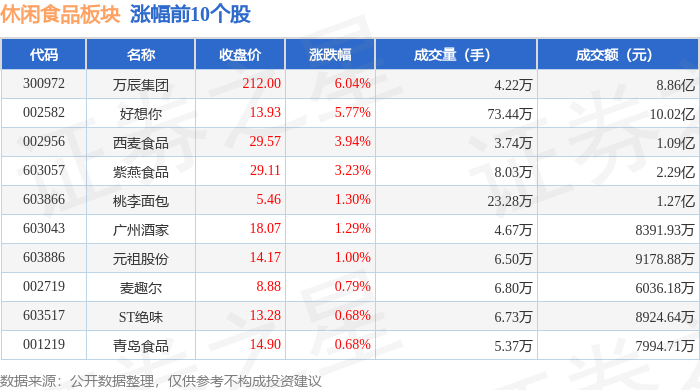
休闲食品板块1月20日涨1.54%,万辰集团领涨,主力资金净流出6030.19万元
Zheng Xing Xing Ye Ri Bao· 2026-01-20 08:51
Group 1 - The leisure food sector increased by 1.54% on January 20, with Wancheng Group leading the gains [1] - The Shanghai Composite Index closed at 4113.65, down 0.01%, while the Shenzhen Component Index closed at 14155.63, down 0.97% [1] - Key stocks in the leisure food sector showed significant price movements, with Wancheng Group rising by 6.04% to a closing price of 212.00 [1] Group 2 - The leisure food sector experienced a net outflow of 60.30 million yuan from institutional investors, while retail investors saw a net inflow of 75.82 million yuan [2] - Notable declines were observed in stocks such as Three Squirrels, which fell by 2.07% to a closing price of 24.58 [2] - The trading volume and turnover for various stocks in the sector varied, with significant activity noted in stocks like Haoxiangni and Ximai Food [2] Group 3 - Haoxiangni had a net inflow of 79.89 million yuan from institutional investors, while it faced a net outflow of 78.76 million yuan from retail investors [3] - Ximai Food also saw a net inflow of 10.14 million yuan from institutional investors, with retail investors experiencing a net outflow [3] - The data indicates varying levels of investor interest across different stocks within the leisure food sector, highlighting the dynamics of institutional versus retail investment [3]



食品饮料行业:月聚焦:如何布局零食“春季躁动”?
GF SECURITIES· 2026-01-20 06:14
Group 1 - The report highlights the "Spring Excitement" in the snack sector, indicating a historical high relative win rate of 70% for the food and beverage sector in the 40 days leading up to the Spring Festival [7][16] - The report emphasizes that the "Spring Excitement" is not solely dependent on the annual beta of the food and beverage sector, as structural opportunities still exist despite a long-term adjustment period since 2021 [7][16] - Key catalysts for the upcoming Spring Festival include concentrated demand for gifts and gatherings, which leads to more planned channel stocking, creating a positive feedback loop of expectations and validations [7][16][28] Group 2 - In December, the food and beverage sector underperformed the market by 7.5 percentage points, with a decline of 5.2%, ranking last among 31 primary industries [7][61] - The report notes a divergence in performance among sub-sectors, with snacks and soft drinks showing gains while liquor and beer experienced declines [7][61][64] - The absolute and relative valuations of the food and beverage sector are at their lowest since 2010, indicating potential investment opportunities [7][61][64] Group 3 - The report tracks the recovery of consumer confidence, with a 0.9% year-on-year increase in retail sales in December, showing improvement from the previous month [7][63] - It highlights that the liquor sector is facing weak demand and declining prices, with the price adjustments for premium liquor nearing levels seen between 2011 and 2015 [7][63][64] - The report identifies structural differentiation in costs, with some packaging materials and agricultural products experiencing price increases [7][63][64] Group 4 - Investment recommendations include a focus on liquor stocks that have undergone a four-year adjustment period, with potential for a "valuation + performance" double bottom [7][64] - For consumer goods, the report anticipates a moderate increase in industry prices in 2026, with specific recommendations for companies like Anjuke Foods, Qianhe Flavor, and Eastroc Beverage [7][64] - The report suggests that the upcoming Spring Festival will provide a favorable environment for growth narratives, particularly in the restaurant supply chain and certain chain formats [7][64]






未知机构:东吴食饮苏铖团队0120Q1消费看大众旺季零食闪亮餐饮餐供季节性饮-20260120
未知机构· 2026-01-20 02:25
Summary of Conference Call Notes Industry Overview - The focus is on the consumer sector, particularly in the food and beverage industry, highlighting a seasonal uptick in demand during spring [1][2]. - The report emphasizes the recovery of service consumption, particularly in the restaurant and food supply sectors, supported by government initiatives to boost consumer spending [2]. Key Companies and Recommendations - **Snack Food Companies**: - Recommended leading snack brands include Wanchen Group, Yanjinpuzi, Weilong, Youyou, and Ganyuan [1][2]. - **Restaurant Supply Chain**: - Key players include Babi, Anjins, Guoquan, and Yihai International, along with Baoli Foods and Lihai Foods [1][2]. - **Beverage Companies**: - Notable recommendations are Yangyuan Beverage and Dongpeng Beverage [1][2]. Company-Specific Insights - **Babi**: Focused on diversified growth strategies to recreate its business model [2]. - **Anjins**: Confirming a bottoming out phase and restarting growth initiatives [2]. - **Guoquan**: Demonstrating a resilient business model with accelerated store openings [2]. Market Trends and Predictions - Historical data indicates that Q1 typically shows positive performance for many restaurant companies, with factors such as market profitability, delayed corporate events, and favorable seasonal reporting expected to drive growth in Q1 2026 [3]. - The report anticipates a multi-factor resonance effect in Q1 2026, which may positively impact metrics like customer spending, same-store sales, and table turnover rates [3]. Government Initiatives - The government has implemented a series of fiscal and financial policies aimed at stimulating domestic demand, which includes measures to clear overdue payments to businesses and ensure wage payments to migrant workers [2]. Additional Insights - The report highlights the cyclical nature of the consumer sector and its role as a leader in consumption recovery, with key companies showing continued improvement [4]. - Emphasis on valuation switching as a strategy to recommend high-quality stocks such as Ximai, Babi, Guoquan, and Yanjinpuzi [4].





食品饮料行业掘金系列专题报告(一):挖掘成本红利,把握优质龙头的盈利改善机会
Guoxin Securities· 2026-01-19 12:26
Investment Rating - The report maintains an "Outperform" rating for the food and beverage industry [5][4]. Core Insights - The report emphasizes the importance of cost fluctuations as a significant factor affecting short-term performance in the consumer goods sector, where operating costs account for approximately 70% of revenue [12][13]. - Historical analysis indicates that material cost declines typically occur during commodity bear markets or due to supply-demand changes in specific agricultural products [17][18]. - The effective transmission of cost benefits to company performance is often non-linear, influenced by market competition, demand stability, and cost control capabilities [24][25]. Summary by Sections Cost Decline Impact on Consumer Goods - Cost fluctuations are crucial for short-term performance, with material costs making up 65%-85% of operating costs [12][13]. - Cost benefits are most effectively realized when competition is stable, demand is not shrinking, and companies have strong cost management [24][25]. 2026 Cost Benefits: Sunflower Seeds and Konjac Snacks - Sunflower seed prices are expected to decline in 2026, benefiting leading companies like Qiaqia Food, which derives over 60% of its revenue from sunflower seeds [33][34]. - The konjac powder price is projected to decrease by 10%-20% in 2026, positively impacting leading companies such as Weidong Delicious and Yanjinpuzi, which have significant revenue contributions from konjac snacks [45][46]. Company Profit Forecasts and Investment Ratings - Qiaqia Food is expected to see a profit recovery due to lower sunflower seed costs, with projected revenues of 6,810 million in 2025 and a net profit of 382 million [44]. - Weidong Delicious is anticipated to achieve revenues of 7,403 million in 2025, with a net profit of 1,420 million, benefiting from a strong brand presence in the konjac market [56]. - Yanjinpuzi is also expected to see positive contributions to its overall margin from declining konjac powder prices, with a projected revenue increase [56].
公司回购策略周报-20260119
Yuan Da Xin Xi· 2026-01-19 12:05
Group 1: Drivers of Excess Returns from Stock Buybacks - Stock buybacks are positively correlated with the buyback ratio, where higher buyback ratios lead to greater excess returns. The highest excess returns for companies with buyback ratios over 5% are 4.48% and 4.36% for the 5th and 4th groups, respectively, while other groups yield less than 1.5% [1][11] - The valuation logic of "stronger gets stronger" and "undervaluation recovery" exists post-buyback announcement. Companies with low valuation (1st group) show a significant excess return of 7.45%, while the highest and lowest valuation groups yield 3.32% and 2.11% excess returns, respectively, over 90 days post-announcement [1][13] Group 2: Recent Stock Buyback Activities - From January 12 to January 16, 2026, 16 companies with more than 10 institutional ratings announced buybacks, with Salted Fish (盐津铺子) being notable for a buyback ratio exceeding 1%. Proya (珀莱雅) is recommended for its low PE percentile over the past three years [2][17] - Salted Fish efficiently completed its buyback, demonstrating strong confidence in its value, with revenue of 4.427 billion and net profit of 605 million in the first three quarters of 2025. The company is upgrading its distribution channels and enhancing profitability [2][19] - Proya initiated its first buyback on January 15, 2026, repurchasing 230,800 shares with a total plan amounting to 80 million to 150 million. The company reported revenue of 7.098 billion and net profit of 1.026 billion in the first three quarters of 2025, with a gross margin of 73.69% [2][19] Group 3: Yearly Stock Buyback Overview - From January 16, 2025, to January 16, 2026, 28 companies with more than 10 institutional ratings announced buybacks, with notable mentions being Jian Sheng Group (健盛集团) and Jingxin Pharmaceutical (京新药业) for buyback ratios exceeding 5% [3][20] - Jian Sheng Group initiated a buyback plan in October 2025, using 150 million to 300 million in self-funds and loans, with a maximum buyback price of 14.69 per share. The company reported revenue of 1.886 billion and net profit of 309 million in the first three quarters of 2025, with a significant cash flow increase of 72.95% [3][23] - Jingxin Pharmaceutical started its buyback plan in January 2025, planning to use 350 million to 700 million in self-funds for employee stock ownership plans. The company reported revenue of 3.048 billion, a slight decline of 5.0%, and a net profit of 576 million, with a non-recurring net profit growth of 8.92% [3][23]


休闲食品板块1月19日涨3.01%,立高食品领涨,主力资金净流入1835.13万元
Zheng Xing Xing Ye Ri Bao· 2026-01-19 08:52
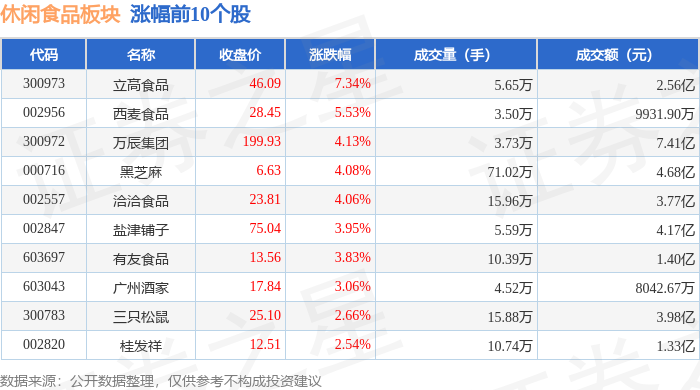
Group 1 - The leisure food sector increased by 3.01% on January 19, with Li Gao Food leading the gains [1] - The Shanghai Composite Index closed at 4114.0, up 0.29%, while the Shenzhen Component Index closed at 14294.05, up 0.09% [1] - Key stocks in the leisure food sector showed significant price increases, with Li Gao Food rising by 7.34% to a closing price of 46.09 [1] Group 2 - The leisure food sector experienced a net inflow of 18.35 million yuan from institutional investors, while retail investors contributed a net inflow of 18.64 million yuan [2] - Notable stocks included San Zhi Song Shu, which had a net inflow of 36.54 million yuan from institutional investors, despite a net outflow from retail investors [3] - The overall trading volume and turnover in the leisure food sector indicated active market participation, with significant movements in individual stock prices [1][2]

盐津铺子1月16日获融资买入938.78万元,融资余额1.45亿元
Xin Lang Cai Jing· 2026-01-19 01:28
Core Viewpoint - Salted Fish's stock performance shows a slight decline, with significant trading activity and notable financing and margin trading figures, indicating a mixed sentiment among investors [1][2]. Group 1: Stock Performance - On January 16, Salted Fish's stock fell by 0.67%, with a trading volume of 161 million yuan [1]. - The financing buy-in amount for Salted Fish on the same day was 9.39 million yuan, while the financing repayment was 9.69 million yuan, resulting in a net financing outflow of 298,500 yuan [1]. - As of January 16, the total financing and margin trading balance for Salted Fish was 147 million yuan [1]. Group 2: Financing and Margin Trading - The current financing balance for Salted Fish is 145 million yuan, accounting for 0.74% of its market capitalization, which is above the 70th percentile of the past year [1]. - On January 16, Salted Fish repaid 500 shares in margin trading and sold 200 shares, with a selling amount of 14,400 yuan based on the closing price [1]. - The margin trading balance is 1.99 million yuan, exceeding the 60th percentile of the past year [1]. Group 3: Company Overview - Salted Fish Food Co., Ltd. is located in Changsha, Hunan Province, and was established on August 4, 2005, with its IPO on February 8, 2017 [1]. - The company's main business includes research, production, and sales of snack foods and deep processing of agricultural products [1]. - The revenue composition of Salted Fish includes spicy snacks (44.91%), baked potato products (15.61%), dried fruits and jellies (14.56%), deep-sea snacks (12.33%), egg snacks (10.52%), and others (2.06%) [1]. Group 4: Financial Performance - As of September 30, the number of shareholders for Salted Fish reached 18,000, an increase of 65.13% compared to the previous period [2]. - The average circulating shares per person decreased by 39.44% to 13,663 shares [2]. - For the period from January to September 2025, Salted Fish achieved a revenue of 4.43 billion yuan, representing a year-on-year growth of 14.67%, and a net profit attributable to shareholders of 605 million yuan, up 22.63% year-on-year [2]. Group 5: Dividend and Institutional Holdings - Since its A-share listing, Salted Fish has distributed a total of 1.43 billion yuan in dividends, with 1.03 billion yuan distributed in the last three years [3]. - As of September 30, 2025, the largest circulating shareholder is Hong Kong Central Clearing Limited, holding 6.88 million shares, a decrease of 2.18 million shares from the previous period [3]. - Other notable institutional shareholders include Fu Guo Consumption Theme Mixed A and Fu Guo Value Creation Mixed A, with varying changes in their holdings [3].