SEAMILD FOODS(002956)

Search documents
菌落总数超标!“燕麦第一股”西麦再登市场监管总局抽检“黑榜”
Guo Ji Jin Rong Bao· 2026-01-21 12:03
Core Viewpoint - Ximai Food, known as "China's Oatmeal First Stock," has been flagged for non-compliance with microbial standards, following a previous incident of excessive mold levels in 2024, raising concerns about its product safety and quality control measures [1][7]. Group 1: Product Quality Issues - Ximai Food's "Middle-aged Nutritional Oatmeal" was found to have unacceptable total bacterial counts, exceeding the national food safety standards during a recent inspection of 2,136 samples, with 40 samples identified as non-compliant [2][4]. - The specific bacterial counts for the oatmeal samples were recorded as 34,000 CFU/g, 49,000 CFU/g, 18,000 CFU/g, 15,000 CFU/g, and 25,000 CFU/g, all surpassing the allowable limits [2][4]. - The company attributed the quality issues to improper management by a distributor, which has since terminated its partnership with Ximai [1][7]. Group 2: Historical Context and Recurrent Issues - This incident follows a previous case in late 2024 where another product, "High-Calcium Milk Oatmeal," was also flagged for excessive mold, with counts significantly exceeding the safety limit [7][8]. - Ximai has faced multiple quality control issues in the past, including a 2019 incident involving "Oatmeal Walnut Powder" due to mold contamination [8]. - The frequency of these quality problems coincides with Ximai's strategic push into the health market, which may undermine consumer trust and impact sales and partnerships [8]. Group 3: Regulatory and Market Implications - The National Market Supervision Administration indicated that such issues may stem from inadequate control over production and processing hygiene, as well as potential problems with packaging and storage conditions [4]. - As Ximai aims to establish a new growth trajectory focused on health products, the ongoing quality concerns could jeopardize its brand value, which is closely tied to food safety [8].

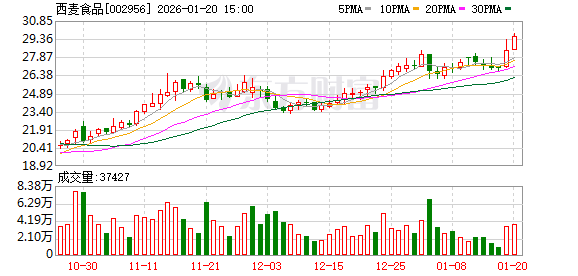
西麦食品:截至2026年1月20日股东户数为10652户
Zheng Quan Ri Bao Wang· 2026-01-21 10:45
证券日报网讯1月21日,西麦食品(002956)在互动平台回答投资者提问时表示,截至2026年1月20日, 公司股东户数为10652户。 ...
1批次西麦食品中老年营养燕麦片检出菌落总数超标
Bei Jing Shang Bao· 2026-01-20 12:25
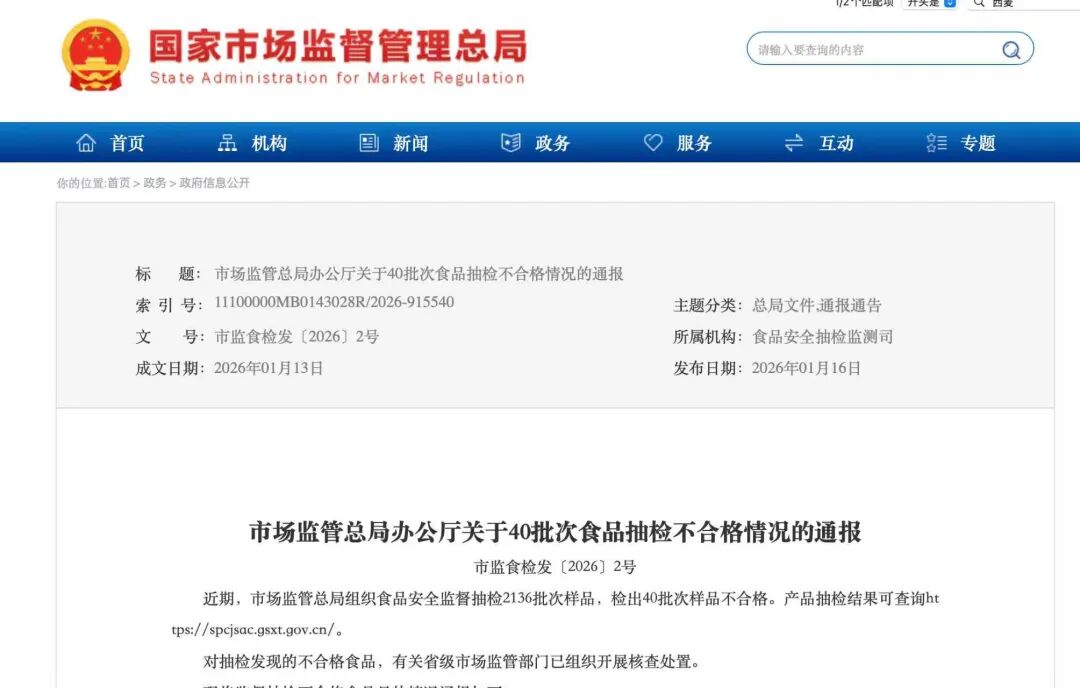
Group 1 - The market regulatory authority conducted a food safety supervision sampling, testing a total of 2,136 batches, with 40 batches found to be non-compliant [1] - One batch of oatmeal produced by Ximai Food was detected with excessive total bacterial count, failing to meet national food safety standards [1] - The specific product involved is a senior nutrition oatmeal (700g) produced by Hebei Ximai Food Co., Ltd., with a shelf life until June 25, 2024 [1] Group 2 - The local market regulatory departments have initiated investigations and actions regarding the non-compliant food products identified in the sampling [1] - Attempts to contact Ximai Food for further information were unsuccessful, as there was no response to phone inquiries [1]
1批次西麦食品中老年营养燕麦片检出菌落总数不合格
Xin Jing Bao· 2026-01-20 10:29
Group 1 - The core issue is that the State Administration for Market Regulation conducted a food safety inspection, revealing that out of 2,136 samples tested, 40 were found to be non-compliant, including a batch of oatmeal produced by Ximai Food [1] - The specific product in question is a senior nutrition oatmeal produced by Ximai Food, which was found to have excessive total bacterial counts, indicating potential hygiene issues during production [1] - Total bacterial count is an indicator of microbial quality rather than a direct pathogen indicator, reflecting the sanitary conditions during food production [1] Group 2 - The excessive total bacterial count can compromise the nutritional value of the food and accelerate spoilage, which may be attributed to inadequate control of hygiene conditions during production or improper packaging and storage [1] - Provincial market regulatory authorities have initiated investigations and actions regarding the non-compliant food products identified in the inspection [1] - Attempts to contact Ximai Food for further information regarding the non-compliance and subsequent actions were unsuccessful, as no one answered the provided contact number [1]
1批次燕麦片菌落总数超标!西麦食品:问题出现在经销商环节
Nan Fang Du Shi Bao· 2026-01-20 09:56
Core Viewpoint - A batch of Ximai Foods' senior nutrition oatmeal was found to exceed the total bacterial count limit, resulting in it being classified as an unqualified product by the State Administration for Market Regulation [2] Group 1: Product Quality Issue - The affected batch of oatmeal was produced by Ximai Foods Group in Guilin, Guangxi, and manufactured by Hebei Ximai Foods Co., Ltd., with a production date of June 25, 2024, and a shelf life of 18 months [2] - Ximai Foods has stated that the issue arose in the distribution channel rather than at the production level, and the company has cooperated with local regulatory authorities to address the situation [2] Group 2: Company Performance - Ximai Foods, established in 1994 and listed on the Shenzhen Stock Exchange in 2019, is recognized as the "first stock of oatmeal" [2] - The latest financial report indicates that for the first three quarters of 2025, the company's revenue increased by 18.34% year-on-year to 1.696 billion yuan, while the net profit attributable to shareholders rose by 21.90% to 132 million yuan [2]
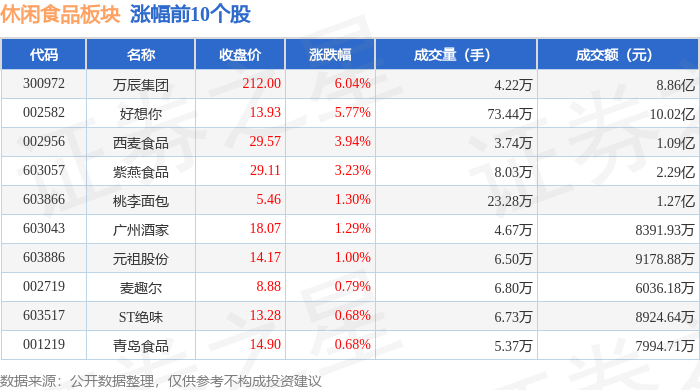
休闲食品板块1月20日涨1.54%,万辰集团领涨,主力资金净流出6030.19万元
Zheng Xing Xing Ye Ri Bao· 2026-01-20 08:51
Group 1 - The leisure food sector increased by 1.54% on January 20, with Wancheng Group leading the gains [1] - The Shanghai Composite Index closed at 4113.65, down 0.01%, while the Shenzhen Component Index closed at 14155.63, down 0.97% [1] - Key stocks in the leisure food sector showed significant price movements, with Wancheng Group rising by 6.04% to a closing price of 212.00 [1] Group 2 - The leisure food sector experienced a net outflow of 60.30 million yuan from institutional investors, while retail investors saw a net inflow of 75.82 million yuan [2] - Notable declines were observed in stocks such as Three Squirrels, which fell by 2.07% to a closing price of 24.58 [2] - The trading volume and turnover for various stocks in the sector varied, with significant activity noted in stocks like Haoxiangni and Ximai Food [2] Group 3 - Haoxiangni had a net inflow of 79.89 million yuan from institutional investors, while it faced a net outflow of 78.76 million yuan from retail investors [3] - Ximai Food also saw a net inflow of 10.14 million yuan from institutional investors, with retail investors experiencing a net outflow [3] - The data indicates varying levels of investor interest across different stocks within the leisure food sector, highlighting the dynamics of institutional versus retail investment [3]



食品饮料行业:月聚焦:如何布局零食“春季躁动”?
GF SECURITIES· 2026-01-20 06:14
Group 1 - The report highlights the "Spring Excitement" in the snack sector, indicating a historical high relative win rate of 70% for the food and beverage sector in the 40 days leading up to the Spring Festival [7][16] - The report emphasizes that the "Spring Excitement" is not solely dependent on the annual beta of the food and beverage sector, as structural opportunities still exist despite a long-term adjustment period since 2021 [7][16] - Key catalysts for the upcoming Spring Festival include concentrated demand for gifts and gatherings, which leads to more planned channel stocking, creating a positive feedback loop of expectations and validations [7][16][28] Group 2 - In December, the food and beverage sector underperformed the market by 7.5 percentage points, with a decline of 5.2%, ranking last among 31 primary industries [7][61] - The report notes a divergence in performance among sub-sectors, with snacks and soft drinks showing gains while liquor and beer experienced declines [7][61][64] - The absolute and relative valuations of the food and beverage sector are at their lowest since 2010, indicating potential investment opportunities [7][61][64] Group 3 - The report tracks the recovery of consumer confidence, with a 0.9% year-on-year increase in retail sales in December, showing improvement from the previous month [7][63] - It highlights that the liquor sector is facing weak demand and declining prices, with the price adjustments for premium liquor nearing levels seen between 2011 and 2015 [7][63][64] - The report identifies structural differentiation in costs, with some packaging materials and agricultural products experiencing price increases [7][63][64] Group 4 - Investment recommendations include a focus on liquor stocks that have undergone a four-year adjustment period, with potential for a "valuation + performance" double bottom [7][64] - For consumer goods, the report anticipates a moderate increase in industry prices in 2026, with specific recommendations for companies like Anjuke Foods, Qianhe Flavor, and Eastroc Beverage [7][64] - The report suggests that the upcoming Spring Festival will provide a favorable environment for growth narratives, particularly in the restaurant supply chain and certain chain formats [7][64]






未知机构:东吴食饮苏铖团队0120Q1消费看大众旺季零食闪亮餐饮餐供季节性饮-20260120
未知机构· 2026-01-20 02:25
Summary of Conference Call Notes Industry Overview - The focus is on the consumer sector, particularly in the food and beverage industry, highlighting a seasonal uptick in demand during spring [1][2]. - The report emphasizes the recovery of service consumption, particularly in the restaurant and food supply sectors, supported by government initiatives to boost consumer spending [2]. Key Companies and Recommendations - **Snack Food Companies**: - Recommended leading snack brands include Wanchen Group, Yanjinpuzi, Weilong, Youyou, and Ganyuan [1][2]. - **Restaurant Supply Chain**: - Key players include Babi, Anjins, Guoquan, and Yihai International, along with Baoli Foods and Lihai Foods [1][2]. - **Beverage Companies**: - Notable recommendations are Yangyuan Beverage and Dongpeng Beverage [1][2]. Company-Specific Insights - **Babi**: Focused on diversified growth strategies to recreate its business model [2]. - **Anjins**: Confirming a bottoming out phase and restarting growth initiatives [2]. - **Guoquan**: Demonstrating a resilient business model with accelerated store openings [2]. Market Trends and Predictions - Historical data indicates that Q1 typically shows positive performance for many restaurant companies, with factors such as market profitability, delayed corporate events, and favorable seasonal reporting expected to drive growth in Q1 2026 [3]. - The report anticipates a multi-factor resonance effect in Q1 2026, which may positively impact metrics like customer spending, same-store sales, and table turnover rates [3]. Government Initiatives - The government has implemented a series of fiscal and financial policies aimed at stimulating domestic demand, which includes measures to clear overdue payments to businesses and ensure wage payments to migrant workers [2]. Additional Insights - The report highlights the cyclical nature of the consumer sector and its role as a leader in consumption recovery, with key companies showing continued improvement [4]. - Emphasis on valuation switching as a strategy to recommend high-quality stocks such as Ximai, Babi, Guoquan, and Yanjinpuzi [4].





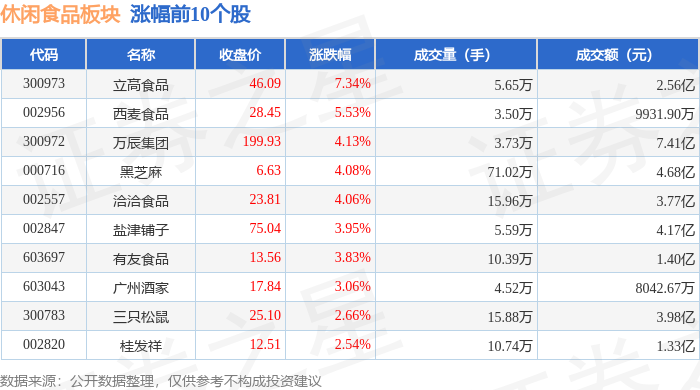
休闲食品板块1月19日涨3.01%,立高食品领涨,主力资金净流入1835.13万元
Zheng Xing Xing Ye Ri Bao· 2026-01-19 08:52
Group 1 - The leisure food sector increased by 3.01% on January 19, with Li Gao Food leading the gains [1] - The Shanghai Composite Index closed at 4114.0, up 0.29%, while the Shenzhen Component Index closed at 14294.05, up 0.09% [1] - Key stocks in the leisure food sector showed significant price increases, with Li Gao Food rising by 7.34% to a closing price of 46.09 [1] Group 2 - The leisure food sector experienced a net inflow of 18.35 million yuan from institutional investors, while retail investors contributed a net inflow of 18.64 million yuan [2] - Notable stocks included San Zhi Song Shu, which had a net inflow of 36.54 million yuan from institutional investors, despite a net outflow from retail investors [3] - The overall trading volume and turnover in the leisure food sector indicated active market participation, with significant movements in individual stock prices [1][2]

【转|太平洋食饮-26年度策略】底部向阳,寻找结构性亮点
远峰电子· 2026-01-18 11:38
Overall Sector Review - The food and beverage sector significantly underperformed the market, with a year-to-date decline of -0.62%, lagging behind the Shanghai Composite Index by 15.0 percentage points [2] - The sector experienced a deep correction after an initial rebound driven by expectations of consumption recovery and supportive policies, but the actual recovery rate was lower than anticipated, leading to a consensus on weak domestic demand [2] Subsector Performance - The snack sector outperformed with a year-to-date increase of 28.88%, driven by channel expansion and a revenue growth rate of 30.97% in the first three quarters [4] - Soft drinks also showed resilience with a 10.11% stock price increase, benefiting from strong travel demand and low-cost, high-frequency consumption [4] - The restaurant chain sector saw a rebound with gains of approximately 10.34% and 10.29% for pre-processed and baked goods, respectively [4] - The liquor sector, particularly high-end liquor, faced challenges with weaker sales and declining prices, while beer performance was supported but affected by high-end market constraints [4] Investment Insights - The sector is under pressure from deflationary trends and a weak recovery, with consumer confidence remaining low, indicating a shift to a "new normal" of low growth [8] - High-end consumption has shown slight recovery due to stock market wealth effects, but sustainability remains a concern [9] - The food and beverage sector's valuation is at historical lows, with a current PE (TTM) of 21.9X, indicating potential investment opportunities in undervalued segments [12] Fund Holdings - As of Q3 2025, the food and beverage sector's fund holdings decreased to 6.38%, nearing levels seen in 2016, with the liquor segment comprising 5.52% of this [14] - Fund holdings in the liquor sector increased for certain subsectors, including white liquor and seasoning products, while others saw declines [16] Long-term Trends - The liquor industry is undergoing its longest adjustment period since 2003, with significant price corrections and a potential bottoming out of valuations [21] - The white liquor sector has underperformed the market with a year-to-date return of -4.87%, reflecting weak demand and a divergence from broader market trends [24] - The third quarter of 2025 saw a significant decline in revenue and net profit for the white liquor sector, indicating a deep adjustment phase [27] Pricing Dynamics - The white liquor market is experiencing a general decline in prices, particularly in high-end segments, while lower price segments show resilience [29] - The average price of high-end products like Moutai has dropped significantly, while mid-range and lower-range products have maintained stability or slight increases [31] Investment Recommendations - The white liquor sector is advised to focus on inventory reduction and demand recovery, with a preference for leading brands that can maintain pricing power and product stability [32]