Maxwell(300751)

Search documents
迈为股份(300751) - 关于股票交易异常波动公告
2026-01-26 12:06
证券代码:300751 证券名称:迈为股份 公告编号:2026-002 苏州迈为科技股份有限公司 关于股票交易异常波动公告 本公司及董事会全体成员保证信息披露的内容真实、准确、完整,没有 虚假记载、误导性陈述或重大遗漏。 一、股票交易异常波动的具体情况 4、公司、控股股东和实际控制人不存在关于公司的应披露而未披露的重大 事项,或处于筹划阶段的重大事项; 5、股票异动期间,未发生公司控股股东、实际控制人买卖公司股票的行为; 6、其他可能或已经对公司股票交易价格产生较大影响的情况说明。 三、是否存在应披露而未披露信息的说明 公司董事会确认,公司目前没有任何根据《深圳证券交易所创业板股票上市 规则》等有关规定应予以披露而未披露的事项或与该事项有关的筹划、商谈、意 苏州迈为科技股份有限公司(以下简称"公司")股票于 2026 年 1 月 22 日、2026 年 1 月 23 日、2026 年 1 月 26 日连续三个交易日收盘价格涨幅偏离值 累计超过 30%,根据深圳证券交易所相关规定,属于股票交易异常波动的情况。 二、说明关注、核实情况 针对公司股票交易异常波动,公司董事会通过通讯及问询等方式对公司、控 股股东、实 ...

太空光伏火了!马斯克联手贝莱德冲刺100GW,低轨卫星+AI算力刚需爆发!
Xin Lang Cai Jing· 2026-01-26 11:09
Group 1: Industry Overview - The space photovoltaic industry is experiencing significant growth driven by the demand for gallium arsenide batteries and other advanced solar technologies, particularly in high-altitude satellites and deep space exploration [1][2][3] - Musk's 100GW solar power capacity plan is expected to boost the demand for space photovoltaic products, benefiting various companies in the supply chain [1][2][3] Group 2: Key Companies and Their Developments - Qianzhao Optoelectronics (300102) is a leading player in gallium arsenide space batteries with over 60% market share in China, achieving a production efficiency of 35% and an experimental efficiency exceeding 42% [1][12] - Dongfang Risen (300118) has successfully delivered small batches of HJT batteries to SpaceX, with its ultra-thin P-type HJT battery meeting the lightweight requirements for satellites [1][13] - Junda Co., Ltd. (002865) is a global leader in TOPCon batteries, with laboratory conversion efficiency surpassing 33.53%, and is rumored to be a potential supplier for SpaceX's perovskite batteries [1][14] - Yunnan Zhiyuan (002428) is a core supplier of germanium wafers for gallium arsenide space batteries, benefiting from the increasing demand for germanium substrates [1][15] - Sanan Optoelectronics (600703) holds the largest gallium arsenide production capacity globally and is expected to see significant revenue growth from its space photovoltaic applications [1][16] - Maiwei Co., Ltd. (300751) is a leading supplier of HJT production equipment and is well-positioned to benefit from the surge in demand for space photovoltaic manufacturing equipment [1][17] - Saiwu Technology (603212) specializes in photovoltaic packaging materials and is developing radiation-resistant encapsulation films for space applications [1][18][19] - China Satellite (600118) is a key player in satellite platform manufacturing and is expected to benefit from the growth in space photovoltaic systems [1][20] - Aerospace Electronics (600879) provides power systems and communication equipment for satellites, with increasing demand expected due to the growth in space photovoltaic applications [1][21] - Tuojin New Energy (002218) focuses on flexible photovoltaic components suitable for space applications, with expected growth in orders as the market expands [1][22] - Trina Solar (688599) covers multiple technology routes and is positioned to benefit from the expansion of space photovoltaic systems [1][23] - Shanghai Portwan (605598) supplies flexible solar wings and is accelerating the commercialization of perovskite batteries through in-orbit testing services [1][24] - Ruihua Tai (688323) is a leader in CPI film materials, essential for flexible space photovoltaic components, and is expected to see increased demand [1][25] - Jiejia Weichuang (300724) is a leading manufacturer of photovoltaic battery production equipment, poised to benefit from the demand surge in space photovoltaic manufacturing [1][26] - Lens Technology (300433) supplies protective covers for satellite batteries, with expected growth in orders due to the increasing demand for space photovoltaic applications [1][27]





半导体行业分析手册之二:混合键合设备:AI算力时代的芯片互连革命与
Dongxing Securities· 2026-01-26 10:09
Investment Rating - The report suggests a positive investment outlook for the hybrid bonding technology, highlighting its critical role in the AI era and advanced packaging market [7]. Core Insights - Hybrid bonding is identified as a key enabling technology for overcoming performance bottlenecks in the post-Moore era, driven by explosive demand in AI and high-performance computing (HPC) [7]. - The market for hybrid bonding equipment is expected to experience significant growth, with demand projected to increase several times by 2030, particularly in high-performance computing and memory applications [5][44]. - The report emphasizes the competitive landscape, noting that while overseas companies like BESI dominate the market, domestic players in China are making significant strides [5][57]. Summary by Sections Hybrid Bonding Overview - Hybrid bonding is an advanced packaging technology that combines dielectric bonding and metal interconnects, allowing for high-density, high-performance 3D integration [14][28]. - The technology enables interconnect distances below 10μm, significantly enhancing data transmission bandwidth compared to traditional methods [29]. Market Demand and Growth - The demand for hybrid bonding technology is transitioning from an advanced option to a core infrastructure in the AI era, with major manufacturers like TSMC and Samsung adopting it for next-generation products [5][33]. - The global hybrid bonding equipment market is projected to exceed $600 million by 2030, with the Chinese market expected to surpass $400 million [48]. Key Players and Competitive Landscape - BESI holds a dominant position in the hybrid bonding equipment market, with a market share of approximately 67% in 2023, and is expected to maintain around 70% in 2024 [57]. - Domestic companies such as Tuojing Technology and Baiao Chemical are rapidly advancing, with Tuojing Technology launching its first mass-production hybrid bonding equipment [5][57]. Applications and Future Trends - Hybrid bonding is primarily applied in 3D NAND and is expanding into high-performance computing scenarios, including HBM4 and HBM5 technologies [25][44]. - The report indicates that the technology is becoming essential for various applications, including AI chips and advanced memory solutions, with significant investments being made in new packaging facilities globally [43][44].


两月股价增两倍,太空光伏点燃迈为股份千亿市值
Xin Lang Cai Jing· 2026-01-26 09:17
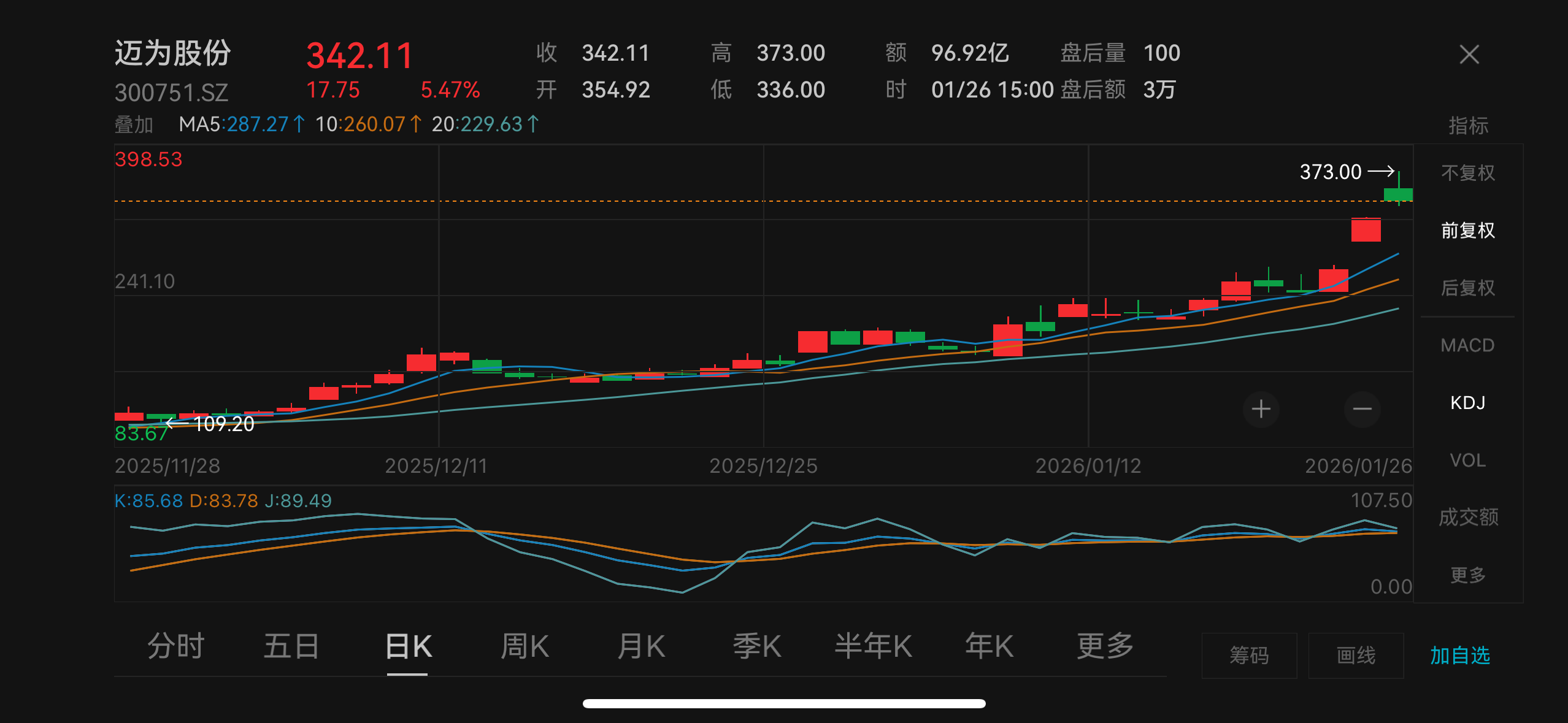
智通财经见习记者|蒋习 1月26日,迈为股份(300751.SZ)股价开盘大涨,市值一度破千亿元。 图片来源:Wind 在2026年1月22日的达沃斯世界经济论坛上,马斯克在与贝莱德CEO拉里·芬克对谈时再次力挺太空光伏,并透露特斯拉与Space X正分别推进在美国的太阳 能制造产能建设,目标为实现每年高达100吉瓦的产能。 马斯克在达沃斯的言论,迅速点燃资本市场对光伏板块的热情。 1月23日,迈为股份、晶科能源(688223.SH)、天合光能(688599.SH)等多家光伏上市公司股价涨停。 此前,有市场传言称,Space X与迈为的HJT设备订单基本敲定,金额约5亿美元,对应约7 GW异质结年产能。 截至1月26日收盘,迈为股份股价报收342.11元/股,涨幅为5.47%,公司市值为955.87亿。 自2025年12月初的114.25元/股起算,其股价在不足两个月内已实现近两倍的增长。 迈为股份是光伏设备商龙头,主营产品为太阳能电池生产设备,系自动化成套生产线。该公司在新一代技术选择上,更偏向于异质结(HJT)。 其股价走强,与特斯拉CEO埃隆·马斯克近期多次高调倡导"太空光伏",以及披露相关产能规划相关 ...

107只个股获机构控盘超10%,科技医药板块成资金“蓄水池”
Huan Qiu Wang· 2026-01-26 07:16
Core Insights - The report highlights the significant presence of public funds in the stock market, with 2,977 stocks appearing in fund heavy positions as of the end of Q4 last year, indicating a clear trend in institutional investment strategies [1] - A total of 107 stocks have a fund holding ratio exceeding 10%, showcasing the high influence and control of institutional funds over these stocks [1] Group 1: Fund Holdings and Stock Performance - Among the 107 stocks with over 10% fund holdings, 56 saw increased investments in Q4, with notable increases in holdings for ShenGong Co., Tianhua New Energy, and Maiwei Co., with increases of 59,020.96%, 15,808.35%, and 959.13% respectively, indicating strong institutional confidence in their fundamentals [2] - Conversely, 48 stocks experienced reductions in fund holdings, with notable decreases for Nuocheng Jianhua-U, Kaiter Co., and Keda Li, with reductions of 43.91%, 41.04%, and 39.95% respectively [2] - Three new stocks entered the heavy holding category, with Baiao Saitu, Litong Technology, and Xingtou Measurement Control having fund holding ratios of 21.55%, 12.60%, and 10.03% respectively [2] Group 2: Institutional Investment Trends - The phenomenon of institutional clustering remains significant, with over 100 funds holding 42 of the 107 stocks, and 29 stocks held by 50 to 99 funds, indicating a strong consensus among institutional investors [4] - Notably, Ningde Times, despite a holding ratio of 11.63%, has the highest number of fund holders at 2,056, followed by Zhongji Xuchuang, Zijin Mining, and Xinyi with over 1,300 fund holders each [4] - The stocks with high fund holdings are predominantly in the "hard technology" and "innovation" sectors, with 42 from the Sci-Tech Innovation Board, 27 from the Growth Enterprise Market, and 31 from the Shanghai and Shenzhen main boards, reflecting a focus on growth sectors [4] Group 3: Performance Expectations - Among the 107 stocks, 26 have released performance forecasts for 2025, with 18 expecting profit increases, 4 expecting declines, and 2 forecasting losses, indicating a generally positive outlook [5] - The highest expected profit growth is for Baiwei Storage at 473.71%, followed by Changxin Bochuang and Baiao Saitu with expected growths of 378.70% and 303.57% respectively, providing strong support for long-term fund holdings [5] - The concentration of fund holdings in the electronics and biopharmaceutical sectors suggests an increased market expectation for technological innovation and consumer recovery [5]




光伏设备行业深度报告:太空光伏深度报告:光伏向空,志在星海
KAIYUAN SECURITIES· 2026-01-26 05:43
Investment Rating - The investment rating for the photovoltaic equipment industry is optimistic (maintained) [1] Core Insights - The photovoltaic sector is entering a silicon era in space applications, driven by the need for cost reduction and efficiency improvement in photovoltaic technology [5][18] - Photovoltaic systems are the most reliable and sustainable power source for spacecraft, providing stable energy supply without the need for fuel resupply [18] - The transition to silicon-based photovoltaic technology in space is being accelerated by the high costs and limitations of III-V multi-junction solar cells, which are currently the most efficient but expensive [64][67] Summary by Sections 1. From Parallel to Convergence: Space Enters the Silicon Era - Photovoltaics are the most important energy supply for spacecraft, providing stable energy without atmospheric interference [18] - Cost reduction and efficiency improvement are the main drivers for the evolution of photovoltaic technology [19] - P-type HJT (Heterojunction Technology) cells show significant advantages in space applications due to their superior radiation resistance [6][69] - Silicon-perovskite tandem cells are expected to become the ultimate solution, breaking the efficiency-cost-radiation resistance triangle [6][68] 2. The Space Race Begins: Photovoltaics Open New Blue Oceans - Low Earth orbit communication satellites are driving the demand for large-scale satellite deployment [7] - The space computing market is expected to release significant potential, with a focus on reliable power supply rather than cost competition [7] 3. Pre-Volume Layout: Equipment Manufacturers Seize Opportunities - Key equipment manufacturers benefiting from the space photovoltaic technology include Maiwei, Jiejia Weichuang, Laplace, and others [8] 4. Competition Among Giants: Leading Manufacturers Tap into Blue Oceans - Major battery manufacturers deeply involved in space photovoltaic technology include Dongfang Risheng, Junda, Trina Solar, and JinkoSolar [8]


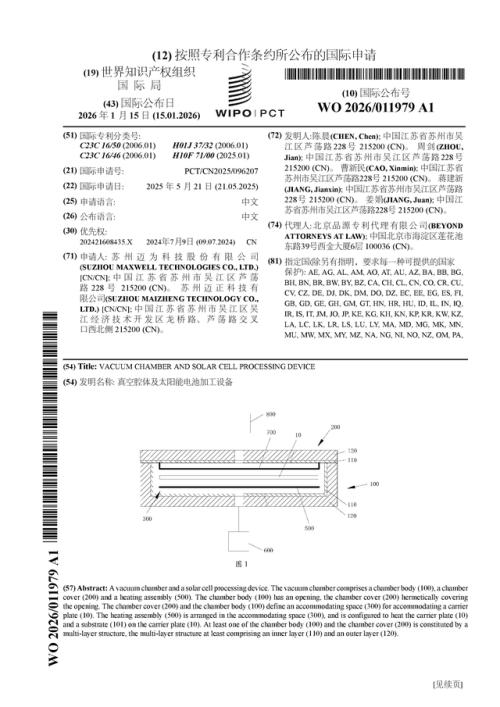
迈为股份公布国际专利申请: "真空腔体及太阳能电池加工设备"
Qi Cha Cha· 2026-01-26 05:00
Group 1 - The core point of the article is that Maiwei Co., Ltd. has filed an international patent application for a vacuum cavity and solar cell processing equipment, with the application number PCT/CN2025/096207, and the international publication date set for January 15, 2026 [1] Group 2 - In 2023, Maiwei Co., Ltd. has announced one international patent application, which is consistent with the same period last year [4] - According to the company's mid-year financial data for 2025, it invested 463 million yuan in research and development in the first half of the year, representing a year-on-year increase of 10.38% [4]

中国高端制造:高端制造企业走访要点-China Advanced Manufacturing_ Advanced manufacturing tour takeaways
2026-01-26 02:50
Summary of Key Points from the Conference Call Industry Overview - The conference focused on the advanced manufacturing sector, particularly in technology and energy storage systems (ESS) [1] Company Insights CSI Solar (688472 CH) - **ESS Growth**: Projected global shipments of ESS for 2026E are expected to reach 14-17 GWh, primarily driven by demand in non-US markets [2] - **Backlog**: The current backlog is approximately USD 3 billion, with high-quality orders concentrated in overseas high-margin regions, indicating strong potential for profitability [2] - **Risk Management**: The company is involved in counter-litigation regarding potential US antidumping duties, assessing the overall risk as low [3] - **Supply Chain**: Currently relies on external sourcing for battery cells but believes it can pass future price increases to customers effectively [3] Maxwell Technologies (300751 CH) - **Order Projections**: Anticipates CNY 6 billion in new orders for 2025E, with expectations to rise to CNY 10 billion for 2026E [4] - **Segment Contributions**: Orders for 2026E are expected to include CNY 6 billion from solar (mainly overseas heterojunction) and CNY 3.5-4.0 billion from non-solar segments [4] - **Long-term Outlook**: Projects semiconductor revenue to scale up to CNY 10 billion by 2029-30E amid diversification efforts [4] Xizi Clean Energy Equipment (002534 CH) - **Growth Drivers**: Long-term growth is supported by overseas market expansion, energy storage operations, and the nuclear power segment, which currently generates CNY 1-2 billion in revenue [5] - **Market Challenges**: Faces localization and policy barriers for entering the US market, with a focus on complementary exports in the short term [5] Shuanghuan Driveline (002472 CH) - **EV Segment Growth**: Expected to generate approximately CNY 4 billion in revenue for 2025E, with double-digit growth projected for 2026E [7] - **ICE Business Decline**: Anticipates a revenue decline of 5-6% in the ICE segment for 2026E due to waning demand [7] - **Construction Machinery**: Projected single-digit revenue growth in 2026E, driven by potential order increases from key clients [7] Additional Insights - The conference highlighted the importance of navigating policy uncertainty and the need for new product development in the advanced manufacturing sector [1] - Companies are focusing on international markets to mitigate risks associated with domestic policy changes and market saturation [5][7] This summary encapsulates the key takeaways from the conference call, providing insights into the advanced manufacturing sector and specific company performances and projections.


光伏设备是太空卫星电源系统,更是AI电力设备
2026-01-26 02:50
Summary of Conference Call on Photovoltaic Equipment Industry Industry Overview - The conference focused on the photovoltaic (PV) equipment industry, particularly in relation to space satellite power systems and AI power devices [1] - The discussion highlighted the recent surge in the PV sector, driven by developments from companies like SpaceX and Tesla, which are planning to build significant solar capacity both in space and on the ground [2][3] Key Points and Arguments SpaceX and Tesla Developments - SpaceX is reportedly planning to construct 100 GW of solar capacity for space applications, which has positively impacted the stock prices of related companies [2] - The technology being explored includes P-type heterojunction cells due to their better radiation resistance and thinner silicon wafers, which are crucial for weight reduction in space applications [3][4] - The choice of technology differs between domestic and international players, with SpaceX favoring crystalline silicon due to lower launch costs associated with their reusable rockets [4][5] Market Dynamics - The PV equipment sector has seen a significant increase in stock prices, with a reported 60% rise since late November, driven by optimism surrounding space-related solar projects [10][11] - The anticipated demand from Tesla for an additional 10 GW of capacity has further fueled market enthusiasm, with potential orders expected in the second quarter of the year [6][7] Long-term Projections - The long-term vision includes both SpaceX and Tesla aiming for 100 GW each, which could reshape the PV market and create new demand narratives beyond just space applications [7][11] - The potential for AI-driven power solutions is highlighted, suggesting that PV and energy storage could become essential for AI infrastructure, expanding the market's scope [10][20] Important but Overlooked Content - The conference emphasized the importance of the ground-based 100 GW project, which is expected to have a significant impact on the PV market, potentially leading to a re-evaluation of company valuations [11][19] - The discussion also touched on the supply chain implications, including the need for materials and auxiliary components, which could see increased demand as the industry evolves [18][19] - Companies like Maiwei and Aotewi were identified as key players due to their strong market positions and technological capabilities in the PV equipment sector [14][15] Conclusion - The overall sentiment is optimistic regarding the PV equipment industry, with expectations of continued growth driven by both space and ground-based solar initiatives [20][21] - The potential for AI integration into the energy supply chain is seen as a transformative trend that could significantly enhance the industry's growth trajectory [20][21]

商业航天行业:太空光伏,逐日天穹,叩问千亿星辰市场
2026-01-26 02:49
Summary of the Conference Call on the Space Photovoltaics Industry Industry Overview - **Industry Focus**: Space Photovoltaics - **Key Players**: SpaceX, Amazon, Chinese satellite companies - **Market Potential**: Estimated to reach a trillion-dollar market Core Insights and Arguments 1. **Cost Reduction through Reusable Technology**: The advent of reusable rocket technology has significantly lowered launch costs, creating a golden opportunity for space photovoltaics. The successful exploration of reusable rockets by companies like SpaceX has led to a rapid decrease in launch costs, making commercial space activities more frequent [5][23][24] 2. **US-China Competition in Commercial Space**: The competition between the US and China in commercial space is accelerating, particularly in low Earth orbit (LEO) communications satellites, which is expected to drive demand for solar wings. The US currently leads in LEO satellite deployment, with China planning to submit applications for 203,000 satellites to the International Telecommunication Union (ITU) by December 2025, aiming to secure valuable orbital resources [5][44][46] 3. **AI and Space Computing**: The concept of deploying AI data centers in space is gaining traction among tech giants. Space-based computing, or "computing in space," is seen as a solution to energy and space limitations. The cost of deploying a 40MW AI data center in space is estimated at $8.2 million, significantly lower than ground deployment costs [5][52][53] 4. **Technological Developments in Photovoltaics**: - **Gallium Arsenide (GaAs)** is currently the mainstream choice for space photovoltaics due to its excellent performance, though it is costly and has material sourcing limitations. - **Heterojunction (HJT)** technology is expected to be a significant choice for large-scale industrialization due to its efficiency and simpler manufacturing process. - **Perovskite technology** shows promise but lacks sufficient empirical data for large-scale application in the short term [5][64] 5. **Investment Recommendations**: The space photovoltaics sector is entering an active exploration phase, with equipment manufacturers poised to benefit. Key companies to watch include: - **HJT/Perovskite Equipment Suppliers**: Maiwei Co., Aotwei, and Jiejia Weichuang - **Comprehensive Photovoltaic Companies**: Jing Sheng Mechanical and Gao Ce Co. [5][5] Additional Important Content 1. **Risks**: Potential risks include slower-than-expected development of the commercial space industry, uncertainties in the technological pathways for space photovoltaics, and lower-than-expected investment and application demand for space computing [5][5] 2. **Market Dynamics**: The global satellite launch frequency has increased significantly since 2020, with projections indicating around 4,000 launches annually by 2025, marking a growth rate exceeding 50% [5][38] 3. **Future Projections**: The estimated demand for space photovoltaics from existing satellite plans could reach nearly 10GW in the near term, with significant growth expected as more satellites are deployed [5][46][62] 4. **Cost Comparisons**: The Levelized Cost of Energy (LCOE) for space photovoltaics is projected to decrease significantly due to reduced launch costs and advancements in technology, potentially reaching $0.04/kWh by 2050 [5][33][34] 5. **Global Competition**: The competition for orbital resources is intensifying, with the US and China leading the charge in satellite deployments, highlighting the strategic importance of space resources [5][42][43] This summary encapsulates the key points discussed in the conference call regarding the space photovoltaics industry, emphasizing the technological advancements, market dynamics, and investment opportunities within this rapidly evolving sector.