
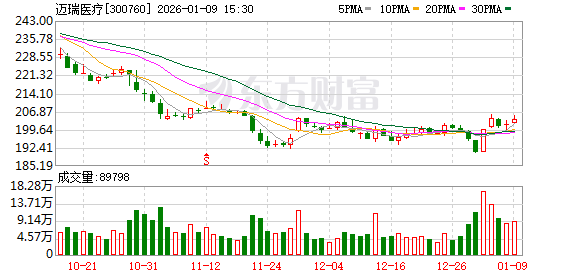
Mindray(300760)

Search documents
医药生物行业2026年1月投资策略:继续推荐创新药及产业链
Guoxin Securities· 2026-01-11 12:54
Core Insights - The report continues to recommend innovative drugs and the related industry chain, highlighting the strong growth potential in the pharmaceutical sector through 2026 [1][4]. Investment Strategy - The investment strategy emphasizes the focus on the CXO sector, particularly in chemical CDMO, where Chinese companies hold significant advantages in talent, chemical capabilities, compliance production, and intellectual property protection [4]. - The report suggests that the upcoming JPM conference will provide updates on the operational progress of Chinese innovative drug companies, which have shown a long-term positive development trend [4]. - The recommended investment portfolio includes A-shares such as Mindray Medical, WuXi AppTec, and Aier Eye Hospital, as well as H-shares like Kangfang Biologics and WuXi Biologics [4][5]. Industry Performance - The pharmaceutical industry experienced a decline of 4.10% in December, underperforming the CSI 300 index by 6.38% [8]. - The report notes that the chemical pharmaceutical sector saw the largest declines among sub-sectors, with a drop of 5.80% [12]. Market Data - For the period from January to November 2025, the pharmaceutical manufacturing industry's total revenue was 220.65 billion yuan, reflecting a year-on-year decrease of 2.0% [7]. - The total retail sales of consumer goods reached 45.61 trillion yuan, with retail sales of Western and Chinese medicines amounting to 660.4 billion yuan, a year-on-year increase of 1.8% [7]. Regulatory Environment - The report discusses the impact of the U.S. "Biological Safety Act," which is expected to have a limited short-term effect on Chinese CXO companies, while emphasizing the need to monitor the long-term implications of international competition and regulatory changes [22]. Recent Drug Approvals - In December 2025, a total of 16 innovative drugs or biosimilars were approved for market entry, including six domestic and ten imported products [24][25].



迈瑞医疗_聚焦加速增长
2026-01-10 06:38
Summary of Shenzhen Mindray (300760.SZ) Conference Call Company Overview - Shenzhen Mindray is a leading medical device manufacturer in China, with three core segments: Patient Monitoring and Life Support (PMLS), In Vitro Diagnostics (IVD), and Medical Imaging, contributing 37%, 38%, and 20% of total revenue respectively in FY24 [24][25]. Key Industry Insights - The China medtech sector is a strategic focus for the government, driven by an aging population and increasing healthcare spending. The sector is expected to recover in 2026 after facing challenges in 2024 [3]. - Mindray's overseas business accounts for over 50% of its revenue, with a target to double market share in emerging markets within five years [1][3]. Financial Performance and Projections - **Earnings Summary**: - FY2023: Net Profit of Rmb 11,582 million, Diluted EPS of Rmb 9.558, P/E ratio of 21.3 [5]. - FY2025E: Projected Net Profit of Rmb 9,488 million, a decline of 18.7% YoY, with a P/E ratio of 26.2 [5]. - FY2026E: Expected recovery with Net Profit of Rmb 10,982 million, a growth of 15.7% YoY, and a P/E ratio of 22.6 [5]. - **Valuation**: - Target price set at Rmb 285, indicating a potential upside of 39.9% from the current price of Rmb 203.68 [6][10]. - Mindray appears undervalued compared to domestic peers, trading at approximately 23x FY26 P/E versus 38x for peers [2]. Strategic Initiatives - **Growth Acceleration**: Management anticipates a return to positive domestic growth in 2026 and further acceleration in 2027 [1]. - **Innovation Focus**: Shift towards high-end, higher-margin products and a recurring revenue model, particularly in IVD reagents [1]. - **Digital Ecosystem**: Development of integrated solutions combining equipment, IT, and AI to enhance competitive advantage [1][19]. Risks and Challenges - Potential margin pressure in FY25 due to strategic investments aimed at long-term growth [2]. - Geopolitical risks, particularly U.S.-China trade tensions, could impact revenue and sourcing [27]. - Challenges in maintaining competitive positioning if unable to adapt to technological trends and customer needs [27]. Conclusion - Mindray is positioned as a top pick in the medtech sector, with a strong growth trajectory supported by strategic initiatives and a favorable market outlook. The company is expected to leverage its leading market position to capitalize on emerging opportunities while navigating potential risks [4][25].
迈瑞医疗:公司高度重视中小投资者的利益保护
Zheng Quan Ri Bao· 2026-01-09 11:45
Core Viewpoint - The company emphasizes the protection of minority investors' interests through various measures, including performance growth, stable dividends, transparent information disclosure, and enhanced investor relations management [2]. Group 1: Performance Growth - The company focuses on its core business and invests in research and development to drive technological breakthroughs and expand its domestic and international operations, thereby unlocking growth potential and enhancing intrinsic value for minority shareholders [2]. Group 2: Dividend Policy - The company has established a sustainable profit distribution policy, committing to at least one profit distribution per year, with cash distributions amounting to no less than 65% of the annual distributable profits. Since its IPO in 2018, the company has not engaged in refinancing and has distributed a total of 37.3 billion yuan in dividends, which is six times the IPO fundraising amount of 5.934 billion yuan [2]. Group 3: Information Disclosure - The company prioritizes the importance of timely and relevant information disclosure, actively sharing information that aids investors' decision-making regarding industry changes, business operations, and risk factors, thereby enhancing market confidence and maintaining the company's image [2]. Group 4: Investor Relations Management - The company has established a comprehensive and efficient investor communication platform, utilizing various online channels and organizing events such as conference calls, performance briefings, and investor visits to foster positive interactions and improve transparency in management [2].

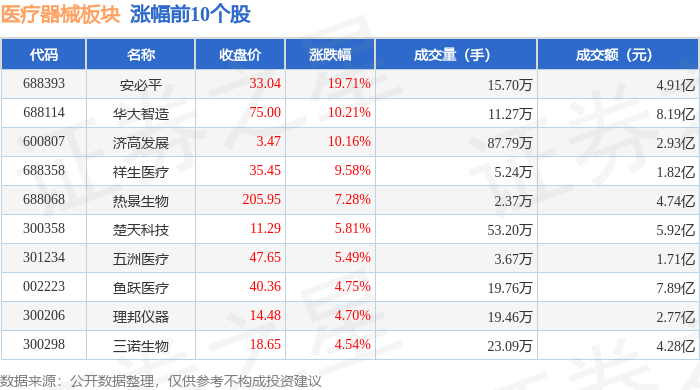
医疗器械板块1月9日涨1.47%,安必平领涨,主力资金净流出6.29亿元
Zheng Xing Xing Ye Ri Bao· 2026-01-09 08:54
Group 1 - The medical device sector increased by 1.47% on January 9, with Anbiping leading the gains [1] - The Shanghai Composite Index closed at 4120.43, up 0.92%, while the Shenzhen Component Index closed at 14120.15, up 1.15% [1] - Anbiping's stock price rose by 19.71% to 33.04, with a trading volume of 157,000 shares and a transaction value of 491 million yuan [1] Group 2 - The medical device sector experienced a net outflow of 629 million yuan from institutional investors, while retail investors saw a net inflow of 797 million yuan [2] - The top gainers in the medical device sector included Huada Zhizao, which rose by 10.21% to 75.00, and Jigaofazhan, which increased by 10.16% to 3.47 [1] - The top losers included Meihua Medical, which fell by 11.81% to 37.55, and Yuanpeng Medical, which decreased by 8.66% to 38.93 [2] Group 3 - The net inflow of funds for Yuyue Medical was 96.43 million yuan, while it faced a net outflow of 63.12 million yuan from retail investors [3] - Jigaofazhan had a net inflow of 71.09 million yuan from institutional investors, with a net outflow of 41.66 million yuan from retail investors [3] - Anbiping saw a net inflow of 37.38 million yuan from institutional investors, while retail investors experienced a net outflow of 15.65 million yuan [3]


研判2025!中国细胞计数仪行业产业链、市场现状、企业格局及未来趋势分析:技术迭代加速传统手动设备淘汰,前沿领域需求推动多功能智能分析仪发展[图]
Chan Ye Xin Xi Wang· 2026-01-09 01:57
Core Insights - The cell counter industry in China is projected to reach a market size of approximately 11.24 billion yuan in 2024, with a year-on-year growth of 6.30% [1][6][8] - Traditional manual or semi-automatic counting devices are being rapidly phased out in favor of multifunctional intelligent cell analyzers that can monitor live cells and possess fluorescence analysis capabilities [1][6][8] Industry Overview - Cell counters are laboratory devices used to accurately measure the number of cells in liquid samples and analyze cell characteristics such as viability, size, morphology, and fluorescence labeling [2] - They are widely applied in fields such as biology, medicine, pharmaceuticals, cell culture, clinical diagnostics, drug screening, and cell therapy, characterized by efficiency, precision, and reduced human error [2] Industry Chain - The upstream of the cell counter industry includes raw materials and components such as lenses, filters, lasers, LED light sources, sensors, chips, and precision mechanical parts [4] - The midstream involves the production and manufacturing of cell counters, while the downstream applications span clinical diagnostics, scientific research, biopharmaceuticals, and environmental monitoring [4] Market Size - The cell counter market is a fundamental tool in the in vitro diagnostics (IVD) sector, which is expected to reach a market size of approximately 120 billion yuan in 2024, growing by 1.27% year-on-year [6] - The demand for fully automated cell counters is increasing due to the push for laboratory automation upgrades, particularly in the context of new healthcare projects [7] Key Companies - The market is characterized by a concentration of leading companies, with products from companies like Ruiwo De and Highpoint Bio being highly recognized [8] - Shenzhen Mindray Biomedical Electronics Co., Ltd. has made significant technological advancements in flow cytometry, enhancing its market position [10] Industry Development Trends 1. The technology is moving towards high integration and intelligence, evolving from mere counting tools to comprehensive intelligent analysis systems [12] 2. Market demand is shifting from general-purpose instruments to specialized solutions tailored for specific applications, leading to a more segmented market [13] 3. The industry is undergoing structural adjustments, with a focus on high-quality products and domestic alternatives gaining traction in the mid-to-high-end market [14]

脑机接口燃爆市场!医疗器械指数ETF(159898)含“脑”量24%、盘中获大额净流入
Sou Hu Cai Jing· 2026-01-08 06:36
Core Viewpoint - The brain-computer interface (BCI) sector is experiencing significant growth, driven by technological advancements and increased investment, particularly in the A-share market, with related stocks showing strong performance [1][5]. Group 1: Market Performance - The medical device index ETF (159898) has seen a rise of over 1.94%, with approximately 37 million yuan in net inflow as of the report [1]. - Key stocks in the BCI sector include Kewei Medical, which surged over 19%, and Shuoshi Bio, which increased over 13%, among others [3]. Group 2: Industry Growth - The global BCI market has grown from $1.2 billion in 2019 to nearly $2 billion in 2023, with a compound annual growth rate (CAGR) exceeding 13% [5]. - Projections indicate that the global BCI industry could reach $7.63 billion by 2029, with a CAGR of over 25% from 2024 to 2029 [5]. Group 3: Investment Opportunities - The BCI sector is positioned at a critical juncture with strong policy support, rapid technological iteration, and accelerated commercialization, making it a promising area for investment [8]. - The medical device index ETF (159898) tracks a broad range of medical device sectors, with leading companies like Mindray Medical and United Imaging Healthcare, providing a pure representation of the A-share medical device sector [8][9].


创业50ETF(159682)跌0.92%,半日成交额1.40亿元
Xin Lang Cai Jing· 2026-01-08 03:44
Core Viewpoint - The article discusses the performance of the ChiNext 50 ETF (159682) as of January 8, highlighting a decline in its value and the performance of its major holdings [1] Group 1: ETF Performance - As of the midday close, the ChiNext 50 ETF (159682) decreased by 0.92%, priced at 1.515 yuan, with a trading volume of 140 million yuan [1] - Since its inception on December 23, 2022, the fund has achieved a return of 53.15%, with a monthly return of 6.35% [1] Group 2: Major Holdings Performance - Key stocks within the ChiNext 50 ETF include: - Ningde Times: down 0.12% - Zhongji Xuchuang: down 2.72% - Dongfang Wealth: down 2.00% - Xinyi Sheng: down 1.74% - Sunshine Power: down 2.38% - Shenghong Technology: down 2.58% - Huichuan Technology: down 0.15% - Mindray Medical: up 0.33% - Yiwei Lithium Energy: down 0.72% - Tonghuashun: down 4.28% [1]





2025 年治疗设备品牌推荐:国产“智能微创”技术领航,进口“高精稳定”深耕高端,分级诊疗场景精准匹配
Tou Bao Yan Jiu Yuan· 2026-01-07 13:12
Investment Rating - The report does not explicitly state an investment rating for the industry Core Insights - The treatment equipment industry in China has experienced significant growth, with the market size increasing from 375.23 billion RMB in 2019 to 621.39 billion RMB in 2023, reflecting a compound annual growth rate (CAGR) of 13.44% [9] - The market is expected to continue growing, with projections indicating an increase to 872.09 billion RMB by 2028, at a CAGR of 6.12% [10] - The integration of AI and advanced technologies is driving innovation and efficiency in treatment devices, enhancing diagnostic accuracy and treatment precision [31] Market Background - The medical device sector includes instruments and software for diagnosis, monitoring, and treatment, with a notable increase in clinical trial institutions from 1,176 in 2022 to 1,340 in 2023, a growth of 13.8% [5] - The treatment equipment category encompasses surgical instruments and rehabilitation devices, which are crucial for patient recovery [6][7] Market Status - The treatment equipment market is expanding due to improved regulatory frameworks and increased domestic innovation, with a total of 13,260 medical device registrations in 2023, a 25.4% increase from 2022 [9] - The demand for treatment devices is rising, driven by an aging population and increased surgical procedures, with PCI surgeries growing from 915,000 in 2018 to 1,636,000 in 2023, a 26.4% year-on-year increase [13] Market Competition - The competitive landscape features a tiered structure, with leading companies like Mindray Medical and MicroPort in the first tier, and others like Qizhi Laser and Yuyue Medical in subsequent tiers [17][18] - The total R&D investment among the top 20 listed medical device companies reached 11.18 billion RMB in 2023, up 14.9% from 2022, indicating a strong focus on innovation [18] Recommended Brands - Mindray Medical is recognized for its leadership in ultrasound imaging and life information support, with a significant market share in high-end ultrasound products [19] - MicroPort specializes in minimally invasive intervention technologies, particularly in cardiovascular and neurological fields [20] - Yuyue Medical leads in home medical devices, with a dominant market position in respiratory therapy and blood glucose monitoring [22] Development Trends - The industry is undergoing a technological revolution with AI, 5G, and IoT integration, enhancing diagnostic and treatment capabilities [31] - The shift towards tiered medical services is optimizing the structure of healthcare consumption, with increased procurement of high-end devices by tertiary hospitals [32] - National policies are fostering domestic innovation and internationalization in the medical device sector, with a focus on streamlining approval processes for innovative products [33]

济南迈瑞科技有限公司成立
Zheng Quan Ri Bao Wang· 2026-01-07 11:49
Group 1 - Jinan Mindray Technology Co., Ltd. has been established with a registered capital of 20 million yuan [1] - The company's business scope includes manufacturing of instruments and meters, production of Class I medical devices, sales of instruments and meters, import and export of goods, technology import and export, and import and export agency [1] - Mindray Medical (300760) holds 100% ownership of the newly established company [1]
研判2025!中国流式细胞仪行业发展历程、产业链及市场现状分析:流式细胞仪驱动生命科学向临床转化,纳米级检测开拓外泌体新场景[图]
Chan Ye Xin Xi Wang· 2026-01-07 01:19
Core Insights - The flow cytometer industry in China is projected to reach a market size of approximately 3.599 billion yuan in 2024, reflecting a year-on-year growth of 19.21% [1][9] - The industry is achieving systematic breakthroughs along three main paths: expanding detection limits, enhancing analytical dimensions, and integrating functional platforms [1][9] Industry Overview - Flow cytometers utilize lasers to detect scattered light and fluorescence signals from cells or particles in a high-speed flow state, enabling rapid multi-parameter analysis, sorting, and quantitative characterization [2] - The core principle involves hydrodynamic focusing technology that allows cells to pass through the laser detection area in a single file, capturing forward scatter (indicating cell size), side scatter (indicating internal complexity), and fluorescence signals [2] Industry Development History - The flow cytometer industry in China has evolved over 40 years, starting with the introduction of the first FACS III in 1981, leading to significant milestones in domestic production and technology breakthroughs from 2013 onwards [4] - Key advancements include the introduction of the first clinical spectral flow cytometer and the first flow mass spectrometer with IVD registration, marking significant progress in high-end equipment [4] Market Size - The flow cytometer market is experiencing a shift from laboratory to clinical applications, with a notable increase in market size and technological advancements [9] - Noteworthy innovations include the development of nano-flow technology by Fuliu Biotechnology, which extends detection limits to 24nm, and the NL-CLC spectral flow cytometer by Xiatai Biotechnology, the first clinical-approved full-spectrum product in China [9] Key Companies - Major players in the flow cytometer market include Mindray Medical, which has integrated instruments, reagents, and software into a comprehensive platform, and Fuliu Biotechnology, a leader in nano-flow technology [10][11] - Mindray's revenue for the first three quarters of 2025 was 25.834 billion yuan, a decrease of 12.38% year-on-year, with a net profit of 7.570 billion yuan, down 28.83% [11] Industry Trends - The industry is witnessing accelerated technological iteration, with a focus on high-end and intelligent advancements, including the integration of AI for data analysis and high-throughput sorting [12] - Applications are expanding beyond clinical and research fields into broader industrial and public health areas, such as environmental monitoring and food safety [13] - The domestic production process is accelerating, driven by supply chain security and the need for local alternatives, reshaping the competitive landscape [14]
