adidas(ADDYY)

Search documents
运动巨头CEO竞相访华:耐克比阿迪达斯低调丨消费参考
2 1 Shi Ji Jing Ji Bao Dao· 2025-10-22 00:27
Group 1 - The importance of the Chinese market for global sports brands is increasing, as evidenced by the frequent visits of CEOs from major companies like Adidas and Nike [1][2] - Adidas CEO Bjoern Gulden expressed confidence in the Chinese market, noting that 95% of products sold in China are "Made in China" and that the company is gradually achieving original designs in China [1][2] - Nike's revenue in Greater China has declined by 10% to $1.512 billion (approximately 107.75 billion RMB) for the latest fiscal quarter ending August 31, 2025, while Adidas reported an 11% increase in revenue to €798 million (approximately 66.53 billion RMB) [2] Group 2 - The competition between international brands in China is intensifying, with Adidas' market share in China at 8.7%, lower than Nike's 16.2%, Anta's 10.5%, and Li Ning's 9.4% [2] - The decline in Nike's sales is attributed to decreased foot traffic, a competitive promotional environment, and ongoing inventory clearance pressures [2] - Adidas has faced challenges in the Chinese market, including a decline in revenue for eight consecutive quarters prior to the recent growth, leading to a drop in its market position from second to fourth [2][3]


8点1氪丨卢浮宫劫案可能是粉红豹所为;王自如入职雷鸟创新;阿迪达斯羽绒服被指由雪中飞代工
3 6 Ke· 2025-10-21 23:56
Group 1 - Adidas customer service responded to claims that their down jackets are made by Snow Flying, assuring that all products have quality guarantees [2][2] - The jacket in question has a price of 579 yuan with a fill power of 600+, while a similar product from Snow Flying is priced at 519 yuan with a fill power of 680+ [2][2] - The Chinese Ministry of Foreign Affairs expressed hope for Japan to work towards mutual understanding following the election of new Prime Minister Takashi Hayashi [2][2] Group 2 - QianDao responded to a viral report regarding a refund issue, clarifying that the transaction was a personal exchange and not related to their platform services [3][4] - The company emphasized that the alleged "minor refund policy" was not an official rule but a personal message from the seller [3][4] - QianDao is committed to improving transaction rules and customer service based on user feedback [4][4] Group 3 - The international gold and silver markets saw significant declines, with COMEX gold futures dropping by 5.07% to $4138.5 per ounce, marking the largest single-day drop since April 2013 [4][4] - COMEX silver futures fell by 6.27% to $48.16 per ounce, also experiencing a significant decline [4][4] Group 4 - The smart glasses market experienced a 64.2% increase in shipments in the first half of 2025, reaching 4.065 million units [11][11] - The global smart glasses market is expected to exceed 40 million units by 2029, with China projected to have the highest growth rate [11][11] Group 5 - Bubble Mart announced an expected revenue growth of 245%-250% for Q3 2025 compared to Q3 2024, with domestic revenue increasing by 185%-190% [17][17] - The company also reported a 365%-370% increase in overseas revenue [17][17] Group 6 - China Telecom reported a net profit of 7.756 billion yuan for Q3 2025, a year-on-year increase of 3.60% [18][18] - The company's revenue for the same period was 124.848 billion yuan, a slight decline of 0.91% [18][18] Group 7 - Good Housekeeper reported a net profit of 57.0469 million yuan for Q3 2025, reflecting a year-on-year increase of 21.67% [19][19] - The company's revenue for the quarter was 382 million yuan, up 7.27% year-on-year [19][19] Group 8 - Quanjude reported a net profit of 13.791 million yuan for Q3 2025, a significant decline of 66.46% year-on-year [21][21] - The company's revenue for the quarter was 329 million yuan, down 17.30% year-on-year [21][21] Group 9 - China National Pharmaceutical Group reported a net profit of 544 million yuan for Q3 2025, an increase of 13.10% year-on-year [22][22] - The company's revenue for the quarter was 13.747 billion yuan, a growth of 3.58% [22][22]


阿迪达斯上调全年业绩指引,营业利润预计将升至20亿欧元
Sou Hu Cai Jing· 2025-10-21 23:39
Core Insights - Adidas reported a preliminary performance for Q3 2025, showing a 12% year-over-year revenue growth after excluding currency effects [1] - The company's gross margin improved by 0.5 percentage points to 51.8%, despite facing adverse currency fluctuations and increased tariffs [1] - Operating profit rose to €736 million, compared to €598 million in the same period last year, with an operating margin of 11.1% [1] - Adidas raised its full-year 2025 guidance, expecting operating profit to reach approximately €2 billion, up from the previous forecast of €1.7 billion to €1.8 billion [1]
阿迪达斯上调全年盈利预期
Sou Hu Cai Jing· 2025-10-21 20:03
Core Viewpoint - Adidas has raised its full-year profit forecast for 2023, driven by strong demand for retro footwear and measures taken to mitigate the impact of U.S. tariffs [1] Financial Performance - The company expects operating profit to be approximately €2 billion, up from the previous target of €1.7 billion to €1.8 billion [1] - Sales are projected to grow by about 9% on a constant currency basis [1] Market Trends - The resurgence of classic shoe models, particularly the Samba, has helped Adidas regain consumer interest and narrow the gap with industry leader Nike [1] - The trend has expanded to other retro shoe models featuring the "three stripes" logo [1] Strategic Initiatives - The increase in profit expectations is attributed to strong brand momentum and successful efforts to partially offset the cost pressures from rising U.S. tariffs [1]
Adidas Raises Guidance as Q3 Revenue Hits Highest Mark Ever
Yahoo Finance· 2025-10-21 17:15
Core Insights - Adidas achieved its highest quarterly revenue ever, reaching 6.63 billion euros in Q3 2025, a 2.8% increase from 6.45 billion euros in the same quarter last year [1][2] - Currency-neutral revenues for the Adidas brand increased by 12% in Q3, driven by strong growth across various markets and product categories [1][2] Revenue and Profit Performance - The operating profit for Q3 improved significantly to 736 million euros, up from 598 million euros in the previous year [2] - The company completed the sale of its remaining Yeezy inventory, meaning Q3 2025 results do not include Yeezy contributions, which were approximately 200 million euros in the prior year [3] Future Guidance - Adidas has raised its full-year guidance for 2025, now expecting currency-neutral revenues to increase by around 9%, up from a previous high-single-digit rate [4] - The expected operating profit for the full year is now around 2.0 billion euros, an increase from the previous guidance of 1.7 billion to 1.8 billion euros [5] - The company anticipates continued double-digit currency-neutral revenue growth for the Adidas brand throughout the year [6]
阿迪达斯三季度业绩报告强劲,上调全年业绩指引
Ge Long Hui A P P· 2025-10-21 16:17
格隆汇10月22日|阿迪达斯:第三季度营业利润初步数据7.36亿欧元,预估6.878亿欧元。若将上一年度 (2024年约6.5亿欧元)的椰子鞋(Yeezy)销售额计算在内,目前预计按固定汇率计算的营收将增长约 9%。就全年而言,公司仍预计阿迪达斯品牌的营收将实现双位数的货币中性增长。 ...
阿迪达斯客服回应“羽绒服由雪中飞代工”
Di Yi Cai Jing Zi Xun· 2025-10-21 11:33
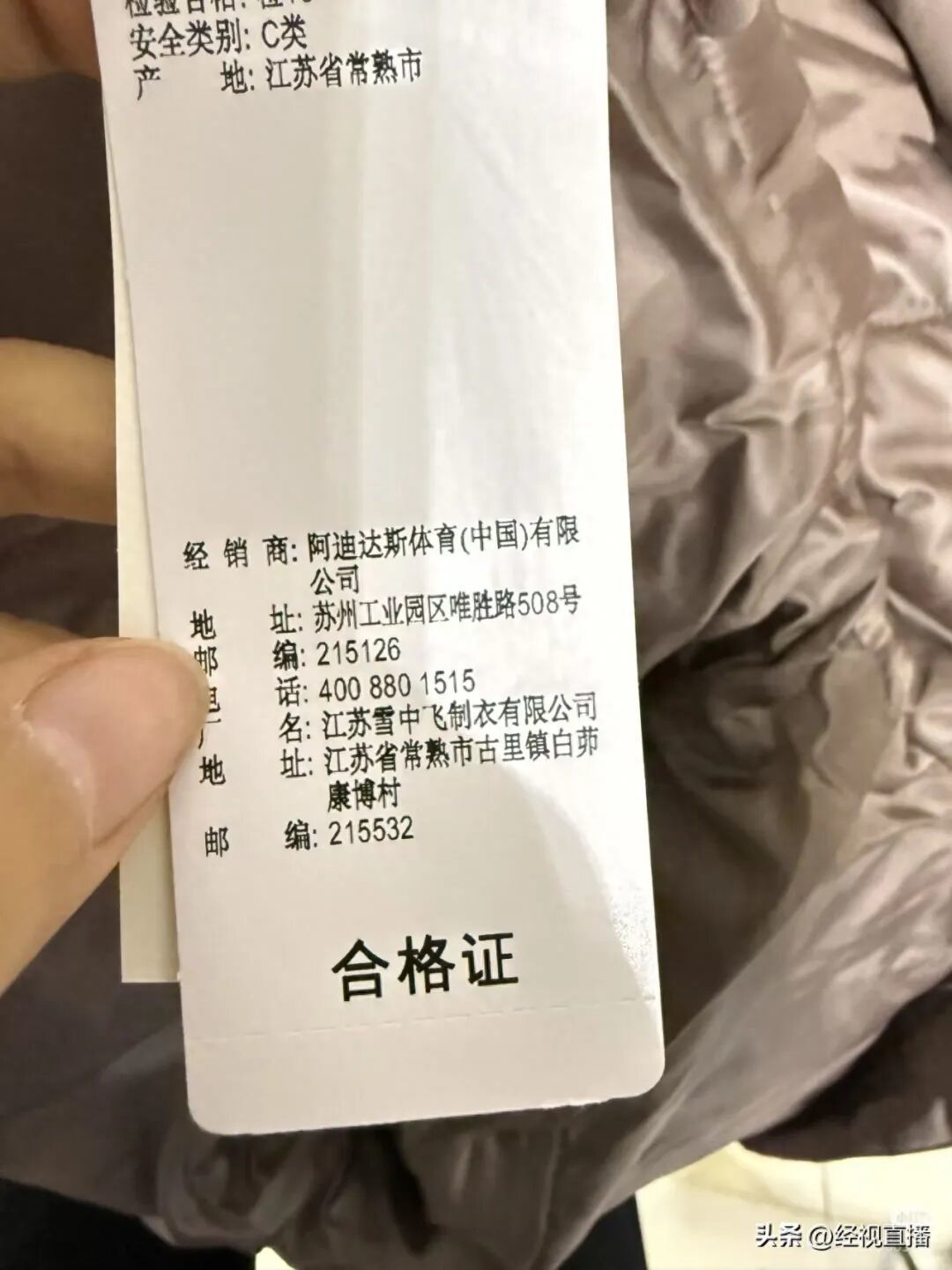
Core Viewpoint - Recent consumer complaints on social media suggest that Adidas down jackets sold on short video platforms are actually produced by Snow Flying, raising questions about brand pricing and product quality [1][4]. Group 1: Product Comparison - A specific short down jacket from Adidas is priced at 579 yuan, featuring duck down with a fill power of 600+ and a down content of 80% [4]. - In contrast, a similar jacket from Snow Flying is priced at 519 yuan, with a fill power of 680+ and a down content of 90%, indicating a better value proposition [4][5]. - Another Adidas jacket listed at 869 yuan contains 135 grams of duck down and 80% down content, while a comparable Snow Flying jacket is priced at 879 yuan with 200-249 grams of duck down and 90% down content [5]. Group 2: Company Background - Jiangsu Snow Flying Garment Co., Ltd. was established in September 1997, with a registered capital of approximately 150 million yuan, and its business scope includes textile sales and garment manufacturing [8]. - The company is wholly owned by Jiangsu Kangbo Intelligent Manufacturing Co., Ltd., which is a subsidiary of Bosideng Co., Ltd. [9].
阿迪达斯羽绒服被质疑为雪中飞代工
Bei Jing Shang Bao· 2025-10-21 11:25
Core Viewpoint - A consumer reported on social media that an Adidas down jacket purchased from a live-streaming platform was actually a product manufactured by a subcontractor, Xuezhongfei, raising concerns about brand authenticity and pricing strategies [1] Company Summary - The jacket in question was labeled as being distributed by Adidas Sports (China) Co., Ltd., with the manufacturer identified as Jiangsu Xuezhongfei Garment Co., Ltd. [1]

阿迪达斯客服回应“羽绒服由雪中飞代工”
第一财经· 2025-10-21 10:45
Core Viewpoint - Recent consumer complaints on social media suggest that Adidas down jackets sold on short video platforms are actually produced by Snow Flying, raising questions about brand pricing and product sourcing [3][6]. Group 1: Product Comparison - An Adidas down jacket priced at 579 yuan has a fill power of 600+ and a down content of 80%, while a similar jacket from Snow Flying is priced at 519 yuan, with a fill power of 680+ and a down content of 90% [6]. - Another Adidas jacket priced at 869 yuan contains 135 grams of duck down and 80% down content, whereas a comparable Snow Flying jacket is priced at 879 yuan, containing 200-249 grams of duck down and 90% down content [7]. Group 2: Company Background - Jiangsu Snow Flying Garment Co., Ltd. was established in September 1997, with a registered capital of approximately 150 million yuan. Its business scope includes textile sales, garment manufacturing, and import-export activities [12]. - Snow Flying is fully owned by Jiangsu Kangbo Intelligent Manufacturing Co., Ltd., which is a wholly-owned subsidiary of Bosideng Co., Ltd. [12]. Group 3: Consumer Feedback and Brand Response - Adidas customer service stated that they do not have information on whether products are outsourced or the details of the manufacturing process, emphasizing that all products are shipped directly from warehouses [7]. - The Adidas official flagship store on short video platforms has received similar consumer inquiries regarding the sourcing of their down jackets [6].
阿迪达斯羽绒服被指雪中飞代工?品牌回应
Jing Ji Guan Cha Wang· 2025-10-21 08:56
Core Viewpoint - A consumer reported on social media that an Adidas down jacket purchased from a live-streaming platform was actually a product made by a different brand, Snow Flying, suggesting that it would be better to buy directly from Snow Flying to avoid the markup [1] Group 1 - The consumer's claim raises concerns about the authenticity of products sold through live-streaming platforms [1] - Adidas customer service responded by stating that all products sold are guaranteed for quality [1]