
Chagee(CHA)

Search documents
霸王茶姬上市后首份季报:业绩狂飙突进 利润率警钟却已拉响
Xi Niu Cai Jing· 2025-06-04 07:56
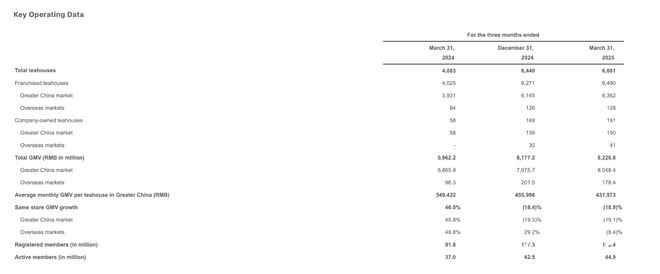
Core Viewpoint - Bawang Chaji (CHA.NASDAQ) recently released its first quarterly report since going public, showing significant revenue growth but also rising operational costs and declining profit margins [1][4]. Financial Performance - In Q1, Bawang Chaji reported a net revenue of 3.3927 billion yuan, a year-on-year increase of 35.4% [4]. - Franchise store revenue accounted for 3.1499 billion yuan, representing 92.8% of total revenue, with a year-on-year growth of 31.8% [4]. - Self-owned store revenue was 242.8 million yuan, making up 7.2% of total revenue, with a year-on-year increase of 7.7% [4]. - The total number of global stores reached 6,681, a year-on-year increase of 63.6% [4]. Cost and Profitability - Total operating expenses for Q1 were 2.5719 billion yuan, a year-on-year increase of 42.8%, outpacing revenue growth [4]. - Material/storage/logistics costs were 1.5903 billion yuan, up 20.8% year-on-year [4]. - Self-owned store operating costs surged to 157 million yuan, a 170% increase due to the addition of 133 new stores [4]. - Net profit for Q1 was 677.3 million yuan, a year-on-year increase of 13.8%, while operating profit rose to 820.8 million yuan, up 16.3% [4]. Cash Flow and Sales Channels - Cash flow for the quarter was 5.3924 billion yuan, a 10% increase from the end of 2024 [5]. - Online sales showed significant growth, with total GMV reaching 8.2268 billion yuan, a year-on-year increase of 38% [5]. - Offline store average monthly GMV declined by 21.4% to 431,970 yuan [5]. Market Dynamics - The competitive landscape in the food and beverage industry is intensifying, with platforms like JD.com entering the delivery market, impacting sales dynamics [5]. - Bawang Chaji's operating profit margin decreased from 28.2% to 24.2%, and net profit margin fell from 23.7% to 20% [5].


透视霸王茶姬(CHA.US)2025一季报:盈利能力领跑同业,海外业务成增长新引擎
智通财经网· 2025-06-03 03:59
Core Viewpoint - The new tea beverage sector has gained significant attention since 2025, marking a transition from "wild growth" to "rational maturity," reflecting the market's recognition of the long-term value of tea consumption [1] Group 1: Company Performance - Bawang Chaji (CHA.US) reported a net income of 3.39 billion yuan in Q1 2025, a year-on-year increase of 35.4%, with total GMV reaching 8.23 billion yuan, up 38% [1] - The company's net profit grew by 13.8% to 677 million yuan, indicating a robust performance despite the industry's adjustment phase [1] - Bawang Chaji maintained a net profit margin of 20% in Q1 2025, consistent with the 20.3% margin for the entire year of 2024, significantly higher than the industry average [3] Group 2: Market Trends - The Chinese tea beverage market is experiencing rapid growth, with a projected market size of 818.9 billion yuan in 2024 and an expected CAGR of 11.5% from 2019 to 2024 [2] - The ready-to-drink tea segment is the fastest-growing, with a CAGR of 21.7% from 2019 to 2024, expected to reach 272.7 billion yuan in 2024 [2] Group 3: Competitive Landscape - The current competitive landscape in the ready-to-drink tea industry is improving, with a net closure of 50,000 stores as the industry enters a clearing phase [3] - Investment activity in the ready-to-drink tea sector has decreased, with 2024 seeing the lowest levels of financing events and amounts in recent years [3] Group 4: Operational Efficiency - Bawang Chaji has enhanced operational efficiency through automated tea-making equipment, allowing staff to produce a standardized drink in 8 seconds [4] - The company has established a two-tier warehousing network covering 37 cities, achieving low inventory turnover days of approximately 5.3 days and logistics costs accounting for less than 1% of total GMV [4] Group 5: International Expansion - Bawang Chaji's international strategy has shown significant results, with overseas GMV reaching 178 million yuan in Q1 2025, a year-on-year increase of 85.3% [6] - The company has opened its first North American store in Los Angeles, achieving over 5,000 cups sold on the opening day, indicating strong market acceptance [7] Group 6: Strategic Positioning - Bawang Chaji's unique strategy of focusing on "big single products" and "original leaf fresh milk tea" has created a competitive advantage, with 91% of GMV in China coming from original leaf fresh milk tea [3] - The brand's differentiation and focus on quality and unique product offerings position it well for long-term growth in a competitive market [8]
霸王茶姬(CHA.US)上市后首份季报:淡季不淡,韧性与成长性并存
Ge Long Hui· 2025-06-03 00:49
Core Insights - The article highlights the strong performance of the new consumption sector, particularly in the tea beverage industry, with BaWang Tea Ji showcasing significant growth despite traditionally being a slow season [1][2]. Group 1: Financial Performance - BaWang Tea Ji reported a GMV of 82.3 billion yuan in Q1, a year-on-year increase of 38%, and a net revenue of 33.9 billion yuan, up 35.4% [2]. - The net profit for the quarter was 6.77 billion yuan, reflecting a 13.8% increase, with a net profit margin of 20% [2]. - The company expanded its global store count to 6,681, adding 241 stores in the quarter, with a total increase of 2,598 stores year-on-year [2]. Group 2: Market Expansion - BaWang Tea Ji's overseas market GMV reached 1.78 billion yuan, growing 85.3% year-on-year, with 169 overseas stores, primarily in Malaysia and Singapore [3]. - The company is actively exploring localized strategies in Southeast Asia and North America, with plans to open 300 stores in Malaysia over the next three years [6][8]. Group 3: Product Innovation - The company invested 53.6 million yuan in product development, launching the "Light Cause" series to cater to consumers with specific needs, including those sensitive to caffeine [3][9]. - The "Light Cause" series features products with significantly reduced caffeine content, appealing to a broader demographic, including young adults and pregnant women [10][11]. Group 4: User Ecosystem - BaWang Tea Ji emphasizes user engagement through initiatives like the "Listening to Consumer" project, which aims to create a positive feedback loop between consumer insights and business optimization [12][13]. - The company has seen a 109.6% year-on-year increase in registered members, reaching 192.4 million, with 44.9 million active users in the quarter [3][14]. Group 5: Strategic Pillars - The company is building three strategic pillars: ongoing global expansion, differentiated product innovation, and a robust user ecosystem, which are crucial for its market positioning and future growth potential [4][15].
消费Insights | 霸王茶姬上市后首份财报:两个疑惑,找到答案
华尔街见闻· 2025-06-02 11:33
Core Viewpoint - Bawang Chaji (CHA.US) has demonstrated robust growth in its first quarterly report since going public, with significant increases in store count, GMV, and net income, reflecting a strong performance amid global uncertainties [1][3][10]. Group 1: Financial Performance - The company reported a total of 6,681 stores globally, with a GMV of 8.23 billion yuan in the first quarter, marking a year-on-year increase of 38% [1][4]. - Total net revenue reached 3.39 billion yuan, up 35.4% year-on-year, while net profit was 677 million yuan, reflecting a 13.8% increase [1][4][6]. - The average monthly GMV per store decreased slightly from 456,000 yuan to 432,000 yuan, attributed to seasonal factors and the ramp-up period for new stores [4][6]. Group 2: User Growth and Marketing - The company has seen a significant increase in registered members, surpassing 190 million, with 15 million new members added in the quarter [7][10]. - Active users reached 44.9 million, maintaining a leading position in the industry [7][10]. - Increased marketing expenses contributed to user growth, with management expenses rising to 353 million yuan and sales expenses to 299 million yuan, driven by new product promotions and advertising [6][10]. Group 3: Expansion Strategy - Bawang Chaji aims to expand its international presence, with 169 overseas stores as of March 31, 2025, primarily in Malaysia, Singapore, and Thailand, showcasing strong growth potential [12][14]. - The overseas GMV reached 178 million yuan, a remarkable year-on-year growth of 85.3%, indicating the potential of international markets [12][14]. - The company is focusing on single-market breakthroughs and expanding into high-value markets, leveraging local partnerships to enhance operational efficiency and brand recognition [14][15]. Group 4: Product Innovation - The company emphasizes product innovation centered around tea, with a strategy that includes both traditional tea drinks and new product lines like pure tea and freshly brewed tea [18][20]. - Bawang Chaji has introduced limited-time offerings and collaborations with cultural IPs to enhance brand appeal and attract diverse consumer segments [21][22]. - The company is investing significantly in product development, with administrative expenses rising to 352.8 million yuan, primarily for R&D and talent acquisition [21][22].

霸王茶姬Q1海外市场GMV大增85%;快手海外业务首次季度盈利|36氪出海·要闻回顾
36氪· 2025-06-01 12:25
Core Insights - The article highlights the significant growth opportunities for Chinese companies in overseas markets, particularly in Southeast Asia and the Middle East, with a focus on Indonesia's $50 billion healthcare market and various successful expansions by Chinese brands [3][4][6][7][9][10]. Group 1: Market Opportunities - 36Kr is organizing events to help Chinese companies explore opportunities in Indonesia's $50 billion healthcare market, featuring insights from Indonesian government officials [3]. - The Chinese Ministry of Commerce reported that the China-Latin America economic cooperation agreements have exceeded $3 billion this year, indicating strong bilateral trade relations [4][12]. - The automotive sector shows promise, with China's automobile exports reaching $19.39 billion in April 2025, reflecting a 6.9% month-on-month increase [17]. Group 2: Company Performances - Bawang Tea's Q1 report shows an 85% increase in overseas GMV, with a total of 6,681 global stores [6]. - Kuaishou achieved its first quarterly profit in overseas operations, with a 32.7% year-on-year revenue growth [6]. - Wanglaoji has initiated localized production in Malaysia, marking its first overseas manufacturing effort [7]. Group 3: Strategic Expansions - GAC Group has launched operations in Brazil, planning to introduce five new vehicle models and expand its sales points significantly by 2025 [12]. - WeRide is entering the Saudi market with plans for comprehensive Robotaxi services by 2025 [9]. - Xiaomi's Q1 revenue reached RMB 111.3 billion, with a focus on expanding its market share in Africa [10]. Group 4: Investment and Financing - TanTu Technology completed a 200 million RMB Series B financing round to enhance its core component development and global market expansion [4]. - BoLi New Materials raised over 200 million RMB in Series B funding to accelerate 3D printing technology development [20]. - Chenglian Technology secured nearly 200 million RMB in B+ round financing to support its global expansion and product upgrades [21].

中国公司全球化周报|霸王茶姬Q1海外总GMV大增85%/快手海外业务首次季度盈利
3 6 Ke· 2025-06-01 04:06
Group 1: Industry Insights - A series of themed events will be launched to help Chinese companies explore opportunities in Indonesia's $50 billion healthcare market, featuring insights from Indonesian government officials [2] - The Chinese Ministry of Commerce announced the completion of the 3.0 version upgrade negotiations for the free trade area with ASEAN, aiming to enhance trade and investment cooperation [12] - The China-Middle East and Gulf Cooperation Council (GCC) summit highlighted the potential for deeper economic collaboration, particularly in digital economy and green energy sectors [12] Group 2: Company Developments - Bawang Tea Ji reported a 38% year-on-year increase in total GMV to 8.23 billion yuan in Q1 2025, with overseas GMV growing by 85.3% to 178 million yuan [3] - Kuaishou's overseas revenue reached 1.3 billion yuan in Q1 2025, marking a 32.7% year-on-year growth, with the company achieving its first quarterly operating profit in international markets [3] - Wanglaoji has initiated local production in Malaysia, marking its first overseas manufacturing venture, which will also serve markets in Indonesia and Thailand [4] Group 3: Market Expansion - GAC Group has officially launched operations in Brazil, planning to establish 120 sales points by the end of 2025 and introduce five new vehicle models [9] - Xiaomi's Q1 2025 revenue reached 111.3 billion yuan, a 47.4% increase, with a focus on expanding its market share in Africa [7] - Pinduoduo's Q1 2025 revenue was 95.7 billion yuan, a 10% year-on-year increase, but faced challenges with a 38% decline in operating profit [8] Group 4: Strategic Partnerships - Xiaoma Zhixing has partnered with the Dubai Roads and Transport Authority to launch a Robotaxi fleet, with plans for full commercial operation by 2026 [6] - WeRide is set to enter the Saudi market with plans for comprehensive Robotaxi services by 2025, having already tested its products in key cities [6] - Meituan's new business segment reported a revenue increase of 19.2% to 22.2 billion yuan in Q1 2025, with a focus on international expansion [6]


一季度收入超33亿,霸王茶姬将从快速扩张转向提高同店销售
Nan Fang Du Shi Bao· 2025-05-31 09:52
Core Viewpoint - Bawang Chaji (NASDAQ: CHA) reported its first quarterly earnings post-IPO, showing strong revenue growth but a slowdown in store expansion and same-store sales performance [1][5]. Financial Performance - In Q1 2024, Bawang Chaji achieved revenue of 3.39 billion RMB, a year-on-year increase of 35.4% [1]. - The net profit for the same period was 677 million RMB, reflecting a year-on-year growth of 13.8% [1]. - The total GMV (Gross Merchandise Volume) reached 8.227 billion RMB, up 38.0% year-on-year, although the average GMV per store decreased by 5.27% quarter-on-quarter and 21.38% year-on-year to 432,000 RMB [1][2]. Store Expansion - As of March 31, 2024, Bawang Chaji operated 6,681 stores globally, with 6,512 in China and 169 overseas [1]. - The net increase in stores for Q1 2024 was 241, a significant slowdown compared to an average of 732 stores per quarter in 2023 [1]. Same-Store Sales - The same-store sales growth for Bawang Chaji was negative at -18.9% in Q1 2024 [2]. - The company is shifting its strategy from rapid market penetration to focusing on same-store sales growth through new products and enhanced customer experiences [2]. Overseas Market Performance - In the overseas market, Bawang Chaji's GMV grew by 85.3% year-on-year, reaching 178 million RMB, with a net increase of 13 stores [3]. - The company has plans to expand further in Southeast Asia, including a joint venture in Malaysia to open 300 stores over the next three years [3]. Cost and Profitability - The net profit margin decreased by 3.7 percentage points to 20.0%, and the operating profit margin fell by 4.0 percentage points to 24.2% in Q1 2024 [5]. - Significant increases in operational costs were noted, with materials, storage, and logistics costs rising by 20.8% to 1.59 billion RMB, and store operating costs increasing by 170.0% to 157 million RMB [5]. Company Background - Bawang Chaji was founded in 2017 in Yunnan and specializes in fresh leaf milk tea [6]. - The company went public on NASDAQ on April 17, 2024, becoming the first Chinese tea beverage company listed in the U.S. [6]. - As of May 30, 2024, Bawang Chaji's stock price was $28.01, with a market capitalization of approximately 51.41 billion USD, equivalent to about 370 billion RMB [6].
霸王茶姬上市后首份财报, 一季度海外市场总GMV增长85%,全球门店数达6681家
Zheng Quan Shi Bao Wang· 2025-05-30 13:29
Core Insights - Bawang Chaji (NASDAQ: CHA) reported its first quarterly earnings for Q1 2025, showcasing strong growth in both GMV and net revenue [1][2] - The company aims to expand its presence in Southeast Asia and North America, with significant new store openings planned [3] Financial Performance - As of the end of Q1 2025, Bawang Chaji's total GMV reached 8.23 billion yuan, a year-on-year increase of 38% [1] - The total net revenue for the quarter was 3.39 billion yuan, reflecting a year-on-year growth of 35.4% [1] - Net profit for the quarter was 677 million yuan, with a net profit margin of 20%, consistent with the previous year's margin [1] Store Expansion - The total number of global stores reached 6,681, with 241 new stores opened in the quarter, marking an increase of 2,598 stores compared to the same period last year [2] - The company has 6,512 stores in China (including Hong Kong) and 169 overseas [2] Membership Growth - Bawang Chaji added approximately 15 million new members in Q1, bringing the total registered members to 192.4 million, a year-on-year increase of 109.6% [2] - The number of active users for the quarter was 44.9 million [2] International Expansion - The overseas market GMV reached 178 million yuan, showing a year-on-year growth of 85.3% [2] - The company opened its first flagship store in Indonesia and its first North American store in Los Angeles, both receiving strong initial sales [3] Cost Structure - General and administrative expenses for Q1 were 352.8 million yuan, up 62.1% year-on-year, primarily due to increased product development and IT services [3] - The company invested 53.6 million yuan in product development during the quarter [3] Product Innovation - Bawang Chaji launched new product lines in March and May, including the "Qingyin" series, to enhance its product offerings [3]
Chagee(CHA) - 2025 Q1 - Earnings Call Presentation
2025-05-30 12:50
DISCLAIMER This presentation cortains forward-rooking statements withn the nearing of Securities Echanne Ad of 1334, as amedied. Thee forward-ocking statements are nade under the '0. Prinate Securities Litjadon Reforn Ad of 1955. These statenents on be inemindoxy such as "will," expects," antipates," fantipates," folune," "phans," beformates," potimule and similar statenents. Orage may aso make witten or ral forward-obing statements in Is percistic reports b the U.S. Sewrities and Extrange Conmission (the " ...
杯盏间的刀光剑影:茶饮股的营销博弈之道
Jin Rong Jie· 2025-05-30 12:49
Core Insights - The article highlights the contrasting business models of tea beverage brands in China, with a focus on the shift from self-operated models to asset-light franchise operations, exemplified by brands like Mixue and Bawang Chaji [1][29]. Business Models - Mixue and other emerging brands like Gu Ming, Hu Shang A Yi, and Cha Bai Dao primarily adopt a franchise model for rapid expansion, generating revenue mainly from supplying products and equipment to franchisees rather than from franchise fees [1][2]. - In contrast, traditional franchise models, such as McDonald's, rely heavily on rental income and franchise fees, providing a safety net even if franchisees perform poorly [2]. Marketing Strategies - Mixue employs social media and various offline activities to engage consumers, with a marketing expenditure of 1.599 billion RMB in 2024, representing 6.44% of total revenue [3][4]. - Gu Ming's marketing spending surged by 42.43% to 479 million RMB, accounting for 5.45% of its revenue [5][6]. - Hu Shang A Yi focuses on a multi-channel marketing approach, with a marketing budget of 394 million RMB, which is 12.0% of its revenue [7][9]. - Cha Bai Dao's marketing expenses increased by 201.64% to 395 million RMB, making up 8.03% of its revenue, reflecting the competitive landscape [10][11]. - Bawang Chaji's marketing costs skyrocketed by 323.96% to 1.109 billion RMB, constituting 8.94% of its revenue, indicating aggressive promotional efforts [12]. Store Expansion - Mixue has expanded to 46,500 stores globally, with a significant presence in lower-tier cities, where 51.33% of its stores are located [13][14]. - Gu Ming has established a presence in 17 provinces, with 80% of its stores in second-tier and below cities, indicating a focus on untapped markets [15][16]. - Hu Shang A Yi operates 9,176 stores across various regions, with 50.4% in lower-tier cities, and has begun international expansion [18][19]. - Cha Bai Dao has increased its store count in lower-tier cities, with plans for further expansion and improved logistics [22]. - Bawang Chaji has rapidly expanded to 6,440 stores, with a notable presence in East China, but faces challenges in maintaining growth [23][24]. Franchisee Retention - The article discusses the importance of franchisee retention rates as a measure of brand attractiveness, with Mixue showing a lower franchisee turnover rate compared to its competitors [26][28]. - Mixue's franchisee turnover rate is approximately 6.97%, while Gu Ming, Hu Shang A Yi, and Cha Bai Dao report significantly higher rates of 18.88%, 19.47%, and 20.66%, respectively [28]. Conclusion - The article concludes that the new tea beverage brands are reshaping the industry with a franchise ecosystem that emphasizes supply chain efficiency over traditional rental models [29]. - Mixue stands out for its effective low-cost marketing strategy, while Bawang Chaji's aggressive expansion raises questions about sustainable growth [29].