
DiDi(DIDIY)

Search documents
滴滴针对司机推出“淡季无单赔”等措施
Bei Jing Shang Bao· 2025-11-19 11:50
Core Points - The seventh "Didi Driver Festival" is being held in 17 cities starting from November 18, where 58 outstanding drivers were recognized and awarded cash prizes [1] - Didi announced six major improvement measures for 2025, including "off-season no order compensation," "penalty compensation," "instant withdrawal," "Didi Driver Service Plan," "care public welfare assistance," and "driver stations" [1] - Didi's CEO Cheng Wei emphasized the festival's purpose is to recognize and motivate drivers while providing updates on the company's progress and adjustments based on driver feedback [1] - Didi's CEO of the ride-hailing platform, Sun Shu, highlighted the importance of income for drivers and the need for service innovation to boost passenger demand [1] Summary by Sections Driver Recognition and Awards - The festival recognized 58 excellent drivers and awarded 100 "Ten-Year Outstanding Drivers" with 18,888 yuan each [1] Improvement Measures for 2025 - Didi plans to enhance driver rights and protections through the "Didi Driver Protection Plan 2.0," focusing on income security, care and welfare, rights protection, and feedback mechanisms [2] - The company has collected over 725,000 driver opinions through various channels, addressing 482 categories of issues and resolving 205 [2] Service Innovation - Didi is exploring innovative service offerings tailored to different customer needs, such as Didi Light Enjoy, Selected Fast Cars, charter services, and pet travel [1]

滴滴举办第七届司机节 网约车CEO孙枢宣布加大司机公益投入
Xin Lang Ke Ji· 2025-11-19 11:08
Core Points - The seventh "Didi Driver Festival" was held in 17 cities across the country starting November 18, with Didi's founder and CEO Cheng Wei delivering a video address [1] - Didi established the Driver Festival to recognize and motivate drivers who work hard and provide quality service, while also reporting on the company's progress over the past year [1] - Didi launched the "Ten-Year Driver Incentive Program" to honor 100 driver representatives who have been with the platform for over ten years, aiming to inspire more outstanding drivers [1] Group 1 - CEO of Didi's ride-hailing platform, Sun Shu, emphasized that income is the primary concern for drivers, and that service, innovation, and quality are essential to increase passenger demand and expand the market [1] - Didi is implementing innovative services tailored to specific scenarios, such as Didi Light Enjoy, Selected Fast Car, Charter, and Pet Travel, to meet diverse consumer needs and boost travel consumption [1] - Didi plans to continue increasing its investment in driver welfare and has established the "Didi Care Public Welfare Assistance Program," which has supported over 2,500 driver families facing major illnesses or accidents since its inception in 2018 [1] Group 2 - In 2025, Didi will upgrade the "Didi Driver Protection Plan" 2.0, enhancing driver rights and protections in four areas: income security, care and welfare, rights protection, and feedback and supervision mechanisms [2]
商贸社服行业周报:双十一大促收官,全网电商销售额平稳增长-20251118
CMS· 2025-11-18 08:34
Investment Rating - The report maintains a "strongly recommended" rating for Alibaba, Pinduoduo, JD.com, and Vipshop, indicating a positive outlook for these companies in the e-commerce sector [17][20][21]. Core Insights - The overall e-commerce sales during the 2025 Double Eleven shopping festival reached 1,695 billion yuan, marking a year-on-year growth of 14.2% [5][24]. - JD.com achieved record sales during the 11.11 event, with a 40% increase in the number of orders and nearly 60% growth in order volume [2][26]. - The report highlights the strong performance of the local life services sector, particularly Meituan, which maintains long-term competitive advantages despite competitive pressures [17]. Summary by Sections E-commerce Sector - The report emphasizes the low valuations of leading e-commerce companies, recommending Alibaba, Pinduoduo, JD.com, and Vipshop as key investment opportunities [17][20]. - Alibaba's e-commerce monetization rate is steadily improving, with significant growth potential in its cloud and AI businesses [17]. - Pinduoduo is expected to see sustainable growth driven by its support plan for merchants and improving global market prospects [20]. Local Life Services - Meituan's long-term investment value remains intact despite short-term competitive disruptions, with a focus on high-value users and operational efficiency [17]. Travel and Tourism - The travel sector is projected to maintain high growth, with recommendations for companies in the OTA and scenic spots, as well as transportation and hotel sectors driven by business travel demand [17]. - The report notes that the restaurant and tourism index rose by 4.81%, outperforming major indices [5][6]. Retail Sector - The report suggests focusing on quality retail trends, with companies like Yonghui adapting to consumer trust and product quality [17]. - The retail sector is experiencing significant growth, with notable increases in various product categories during the Double Eleven sales [5][24].


中国公司全球化周报|滴滴自动驾驶出海首站落户中东阿布扎比/菜鸟与AKI集团达成合作
3 6 Ke· 2025-11-17 11:55
Company Developments - Didi Autonomous Driving has established its first overseas station in Abu Dhabi, partnering with the Abu Dhabi Investment Office to support smart mobility and sustainable transportation initiatives [5][6]. - Two Chinese companies, Loong and WeRide, received the first batch of fully autonomous commercial operation licenses in Abu Dhabi, allowing them to operate Robotaxi services without onboard safety personnel [5][6]. - Cao Cao Mobility signed a memorandum of understanding with the Abu Dhabi Investment Office to promote electric and battery-swapping vehicles in the region [5]. - Cainiao Network partnered with Al Khayyat Investments to enhance logistics efficiency in the UAE using AI technology [5]. Market Trends - Ant Group showcased its AI products at the Singapore FinTech Festival, emphasizing its global strategy and partnerships with over 13,000 enterprises across 24 countries [7]. - TikTok Shop in Southeast Asia reported a 2.3 times increase in total transaction volume during the Double Eleven shopping festival compared to the previous year, indicating strong market potential [7]. - AliExpress surpassed Amazon in app downloads in several countries during its overseas Double Eleven sales event, with over 200 brands achieving double the average daily sales of Amazon [7]. Investment and Financing - Paitena Robotics completed a multi-million A round financing to enhance its construction robotics and overseas expansion efforts [8]. - Xunming Biotechnology raised tens of millions of dollars in A round financing to advance its antibody drug development and global partnerships [8]. - Langchong Future secured a Pre-A round financing of over 100 million yuan, with 90% of its revenue coming from overseas markets [8]. - Andao Pharmaceutical completed a C round financing of over 400 million yuan to accelerate clinical research for its new drugs globally [8]. Policy and Market Insights - Global investment in data centers is projected to exceed oil spending for the first time, with an expected investment of $580 billion in data centers by 2025 [9]. - The EU plans to eliminate the tax exemption for low-value packages by 2026, accelerating the timeline for this policy change [10]. - China holds a 56.6% share of the global laser equipment market, with significant growth in exports to the Middle East, Europe, and Southeast Asia [10]. - Chinese electric motorcycle brands are rapidly expanding in Southeast Asia, with significant market shares in Thailand and Vietnam [10].

宇树科技完成IPO辅导,滴滴自动驾驶出海 | 投研报告
Zhong Guo Neng Yuan Wang· 2025-11-17 01:44
Core Viewpoint - The automotive sector in A-shares underperformed the broader market, with a decline of 2.11% compared to the 1.08% drop in the CSI 300 index [2] Group 1: Market Performance - The automotive sector's decline of 2.11% places it 26th among A-share Shenwan first-level industries [2] - The SW passenger vehicle index saw a slight increase of 0.03%, with Haima Automobile and Jianghuai Automobile leading the gains [2] - The SW commercial vehicle index increased by 0.14%, with Jinlong Automobile and CIMC Vehicles leading [2] - The SW auto parts index experienced a decline of 3.19%, with Langbo Technology and Yingli Automobile leading the losses [2] Group 2: Industry Highlights - Yushu Technology completed IPO guidance and plans to issue shares domestically [2] - Didi's autonomous driving initiative expands to Abu Dhabi [2] - Baidu's "RoboTaxi" service begins full commercialization in Abu Dhabi [2] - The Ministry of Public Security will introduce acceleration time limits for new energy vehicles [2] - Dongfeng Motor plans to mass-produce its next-generation solid-state battery by September next year, with an energy density of 350Wh/kg [2] - Yika Technology will provide intelligent cockpit solutions for multiple Volkswagen models in Latin America [2] - NIO's Firefly will connect to NIO's fifth-generation battery swap stations [2] - CATL and GAC Group signed a 10-year strategic cooperation agreement to promote the chocolate battery swap ecosystem [2] - The 2025 Guangzhou Auto Show will feature 93 new car debuts and a total of 1,085 vehicles on display [2] - Global sales of new energy vehicles increased by 26% year-on-year in the first three quarters [2] Group 3: Recommendations - For complete vehicle manufacturers, companies to watch include BYD, Geely Automobile, Great Wall Motors, Leap Motor, Seres, BAIC Blue Valley, Jianghuai Automobile, Li Auto-W, Xpeng Motors-W, GAC Group, and Changan Automobile [3] - In the commercial vehicle sector, recommended companies include China National Heavy Duty Truck, FAW Liberation, Weichai Power, Tianrun Industrial, and Foton Motor [3] - For auto parts, companies to focus on include Songyuan Safety, Fengmao Co., Ningbo Gaofa, Baolong Technology, Bertley, Junsheng Electronics, Zhejiang Xiantong, Fuyao Glass, Wuxi Zhenhua, China Automotive Research, Desay SV, Huguang Co., Shuanghuan Transmission, Songyuan Co., Top Group, Best, Sanhua Intelligent Control, Debang Lighting, Changshu Automotive Trim, New Spring Co., Jingzhu Technology, Kabeiyi, Jifeng Co., Shanghai Yanpu, and Mingxin Xuteng [3]
滴滴自动驾驶加入阿布扎比智能和自动驾驶汽车产业集群SAVI
Bei Jing Shang Bao· 2025-11-13 10:01
Core Insights - Didi Autonomous Driving has announced a strategic partnership with the Abu Dhabi Investment Office (ADIO) to collaborate on autonomous driving technology innovation, AI talent development, and ecosystem building [1] Group 1: Partnership Details - Didi Autonomous Driving joins the Abu Dhabi Smart and Autonomous Vehicle Industry Cluster (SAVI) [1] - The collaboration aims to support Abu Dhabi in building a leading smart mobility and sustainable transportation ecosystem [1] - The partnership is expected to expand to a broader scope across the Middle East region [1] Group 2: SAVI Industry Cluster - The SAVI industry cluster is initiated by the Abu Dhabi Department of Economic Development and ADIO, positioning itself as a smart transportation hub in the Middle East and North Africa [1] - The cluster aims to promote innovation and commercialization of autonomous driving technologies across land, sea, and air [1] - ADIO projects that by 2045, the SAVI cluster will contribute 44 billion dirhams to Abu Dhabi's GDP and create 40,000 jobs [1]
滴滴自动驾驶出海落子中东 将在阿布扎比开展技术合作与人才培养
Feng Huang Wang· 2025-11-13 08:49
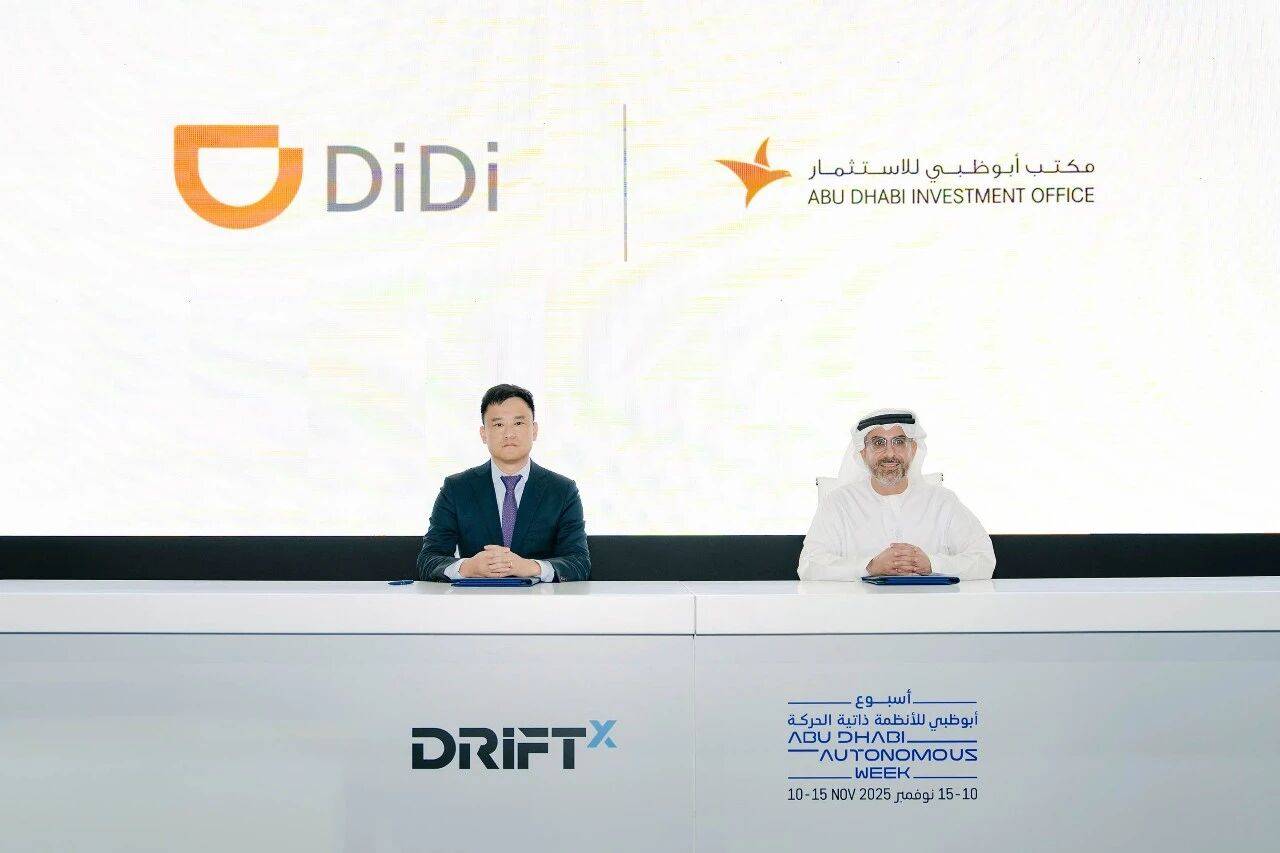
Core Insights - Didi Autonomous Driving has announced a strategic partnership with the Abu Dhabi Investment Office (ADIO), marking its entry into the Middle East market [1] - The collaboration will focus on the application of autonomous driving technology, AI talent development, and ecosystem construction [1] Group 1: Strategic Partnership - Didi has joined the Abu Dhabi Smart and Autonomous Vehicle Industry Cluster (SAVI), which aims to establish a smart transportation hub in the Middle East and North Africa [1] - The SAVI cluster is supported by the local Department of Economic Development and the Investment Office, with plans to cover multi-dimensional R&D and commercialization of autonomous driving technologies [1] Group 2: Economic Impact - The SAVI cluster is projected to contribute 44 billion dirhams to Abu Dhabi's economy and create 40,000 jobs by 2045 [1] Group 3: Company Statements - Badr Al-Olama, Director General of the Abu Dhabi Investment Office, emphasized that this partnership is a crucial step in shaping the future transportation system [1] - Didi's Vice President Wang Yue stated that the Middle East market is a vital part of its global strategy, leveraging its experience in Level 4 autonomous driving to advance smart mobility solutions [1] - Didi's autonomous driving system has achieved over 1,900 days of continuous safe operation, with a new generation autonomous vehicle developed in collaboration with GAC Aion set for delivery by the end of the year [1]
滴滴自动驾驶宣布与阿布扎比投资办公室达成战略合作
Sou Hu Cai Jing· 2025-11-13 08:36
Core Insights - Didi Autonomous Driving has announced a strategic partnership with the Abu Dhabi Investment Office (ADIO) to support the development of smart mobility and sustainable transportation ecosystems in Abu Dhabi and the broader Middle East region [1][3] Group 1: Strategic Partnership - The partnership involves Didi joining the Abu Dhabi Smart and Autonomous Vehicle Industry Cluster (SAVI) to collaborate on innovation in autonomous driving technology, AI talent development, and ecosystem building [1][3] - The collaboration aims to establish Abu Dhabi as a leading hub for smart mobility and sustainable transportation [1][3] Group 2: Economic Impact - The SAVI cluster, initiated by the Abu Dhabi Department of Economic Development and ADIO, is expected to contribute 44 billion dirhams to Abu Dhabi's GDP and create 40,000 jobs by 2045 [3] Group 3: Company Positioning - Didi Autonomous Driving is recognized as a global leader in autonomous driving technology, and the partnership is seen as a key milestone in shaping the future of transportation in Abu Dhabi [3] - The Middle East is identified as a crucial part of Didi's global strategy, aligning with Abu Dhabi's goals for smart city development and sustainable growth [3] Group 4: Technological Advancements - Didi Autonomous Driving focuses on L4-level autonomous driving technology, leveraging advanced AI for research and product application [4] - The company has achieved over 1,900 days of safe operation and plans to deliver a new generation of autonomous vehicles in collaboration with GAC Aion by the end of the year [4]
滴滴自动驾驶宣布出海,首站落户中东阿布扎比
Xin Lang Ke Ji· 2025-11-13 08:01
Core Insights - Didi Autonomous Driving has announced a strategic partnership with the Abu Dhabi Investment Office (ADIO) to join the Smart and Autonomous Vehicle Industry Cluster (SAVI) in Abu Dhabi, focusing on innovation in autonomous driving technology, AI talent development, and ecosystem building [2][2][2] Group 1: Strategic Partnership - The collaboration aims to support Abu Dhabi in building a leading smart mobility and sustainable transportation ecosystem, with plans to expand cooperation across the broader Middle East region [2][2] - The SAVI industry cluster, initiated by the Abu Dhabi Department of Economic Development and ADIO, is positioned as a smart transportation hub in the Middle East and North Africa [2][2] Group 2: Economic Impact - ADIO projects that the SAVI industry cluster will contribute 44 billion dirhams to Abu Dhabi's GDP and create 40,000 jobs by 2045 [2][2] - The partnership is seen as a key milestone in shaping the future of transportation in Abu Dhabi, with expectations for Didi to drive the large-scale application of autonomous driving technology in the region [2][2] Group 3: Company Perspectives - Didi Autonomous Driving views the Middle East as a crucial part of its global strategy, aligning with Abu Dhabi's goals for smart city development and sustainable growth [2][2] - The company aims to leverage local partnerships to advance autonomous driving technology and enhance user experience in the Middle East [2][2]

滴滴自动驾驶宣布与阿布扎比投资办公室(ADIO)达成战略合作
Mei Ri Jing Ji Xin Wen· 2025-11-13 07:50
Core Viewpoint - Didi Autonomous Driving has announced a strategic partnership with the Abu Dhabi Investment Office (ADIO) to collaborate on autonomous driving technology innovation, AI talent development, and ecosystem construction in the Middle East region [1] Group 1 - Didi Autonomous Driving joins the Abu Dhabi Smart and Autonomous Vehicle Industry Cluster (SAVI) [1] - The collaboration will focus on open cooperation in various fields, including technology innovation and talent cultivation [1] - The partnership aims to gradually expand cooperation to a broader Middle Eastern region [1]