Alphabet(GOOG)

Search documents
AI 供应链:CES 展会影响、ASIC 芯片生产、中国 AI 芯片-Asia-Pacific Technology-AI Supply Chain CES implications, ASIC production, China AI chips
2026-01-07 03:05
Summary of Key Points from the Conference Call Industry Overview - The focus is on the **AI semiconductor industry**, particularly the dynamics surrounding **AI GPUs** and **AI ASICs**. The demand for these components is expected to be strong in 2026, driven by supply factors such as memory availability and TSMC's 3nm technology [1][4][42]. Core Insights - **Nvidia's Production**: Nvidia's management reported that the **Rubin** compute board is in "full production," with assembly time significantly reduced from approximately **2 hours** for Blackwell to about **5 minutes** for Rubin. The launch is anticipated in the **second half of 2026** [2][54]. - **China's AI Chip Demand**: There is a forecast of around **2 million units** of H200 chips demanded by Chinese customers, with ongoing licensing processes. Companies like **ByteDance** are actively developing AI server racks compatible with both Nvidia and local chips [4][84]. - **Market Size Projections**: The total AI chip market is projected to reach **US$550 billion** by **2029**, which includes both AI GPUs and ASICs. This reflects a significant growth trajectory for the sector [5][42]. Capacity and Production Dynamics - **TSMC's CoWoS Capacity**: TSMC is expected to expand its CoWoS capacity by **20-30%** in 2026, with a revised forecast of **125kwpm** by the end of the year, marking a **79% increase** from previous estimates [12][43]. - **ASE/SPIL and Amkor**: Both ASE/SPIL and Amkor are also expanding their CoWoS capacities to meet rising demand from key customers like Nvidia, AMD, and AWS [13][14]. - **Google TPU Production**: Google is accelerating the production of its next-generation **TPU** chips, moving the timeline from **4Q26** to **3Q26**. Broadcom has also booked **30k** of CoWoS-S capacity to meet TPU demand [26][28]. Financial Outlook - **Revenue Growth**: TSMC is projected to generate **US$107 billion** from AI chip foundry services by 2029, which would account for about **43%** of its total revenue [44]. - **Cloud Capex Spending**: Estimated cloud capital expenditure for 2026 is projected to reach **US$632 billion**, indicating robust investment in AI infrastructure [45]. Risks and Considerations - **Supply Chain Risks**: The primary concerns for 2026 are expected to be shortages in memory, T-Glass, and TSMC's 3nm wafers, rather than CoWoS capacity itself [43][42]. - **China's Localization Efforts**: China is expected to increase its local chip production to support AI development, which may create additional demand for both local and foreign chips [81][82]. Additional Insights - **ByteDance's AI Server Racks**: At a recent conference, ByteDance showcased its **256-node AI server racks**, which are designed to work with both Nvidia and local AI chips, highlighting the competitive landscape in China's AI market [84]. - **Market Dynamics**: The AI semiconductor market is characterized by rapid growth and evolving dynamics, with significant implications for companies involved in chip production and supply chain management [42][43]. This summary encapsulates the key points discussed in the conference call, providing insights into the current state and future outlook of the AI semiconductor industry.



How Google Got Its Groove Back and Edged Ahead of OpenAI
WSJ· 2026-01-07 02:00
Core Insights - After the initial success of ChatGPT in the chatbot market, Google has responded with a robust AI model and a significant overhaul of its search engine [1] Group 1 - Google has launched a powerful AI model to compete with ChatGPT, indicating a strategic shift in its approach to AI technology [1] - The search engine overhaul is described as the largest in years, highlighting the company's commitment to enhancing its search capabilities [1]


近十年后谷歌与波士顿动力再「牵手」,这次要为人形机器人注入「灵魂」
机器之心· 2026-01-07 00:49
Core Viewpoint - Boston Dynamics and Google DeepMind have announced a new AI partnership aimed at ushering in a new era of artificial intelligence for humanoid robots, with a focus on enhancing industrial tasks and transforming the manufacturing sector, particularly in the automotive industry [1][7]. Group 1 - The collaboration will integrate DeepMind's advanced Gemini Robotics AI model with Boston Dynamics' new Atlas humanoid robot [6]. - The joint research efforts are expected to commence in the coming months, with activities taking place within both companies [8]. - Boston Dynamics aims to create the world's most capable humanoid robot and sees DeepMind as the ideal partner to develop a new visual-language-action (VLA) model for these complex robots [9]. Group 2 - DeepMind's Gemini Robotics model is designed to bring AI into the physical world, enhancing the capabilities of Boston Dynamics' Atlas robots [10]. - The partnership is viewed as a strong alliance, with DeepMind providing intelligence and Boston Dynamics offering a top-tier hardware platform [10]. - The combination of Gemini Robotics' foundational capabilities with Atlas hardware represents a significant advancement in embodied intelligence for robotics [12]. Group 3 - The collaboration has generated excitement among observers, with some anticipating a competitive showdown between Western robots like Atlas and Chinese counterparts [13]. - Historical context reveals that this is not the first collaboration between the two companies; Google previously acquired Boston Dynamics in 2013 but sold it due to unmet market expectations [14]. - The renewed partnership reflects a maturation of technology conditions, with both companies now better positioned to leverage each other's strengths [14][15]. Group 4 - The significance of this collaboration raises questions about which company stands to gain more, whether it is Boston Dynamics' victory or the beginning of a new chapter for Google in robotics [15]. - The partnership is poised to create a future where humans and machines coexist and collaborate [16].

昨夜,全线收涨!涉及美联储降息!
Xin Lang Cai Jing· 2026-01-07 00:29
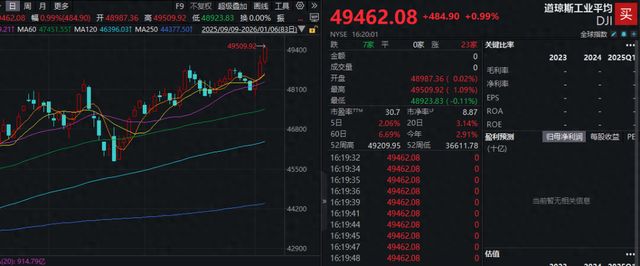
Group 1: Market Performance - The U.S. stock market saw all three major indices rise, with the Dow Jones Industrial Average reaching a new historical high, approaching the 50,000 mark, closing at 49,462.08 points, up 0.99% [3] - The Philadelphia Semiconductor Index increased by 2.75%, setting a new historical high, with notable gains in chip stocks such as Microchip Technology up over 11%, Micron Technology up over 10%, and NXP Semiconductors up over 9% [5][6] Group 2: Federal Reserve Insights - Federal Reserve Governor Milan stated that the Fed should lower interest rates by more than 100 basis points this year, as economic data trends may support further rate cuts [5] - Milan noted that core inflation has returned to around the Fed's 2% target, and he expects strong economic growth in the U.S. this year [5] Group 3: Commodity Prices - Silver prices surged again, with COMEX silver futures breaking the $80 per ounce mark, reflecting a rise of approximately 6% [8] - Gold prices also saw a slight increase, with COMEX gold futures surpassing $4,500 per ounce, up over 1% [8]


盘前必读丨央行定调2026年重点工作;两大牛股1月7日起停牌核查
Di Yi Cai Jing· 2026-01-06 23:17
Market Overview - The US stock market closed higher, with the Dow Jones and S&P 500 indices reaching all-time closing highs. The S&P 500 rose by 0.62%, the Nasdaq increased by 0.65%, and the Dow Jones gained 0.99% [3] - The core drivers of the market were semiconductor and AI-related stocks, particularly following announcements from Nvidia's CEO regarding new AI processors and storage technology [3] - Semiconductor stocks performed exceptionally well, with SanDisk surging over 27%, Western Digital up 17%, Seagate Technology rising 14%, and Micron Technology increasing by 10% [3] - The Philadelphia Semiconductor Index rose by 2.75%, marking a historical record with a cumulative gain of approximately 8% in the first three trading days of the year [3] Technology Sector - Large tech stocks showed mixed performance, with Amazon leading at a 3.38% increase, followed by Microsoft at 1.20%. However, Tesla fell sharply by 4.14%, and Nvidia declined by 0.47% [3] - Chinese concept stocks faced pressure, with the Nasdaq Golden Dragon China Index dropping by 0.78%. Notable movements included a 70.83% surge in Zhongchi Chefu and a 3.18% increase in ASE Technology [4] Commodity Market - Gold prices continued to rise, with spot gold increasing by 0.8% to $4485.39 per ounce [5] - International oil prices retreated, with light crude oil futures for February delivery falling by 2.04% to $57.13 per barrel [5] Regulatory Developments - The Chinese Ministry of Commerce announced stricter export controls on dual-use items to Japan, effective immediately, to safeguard national security [6] - The People's Bank of China outlined its monetary policy for 2026, emphasizing a moderately loose approach and support for economic development and financial stability [6] Financial Sector Insights - Financial institutions anticipate an improvement in market liquidity due to increased credit issuance and fiscal fund allocation at the beginning of the year [9] - Analysts suggest that the Shanghai Composite Index may experience slight upward fluctuations, urging investors to monitor macroeconomic data and policy changes closely [9]





Prediction: These 4 Quantum Computing Stocks Will Skyrocket in 2026
The Motley Fool· 2026-01-06 19:10
Core Insights - Quantum computing is expected to make significant advancements in 2026, although it will not reach mainstream adoption yet [1] - Companies like Alphabet, Microsoft, Nvidia, and IonQ are positioned to benefit from developments in quantum computing [1][6] Group 1: Alphabet and Microsoft - Alphabet and Microsoft are leading players in quantum computing due to their vast resources and strong cloud computing divisions [2][3] - Both companies aim to develop their own quantum computing hardware to control costs and improve margins when renting out capacity [3] - The competitive landscape will keep both companies engaged in quantum computing, although AI will be the primary driver of their growth in 2026 [6] Group 2: Nvidia - Nvidia is a key player in AI and traditional computing, providing a bridge between quantum computers and supercomputers through its NVQLink technology [7][9] - While Nvidia is not directly developing quantum computing units, its technology supports hybrid systems that could be crucial for future quantum computing applications [10] Group 3: IonQ - IonQ is a pure-play quantum computing startup focused on achieving commercial viability through high accuracy [11] - The company holds a record for two-qubit gate fidelity at 99.99%, significantly higher than competitors, positioning it favorably in the market [12][13] - IonQ's progress in reducing error rates could lead to substantial stock growth if it continues to advance its technology [14]




2 Undervalued AI Companies to Buy in 2026 and Hold for Decades
Yahoo Finance· 2026-01-06 19:05
Core Insights - The most durable AI investments will be driven by companies integrated into AI adoption and monetization trends, rather than short-term earnings spikes [1] - 90% of AI investors plan to hold or buy more AI stocks in the next year, highlighting a strong long-term interest in the sector [1] Micron Technology - Micron's Q1 fiscal 2026 earnings show a 57% year-over-year revenue increase to $13.6 billion and a 167% year-over-year EPS surge to $4.78, driven by high demand for DRAM and NAND memory from data center and AI customers [3] - The high-bandwidth memory (HBM) market is expected to grow from $35 billion in 2025 to $100 billion in 2028, with Micron holding a 21% market share, providing strong revenue visibility and pricing power [4] - Memory is becoming a strategic component for AI systems, with increasing memory content per device across various applications, positioning Micron as a potential long-term earnings compounder [5] Alphabet - Alphabet is effectively monetizing its AI technologies on a global scale, contributing to its growth prospects [6] - Both Micron and Alphabet have experienced significant share price gains in 2025 while maintaining reasonable valuations relative to their future growth potential [6]
Boston Dynamics' Atlas Robot Gets Ready for Real Work
Barrons· 2026-01-06 19:02
Core Insights - The company has announced the launch of its first commercial version of the Atlas humanoid robot, which is specifically designed for industrial applications [1] Group 1 - The Atlas humanoid robot is aimed at enhancing efficiency in industrial work environments [1] - This launch marks a significant milestone in the company's robotics development, indicating a shift towards commercializing advanced robotic technologies [1] - The introduction of the Atlas robot may open new market opportunities within the industrial sector, potentially leading to increased revenue streams for the company [1]

3 Stocks Greg Abel, Warren Buffett's Successor, May Be Watching in 2026
Yahoo Finance· 2026-01-06 17:33
Group 1 - Warren Buffett has officially stepped down as CEO of Berkshire Hathaway, passing the role to Greg Abel, who will now be responsible for the conglomerate's stock picks [1] - The change in leadership raises questions about how Berkshire's stock-picking strategy may evolve under Abel's guidance [2] - Abel's background in the energy sector may influence Berkshire's investment decisions, particularly regarding Occidental Petroleum, where the company already owns 27% [4][5] Group 2 - Buffett's historical aversion to technology stocks may not be shared by Abel, who could consider increasing Berkshire's stake in Alphabet, which is currently valued at over $5 billion [6][8] - The existing position in Alphabet represents less than 2% of Berkshire's total stock portfolio, suggesting potential for further investment [6] - Abel's approach may focus on consolidating positions in well-established growth companies like Alphabet, contrasting with Buffett's previous strategy [8]

AI 算力破局关键!52 页先进封装报告逐页拆解(含隐藏机遇)
材料汇· 2026-01-06 16:00
Core Insights - The article discusses the rising costs associated with advanced semiconductor processes, highlighting that the transition from planar FET to FinFET and Nanosheet technologies has led to exponential increases in design and manufacturing costs, making it difficult for small and medium enterprises to invest in advanced processes [8][9]. - The industry is shifting towards higher concentration among leading foundries, while advanced packaging technologies allow smaller companies to participate in high-end chip design without relying on advanced processes [9][11]. - The article emphasizes the importance of heterogeneous integration and the need for tailored architectures based on application scenarios, indicating a trend towards dynamic adjustments in advanced packaging strategies [25][56]. Cost Trends - Design costs have surged from $28 million for 65nm processes to $725 million for 2nm processes, with manufacturing investments also increasing significantly [9]. - The investment required for a 5nm factory is five times that of a 20nm factory, indicating a substantial financial barrier for smaller players in the industry [8]. Architectural Comparisons - The article compares four architectures, noting that smaller systems (like mobile chips) benefit from a "large chip + 3D stacking" approach, while larger systems (like AI servers) favor a "chiplet + 3D stacking" strategy to balance performance and cost [16][24]. - As system complexity increases, the advantages of chiplet-based designs become more pronounced, particularly in terms of cost efficiency [17][23]. Advanced Packaging Technologies - Advanced packaging is evolving to meet the demands of AI and high-performance computing, with technologies like 2.5D and 3D packaging becoming standard for high-end chips [36][72]. - The integration of HBM (High Bandwidth Memory) with 2.5D packaging has become a standard, driven by the need for high memory bandwidth in AI applications [29][36]. Interconnect Technologies - The article highlights the critical role of interconnect technologies in enhancing I/O density, with projections showing a significant increase in interconnect density from 1960s levels of 2/mm² to future levels of 131072/mm² [38]. - Advanced packaging is shifting from being a secondary process to a core component of performance enhancement, with interconnect-related technologies expected to yield higher profit margins than traditional packaging [39][42]. Market Dynamics - The article notes that the demand for advanced packaging is driven by the need for high bandwidth, miniaturization, and low power consumption, particularly in edge AI applications [49][50]. - The automotive sector's transition from distributed ECUs to centralized computing is pushing for higher integration levels, which in turn drives advancements in packaging technologies [53][56]. Technology Evolution - The evolution of packaging technologies is characterized by a shift from single technology optimization to system-level engineering design, necessitating cross-domain integration capabilities [68][70]. - The article outlines a clear roadmap for the evolution of interconnect technologies, indicating that the industry is entering a phase of rapid technological iteration driven by market demands [154][165]. Cost Structure - The cost structure for 2.5D packaging is primarily driven by the interposer (Si/mold/silicon bridge) and packaging substrate, while for 3D packaging, the key cost factor is the bonding process [168][169]. - The differences in cost structures dictate the profitability models for companies, with 2.5D packaging firms needing to manage interposer and substrate costs, while 3D packaging firms focus on optimizing bonding yields and efficiency [169].