
Goldman Sachs(GS)

Search documents
X @Bloomberg
Bloomberg· 2025-11-19 05:06
"We believe that much of the absorption of tariffs has actually been in the value chain in the company margin and hasn't been passed on," says Goldman Sachs President and COO John Waldron at the Bloomberg #NewEconomyForum in Singapore.Follow the latest here: https://t.co/UmzuzSob5x ...

高盛预计2026年美国将出现更多裁员
Di Yi Cai Jing· 2025-11-19 04:57
(文章来源:第一财经) 据报道,高盛总裁约翰·沃尔德伦表示,预计通胀将持续,2026年美国将出现更多裁员。 ...
高盛:通胀将保持顽固态势 预计2026年美国将有更多裁员
Xin Lang Cai Jing· 2025-11-19 04:44
格隆汇11月19日|高盛集团总裁John Waldron表示,高盛的观点是,通货膨胀将保持"顽固"的态势。"我 认为 2026 年将会是裁员的年份,"他补充道,这里他所指的是美国的企业。 来源:格隆汇APP ...
高盛:2040年前石油需求持续增长
Zhong Guo Hua Gong Bao· 2025-11-19 02:34
Core Insights - Goldman Sachs' new report indicates that global oil demand will continue to grow until 2040, driven by limited substitutes for aviation fuel and petrochemical products, energy demand growth outpacing low-carbon technology alternatives, and an indirect increase in demand of 3 million barrels per day due to artificial intelligence boosting global GDP [1][2] Group 1: Oil Demand Projections - Global oil demand is expected to rise from 103.5 million barrels per day in 2024 to 113 million barrels per day by 2040, with an average annual increase of 600,000 barrels per day [1] - The International Energy Agency (IEA) has also projected that under current policy scenarios, global oil demand will continue to grow until 2050, highlighting a significant divergence from previous annual World Energy Outlook reports [1] Group 2: Key Drivers of Demand - The petrochemical sector is anticipated to become the main driver of oil demand growth as road transport oil consumption is expected to peak around 2030, with petrochemical oil demand (naphtha, ethane, liquefied petroleum gas) growing by an average of 500,000 barrels per day, representing a 2.1% increase [2] - Non-OECD countries are projected to contribute over 90% of the growth in petrochemical oil demand over the next 15 years, with China and the Middle East leading this growth due to the concentration of petrochemical and plastic production facilities in these regions [2] Group 3: Impact of Artificial Intelligence - Artificial intelligence is expected to indirectly drive global oil demand by promoting economic growth, with an estimated increase of 3 million barrels per day by 2040 under baseline scenarios [2] - In an optimistic scenario where AI is fully adopted, this demand-boosting effect could reach up to 6 million barrels per day by 2040 [2]
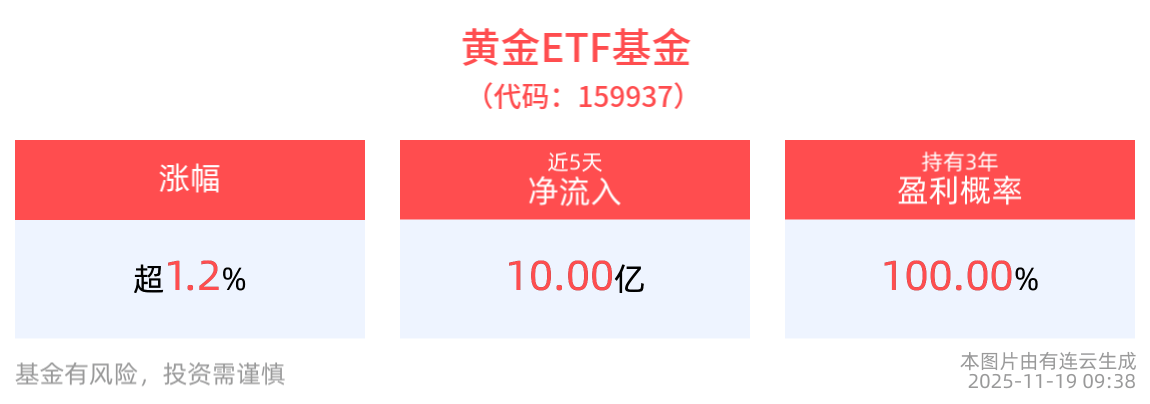
避险情绪提振避险需求,金价止跌回升,黄金ETF基金(159937)高开涨超1.2%,近2日“吸金”超6.8亿元
Sou Hu Cai Jing· 2025-11-19 02:03
Group 1 - The core viewpoint of the articles highlights the increasing interest in gold as a safe-haven asset, driven by geopolitical and financial risks, with significant purchases by central banks and rising gold prices expected to continue [3] - As of November 18, 2025, the gold ETF fund has seen a 0.50% increase over the past two weeks, with a current price of 8.87 yuan and a trading volume of 6397.36 million yuan [2] - Gold prices have risen 55% year-to-date, influenced by economic concerns, geopolitical tensions, and increased inflows into exchange-traded funds (ETFs) [3] Group 2 - Goldman Sachs estimates that central banks purchased 64 tons of gold in September, a significant increase from 21 tons in August, indicating a trend towards diversifying reserves [3] - The recent hawkish statements from Federal Reserve officials have corrected previous overly optimistic rate cut expectations, contributing to a price pullback in gold, although strong support is seen around the $4000 per ounce level [3] - The latest net inflow into the gold ETF fund is 3.65 billion yuan, with a total of 10 billion yuan in net inflows over the past five trading days, indicating strong investor interest [3]

全球市场观点 - 交易 2025,布局 2026-Global Market Views_ Trading 2025, Thinking 2026
2025-11-19 01:50
Summary of Key Points from the Conference Call Industry Overview - The analysis focuses on the global macroeconomic environment, particularly the implications of the US labor market and Federal Reserve policies on equity markets and investment strategies. Core Insights and Arguments 1. **US Labor Market Risks**: The US labor market remains a significant near-term macro risk, with rising layoffs indicating potential for a quicker increase in the unemployment rate. The upcoming October jobs report is critical, as it may not provide clarity until mid-December. A meaningful rise in unemployment could escalate recession fears, impacting risk assets negatively [5][9][11]. 2. **Economic Outlook for 2026**: The baseline scenario suggests that if the labor market remains stable, growth recovery in 2026 could be supported by fiscal policy and easing tariff risks. However, there is a potential challenge if the market's confidence in the Fed's easing path is undermined by improving economic conditions [9][11][19]. 3. **AI Market Dynamics**: The pricing of AI-related stocks has advanced significantly since the introduction of ChatGPT, with market valuations reflecting high expectations for future economic contributions. This optimism may lead to increased volatility and potential disappointments if the anticipated returns do not materialize [11][15][19]. 4. **China's Economic Impact**: China's exports are expected to grow by 5%-6% annually, driven by cost competitiveness and market share gains in non-US economies. This growth could have both positive and negative spillover effects globally, potentially squeezing competitors while providing a disinflationary impulse [16][19][24]. 5. **Federal Reserve Leadership Changes**: Anticipation of changes in Fed leadership could influence market expectations regarding monetary policy. An insider appointment may reinforce aggressive easing expectations, while other candidates could lead to a more cautious approach, affecting asset prices and the USD [19][24][29]. 6. **Emerging Markets (EM) Performance**: The macro backdrop remains supportive for EM assets, with equities and currencies performing well. There is a focus on reallocating investments towards domestic-oriented markets like India, Brazil, and South Africa, which may offer better balance amid potential volatility [32][33][38]. 7. **Dollar Valuation Trends**: The USD is expected to experience further depreciation due to less exceptional macro performance. However, this may be more pronounced against pro-cyclical currencies in G10 and EM, while the CNY is anticipated to appreciate gradually [24][25][29]. 8. **Market Volatility and Risk Management**: The current market environment suggests a balancing act between maintaining exposure to risk assets while being protected against potential economic downturns and volatility in AI narratives. Strategies may include positioning for higher equity volatility and underperformance in credit markets [37][38][39]. Other Important Considerations - The analysis emphasizes the fragility of current market conditions, with potential vulnerabilities to both growth disappointments and inflationary pressures. The interplay between fiscal policy, labor market dynamics, and AI investment trends will be crucial in shaping the investment landscape moving forward [5][9][11][19].
Goldman Sachs ETFs Recently Hit $50 Billion in AUM
Etftrends· 2025-11-18 19:31
Core Insights - Goldman Sachs' ETF suite has surpassed $50 billion in total AUM, marking a significant milestone for the firm in the ETF management industry [1] - The firm's largest ETF, the TR Activebeta US Large Cap Equity ETF (GSLC), has achieved over $14.5 billion in AUM since its launch, emphasizing high quality, strong momentum, and low volatility stocks [2] - The Access Treasury 0-1 Year ETF (GBIL) has seen the most significant growth, adding over $3.5 billion in AUM over the last five years, currently standing at just under $6.5 billion [2] - The Goldman Sachs ActiveBeta International Equity ETF (GSIE) has reached $4.7 billion in AUM, benefiting from a 26.6% YTD return, and has added $1.6 billion over the last five years [3] ETF Performance and Strategy - GSLC charges a low fee of 9 basis points and tracks a multifactor index focused on quality and momentum [2] - GBIL, with a fee of 12 basis points, tracks U.S. Treasury securities expiring within the next 12 months and has outperformed its category average with a 2.9% return over the last five years [2] - GSIE applies a multifactor approach similar to GSLC but focuses on international equities, contributing to its strong performance [3] Future Outlook - Goldman Sachs' ETFs are expected to continue attracting investor interest due to their distinct strategies and performance metrics [3]

Goldman Sachs pinpoints the 5 stocks that will get the biggest productivity boost from AI
Yahoo Finance· 2025-11-18 18:15
Core Insights - Hyperscalers are investing heavily in AI infrastructure, leading to speculation about when small- and mid-cap stocks will benefit from this technology [1] - Goldman Sachs identifies distinct phases of AI development, with current gains concentrated in hardware makers like Nvidia, while suggesting investors should focus on the next phase [1][2] AI Adoption and Market Focus - Despite ongoing AI adoption, returns have primarily been seen in the infrastructure sector rather than in applications or productivity [2] - Analysts note that corporate AI adoption and concerns about AI infrastructure risks have shifted investor focus towards potential beneficiaries of AI-driven productivity gains [3] Companies Highlighted for AI Potential - Goldman Sachs has identified several companies that are sensitive to AI disruption and have high labor costs, making them potential beneficiaries of AI productivity gains [4] - Five stocks were flagged, including H&R Block, Robert Half, and Cognizant, which are expected to see significant profit boosts from AI adoption [4] Detailed Company Analysis - **H&R Block (Ticker: HRB)** - Share of wage bill exposed to AI automation: 41% - Labor costs as % of sales: 46% - Average percentile rank of potential AI boost among Russell 1000 companies: 97th - Potential boost to earnings: 51% [5] - **Robert Half (Ticker: RHI)** - Share of wage bill exposed to AI automation: 38% - Labor costs as % of sales: 79% - Average percentile rank of potential AI boost among Russell 1000 companies: 96th - Potential boost to earnings: 270% [5] - **Cognizant Technology Solutions** - Specific data not provided, but included among the companies expected to benefit from AI adoption [4]


高盛:各国央行11月可能继续大举购金
Sou Hu Cai Jing· 2025-11-18 16:11
今年迄今金价已上涨55%,主要受经济与地缘政治担忧、黄金ETF资金流入增加以及对美国进一步降息 的预期推动。(国际财闻汇) 高盛周一表示,各国央行在11月可能继续大量购金,这延续了近年来为分散外汇储备、对冲地缘政治与 金融风险的长期趋势。 高盛预计,9月份央行购金量为64吨,高于8月份的21吨。到2026年底,金价将升至4900美元;如果私人 投资者继续分散投资组合,金价可能会进一步上涨。 ...
Goldman Sachs: Oil Prices To Drop to $53 In 2026
Yahoo Finance· 2025-11-18 15:30
Core Viewpoint - Oil prices are expected to decline further into next year due to a significant market surplus, with WTI Crude projected to average $53 per barrel in 2026 [1][3]. Group 1: Current Market Conditions - As of early Tuesday, WTI Crude was trading at $60.09 per barrel, reflecting a 0.22% increase on the day [1]. - There has been a notable increase in global oil inventories, with stocks rising by 2 million barrels per day (bpd) over the last 90 days [2]. Group 2: Future Projections - Goldman Sachs anticipates an average surplus of 2 million bpd in the oil market next year, with 2026 marking the end of the current significant supply wave [3]. - Low WTI prices in the low $50s per barrel are expected to slow U.S. shale capital expenditures and production growth, leading to a market rebalancing by 2027 [3]. Group 3: Long-term Supply and Demand Outlook - Future supply growth is expected to primarily come from OPEC, which has spare capacity and is investing in expansion [4]. - U.S. shale production may see modest growth, contingent on Brent Crude prices reaching around $80 per barrel by the end of the decade [4]. - By 2040, global oil demand could rise to 113 million bpd, up from 103.5 million bpd in 2024, indicating a shift from previous predictions of peak demand in 2034 [5].