Intel(INTC)

Search documents
从入门到旗舰:上班族装机不可错过的五大CPU
Xin Lang Cai Jing· 2026-01-07 01:45
Core Insights - The article emphasizes the importance of selecting a suitable CPU for enhancing productivity in office environments, particularly for tasks involving long hours of software use, large file handling, and content creation [1][5]. Group 1: Recommended CPUs - Intel Core i5-10400F is priced at 880 yuan, featuring a 6-core, 12-thread design, suitable for multitasking in office applications and light image processing, with a good energy efficiency ratio due to its 14nm process and 65W low power consumption [1][5]. - Intel Core i5-13490F is priced at 1599 yuan, positioned as a mid-range model with 10 cores (6 performance and 4 efficiency) and a maximum turbo frequency of 4.8GHz, ideal for professionals engaged in office work and light design tasks [2][6]. - Intel Core i3-12100 is available for 990 yuan, offering 4 cores and 8 threads, with a base frequency of 3.3GHz, making it suitable for basic office tasks and small businesses [2][6]. - AMD Ryzen 9 9950X3D, although its price is not yet announced, is expected to be a flagship product for 2025, featuring 16 cores and 32 threads, with a maximum boost frequency of 5.7GHz, tailored for high-intensity tasks like video rendering and 3D modeling [4][7]. - Intel Core i9-14900K is priced at 4999 yuan, boasting 24 cores and 32 threads, with a peak frequency of 6.0GHz, designed for demanding applications such as large presentations and multi-track video editing [4][7]. Group 2: Market Positioning - Each CPU is strategically positioned to meet specific user needs, from budget-friendly options for entry-level users to high-end processors for professionals requiring maximum performance [4][7]. - The article highlights the significance of matching CPU performance with user requirements and budget to create an efficient work platform [4][7].


高负载不卡顿:i7处理器编程体验大升级
Xin Lang Cai Jing· 2026-01-07 01:45
Core Insights - The article highlights three different Intel Core i7 processors that cater to various needs of developers, emphasizing their performance and suitability for high-load tasks in both mobile and desktop environments [1][4]. Group 1: Product Recommendations - The first recommended product is the Intel Core i7-9750H, a mobile flagship processor with 6 cores and 12 threads, featuring a base frequency of 2.6GHz and a maximum turbo frequency of 4.5GHz, priced at 0.0 yuan [5][6]. - The second recommendation is the Intel Core i7-12700F, a desktop processor with a hybrid design of 12 cores and 20 threads, a maximum turbo frequency of 4.90GHz, and a price of 2280.0 yuan [3][6]. - The third product is the Intel Core i7-9700, which has 8 cores and 8 threads, a maximum turbo frequency of 4.90GHz, and is priced at 2599.0 yuan, offering strong performance in single-threaded applications [3][6][7]. Group 2: Performance and Features - The i7-9750H is particularly suitable for developers who travel frequently, as it can handle heavy development environments and lightweight AI training tasks, supported by an RTX 2070 Max-Q GPU and 16GB DDR4 RAM [5][6]. - The i7-12700F supports DDR5 4800 MT/s memory and PCIe 5.0, making it ideal for future upgrades and capable of handling large-scale data processing and algorithm simulations with a TDP of only 65W [3][6]. - The i7-9700 remains competitive in Java backend and web full-stack development, offering strong compatibility and stability for users with budget constraints [3][6][7]. Group 3: Target Audience - The i7-9750H is aimed at mobile developers who require portability and performance [4][7]. - The i7-12700F targets high-performance desktop users looking for advanced multi-threading capabilities [4][7]. - The i7-9700 is designed for practical developers who prioritize stability and compatibility in their systems [4][7].
编译提速50%?这些处理器让开发效率翻倍
Xin Lang Cai Jing· 2026-01-07 01:45
深夜调试代码,编译任务堆积如山,系统卡顿让人焦躁——这是许多嵌入式开发工程师日常面临的挑 战。一款具备强劲多核性能、高频率响应和先进架构支持的CPU,不仅能缩短构建时间,更能提升虚拟 机运行、交叉编译与仿真环境的流畅度。在预算允许的前提下,选择2000元以上的高性能处理器已成为 专业开发者的共识。今天,我们为追求极致效率的嵌入式开发者精选四款实力出众的CPU,覆盖主流旗 舰与前沿新品,助力打造高效稳定的开发平台。 Intel 酷睿 Ultra 7 265K 到手价3199.0元,作为Arrow Lake架构的先锋之作,其采用Foveros 3D封装与 TSMC N3B制程工艺,带来前所未有的能效比升级。20核心(8性能核+12能效核)设计,在无超线程模 式下仍实现20线程并行处理,特别适合同时运行多个容器化开发环境或进行大规模固件编译。性能核最 高可达5.5GHz睿频,配合DDR5 6400 MT/s内存支持与PCIe 5.0通道,数据吞吐能力卓越。更值得关注的 是其集成NPU峰值达13TOPS(Int8),AI总峰值25TOPS,可加速本地AI推理任务,满足智能边缘设备 开发需求,是面向未来的嵌入式AI开发 ...
不只是快:i9为科研场景打造极致算力体验
Xin Lang Cai Jing· 2026-01-07 01:45
Intel 酷睿 i9-13900K 定价5500.0元,是桌面级科研主机 的核心力量。同样采用24核32线程架构,性能核最高频 率5.4GHz,最大睿频突破5.8GHz,二级缓存高达 32MB,确保复杂指令快速响应。TDP虽达253W,但在 风冷或水冷条件下可长期维持高频运行,适用于长时间 连续仿真的科研负载。支持ECC内存纠错技术,有效防 止因内存错误导致的数据偏差,在生物信息学、量子计 算等对精度要求极高的领域尤为关键。此外,原生支持 HDMI 2.1与DP 1.4a,便于连接高分辨率显示器进行可视 化分析,兼顾性能与实用性的全能表现使其成为实验室 主力机的优选。 Intel 酷睿 i9-13900HX 到手价为0.0元,定位于高性能移 动平台,却具备媲美桌面处理器的运算能力。24核32线 程,性能核睿频达5.4GHz,支持PCIe 5.0共20通道,极大提升SSD与GPU的通信效率,特别适合搭载于 便携式科研设备或野外采集系统中。其BGA封装适配高端移动主板,双通道内存设计保障数据吞吐流 畅,集成显卡支持DirectX 12.1与Quick Sync视频加速,可用于实时图像预处理。尽管功耗上限为 15 ...
今年CES,芯片厂商又开始“神仙打架”
3 6 Ke· 2026-01-07 00:42
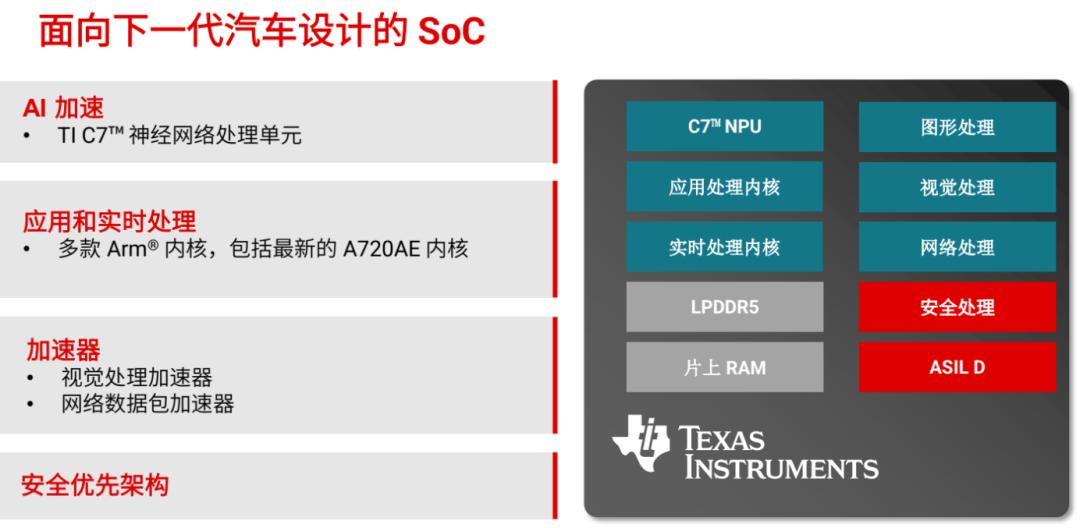
Group 1: TI's Automotive Innovations - TI launched three powerful automotive products at CES: the TDA5 series SoC, AWR2188 radar transmitter, and DP83TD555J-Q1 Ethernet PHY [1][4][7] - The TDA5 SoC features a maximum performance of 1200 TOPS and an energy efficiency of over 24 TOPS/W, with a 12-fold increase in AI computing power compared to previous generations [1] - AWR2188 is the industry's first single-chip 8x8 radar solution, enhancing performance by 30% and achieving high-precision detection for targets over 350m [4] - The DP83TD555J-Q1 Ethernet PHY supports nanosecond-level time synchronization and can transmit power and data over the same line, reducing cable design complexity and costs [7] Group 2: ADI's Diverse Solutions - ADI showcased various solutions in automotive, consumer, and robotics sectors, highlighting the A²B 2.0 solution with four times the bandwidth of its predecessor [10] - The automotive solutions include advanced lighting control and ADAS systems utilizing machine vision inputs [10][11] Group 3: NXP's High-Integration Processor - NXP introduced the S32N7 processor series, which integrates multiple vehicle functions on a single chip, potentially reducing total cost of ownership (TCO) by up to 20% [12][15] Group 4: Microchip's Demonstrations - Microchip presented demos including the ASA Motion Link for Qualcomm's Ride platform and a software-free intelligent headlight system using 10BASE-T1S technology [17][18] Group 5: Silicon Labs' New SDK - Silicon Labs launched a new Simplicity SDK for Zephyr, enhancing support for embedded systems and showcasing advancements in Bluetooth wireless technology [19] Group 6: Infineon's Development Kit - Infineon and Flex unveiled a modular development kit for regional control units, aimed at accelerating the development of software-defined vehicle architectures [20] Group 7: ST's Automotive Gateway - ST displayed the Osdyne Automotive Gateway, which enhances vehicle communication and security while reducing wiring complexity [22] Group 8: Ambarella's AI Vision Chip - Ambarella released the CV7 AI vision SoC, built on a 4nm process, achieving over 20% power reduction and more than 2.5 times the AI performance of its predecessor [25] Group 9: NVIDIA's Revolutionary Products - NVIDIA introduced the Rubin platform with six new chips and launched the Alpamayo series for AI-assisted driving development [26][28] Group 10: AMD's AI Innovations - AMD announced several new products, including the MI455X GPU and Ryzen AI 400 series processors, emphasizing its comprehensive AI capabilities [29][30] Group 11: Arm's Technology Trends - Arm focused on five key technology trends at CES, including advancements in autonomous driving, robotics, and smart home devices [31][32] Group 12: Industry Trends - The CES highlighted three major trends: the penetration of AI across all technology layers, the shift towards centralized and software-defined automotive electronics, and the importance of ecosystem collaboration over isolated technology competition [33]




美国CES展开幕,14句重要论断
吴晓波频道· 2026-01-07 00:30
Core Insights - The article discusses the collaborative evolution of various AI technologies, including Physical AI, Hybrid AI, and Spatial Intelligence, showcased at CES 2026 [3][26]. Group 1: Event Overview - CES 2026 opened with significant participation from over 4,000 exhibitors and tens of thousands of attendees, covering a vast area of over 2.5 million square feet [4]. - Major AI companies, including NVIDIA, AMD, and Intel, presented their visions and technological paths, indicating a shift from consumer-focused products to data center needs and AI advancements [5][9]. Group 2: Key Themes from Presentations - NVIDIA's founder emphasized that AI must understand the physical world to interact effectively, suggesting that the potential of the physical world exceeds that of the online realm [9][11]. - AMD's CEO highlighted the need for a 100-fold increase in computing power in the coming years to address the "computing power shortage" [11][21]. - Intel focused on the importance of edge AI, which is crucial for applications in healthcare, finance, and industry, emphasizing data privacy and low latency [11][23]. Group 3: Future AI Development Insights - The concept of Physical AI is expected to emerge significantly by 2026, with advancements in automation driven by AI and robotics due to global labor shortages [13][18]. - The number of active AI users has surged from 1 million to over 1 billion, with projections suggesting it could exceed 5 billion, indicating AI's integration into daily life [14]. - The article outlines a shift from passive AI systems to proactive AI agents that can assist in various tasks, marking a transition towards more interactive AI applications [17][24]. Group 4: China's Role in AI - Chinese companies are positioned as key players in the AI landscape, with strengths in application innovation, hardware manufacturing, and specific technological breakthroughs [27][28]. - The article notes that China has a significant advantage in the AI application market due to its diverse and large-scale demand across various sectors [27]. - Chinese enterprises are increasingly contributing to the open-source ecosystem, enhancing their influence in the global tech community [28].


2 Chip Stocks Staging Opposite Moves During CES
Schaeffers Investment Research· 2026-01-06 20:34
Group 1 - Intel launched its latest AI chip, Panther Lake, for laptops, utilizing its new 18A manufacturing process [1] - Intel's stock is currently trading at $39.90, reflecting a 100.9% year-over-year increase, despite facing resistance at $42.50 [2] - The options market shows a strong preference for calls on Intel, with a significant call/put volume ratio of 1.60 for AMD, indicating bullish sentiment [3] Group 2 - AMD's stock is down 3.2% to $213.94, marking its fourth loss in the last five sessions, although it has increased by 173.4% over the past nine months [4] - Options traders are predominantly bearish on AMD, as indicated by its put/call open interest ratio being in the 99th percentile of its annual range [4]
腾讯研究院AI速递 20260107
腾讯研究院· 2026-01-06 16:05
Group 1: Generative AI Developments - Nvidia officially launched the Vera Rubin supercomputing architecture, achieving a 5x increase in inference performance and a 3.5x increase in training performance while reducing costs by 90%, set to be mass-produced and available in the second half of 2026 [1] - AMD introduced the Helios all-liquid-cooled rack platform featuring the MI455X GPU, which has 320 billion transistors and 432GB of HBM4 memory, offering a 10x performance improvement over the MI355X, with a planned release of the 2nm MI500 in 2027 [2] - Intel released the third-generation Core Ultra processor, the first based on Intel's 18A process (1.8nm), achieving 180 TOPS of edge AI computing power, with a 60% increase in multi-threaded performance and a 77% increase in gaming performance [3] Group 2: Key Personnel Changes in AI Companies - OpenAI's VP of Research, Jerry Tworek, announced his departure after seven years, citing a desire to pursue research that cannot be conducted at OpenAI, marking a significant loss of talent following the exits of other key figures [4] Group 3: AI Innovations and Experiments - MiroMind launched the MiroThinker 1.5 model, which, despite having only 30B and 235B parameters, set a new record in the BrowseComp test with a single call cost of just $0.07, innovating through an internalized training mechanism [6] - A professor at Hong Kong University of Science and Technology conducted an experiment using AI glasses powered by GPT-5.2, achieving a score of 92.5 in a computer networking exam, outperforming 95% of students [7] - Boston Dynamics unveiled the new Atlas robot, which stands 1.9 meters tall and weighs 90 kg, with a production goal of 30,000 units annually by 2028, supported by a partnership with Google DeepMind [8] Group 4: AI Training and Performance Enhancements - The ZhiYuan Institute proposed the SOP (Scalable Online Post-training) framework, integrating online, distributed, and multi-task mechanisms for real-world training, achieving a 92.5% success rate in parallel learning experiments [9] - Anthropic's community lead shared 31 practical tips for using Claude Code, emphasizing the importance of understanding when to use specific modes and how to construct prompts effectively [10][11]

扩产不能停!花旗:三星、台积电、英特尔三巨头资本开支将有积极指引
美股IPO· 2026-01-06 16:04
Core Viewpoint - Citigroup anticipates that TSMC will set its 2026 capital expenditure guidance in the range of $46 billion to $48 billion, while Intel's capital expenditure is expected to stabilize, and Samsung may increase its investment following Micron's expansion plans. The combined capital expenditures of these three companies account for approximately 59% of Citigroup's 2026 global WFE spending model, indicating their capital expenditure trends serve as a bellwether for the entire semiconductor equipment industry [1][3]. Group 1: TSMC - TSMC is expected to announce its 2026 capital expenditure guidance between $46 billion and $48 billion, with potential for upward adjustments throughout the year [5]. - Citigroup's model predicts TSMC's capital expenditure for 2026 to be $47 billion, with additional upward potential [5]. - Market expectations for TSMC's 2026 capital expenditure are around $50 billion, reflecting optimism regarding TSMC's expansion efforts [5]. Group 2: Intel - Citigroup forecasts Intel's 2026 capital expenditure to stabilize, benefiting from improvements in its backend customer pipeline, with projected expenditures of $18 billion in 2025 and $15 billion in 2026 [6]. - Intel is expected to maintain its 2025 capital expenditure guidance at $18 billion and project approximately $16 billion for 2026 [6]. - Despite a decrease in capital expenditure for 2026 compared to 2025, Intel's capital spending is expected to stabilize due to growth in its backend packaging business [6]. Group 3: Samsung - Citigroup believes Samsung's 2026 capital expenditure has room for upward adjustment, influenced by Micron's significant increase in capital expenditure guidance [7]. - Samsung's management has indicated a flexible approach to 2026 capital expenditure, planning to increase investments based on the growth in AI demand [7]. - Micron's recent announcement to raise its 2026 net capital expenditure from $18 billion to $20 billion, a 45% increase, may prompt Samsung to take similar actions to maintain its market position [8].

AI 算力破局关键!52 页先进封装报告逐页拆解(含隐藏机遇)
材料汇· 2026-01-06 16:00
Core Insights - The article discusses the rising costs associated with advanced semiconductor processes, highlighting that the transition from planar FET to FinFET and Nanosheet technologies has led to exponential increases in design and manufacturing costs, making it difficult for small and medium enterprises to invest in advanced processes [8][9]. - The industry is shifting towards higher concentration among leading foundries, while advanced packaging technologies allow smaller companies to participate in high-end chip design without relying on advanced processes [9][11]. - The article emphasizes the importance of heterogeneous integration and the need for tailored architectures based on application scenarios, indicating a trend towards dynamic adjustments in advanced packaging strategies [25][56]. Cost Trends - Design costs have surged from $28 million for 65nm processes to $725 million for 2nm processes, with manufacturing investments also increasing significantly [9]. - The investment required for a 5nm factory is five times that of a 20nm factory, indicating a substantial financial barrier for smaller players in the industry [8]. Architectural Comparisons - The article compares four architectures, noting that smaller systems (like mobile chips) benefit from a "large chip + 3D stacking" approach, while larger systems (like AI servers) favor a "chiplet + 3D stacking" strategy to balance performance and cost [16][24]. - As system complexity increases, the advantages of chiplet-based designs become more pronounced, particularly in terms of cost efficiency [17][23]. Advanced Packaging Technologies - Advanced packaging is evolving to meet the demands of AI and high-performance computing, with technologies like 2.5D and 3D packaging becoming standard for high-end chips [36][72]. - The integration of HBM (High Bandwidth Memory) with 2.5D packaging has become a standard, driven by the need for high memory bandwidth in AI applications [29][36]. Interconnect Technologies - The article highlights the critical role of interconnect technologies in enhancing I/O density, with projections showing a significant increase in interconnect density from 1960s levels of 2/mm² to future levels of 131072/mm² [38]. - Advanced packaging is shifting from being a secondary process to a core component of performance enhancement, with interconnect-related technologies expected to yield higher profit margins than traditional packaging [39][42]. Market Dynamics - The article notes that the demand for advanced packaging is driven by the need for high bandwidth, miniaturization, and low power consumption, particularly in edge AI applications [49][50]. - The automotive sector's transition from distributed ECUs to centralized computing is pushing for higher integration levels, which in turn drives advancements in packaging technologies [53][56]. Technology Evolution - The evolution of packaging technologies is characterized by a shift from single technology optimization to system-level engineering design, necessitating cross-domain integration capabilities [68][70]. - The article outlines a clear roadmap for the evolution of interconnect technologies, indicating that the industry is entering a phase of rapid technological iteration driven by market demands [154][165]. Cost Structure - The cost structure for 2.5D packaging is primarily driven by the interposer (Si/mold/silicon bridge) and packaging substrate, while for 3D packaging, the key cost factor is the bonding process [168][169]. - The differences in cost structures dictate the profitability models for companies, with 2.5D packaging firms needing to manage interposer and substrate costs, while 3D packaging firms focus on optimizing bonding yields and efficiency [169].