Microsoft(MSFT)

Search documents
Anthropic appoints Microsoft veteran Irina Ghose as India MD
Reuters· 2026-01-16 04:55
Core Insights - Anthropic, an artificial intelligence startup, has appointed Irina Ghose as its managing director for India, indicating a strategic move to strengthen its presence in the Indian market [1] Company Developments - The appointment of Irina Ghose, a former Microsoft executive, suggests that Anthropic is looking to leverage her experience and expertise to enhance its operations and growth in India [1]



每周死机3次,还疯狂偷数据?一名程序员的Linux迁徙记:“我终于把Win11删光了”
猿大侠· 2026-01-16 04:11
Core Viewpoint - The article discusses the increasing trend of users, particularly developers, migrating from Windows 11 to Linux due to frustrations with data telemetry and software stability issues in Windows 11 [5][19][24]. Group 1: Reasons for Migration - The primary reasons for the shift to Linux are excessive data telemetry and deteriorating software stability in Windows 11, which collects extensive user data without the ability to fully disable it [5][19]. - Users experience frequent system crashes and bugs in Windows 11, leading to a decision to switch to Linux for a more stable and controllable environment [6][19]. Group 2: Linux Distribution Experience - The author highlights the experience of trying various Linux distributions, including Mint, Debian, and Artix, ultimately settling on Artix for its speed and low resource usage [12][15]. - Artix Linux is noted for its lack of SystemD, resulting in faster boot times and lower resource consumption, although it requires more user intervention compared to other distributions [12][13]. Group 3: Challenges Faced - The transition to Linux involved challenges such as missing drivers, particularly for WiFi on older hardware, which required manual installation [14][16]. - The author faced compatibility issues with certain applications and games on Linux, but found workarounds for most problems, highlighting the need for adaptability [16][20]. Group 4: User Experience and Benefits - The article emphasizes the joy of using Linux, with users regaining control over their systems and enjoying a more customizable experience compared to Windows [19][21]. - The ability to manage mobile devices, such as iPhones, was found to be more straightforward on Linux, enhancing the overall user experience [17][18]. Group 5: Conclusion and Outlook - Linux is presented as a viable alternative to Windows, offering flexibility and a deeper understanding of system operations, appealing to users who enjoy a challenge [22][23][24]. - The article encourages those frustrated with Windows 11 to consider switching to Linux, as it is increasingly seen as a practical choice for developers and tech enthusiasts alike [24].

告别免费抓取!维基与亚马逊、Meta等企业构建AI数据付费生态
Huan Qiu Wang· 2026-01-16 03:13
Core Insights - The Wikimedia Foundation announced a partnership with major tech companies including Amazon, Microsoft, and others to establish paid agreements for the use of Wikipedia content in AI model training, marking a shift from web scraping to legal data acquisition [1][4] Group 1: Partnership Details - The collaborations have been formalized over the past year and were previously kept confidential [4] - Companies will utilize Wikimedia's enterprise services to integrate human-governed knowledge resources on a large scale [4] Group 2: Financial Implications - The Wikimedia Foundation, as the largest non-profit encyclopedia platform, hosts over 65 million entries in more than 300 languages, making it a vital source of high-quality data for AI training [4] - The previous free scraping practices led to increased server load and operational costs, while the foundation's primary revenue relied on small public donations [4] - The new paid collaboration model provides a sustainable revenue stream for the non-profit organization [4] Group 3: Value of Knowledge - A spokesperson from the foundation emphasized that the long-term development of AI companies depends on the accumulation of human knowledge, and that paid partnerships respect knowledge producers [4]



Nancy Pelosi bets big on 2 Dividend Stocks in 2026
Yahoo Finance· 2026-01-16 03:03
Core Insights - Nancy Pelosi's stock trades attract attention due to her well-timed investments, particularly in Microsoft and Alphabet, which are significant players in the AI sector [1][2][25]. Company Analysis Microsoft - Microsoft's equity portfolio is valued at approximately $32.5 million, with significant investments in AI infrastructure, spending nearly $35 billion per quarter [2][6]. - The company reported over $77.7 billion in revenue, an 18% year-over-year increase, with its cloud business generating $49.1 billion, growing at 26% [8]. - Microsoft 365 Copilot, an AI assistant, is used by over 90% of Fortune 500 companies, contributing to revenue growth [9]. - The commercial remaining performance obligation reached $392 billion, nearly doubling in two years, indicating strong future revenue commitments [11]. - Microsoft has consistently raised its dividend since 2004, currently at $0.91 per share, yielding around 0.79% [12][13]. Alphabet - Alphabet achieved its first-ever $100 billion revenue quarter, with a 16% increase to $102.3 billion, driven by Google Search revenue of $56.6 billion, up 15% [14]. - AI enhancements have led to increased search queries, with Alphabet monetizing these experiences effectively [15][21]. - Google Cloud revenue grew 34% to $15.2 billion, with operating margins expanding from 17% to nearly 24% [16]. - The backlog for Google Cloud reached $155 billion, an 82% year-over-year increase, indicating strong future revenue potential [18]. - Alphabet's dividend is currently $0.21 per share, yielding about 0.25%, with a 5% increase this year [19][23]. Industry Trends - Both Microsoft and Alphabet are positioned at a critical juncture in the AI infrastructure buildout, with tangible demand reflected in signed contracts worth billions [25][27]. - The AI revolution necessitates substantial infrastructure investment, with only a few companies, including Microsoft and Alphabet, capable of competing at this scale [27]. - The current spending is supported by actual customer commitments and revenue, contrasting with the speculative nature of the dot-com bubble [27].
微软:总部实地调研要点
2026-01-16 02:56
Summary of Microsoft Corp. (MSFT) Conference Call Company Overview - **Company**: Microsoft Corp. (MSFT) - **Market Cap**: $3.4 trillion - **Enterprise Value**: $3.4 trillion - **Industry**: Americas Software Key Takeaways 1. **AI Compute Cycle Management**: Microsoft is focusing on fungibility to navigate the AI compute cycle, addressing both supply constraints and potential excess supply, while also mitigating customer concentration risk [2][3] 2. **Capacity Planning**: The company emphasizes dynamic capacity planning, allowing for the allocation of compute resources across Azure customers, internal R&D, and first-party applications [2][3] 3. **Gross Margin Advantage**: Microsoft benefits from a partnership with OpenAI, enabling it to leverage models without incurring additional LLM API fees, which enhances its gross margin [2][3] 4. **Enterprise Conversations**: There has been a notable shift in enterprise discussions towards greater support for Copilot adoption compared to the previous year [2][3] 5. **EPS Growth Projection**: Microsoft is projected to achieve approximately $35 in EPS by FY30, indicating over 20% EPS growth [2][3] Financial Projections - **Revenue Growth**: Expected revenue growth from $281.7 billion in FY25 to $464.4 billion in FY28, reflecting a compound annual growth rate (CAGR) of approximately 20% [4][10] - **EBITDA Growth**: Projected EBITDA growth from $156.5 billion in FY25 to $279.4 billion in FY28 [4][10] - **EPS Growth**: EPS is expected to grow from $13.71 in FY25 to $23.35 in FY28 [4][10] - **Gross Margin**: Anticipated decline in gross margin from 68.8% in FY25 to 64.0% in FY28 [10] AI and Cloud Strategy 1. **AI Margins Improvement**: Microsoft expects AI margins to improve over time, with parallels drawn between the AI cycle and the early cloud cycle, initially characterized by high costs but improving with scale and efficiency [3][17] 2. **Role of LLMs**: Microsoft sees LLMs as the next abstraction layer, simplifying application logic and improving long-term unit economics [22][24] 3. **Azure Build-Out Strategy**: The company approaches Azure build-out through a supply-demand lens, with a focus on monetization profiles across workloads [25][30] 4. **Fungibility in Infrastructure**: Microsoft's infrastructure strategy is centered on maintaining fungibility across demand planning and data center design, allowing for flexibility in response to evolving demand signals [36][30] Copilot and Enterprise AI Adoption 1. **Shift in Customer Conversations**: Discussions around Copilot have evolved from "if" to "when" regarding adoption, indicating increased confidence among customers [38][39] 2. **Pricing Strategy**: Microsoft employs a value-based pricing approach for Copilot, with a lower-priced business SKU introduced to broaden adoption [40][39] 3. **Enterprise AI Adoption Trends**: There is a growing number of customers using AI, with deployments expanding significantly as familiarity with Copilot increases [38][39] Risks and Valuation - **Valuation**: The current price target is set at $655, based on a 32x P/E multiple of adjusted net income [43] - **Key Risks**: Potential risks include lower-than-expected revenue from the OpenAI partnership, longer ramp-up times for internal silicon, and shifts towards custom software impacting the applications business [43][44] Conclusion Microsoft is well-positioned to capitalize on the evolving AI landscape, with a strong focus on capacity planning, gross margin enhancement through strategic partnerships, and a growing enterprise AI adoption trend. The company's financial projections indicate robust growth, although it faces certain risks that could impact its performance.
马斯克诉OpenAI案将进入陪审团审判
Ge Long Hui· 2026-01-16 02:04
美股频道更多独家策划、专家专栏,免费查阅>> 1月16日,OpenAI与微软未能规避与马斯克对簿公堂。马斯克指控山姆·奥尔特曼创立的这家初创公司在 获得微软数十亿美元投资并计划转型营利性企业后,背叛了其作为一家公益机构的创立使命。加州奥克 兰市联邦法官周四驳回了OpenAI与微软要求驳回马斯克诉讼的请求,并下令此案进入定于四月下旬举 行的陪审团审判程序。 OpenAI发言人回应称:"马斯克的诉讼仍然缺乏依据,是其持续骚扰行为的一部分,我们期待在庭审中 证明这一点。我们将继续专注于赋能OpenAI基金会,该基金会已是史上资源最丰富的非营利组织之 一。"马斯克的代理律师Marc Toberoff及微软方面代表未作出回应。 责任编辑:栎树 ...
数据中心背后民怨沸腾,微软给马斯克上了一课
3 6 Ke· 2026-01-16 01:45
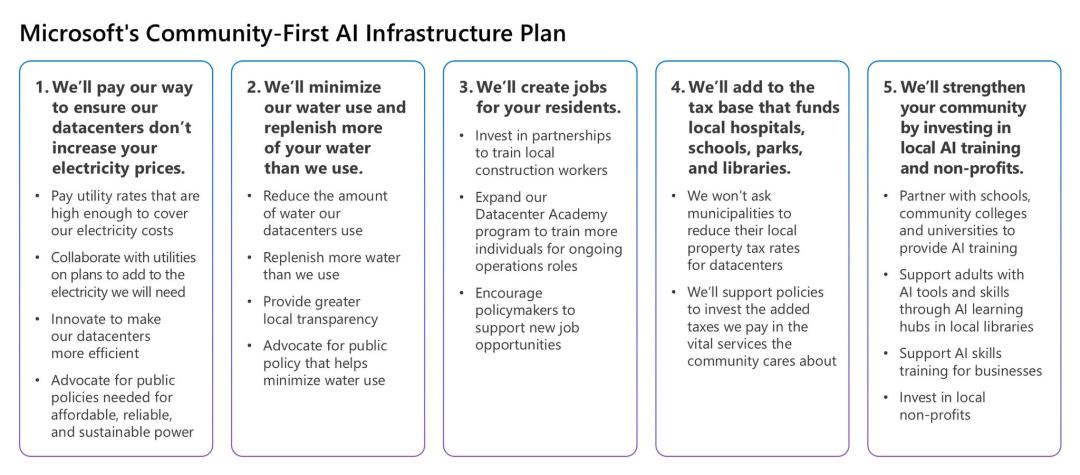
Core Viewpoint - Microsoft has introduced a "Community-First AI Infrastructure" plan, committing to responsible data center development that prioritizes community benefits over costs, aiming for a win-win between technological innovation and local employment [1][3][23]. Group 1: Microsoft's Commitments - Microsoft will not seek electricity subsidies or tax breaks, ensuring that local residents do not bear the costs of increased electricity prices due to data centers [2][23]. - The company promises to minimize water usage and replenish more water than it consumes, investing in local water systems [2][23]. - Microsoft aims to create job opportunities for local residents and enhance the tax base to support local services like hospitals and schools [2][23]. Group 2: Industry Context - The competition among major tech companies for data center investments is unprecedented, with projected capital expenditures reaching $400 billion by 2025, primarily for AI infrastructure [4][5]. - Data centers are expected to consume approximately 250 terawatt-hours (TWh) of electricity by 2026, increasing to 400-426 TWh by 2030, which will account for 6.7-12% of the total electricity consumption in the U.S. [5][7]. - The rapid growth in data center electricity consumption poses significant challenges to the U.S. energy system, with a projected total electricity consumption of 183 TWh by 2024 [4][5]. Group 3: Community Concerns - Local communities are increasingly concerned about the rising electricity prices and water resource depletion caused by data centers, with reports indicating a 267% increase in wholesale electricity prices in data center-heavy regions over five years [7][9]. - The disparity in resource consumption is stark, as communities near data centers face resource shortages while tech companies consume vast amounts of electricity and water [11][12]. - Employment opportunities created by data centers are often limited, with a typical facility requiring only 50 to 100 full-time employees after construction [8][12]. Group 4: Broader Implications - The current situation highlights the need for a new social contract between tech companies and communities, where the costs of resource consumption are shared more equitably [24][25]. - Microsoft’s commitments could serve as a model for other tech giants, emphasizing the importance of corporate responsibility in resource management and community engagement [23][25]. - The ongoing resistance from communities against data center projects indicates a growing demand for transparency and accountability from tech companies regarding their environmental and social impacts [22][25].
微软谷歌正在大力招「电工」
3 6 Ke· 2026-01-16 00:31
Core Insights - The tech giants are increasingly focusing on hiring talent in the energy sector to address power supply issues critical for AI development [1][3][11] Group 1: Hiring Trends - Since 2022, major tech companies have significantly increased their hiring in the energy sector, with a 34% year-on-year growth expected in 2024 [4] - Amazon leads with 605 new hires in energy roles, followed by Microsoft with over 570 and Google with around 340 [4] - Other companies like Apple and Nvidia have also added nearly 200 positions related to energy [4] Group 2: Talent Acquisition - Notable hires include Betsy Beck from Google, who has over 15 years of experience in the energy field [6] - Google recently recruited Eric Schubert, a former BP advisor, and Tyler Norris, recognized as a top climate figure, to strengthen its energy strategy [8][10] Group 3: Energy Supply Challenges - Microsoft CEO Satya Nadella emphasized that the lack of electricity is a more critical issue than the shortage of GPUs for AI development [11] - Elon Musk highlighted that energy supply bottlenecks are becoming the main constraint for AI, surpassing chip shortages [11] Group 4: Long-term Investments - Tech companies are making long-term investments in nuclear energy, with Meta partnering with various nuclear firms to support operations and capacity [13] - Companies like Helion and CFS are attracting investments from major tech players for fusion energy projects [17][18] Group 5: Energy Efficiency - Improving energy efficiency in data centers is another avenue being explored, which ties back to the need for skilled talent in the energy sector [19][20]

原油,大跌!刚刚,白银、黄金跳水
Zhong Guo Ji Jin Bao· 2026-01-16 00:28
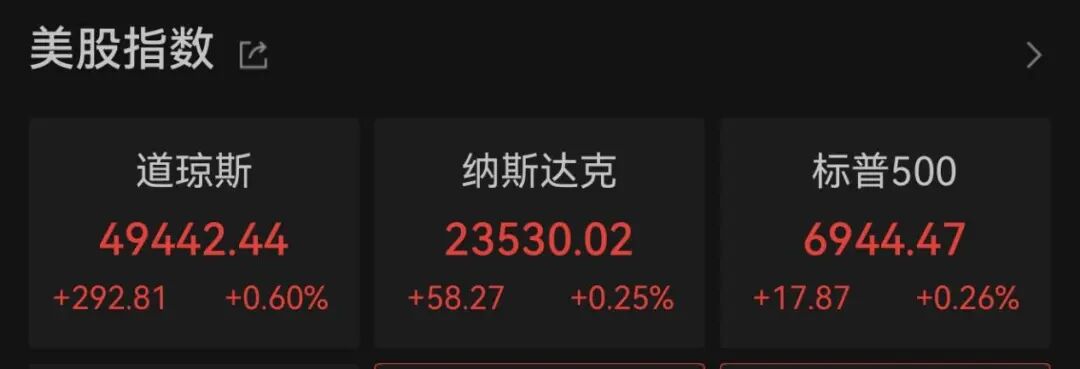
Market Overview - US stock market closed higher, led by gains in bank and chip stocks, with the Dow Jones up 292.81 points (0.60%) at 49,442.44, Nasdaq up 58.27 points (0.25%) at 23,530.02, and S&P 500 up 17.87 points (0.26%) at 6,944.47 [1] Chip Sector - The semiconductor sector saw a broad increase following TSMC's earnings report, with the Philadelphia Semiconductor Index rising 1.76% to a new historical high [4] - The White House announced a 25% import tariff on certain semiconductors and related equipment starting January 15, affecting products like Nvidia's H200 chip and AMD's MI325X AI accelerator chip, while excluding semiconductors for data centers and R&D [4] - TSMC reported a 35% increase in net profit for Q4 2025, reaching approximately $16 billion, marking a record high and exceeding expectations [5] Technology Sector - Major tech stocks showed mixed performance, with Nvidia up over 2%, Facebook up 0.86%, and Amazon up 0.65%, while Google down nearly 1%, Apple down 0.67%, and Microsoft down 0.59% [6] - Apple announced an expansion of Apple Pay's cross-border payment support for users of specific Chinese banks [7] Banking Sector - Bank stocks generally rose, with JPMorgan up 0.48%, Goldman Sachs up over 4%, Citigroup up over 4%, Morgan Stanley up nearly 6%, and Bank of America up 0.16%, while Wells Fargo fell 0.34% [8] - Goldman Sachs and Morgan Stanley reported record high revenues in their trading divisions, with Goldman planning to issue $16 billion in investment-grade bonds, the largest such issuance in Wall Street history [9] Commodity Market - Brent crude oil futures fell by $2.76 (4.15%), and WTI crude oil futures dropped by $2.83 (4.56%) [10] - Gold and silver prices experienced significant declines, with silver down over 1.5% [10]


AI在美国“与民争电”,核电成了硅谷“全村的希望”
虎嗅APP· 2026-01-16 00:22
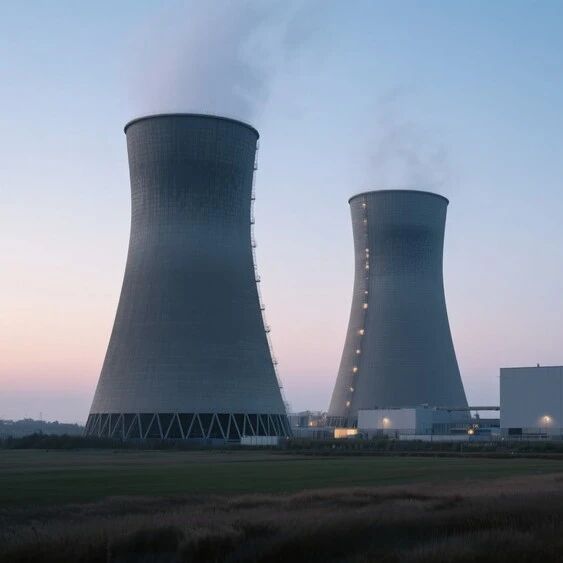
Core Viewpoint - The article discusses the increasing involvement of AI companies in the energy sector, particularly in nuclear power, as they seek to secure stable and clean energy sources to meet the growing demand driven by AI applications [4][10]. Group 1: AI Companies' Investments in Energy - Meta has signed a long-term power purchase agreement with Vistra to procure electricity from its nuclear power plants, aiming for a potential supply of up to 6.6 GW by 2035 [4][10]. - Other AI giants like Microsoft, Amazon, and Google are also investing in nuclear energy, with Microsoft reviving retired nuclear plants and Amazon purchasing data centers near nuclear facilities [9][11]. - The trend marks a shift from merely buying electricity to actively participating in energy infrastructure development, as AI companies adapt to the increasing energy demands of their operations [8][10]. Group 2: Energy Demand and Supply Challenges - The demand for electricity in the U.S. is expected to grow at an annual rate of 4.8% over the next decade, primarily driven by data centers and AI applications [5]. - The International Energy Agency (IEA) predicts that global data center electricity consumption will double to approximately 945 TWh by 2030, with AI being the main driver [6]. - The construction timelines for new power generation and transmission infrastructure lag significantly behind the rapid expansion of AI data centers, leading to potential supply shortages [12][15]. Group 3: Nuclear Energy's Role and Market Dynamics - Nuclear power is being positioned as a key solution to meet the stable energy needs of AI, with significant investments from major tech companies and supportive government policies [11][22]. - The U.S. nuclear power capacity is expected to increase, with projections indicating that AI companies could secure over 10 GW of nuclear capacity by 2035 [11]. - The article highlights the stock performance of nuclear-related companies, which have seen significant gains due to the renewed focus on nuclear energy [11]. Group 4: Infrastructure and Regulatory Challenges - The U.S. faces a significant lag in the construction of transmission infrastructure, which is critical for delivering electricity from new generation sources to high-demand areas [20][21]. - Regulatory changes are being implemented to address the challenges posed by the rapid growth of data centers, including new pricing structures for large electricity users [16][21]. - The article emphasizes that merely investing in new power plants will not resolve the energy crisis without concurrent improvements in transmission infrastructure [18][20].