NTES(NTES)

Search documents
沪指10连阳,AI概念爆发,十余股涨停,港股科网股集体拉升,百度大涨8%
21世纪经济报道· 2025-12-30 07:40
Market Overview - The A-share market experienced a strong upward trend, with the Shanghai Composite Index closing with a 10-day winning streak, while the Shenzhen Component Index and the ChiNext Index rose by 0.49% and 0.63% respectively [1] - The total trading volume in the Shanghai and Shenzhen markets exceeded 2 trillion yuan for the third consecutive trading day, increasing by 3.8 billion yuan compared to the previous trading day [2] Sector Performance - The robotics sector saw significant gains, with multiple stocks hitting the daily limit, including Fenglong Co. with five consecutive limit-ups and Tianqi Co. with four consecutive limit-ups [3] - The AI glasses concept also showed strong performance, with stocks like New Xiang Micro rising nearly 10% and Yingpais rising over 7% [3] - AI-related stocks collectively surged, with over ten stocks in the AI, AI agents, and AIGC sectors hitting the daily limit, including Kute Intelligent and Baijia Qiancheng [3] Hong Kong Market - The Hong Kong stock market also showed strength, with the Hang Seng Index rising over 1% and the Hang Seng Tech Index increasing by more than 2% [5] International Markets - The Japanese and South Korean stock markets closed early due to the New Year's holiday, with the Nikkei 225 Index down 0.37% but showing a strong annual performance, gaining over 10,000 points and up 26.18% for the year [7]





这音乐App月活直逼网易云,1.2亿用户是用抖音“喂”出来的?能赚到钱吗
Bei Jing Shang Bao· 2025-12-30 06:52
Core Insights - Soda Music has rapidly grown to 120 million monthly active users, closely approaching NetEase Cloud Music's 147 million, largely due to its integration with Douyin's traffic and resources [2][8] - The platform serves as a copyright music library for content platforms like Douyin, Jianying, and Xigua Video, positioning itself as a disruptor in the music market [2][5] - Despite its growth, Soda Music faces challenges in monetization, as its user acquisition strategy relies heavily on a free model, raising questions about long-term profitability [12][16] User Engagement and Growth - Soda Music's user base is significantly driven by Douyin, with 82.1% of its users coming from the platform [8] - The app's initial appeal was as a "music collection" tool for Douyin users, with a high percentage of trending songs being popular Douyin tracks [6][11] - Users appreciate the platform's free membership model, which allows them to access music without traditional subscription fees [9][11] Market Position and Strategy - The platform's music library includes a mix of Douyin hits, popular covers, classic tracks, and original works, including AI-generated music [11] - Soda Music's strategy involves leveraging AI to attract users, with a focus on creating a comprehensive ecosystem for music creation and monetization [11][12] - The platform's growth has raised concerns about its ability to sustain profitability given the high costs associated with copyright and operations [12][15] Competitive Landscape - The music industry is characterized by a strong head effect, making it difficult for new entrants like Soda Music to establish a stable commercial model [12][15] - Analysts suggest that Soda Music may struggle to attract core music users due to its reliance on a free model, which could undermine its competitive advantage [15][16] - The introduction of new music apps by ByteDance, such as Tomato Music, indicates a broader strategy to capture the music market, but also highlights the competitive pressures Soda Music faces [16]

瑞银:网易-S(09999)或于2027年初实现港交所双重主要上市 重申“买入”评级
智通财经网· 2025-12-30 05:55
智通财经APP获悉,瑞银发布研报称,网易-S(09999)有望符合港交所双重主要上市标准。据万得数据, 截至12月25日,网易香港上市股份的成交金额已占其全球(香港+ADR)成交金额的57%,高于港交所双 重主要上市交易迁移测试要求的55%门槛。瑞银重申网易"买入"评级,维持目标价288.6港元。 若网易如该行预期顺利获得双重主要上市地位,核心利好将是具备沪深港通纳入资格。但南向通纳入评 估时网易暂不符合"快速纳入规则"(目前要求为恒生指数前10大成分股),因此预计纳入时间点大概在 2027年9月。 报告表示,南向投资者对网易兴趣浓厚,主要看好其强劲的网络游戏基本面,以及相较A股游戏公司更 具吸引力的估值水平。该行认为,网易若宣布启动双重主要上市流程,也将成为短期利好催化剂。以哔 哩哔哩-W(09626)为例,其宣布启动双重主要上市准备工作后一周内,股价表现跑赢MSCI中国指数12个 百分点。 基于对港交所相关规则的理解,并假设2025年剩余交易日网易美国市场成交量无大幅增长,该行认为, 网易有望在2026年推进港交所双重主要上市资格的合规工作,并大概于2027年初实现双重主要上市。 ...
瑞银:网易-S或于2027年初实现港交所双重主要上市 重申“买入”评级
Zhi Tong Cai Jing· 2025-12-30 05:54
瑞银发布研报称,网易-S(09999)有望符合港交所双重主要上市标准。据万得数据,截至12月25日,网 易香港上市股份的成交金额已占其全球(香港+ADR)成交金额的57%,高于港交所双重主要上市交易迁 移测试要求的55%门槛。瑞银重申网易"买入"评级,维持目标价288.6港元。 若网易如该行预期顺利获得双重主要上市地位,核心利好将是具备沪深港通纳入资格。但南向通纳入评 估时网易暂不符合"快速纳入规则"(目前要求为恒生指数前10大成分股),因此预计纳入时间点大概在 2027年9月。 报告表示,南向投资者对网易兴趣浓厚,主要看好其强劲的网络游戏基本面,以及相较A股游戏公司更 具吸引力的估值水平。该行认为,网易若宣布启动双重主要上市流程,也将成为短期利好催化剂。以哔 哩哔哩-W(09626)为例,其宣布启动双重主要上市准备工作后一周内,股价表现跑赢MSCI中国指数12个 百分点。 基于对港交所相关规则的理解,并假设2025年剩余交易日网易美国市场成交量无大幅增长,该行认为, 网易有望在2026年推进港交所双重主要上市资格的合规工作,并大概于2027年初实现双重主要上市。 ...
游戏行业赚快钱的时代结束了
Di Yi Cai Jing· 2025-12-30 05:45
Core Insights - The Chinese gaming industry in 2025 is characterized by a complex landscape of "recovery" and "internal competition," with market revenue exceeding 350 billion yuan and user base surpassing 680 million, indicating a year of continued recovery despite intense competition [3][4][12] - The industry is experiencing a significant market divide, with the "winner-takes-all" trend intensifying, leading to a situation where a few leading companies dominate the market, while smaller teams find new opportunities in single-player and AI-native games [3][10][12] Market Performance - In 2025, the domestic gaming market revenue is approximately 350.8 billion yuan, reflecting a year-on-year growth of 7.7%, while the user base has grown by 1.4% to over 680 million [4][5] - Self-developed games have generated overseas revenue of about 20.46 billion USD, maintaining a scale exceeding 100 billion yuan for six consecutive years [4][5] - Despite the overall upward trend in the gaming and esports industry, the market has entered a phase of stock competition, with a saturated user base and increased self-developed game output [4][5] Industry Challenges - The competition among gaming companies has intensified, with many projects failing despite significant investments, as seen with NetEase's "射雕" and Kingsoft's "解限机," which faced substantial player drop-off and negative feedback [5][6] - The cost of developing successful mobile games has increased significantly, making it harder for companies to achieve profitability [6][9] Market Dynamics - The market recovery is largely driven by a few top-tier games from leading companies like Tencent and NetEase, which dominate the revenue charts [7][9] - Tencent's gaming revenue reached 636 billion yuan in Q3 2025, with total revenue for the first three quarters exceeding 1.8 trillion yuan, solidifying its position in the market [9][10] Future Trends - The rise of single-player games is a notable trend, with companies increasingly focusing on high-quality, creative content rather than just marketing [12][13] - AI technology is emerging as a potential game-changer, offering new opportunities for smaller developers to compete by lowering development costs and enhancing creativity [11][15] - The industry is expected to enter a new "golden decade" of growth, driven by improved game quality, expanded overseas markets, and supportive policies [12][15]

游戏行业赚快钱的时代结束了
第一财经· 2025-12-30 05:30
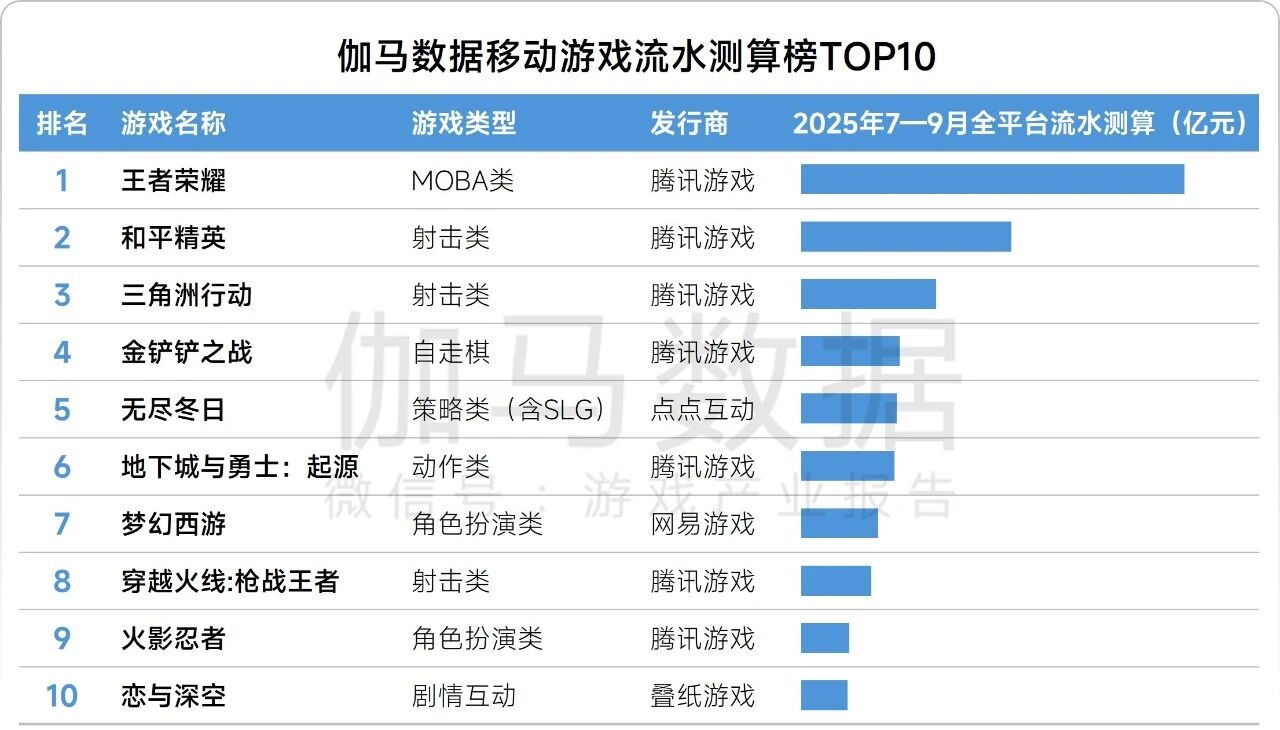
Core Viewpoint - The Chinese gaming industry in 2025 is characterized by a complex landscape of "recovery" and "internal competition," with market revenue exceeding 350 billion yuan and user base surpassing 680 million, yet competition remains fierce and profitability increasingly challenging [3][4]. Market Overview - The domestic gaming market revenue for 2025 is approximately 350.8 billion yuan, reflecting a year-on-year growth of 7.7%, while the user base has grown by about 1.4% to over 680 million [4]. - Self-developed games have generated overseas revenue of approximately 20.46 billion USD, maintaining a scale exceeding 100 billion yuan for six consecutive years [4]. - The industry has entered a phase of stock competition, with a saturated user base and a significant increase in self-developed game output, leading to heightened competition among companies [4][5]. Industry Trends - The gaming industry is experiencing a trend of increasing investment in research and development, particularly in art and quality, but the risk of failure for new games is rising due to intense competition in the stock market [4][5]. - The "winner-takes-all" phenomenon is intensifying, with top companies capturing a larger market share, leading to a shift from the "80/20 rule" to a potential "90/10 rule" in the industry [8][12]. Company Performance - Tencent's gaming revenue for Q3 2025 exceeded 63.6 billion yuan, marking a significant milestone, while NetEase's gaming revenue surpassed 70 billion yuan in the same period, indicating stable growth [10][11]. - The top ten mobile games in terms of revenue are dominated by Tencent, which has seven titles in the list, showcasing its strong market position [9][10]. New Opportunities - The rise of single-player games is a notable trend, with companies increasingly investing in AAA titles following the success of "Black Myth: Wukong," indicating a structural opportunity in the gaming industry [12][13]. - AI-native games are emerging as another exploration direction, with companies like miHoYo leading the way in integrating AI into game narratives, suggesting a potential shift in game development dynamics [14][15]. Future Outlook - The gaming industry is expected to enter a new "golden decade" of growth, driven by improved game quality, expanded overseas market pathways, and supportive policies, marking a transition from rapid growth to a focus on creativity and technology [15][16].



12月版号发布;网易副总裁荣誉退休丨游戏周报
2 1 Shi Ji Jing Ji Bao Dao· 2025-12-30 04:03
Industry Updates - The December version number list has been released, including 144 domestic games and 3 imported games, with 7 games having changes in approval information [3][4] - The "2025 Guangdong Game Industry Report" indicates that Guangdong's game revenue will reach 283.613 billion yuan in 2025, a year-on-year increase of 8.9%, with mobile game revenue surpassing 200 billion yuan for the first time [5] - Guangzhou has issued "Eighteen Measures" to support the game and esports industry, including a special fund for the industry with a maximum annual subsidy of 10 million yuan per company [6] Company News - NetEase announced the honorary retirement of its Executive Vice President and head of the Interactive Entertainment Division, Ding Yingfeng, effective December 31, 2025 [7] - The remastered version of "The Legend of Sword and Fairy 4" has been officially previewed, developed using Unreal Engine 5 [7] - Game Science has established a new company in Hangzhou, focusing on internet game services and development [8] Notable Events - Vince Zampella, co-founder of "Call of Duty" and head of Respawn Entertainment, tragically passed away in a car accident at the age of 55 [10] - Sony has announced its first-party game release plan for 2026, confirming two single-player titles for the PS5 platform [11]

单机崛起、AI破局,游戏行业赚快钱的时代结束了
Di Yi Cai Jing· 2025-12-30 03:24
Core Insights - The Chinese gaming industry in 2025 is characterized by a complex landscape of "recovery" and "internal competition," with market revenue exceeding 350 billion yuan and user base surpassing 680 million, indicating a year of continued recovery despite intense competition [1][2] - The industry is experiencing a significant market divide, with the "winner-takes-all" trend intensifying, leading to a shift from the "80/20 rule" to a "90/10 rule," where a few dominant players capture most of the market share [1][6][8] - The industry is transitioning from a focus on quantity to quality, with an emphasis on creativity and innovation, marking the beginning of a new growth cycle for the Chinese gaming sector [1][9][10] Market Performance - In 2025, the domestic gaming market revenue is approximately 350.8 billion yuan, reflecting a year-on-year growth of 7.7%, while the user base has grown by 1.4% [2] - Self-developed games have generated overseas revenue of about 20.46 billion USD, maintaining a scale exceeding 100 billion yuan for six consecutive years [2] - Tencent and NetEase dominate the market, with their combined revenue exceeding 250 billion yuan in the first three quarters of 2025, solidifying their "duopoly" status [7] Industry Challenges - The gaming industry is facing heightened competition in a saturated market, with many new products vying for limited user attention, leading to increased failure rates for new game launches [2][3] - Major companies are investing heavily in R&D to meet rising player expectations, but the intense competition in the existing market makes success increasingly difficult [2][4] - Notable failures include NetEase's "The Legend of the Condor Heroes" mobile game, which was shut down after only 600 days of operation, highlighting the risks associated with high-budget projects [3] Trends and Opportunities - The rise of single-player and AI-native games presents new opportunities for smaller teams to break through in the competitive landscape [1][10] - The success of titles like "Black Myth: Wukong" has catalyzed a shift towards high-quality, creative gaming, with increased investment in AAA games from both startups and established companies [9][10] - AI technology is emerging as a significant factor in game development, potentially lowering costs and enhancing creativity, which could benefit smaller developers [8][11] Future Outlook - The Chinese gaming industry is poised for a new "golden decade" of growth, driven by improved game quality, expanded overseas opportunities, and supportive government policies [1][10] - The market is expected to evolve from rapid growth to a focus on creative and technological advancements, moving away from quick profits to sustained endurance [12]
大行评级|花旗:重申腾讯、网易及世纪华通为游戏板块首选股 均予“买入”评级
Ge Long Hui· 2025-12-30 03:24
Core Insights - The report by Citigroup highlights the healthy growth of China's gaming market driven by policy support, innovation, evergreen games, and the expansion of self-developed games into overseas markets [1] - The increasing application of generative AI, empowerment from the digital economy, effective measures for the protection of minors, and talent development are identified as key trends contributing to the growth of the gaming market this year [1] - Looking ahead to next year, Citigroup anticipates sustainable growth in the Chinese gaming market, fueled by the rise of generative AI interactive applications and innovative gameplay [1] Company Recommendations - Citigroup reaffirms Tencent, NetEase, and Century Huatong as preferred stocks in the sector, all receiving a "Buy" rating [1] - The target price for Tencent is set at HKD 751, while the target price for NetEase is set at USD 161 [1]
年终盘点|单机崛起、AI破局,游戏行业赚快钱的时代结束了
Di Yi Cai Jing· 2025-12-30 03:14
Core Insights - The Chinese gaming industry is experiencing a complex landscape of "recovery" and "internal competition," with market revenue surpassing 350 billion yuan and user base exceeding 680 million, indicating a year of continued recovery despite intense competition [2][3] - The industry is shifting from "Chinese production" to "Chinese creation," focusing on creativity rather than just sales, suggesting a new growth cycle for the gaming sector [2][12] Market Performance - In 2025, the domestic gaming market revenue is approximately 350.8 billion yuan, a year-on-year increase of 7.7%, while the user base has grown by 1.4% [3] - The self-developed games' overseas revenue reached approximately 20.46 billion USD, maintaining a scale exceeding 100 billion yuan for six consecutive years [3] Competitive Landscape - The gaming industry has entered a phase of stock competition, with a saturated user base and an exponential increase in self-developed game output, leading to heightened competition among companies [3][6] - The "80/20 rule" is evolving into a "90/10 rule," indicating that a small number of companies are capturing most of the market share, while many smaller firms struggle to survive [11] Major Players - Tencent continues to dominate the market, with its gaming revenue exceeding 636 billion yuan in Q3, and its total revenue for the first three quarters surpassing 1.8 trillion yuan [9][10] - NetEase's gaming revenue for the first three quarters is over 700 billion yuan, maintaining stable growth, but still lagging behind Tencent [10] Project Failures - High-profile game failures, such as NetEase's "射雕" and Kingsoft's "解限机," highlight the increasing difficulty of achieving success in the gaming market, even for major companies [4][5] - Kingsoft's gaming business revenue fell by 47% year-on-year to 900 million yuan, marking the largest decline since 2019 [4] Future Trends - The rise of single-player and AI-native games presents new opportunities for smaller teams to break through in the competitive landscape [2][12] - The success of "黑神话:悟空" has catalyzed a shift towards high-quality game development, with increasing investment in AAA titles [12][13] - AI technology is expected to lower development costs and enhance creativity, potentially leveling the playing field between large and small developers [11][14] Government Support - The Shanghai government is set to release policies to support the esports industry, which may further stimulate growth in the gaming sector [14]