PDD(PDD)

Search documents
隔夜欧美·1月1日
Sou Hu Cai Jing· 2026-01-01 00:26
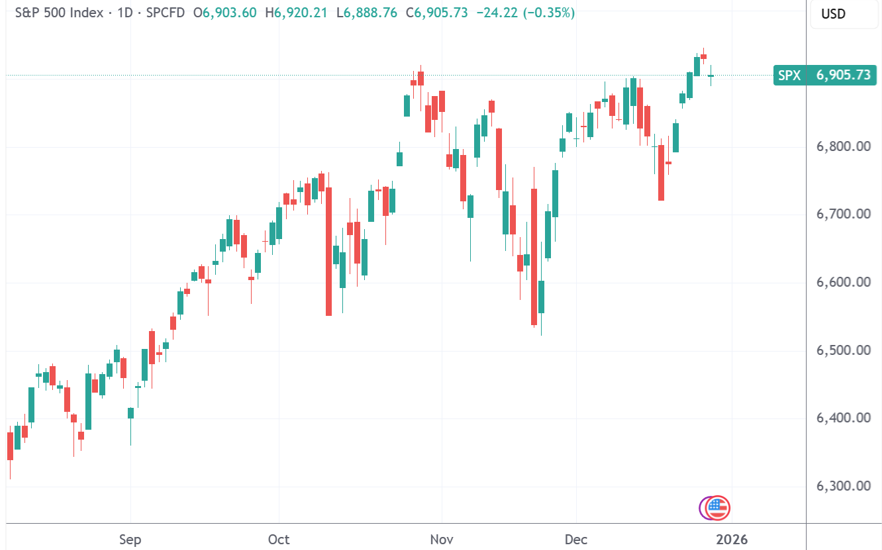
Market Performance - The three major U.S. stock indices closed lower, with the Dow Jones down 0.63% at 48,063.29 points, the S&P 500 down 0.74% at 6,845.5 points, and the Nasdaq down 0.76% at 23,241.99 points [1] - Popular Chinese concept stocks generally fell, with Alibaba down 0.52%, Pinduoduo down 0.39%, NetEase down 2.01%, Ctrip down 0.57%, Baidu down 1.30%, and JD.com down 0.03% [1] - Major tech stocks collectively declined, with NIO down over 7%, NetEase down 2%, and Baidu down over 1% [1] European Market - Major European stock indices closed slightly lower, with the French CAC40 index down 0.23% at 8,149.5 points and the UK FTSE 100 index down 0.09% at 9,931.38 points; the German market was closed due to a holiday [1] Commodity Prices - U.S. oil futures fell 0.93% to $57.41 per barrel, while Brent crude oil futures dropped 0.68% to $60.91 per barrel [1] - International precious metal futures generally declined, with COMEX gold futures down 1.24% at $4,332.10 per ounce and COMEX silver futures down 8.91% at $70.98 per ounce [1] Currency and Bond Market - The U.S. dollar index rose 0.05% to 98.27, while the offshore RMB against the U.S. dollar increased by 168 basis points to 6.9755 [1] - U.S. Treasury yields collectively rose, with the 2-year yield up 2.67 basis points to 3.475%, the 3-year yield up 3.65 basis points to 3.536%, the 5-year yield up 5.19 basis points to 3.725%, the 10-year yield up 5.49 basis points to 4.175%, and the 30-year yield up 4.67 basis points to 4.852% [1] - The UK 10-year government bond yield fell by 2.3 basis points to 4.473% [1]


1月1日热门中概股普跌 小鹏汽车跌4.65%,蔚来跌7.27%
Xin Lang Cai Jing· 2025-12-31 21:25
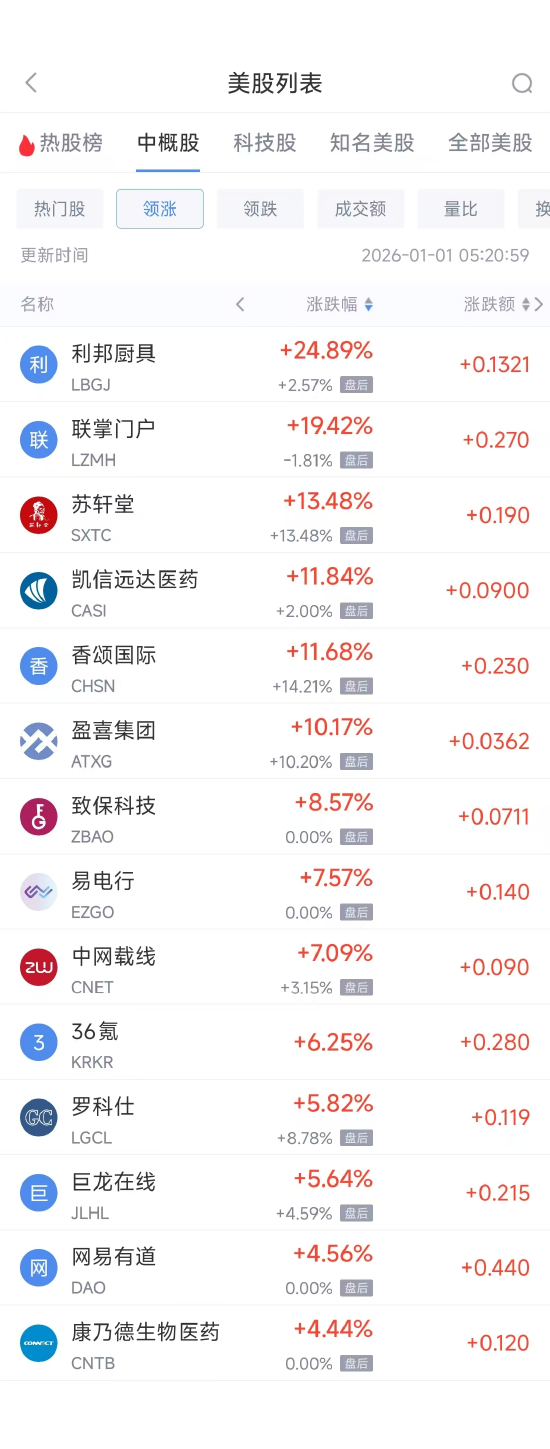
Market Overview - The Nasdaq China Golden Dragon Index (HXC) fell by 1.13% on January 1, with notable declines in major Chinese stocks such as Alibaba, Pinduoduo, and NIO, which dropped by 0.52%, 0.39%, and 7.27% respectively [1][11] - The S&P 500 index recorded its fourth consecutive day of decline, despite achieving a yearly increase of 16.39%, marking its third consecutive year of double-digit annual growth [2][12] Stock Performance - Among the rising stocks, TSMC increased by 1.45%, while other notable gainers included ASE Technology (+0.44%) and Huazhu Hotels (+0.15%) [1][11] - Conversely, significant declines were observed in stocks such as Xpeng Motors (-4.65%), Li Auto (-1.97%), and Beike (-0.57%) [1][11] Index Performance - The Dow Jones Industrial Average decreased by 303.77 points, or 0.63%, closing at 48,063.29 points, while the Nasdaq Composite fell by 177.09 points, or 0.76%, to 23,241.99 points [12] - The Nasdaq Composite has benefited from the AI boom, with a cumulative increase of 20.36% in 2025 [3][13] - The Dow Jones has seen a 12.97% increase in 2025, lagging behind due to a lower weight of technology stocks [4][14]


互联网电商 25Q3 业绩总结及展望:即时零售转向 UE 修复,加速打造 AI 生态闭环
Shenwan Hongyuan Securities· 2025-12-31 13:46
Investment Rating - The report recommends investment in Alibaba, Meituan, Pinduoduo, and JD.com, indicating a positive outlook for these companies in the e-commerce sector [4]. Core Insights - Online consumption continues to grow steadily, with a total retail sales of 45.6 trillion yuan in the first 11 months of 2025, reflecting a year-on-year increase of 4.0%. The online retail sales reached 14.5 trillion yuan, up 9.1% year-on-year, with physical goods online retail sales growing by 5.7% to 11.8 trillion yuan, resulting in a penetration rate increase of 0.42 percentage points to 25.9% [1][12]. - The impact of the "old-for-new" policy from the previous year is starting to show, leading to a high base effect that is affecting growth rates. The express delivery business volume reached 180.74 billion pieces, a year-on-year increase of 14.9%, but this growth is slowing compared to the previous half of the year [1][12]. - The competition in the instant retail sector has peaked, with platforms shifting their strategies towards differentiation to improve user experience (UE). The report notes that the industry is entering a new phase of competition, focusing on quality and efficiency rather than just price competition [3][47]. Summary by Sections 1. Online Consumption and Retail Performance - Online consumption remains robust, with significant growth in penetration rates. The high base effect from last year's policies is now impacting growth rates, leading to a slowdown in the growth of express delivery and online retail sales [1][12]. - Major platforms are adjusting their strategies in response to the high base effect, with JD.com experiencing a notable decrease in GMV growth rates in Q3 [1][17]. 2. AI Investment and Development - The AI sector is witnessing intensified competition, with major internet companies launching numerous updates and iterations of AI models. The focus is shifting from broad capabilities to specialized strengths, enhancing user experience and application in consumer-facing products [3][34]. - Alibaba's cloud business is accelerating, with AI-related product revenues achieving triple-digit year-on-year growth for nine consecutive quarters, indicating a successful transition from technology investment to value realization [3][34]. 3. Instant Retail Sector Dynamics - The instant retail sector has seen a peak in competition, with platforms initially investing heavily to capture market share. However, as the market stabilizes, strategies are shifting towards differentiation and quality improvement [3][47]. - The report highlights that platforms like Meituan and Taobao are focusing on enhancing user experience and profitability, moving away from aggressive subsidy strategies [3][47]. 4. Performance of Major E-commerce Platforms - Alibaba's core business revenue growth remains strong, while Meituan's local business is under pressure. JD.com and Pinduoduo are expected to see profit recovery in the upcoming quarters, driven by strategic investments and operational efficiencies [3][4]. - The report notes that the profitability of platforms is becoming increasingly differentiated, with expectations for Alibaba and Meituan to see profit recovery soon [4].

股票市场概览:资讯日报:中国提前下达625亿元超长期特别国债支持以旧换新-20251231
Guoxin Securities Hongkong· 2025-12-31 06:23
Market Overview - The Hang Seng Index closed at 25,855, down 0.86% for the day but up 28.89% year-to-date[1] - The Hang Seng Technology Index rose 1.74% to 5,578, with a year-to-date increase of 24.85%[1] - The Hang Seng China Enterprises Index increased by 1.12% to 8,991, with a year-to-date rise of 23.34%[1] Sector Performance - Baidu's stock surged nearly 9% due to advancements in AI and smart cloud business, with significant growth in its self-developed AI chip and smart driving orders[7] - The semiconductor sector saw strong gains, with InnoTek rising over 15% and SMIC up more than 4% following Nvidia's announcement of partnerships for a new power architecture[7] - Robotics stocks were active, with Yujing Technology up over 13% and Sanhua Intelligent Control up over 12%, supported by a significant increase in industrial robot production[7] Oil and Entertainment - Oil stocks continued to perform well, with CNOOC rising nearly 4% as international oil prices increased due to geopolitical tensions[7] - The entertainment sector saw a boost, with Emperor Culture Industries rising nearly 9% as the 2025 New Year box office surpassed 5.3 billion yuan, a near eight-year high[7] Economic Indicators - The WTI crude oil price surpassed $58 per barrel, while Brent crude approached $62 per barrel, driven by rising geopolitical risks[7] - The US Federal Reserve indicated potential future interest rate cuts if inflation continues to decline, as noted in the December meeting minutes[11]




2026两新政策发布,重在优化升级:环球市场动态
citic securities· 2025-12-31 05:17
Market Overview - A-shares experienced a slight upward trend, with the Shanghai Composite Index closing at 3,965 points, while the Shenzhen Component and ChiNext Index rose by 0.49% and 0.63% respectively, with a total market turnover of 2.16 trillion yuan[13] - The Hang Seng Index increased by 0.86%, driven by technology and semiconductor sectors, while the Hang Seng Tech Index surged by 1.74%[9] - European markets showed strength, with the Stoxx 600 index rising by 0.6%, and several markets reaching new highs despite geopolitical uncertainties[7] Economic Policies - The Chinese government announced a 625 billion yuan special bond issuance to support the "old for new" consumption policy for 2026, aiming for a retail sales growth rate of approximately 3.2%[4] - The Federal Reserve's meeting minutes revealed internal divisions regarding future interest rate cuts, with a majority favoring further reductions, although uncertainty remains[28] Commodity and Currency Movements - Silver rebounded strongly, rising over 10% after experiencing its largest single-day drop in over five years, while copper prices extended their gains for eight consecutive days, marking the longest streak since 2017[25] - The U.S. dollar index increased by 0.2% to 98.24, while the euro appreciated by 13.5% year-to-date against the dollar[24] Investment Recommendations - The report suggests focusing on AI-driven companies in the internet sector, with recommendations including Alibaba (BABA US), Pinduoduo (PDD US), and Bilibili (BILI US) as potential investment opportunities[6] - In the banking sector, the report highlights the potential for profit growth of around 5% in 2026, recommending stocks like China Merchants Bank (600036 CH) and China Construction Bank (601939 CH) for their valuation recovery potential[11]




拼多多想好往哪儿走了
远川研究所· 2025-12-30 12:04
Core Insights - Pinduoduo's recent shareholder meeting revealed significant changes, including the introduction of a co-chairman system with Zhao Jiazhen and Chen Lei as co-CEOs, and a strategic focus on enhancing the Chinese supply chain while aiming to create a new Pinduoduo that emphasizes quality and ecosystem [3][4] - Temu has rapidly grown to become one of the largest e-commerce platforms globally, achieving a GMV of 168 billion with a 42% year-on-year increase, and a monthly active user base of 530 million [5][7] Group 1: Strategic Shifts - The shareholder meeting indicated a shift from merely building an e-commerce platform to investing in supply chains and co-creating industry ecosystems, which could significantly impact the Chinese e-commerce sector [4] - Pinduoduo's management expressed ambitions to "recreate Pinduoduo" over the next three years, focusing on leveraging the supply chain to enhance product quality and market reach [3][12] Group 2: Temu's Business Model - Temu's "full management + semi-management" model has set a new standard in cross-border e-commerce, allowing factories to take center stage and reducing intermediary costs while enhancing quality control [7][9] - The model is tailored to connect China's mature supply chain with global consumer markets, facilitating rapid production and distribution [11][18] Group 3: Support for Industry Transformation - Pinduoduo's "New Quality Merchant Support Plan" aims to provide substantial resources for industry transformation, including a 10 billion yuan fund to support merchants in various sectors [12][14] - The plan is designed to empower merchants to transition from low-margin OEM models to developing their own brands, thereby increasing their control over high-value segments [18][20] Group 4: Market Dynamics and Consumer Insights - Pinduoduo's approach focuses on providing certainty to producers by aligning production with consumer demand, thus enabling factories to adopt a more responsive production strategy [20][21] - The platform's data-driven insights have helped merchants identify market opportunities, leading to significant sales growth and brand development [17][21] Group 5: Competitive Landscape - The shift in focus from traffic acquisition to supply chain efficiency distinguishes Pinduoduo from other e-commerce platforms, positioning it to better respond to market demands and provide stability to industry players [24]

Shopify卖家,被Temu拉入战局
3 6 Ke· 2025-12-30 09:24
Group 1 - Temu has launched a local seller program allowing Shopify sellers to list their products on Temu, covering over 30 countries including the US, Canada, and the UK [2][3] - The local seller program is a response to the cancellation of small package tax exemptions in various countries, which has affected Temu's supply chain model [2][6] - Shopify sellers have mixed feelings about Temu, with some seeing it as a new sales channel while others view it as a means to clear inventory due to lower prices on Temu [2][4] Group 2 - Temu has set specific conditions for Shopify sellers, including local shipping, fulfillment timelines, and local return services [3][5] - The platform operates in a "quasi-managed" mode where sellers are responsible for order fulfillment and customer service, while Temu provides a traffic entry point [3][5] - Temu's user base is highly price-sensitive, making it challenging for sellers to establish brand loyalty on the platform [3][5] Group 3 - Temu has experienced rapid global expansion, reaching over 1.2 billion downloads and 530 million monthly active users by August 2025 [6] - The company is facing significant challenges due to new tax policies in various regions, which threaten its low-cost model [6][10] - To address localization issues, Temu is transitioning from a light asset model to a heavy asset model by building local warehouses in key markets [10][12] Group 4 - Temu has initiated the construction of local warehouses in the US and Europe to enhance fulfillment capabilities [11][12] - The shift to a self-built warehouse model represents a significant challenge for Temu, which has previously relied on a low-risk, light asset strategy [12][13] - Both Temu and its parent company Pinduoduo are focusing on leveraging the Chinese supply chain to expand globally [14]


重仓中国供应链:拼多多的 “价值跃迁” 之路
21世纪经济报道· 2025-12-30 03:27
Core Viewpoint - Pinduoduo is at a critical turning point in its ten-year journey, shifting from a traffic-driven model to a focus on deepening its supply chain capabilities, aiming to "recreate another Pinduoduo" in the next three years [1][2] Group 1: Strategic Shift - The new strategy emphasizes a comprehensive commitment to the Chinese supply chain, moving from merely selling products to building brands and deeply embedding within the supply chain [1][2] - Pinduoduo's overseas business, Temu, has rapidly expanded, achieving in three years what took Pinduoduo a decade in the domestic market, highlighting the need for new growth points [1][4] - The management recognizes that sustainable profitability requires a shift from merely outputting capacity to delivering products and brands [5] Group 2: Supply Chain Empowerment - Temu's initial success overseas relied on cost advantages from the Chinese supply chain, but it now aims for a value leap by deeply embedding and empowering the supply chain [2][4] - Pinduoduo is restructuring its growth logic around the supply chain, focusing on long-term value creation and global risk resilience [2][4] Group 3: Brand Building - The transition from "selling goods" to "building brands" is crucial, with Pinduoduo pushing merchants to enhance product quality and brand recognition [3][5] - Examples like the paper towel brand Sipiao demonstrate how Pinduoduo helps brands elevate their market positioning and product quality [7][11] Group 4: Industry Collaboration - Pinduoduo's strategy involves not just individual brand empowerment but also a broader industry collaboration to drive transformation across domestic industrial clusters [9][14] - Initiatives like "hundred billion subsidies" and "new quality supply" aim to support merchants in upgrading their offerings and overcoming homogenization challenges [9][14] Group 5: Compliance and Quality - As Pinduoduo expands its supply chain globally, it faces increasing compliance challenges, necessitating a shift from a price-driven growth model to one focused on quality and compliance [14][15] - The company is building a digital compliance system to monitor and ensure product quality and regulatory adherence across the supply chain [15][16] Group 6: Future Outlook - The ultimate goal of Pinduoduo's supply chain strategy is to create a sustainable and legally compliant operational foundation, ensuring long-term consumer retention through reliable quality and brand trust [15][16] - This strategic pivot reflects a broader trend in the Chinese e-commerce and manufacturing sectors towards high-quality development [16]

盘前必读丨美股收跌贵金属大幅下挫;赣锋锂业涉嫌内幕交易罪被移送起诉
Di Yi Cai Jing· 2025-12-29 23:16
Group 1 - The overall market trend before the Spring Festival is expected to have upward potential, with short-term opportunities for low-position layouts identified by Zhongtai Securities [9] - Daitong Securities indicates that the post-holiday market will be crucial, with a clear upward trend supported by loose monetary policy and strong performance in key sectors [9] - China Aviation Securities notes that the current domestic economic growth stabilization effects need further confirmation, suggesting a cautious approach in the current slow bull market, with potential for new highs in A-shares after new catalysts emerge [9] Group 2 - The U.S. stock market saw all three major indices decline, with the Dow Jones down 0.51%, Nasdaq down 0.50%, and S&P 500 down 0.35% [3] - Tesla shares fell by 3.2% as ARK Invest continued to reduce its holdings, selling $30 million worth of Tesla stock [3] - Major tech stocks showed mixed results, with Apple up 0.1% and Nvidia down 1.2%, while the Nasdaq China Golden Dragon Index fell by 0.67% [4] Group 3 - International oil prices increased, with WTI crude oil rising by 2.36% to $58.08 per barrel, and Brent crude oil up by 2.14% to $61.94 per barrel [5] - The precious metals market experienced significant declines, with COMEX gold futures dropping by 4.50% to $4325.10 per ounce, marking the largest drop in two months, and silver futures down 8.67% to $69.856 per ounce, the worst performance since February 2021 [5] Group 4 - The Ministry of Finance and the State Administration of Taxation announced that tobacco advertising expenses are not deductible for tax purposes, while advertising expenses for cosmetics, pharmaceuticals, and beverages can be deducted up to 30% of annual sales revenue [6] - From January to November, state-owned enterprises in China reported total operating revenue of 75,625.76 billion yuan, a year-on-year increase of 1.0%, while total profits decreased by 3.1% to 371.945 billion yuan [6]


贵金属风暴冲击市场情绪,美股三大指数集体收跌,中概股震荡走弱
Feng Huang Wang· 2025-12-29 22:52
Market Performance - The U.S. stock market indices collectively declined due to heightened tensions from significant fluctuations in commodity prices, with the S&P 500 down 0.35% to 6905.74 points, the Nasdaq Composite down 0.5% to 23474.35 points, and the Dow Jones Industrial Average down 0.51% to 48461.93 points [1] - The mining sector experienced a collective drop, with First Majestic Silver down 4.13% and Newmont Mining down 5.64%, while lithium giant Albemarle fell by 3.62% [2] Commodity Market - Silver futures on Comex saw extreme volatility, reaching a high of $82 per ounce before plummeting to $71.6, marking a decrease of 7.20% [4] - Analysts suggest that precious metals have been severely overbought, and the recent declines may present a buying opportunity in the coming weeks [4] Company News - SoftBank Group announced a $4 billion acquisition of data center investment company DigitalBridge, marking a significant step in its artificial intelligence strategy [10] - Citigroup expects to record an after-tax loss of approximately $1.1 billion in Q4 related to the sale of its Russian business, with the transaction anticipated to complete next year [11] - Meta has acquired AI startup Manus, which was originally founded in China and later moved to Singapore, although financial terms of the deal were not disclosed [12] Sector-Specific Developments - Lululemon is facing a rare power struggle as founder Chip Wilson seeks to remove the current board, emphasizing the need for visionary leadership to drive the company's next phase of success [9] - Novo Nordisk has lowered the price of its weight loss drug semaglutide in China, following the impending expiration of its patent, with local companies preparing to introduce cheaper generic alternatives [8] Chinese Stocks - The Nasdaq Golden Dragon China Index fell by 0.67%, with notable declines in Alibaba (down 2.46%) and JD.com (down 0.44%), while NIO and NetEase saw gains of 4.71% and 0.92%, respectively [7]