PDD(PDD)

Search documents
拼多多陈磊:专注长期使命,未来十年以更大担当回馈社会
Xin Lang Ke Ji· 2025-11-18 12:46
Core Viewpoint - Pinduoduo emphasizes its commitment to social responsibility and long-term value creation as it celebrates its tenth anniversary, aiming to enhance its platform's ecosystem and public interest [1] Group 1: Company Strategy - Pinduoduo's chairman and co-CEO Chen Lei stated that the company has grown significantly over the past decade and must now take on greater social responsibilities [1] - The company plans to invest more in strategic projects like the "100 billion support" initiative, which benefits both supply and demand sides [1] - Pinduoduo aims to focus on internal value and long-term vision, aspiring to evolve into a model akin to "Costco + Disney" in the next decade [1]

拼多多陈磊:全球化业务面临更多不确定性,会影响短期乃至长期的财务表现
Xin Lang Ke Ji· 2025-11-18 12:46
Core Viewpoint - Pinduoduo's latest financial report highlights the increasing complexity of the international environment, with significant changes in trade policies, taxation, data, and product compliance regulations across various countries and regions, leading to greater challenges and uncertainties for the company [1] Group 1 - Pinduoduo's Chairman and Co-CEO Chen Lei emphasized the company's efforts to learn, adapt, and keep pace with these regulatory changes [1] - The uncertainties present significant risks that are unpredictable and difficult to quantify, potentially impacting both short-term and long-term financial performance [1]
拼多多第三季度营收1082.8亿元,同比增长9%
3 6 Ke· 2025-11-18 12:25
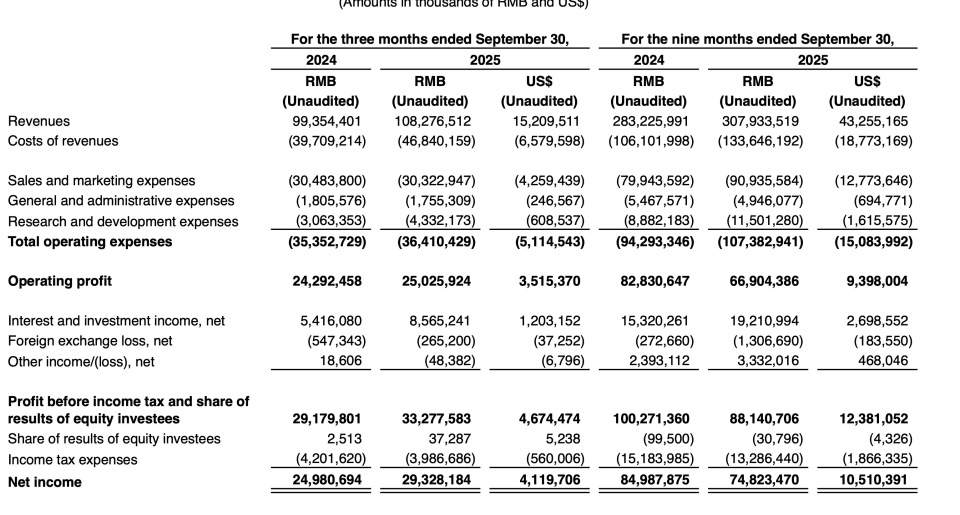
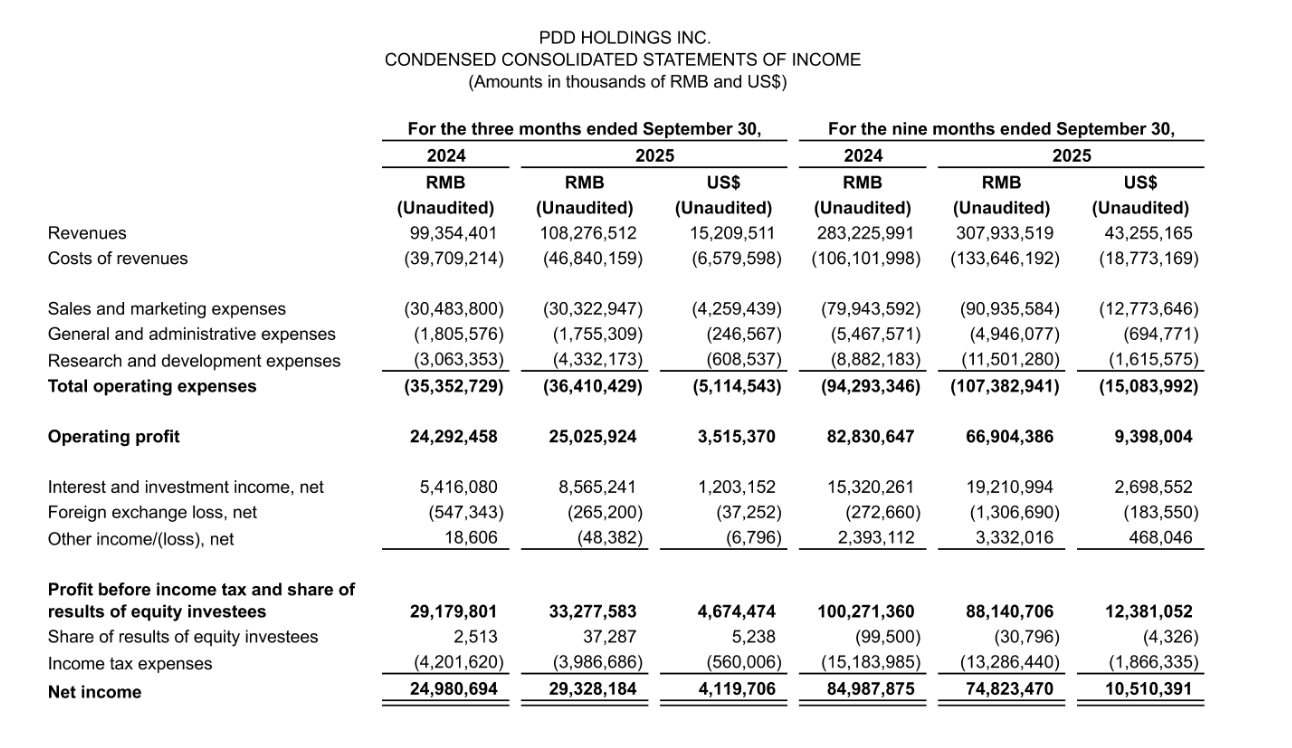
Core Viewpoint - Pinduoduo's Q3 earnings exceeded Wall Street expectations for earnings per share, but revenue fell short, leading to a pre-market stock price drop of over 4% [1] Financial Performance Summary - Total revenue for Q3 was RMB 108.3 billion (approximately USD 15.2 billion), a 9% increase from RMB 99.3 billion in the same period last year, but below Wall Street's average expectation of RMB 108.7 billion [2] - Revenue from online marketing services and others was RMB 53.4 billion (approximately USD 7.5 billion), an 8% increase from RMB 49.3 billion year-on-year; revenue from transaction services was RMB 54.9 billion (approximately USD 7.7 billion), a 10% increase from RMB 50.0 billion year-on-year [2] - Total cost of revenue was RMB 46.8 billion (approximately USD 6.6 billion), an 18% increase from RMB 39.7 billion year-on-year, primarily due to increased fulfillment costs, bandwidth and server costs, and payment processing fees [3] - Total operating expenses were RMB 36.4 billion (approximately USD 5.1 billion), compared to RMB 35.4 billion in the same period last year; sales and marketing expenses were RMB 30.3 billion (approximately USD 4.3 billion), slightly down from RMB 30.5 billion; general and administrative expenses were RMB 1.8 billion (approximately USD 0.25 billion), down from RMB 1.8 billion; R&D expenses were RMB 43.3 billion (approximately USD 6.1 billion), a 41% increase from RMB 30.6 billion [3] - Operating profit was RMB 25.0 billion (approximately USD 3.5 billion), compared to RMB 24.3 billion year-on-year; non-GAAP operating profit was RMB 27.1 billion (approximately USD 3.8 billion), compared to RMB 26.8 billion year-on-year [3] Net Income and Earnings Per Share - Net income attributable to ordinary shareholders was RMB 29.3 billion (approximately USD 4.1 billion), a 17% increase from RMB 24.9 billion year-on-year; non-GAAP net income attributable to ordinary shareholders was RMB 31.4 billion (approximately USD 4.4 billion), a 14% increase from RMB 27.5 billion year-on-year [4] - Basic and diluted earnings per American Depositary Share (ADS) were RMB 20.96 (approximately USD 2.94) and RMB 19.70 (approximately USD 2.77), respectively, compared to RMB 18.02 and RMB 16.91 year-on-year; non-GAAP diluted earnings per ADS were RMB 21.08 (approximately USD 2.96), compared to RMB 18.59 year-on-year, exceeding Wall Street's average expectation of RMB 16.57 [4] Cash Flow and Financial Position - Net cash provided by operating activities was RMB 45.7 billion (approximately USD 6.4 billion), compared to RMB 27.5 billion year-on-year [5] - As of September 30, 2025, Pinduoduo held cash, cash equivalents, and short-term investments totaling RMB 423.8 billion (approximately USD 59.5 billion), up from RMB 331.6 billion as of December 31, 2024 [5] Management Commentary - The Chairman and Co-CEO expressed commitment to social responsibility and long-term development in the e-commerce ecosystem as the company celebrates its tenth anniversary [6] - The Executive Director and Co-CEO emphasized a focus on long-termism and continued investment in merchant support programs to drive sustainable development [6] - The CFO noted that revenue growth is moderating, reflecting ongoing competitive dynamics and external uncertainties, with potential for quarterly fluctuations in financial performance [6]

拼多多最新财报:“千亿扶持”继续反哺产业 经营利润低个位数增长
Zheng Quan Shi Bao Wang· 2025-11-18 12:22
Core Insights - Pinduoduo reported Q3 2025 revenue of 108.3 billion yuan, with a sequential decline in net profit and low single-digit year-on-year growth in operating profit [1] - The company has initiated a "trillion-level" support strategy in the e-commerce sector, which has impacted recent performance but aims to create long-term value for merchants and the industry [1] - Pinduoduo plans to increase investments in ecosystem development and introduce more initiatives similar to the "trillion support" program to benefit the ecosystem and society [1] Group 1: Agricultural Support Initiatives - Pinduoduo launched a "trillion-level" agricultural support initiative this year, resulting in a 47% year-on-year increase in agricultural product sales in the first half of the year [2] - The number of agricultural merchants on the platform has also seen rapid growth, particularly among "post-00" merchants, which increased by over 30% year-on-year [2] - In Q3, Pinduoduo continued to invest in agricultural e-commerce, providing 1 billion yuan in subsidies and 2 billion yuan in traffic resources to support local agricultural products [2] Group 2: Industrial Transformation Support - Pinduoduo's "trillion support" initiative has been instrumental in helping industrial zones transition to new quality standards, addressing the challenges of homogenized competition [3] - The platform's "new quality supply" team has engaged with various industrial zones to enhance product quality and efficiency through digital capabilities [3] - A report released by Pinduoduo indicated a significant increase in the number of merchants from the "post-95" and "post-00" generations, with a 31% and 44% year-on-year growth respectively [3]
拼多多三季度营收1083亿元
Di Yi Cai Jing· 2025-11-18 12:17
Core Viewpoint - The company's revenue growth continues to slow down, reflecting the ongoing evolution of the competitive landscape and external uncertainties [1]. Financial Performance - For Q3 2025, the company reported revenues of 108.3 billion RMB, a year-on-year increase of 9% [1][4]. - Non-GAAP operating profit was 270.8 billion RMB, exceeding the estimate of 244.6 billion RMB [1]. - Net profit attributable to shareholders was 293.3 billion RMB, representing a 17% year-on-year growth [1]. - Adjusted earnings per ADS were 21.08 RMB, surpassing the forecast of 16.86 RMB [1]. Cash Flow and Profitability - The net cash flow from operating activities for the quarter was 456.6 billion RMB, compared to 275.2 billion RMB in the same period of 2024 [2]. - Operating profit for the quarter was 250.3 billion RMB, showing a modest year-on-year increase of 3% from 242.9 billion RMB [2]. Revenue Breakdown - Revenue from online marketing services and other businesses was 53.35 billion RMB, up 8% year-on-year [4]. - Transaction service revenue reached 54.93 billion RMB, marking a 10% year-on-year increase [4]. - The growth rate for online marketing services revenue declined from 13% to 8%, while transaction service revenue saw a significant rebound from just 0.7% growth in the previous quarter [4]. Cost Structure - Total cost of revenue for the quarter was 46.84 billion RMB, an 18% increase year-on-year [5]. - Research and development expenses rose to 4.33 billion RMB, a 41% increase, driven by higher employee-related costs and increased bandwidth and server costs [5]. - The company indicated that rising costs were primarily due to fulfillment expenses, bandwidth and server costs, and payment processing fees [5]. Strategic Outlook - The company is cautiously optimistic about regaining revenue growth despite previous forecasts of slowing income and profit [2]. - The CFO highlighted ongoing uncertainties and the potential financial impact of merchant support programs, suggesting that future financial performance may continue to exhibit volatility [5].
吃肉没赶上 割肉一次没落下
Datayes· 2025-11-18 11:57
Core Viewpoint - The article discusses the global risk-off sentiment affecting various markets, including declines in U.S. stocks, Japanese stocks, cryptocurrencies, and even gold. It highlights the investment strategies of former President Trump, who purchased significant amounts of corporate and municipal bonds during this period [1]. Market Overview - The article notes that the A-share market experienced a collective decline on November 18, with the Shanghai Composite Index down 0.81%, the Shenzhen Component down 0.92%, and the ChiNext Index down 1.16%. The total trading volume across the three markets was 1,946.17 billion yuan, an increase of 15.701 billion yuan from the previous day [16]. - Over 4,100 stocks in the market fell, with 63 stocks hitting the daily limit up, while 23 stocks were locked, and 17 stocks had consecutive limit-ups, with the maximum being six consecutive limit-ups [16]. Sector Analysis - The lithium battery sector faced a downturn due to profit-taking and rumors regarding price increases being debunked. Additionally, there were reports of a price war in the energy storage sector, with prices dropping by 30% [12]. - The AI application sector saw some stocks rise against the trend, with companies like Rongji Software and Inspur Software performing well [16]. - The semiconductor sector remained active, driven by concerns over supply chain security due to changing Sino-Japanese relations and the upcoming IPOs of domestic companies [16]. Financial Support Initiatives - The People's Bank of China and 12 other departments issued a plan to boost consumption in Beijing, particularly focusing on financial support for automobile loans, including incentives for new energy vehicle purchases [23]. Investment Trends - The article highlights that the main funds saw a net outflow of 87.67 billion yuan, with the largest outflows occurring in the electric equipment sector. Conversely, sectors like media, computing, and communication saw net inflows [26]. - Notable stocks with significant net inflows included Liou Shares and Huasheng Tiancai, while companies like Tianshi Materials and Yangguang Electric Power experienced the largest net outflows [26]. Valuation and Market Sentiment - The article indicates that sectors such as media, computing, and electronics are leading in performance, while coal, electric equipment, and steel are lagging. The trading heat in sectors like defense, basic chemicals, and agriculture has increased, with some sectors like agriculture and non-bank financials currently at historical low PE percentiles [33].





拼多多:Q3营收1082.8亿元,同比增长9%
Feng Huang Wang· 2025-11-18 11:20
Core Insights - Pinduoduo reported Q3 2025 total revenue of 108.2765 billion yuan (approximately 15.2095 billion USD), a 9% increase from 99.3544 billion yuan in Q3 2024, driven primarily by online marketing services and transaction service revenue [1] - The company's operating profit reached 25.0259 billion yuan (approximately 3.5154 billion USD), compared to 24.2925 billion yuan in the same period last year, while non-GAAP operating profit was 27.0794 billion yuan (approximately 3.8038 billion USD) [1] - Net profit attributable to ordinary shareholders was 29.3282 billion yuan (approximately 4.1197 billion USD), a 17% increase from 24.9807 billion yuan in Q3 2024, with non-GAAP net profit at 31.3817 billion yuan (approximately 4.4082 billion USD), up 14% [1] Revenue Breakdown - Online marketing services and other income amounted to 53.3476 billion yuan (approximately 7.4937 billion USD), an 8% increase from 49.3510 billion yuan in Q3 2024 [2] - Transaction service revenue was 54.9289 billion yuan (approximately 7.7158 billion USD), reflecting a 10% growth from 50.0034 billion yuan in the same quarter last year [2] Cost and Expenses - Total revenue cost was 46.8402 billion yuan (approximately 6.5796 billion USD), an 18% increase from 39.7092 billion yuan in Q3 2024, primarily due to rising fulfillment costs, bandwidth and server costs, and payment processing fees [2] - Total operating expenses were 36.4104 billion yuan (approximately 5.1145 billion USD), compared to 35.3527 billion yuan in the same period last year [2]
盘前一度上涨超4%转跌4%!拼多多Q3营收增速放缓至9%,净利润同比增17%,管理层警告财务波动将持续
美股IPO· 2025-11-18 11:15
拼多多Q3营收为1082.8亿元,同比增长9%,为公司近年来营收增速首次降至个位数区间。归属股东净利润293.3亿元,同比增长17%,Non-GAAP净 利润313.8亿元,同比增长14%。财务副总裁刘俊警告,"随着加大商家支持和生态投资,财务结果可能继续逐季波动"。 拼多多第三季度营收为1082.8亿元(约合152.09亿美元),同比增长9%。这一增速较前几个季度明显放缓,为公司近年来营收增速首次降至个位数区 间。归属股东净利润293.3亿元,同比增长17%,Non-GAAP净利润313.8亿元,同比增长14%。 财务副总裁刘俊警告,"营收增长持续放缓,反映竞争格局演变和外部不确定性",并表示"随着加大商家支持和生态投资,财务结果可能继续逐季波 动"。 18日,拼多多公布Q3财报: 营收1082.8亿元人民币,预估1075.9亿元,同比增长9%。 归属股东净利润293.3亿元,同比增长17%,Non-GAAP净利润313.8亿元,同比增长14%。 调整后营业利润270.8亿元,预估244.6亿元。 调整后每ADS收益 21.08元,预估16.86元。 | | December | | | | --- | - ...

拼多多“千亿扶持”半年耕耘成果初显
Sou Hu Cai Jing· 2025-11-18 11:14
Core Insights - Pinduoduo's "100 Billion Support" initiative is driving high-quality development in e-commerce, enabling more regions to enjoy convenient online shopping services and share the benefits of e-commerce growth [1][3][10] Group 1: Business Strategy - The "100 Billion Support" program was launched in early April to invest heavily in building a high-quality e-commerce ecosystem, aiming for a win-win situation among users, merchants, and the platform [1][3] - Pinduoduo has increased support for small and medium-sized businesses, new quality merchants, and brand merchants, leading to a 51% year-on-year growth in quality product SKUs [3][5] - The number of merchants has accelerated, with a 42% increase in the number of merchants born in the 1995 and 2000 generations [3][7] Group 2: Agricultural Support - Pinduoduo is committed to promoting agricultural products, with the "Duoduo Good Specialty" initiative exploring new models for agricultural product sales and helping farmers increase income [4][5] - The initiative has successfully introduced customized development plans for hundreds of agricultural merchants across various regions, enhancing the value of agricultural products [4][5] - The sales of agricultural products on the platform have grown by 47% year-on-year, with a significant increase in the number of agricultural merchants [5][6] Group 3: Market Expansion - Pinduoduo is expanding its consumer base by reducing logistics costs for remote areas, allowing more consumers in western regions to access quality products [8][9] - The platform has eliminated logistics transfer fees for regions like Qinghai, Gansu, Tibet, and Inner Mongolia, significantly improving delivery times [8][9] - The initiative has led to a notable increase in orders from county-level areas, with consumers now enjoying the same online shopping conveniences as those in urban areas [8][9] Group 4: Future Outlook - Pinduoduo plans to continue focusing on sustainable development and expanding its services to cover broader regions, leveraging the "100 Billion Support" initiative [10]
段永平最新11只美股持仓曝光!60句读懂段永平最新发声
2 1 Shi Ji Jing Ji Bao Dao· 2025-11-18 11:13
Group 1 - H&H International Investment's portfolio reached a total market value of approximately $14.679 billion by the end of Q3, reflecting a growth of about 28% from the previous quarter [1] - The top ten holdings in the portfolio account for a high concentration of 99.51%, with Apple Inc. being the largest holding [1] - New investments include ASML, with significant increases in Berkshire Hathaway shares, while there were notable reductions in Alibaba and NVIDIA shares, exceeding 25% [1] Group 2 - The investment philosophy of "buying stocks is buying companies" emphasizes the importance of understanding the business, which is inherently challenging [3] - The investor acknowledges limitations in understanding certain companies, such as General Electric and Google, and advises against investing in businesses that one does not comprehend [3][11] - The principle of "finding the right people and doing the right things" is highlighted as crucial for business success, along with a focus on differentiated products and user orientation [3][5] Group 3 - The investor expresses admiration for the business models of companies like Moutai, Tencent, and Apple, while reflecting on past investment mistakes, such as in General Electric [2][18] - The investor's strategy includes a significant focus on opportunity cost and the importance of holding onto investments that align with long-term value [2][35] - The investor's approach to investing in NVIDIA is driven by the recognition of its strong ecosystem and strategic vision, particularly in the context of the AI revolution [21][26] Group 4 - The investor emphasizes that investment decisions should not be solely based on price-to-earnings ratios but rather on future cash flows [17] - The importance of understanding company culture and business models is reiterated, with a specific mention of Apple's commitment to product quality and user experience [12][14] - The investor's experience with Pinduoduo is characterized as a risk investment, with uncertainty about its long-term sustainability despite trust in its culture and team [32]