P&G(PG)

Search documents
非农“掺假”、经济支柱出现裂缝,美国经济开始撑不住了?
智通财经网· 2025-08-04 11:36
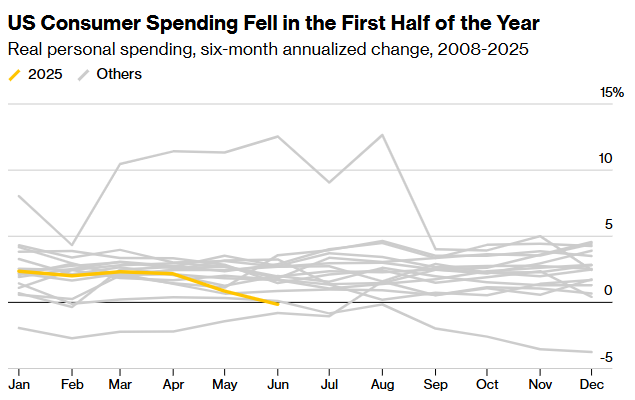
Economic Overview - Recent economic data has raised warning signals, confirming concerns among U.S. corporate executives and consumers regarding the economic situation [1] - The non-farm payroll data released last Friday indicated a much worse labor market condition than previously reported, with a downward revision of nearly 260,000 jobs for May and June [3] - The average job growth over the past three months was only 35,000, marking the worst level since the pandemic [3] Consumer and Business Impact - Many U.S. businesses have paused investments and hiring due to uncertainty surrounding Trump's economic policies, particularly tariffs [4] - Consumer spending has decreased due to rising debt levels, leading to reduced consumption of non-essential goods [4] - Economic growth is expected to be steady but lower than in previous years, with forecasts predicting a 1.5% growth for 2023 and 1.7% by 2026 [4] Inflation and Pricing Pressure - Companies like Procter & Gamble have noted that economic uncertainty is suppressing consumer demand, with CFO Andre Schulten indicating a noticeable slowdown in consumption trends [5] - Prices for frequently imported goods, such as furniture and appliances, have risen, suggesting that companies are passing on higher tariff costs to consumers [5] - Economists anticipate that import tariffs will further increase prices in the coming months [5] Federal Reserve's Position - Federal Reserve Chairman Jerome Powell acknowledged the downward risks in the labor market while describing it as "robust," also noting the slowdown in consumer spending [9] - The housing market continues to be a drag on economic growth, with total spending on residential and non-residential projects down 2.9% year-over-year in June, marking one of the most severe annual declines since early 2019 [9] Employment Data Revisions - The recent large-scale revision of employment data revealed that the number of new jobs added in May and June was 258,000 less than previously reported, shifting the labor market from robust growth to near stagnation [12] - Despite a slowdown in hiring, most companies have not resorted to layoffs, and the unemployment rate rose to 4.2% in July, remaining relatively low [12] - The decline in non-farm employment and rising unemployment will significantly suppress consumer spending, particularly affecting low-income groups reliant on wages [12]


宝洁换帅后公布2025财年业绩:定价与有机销量均增长1%
Nan Fang Du Shi Bao· 2025-08-04 08:16
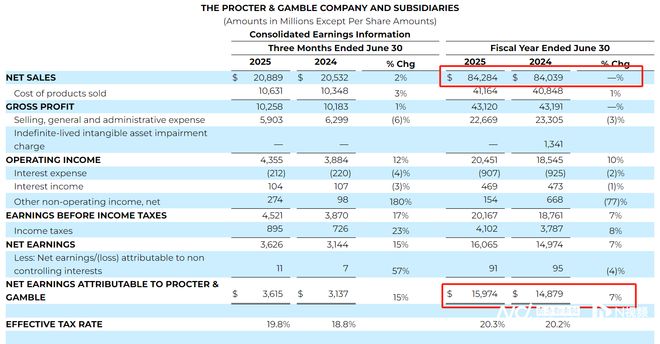
Core Insights - Procter & Gamble (P&G) announced a leadership change with COO Shailesh Jejurikar set to become the first Indian-American CEO starting January 1, 2026, succeeding Jon Moeller, who will transition to Executive Chairman [1][8][9] - The company reported a net sales figure of $84.284 billion for the fiscal year 2025, showing a slight increase from $84.039 billion in the previous year, with organic sales growth of 2% [2][4] - P&G's organic sales growth rate for fiscal year 2025 was the lowest in recent years, with a notable decline in the beauty segment, which saw a 2% drop in net sales [8][6] Financial Performance - For fiscal year 2025, P&G's net profit increased by 7% to approximately $16 billion, while gross profit remained relatively stable at $43.12 billion [2][3] - The company experienced a slight decrease in gross margin, down 0.2% to 51.2% [2] - The productivity plan announced in June aims to improve cost structure and competitiveness, with expected restructuring costs of $1 billion to $1.6 billion over the next two years [4][14] Segment Performance - The Fabric & Home Care segment generated net sales of $29.617 billion, remaining stable year-over-year, with a net profit increase of 3% to $5.848 billion [5][7] - The Beauty segment reported a 2% decline in net sales to $14.964 billion and an 8% drop in net profit to $2.715 billion [6][7] - The Health Care segment saw a 2% increase in net sales to $11.998 billion, with net profit rising by 8% to $2.440 billion [6][7] Market Trends - The Greater China region experienced a 5% decline in performance for fiscal year 2025, although there was a 2% growth in the most recent quarter [1][13] - P&G plans to raise prices on approximately 25% of its products in the U.S. due to tariff impacts, with an average price increase of about 2.5% across the portfolio [13][14] - The company anticipates a pre-tax cost increase of $1 billion due to tariffs, with specific impacts from imports from China and Canada [13][14]
美联储主席紧急预警:关税冲击比预想更猛,消费者钱包即将被“榨干”
Sou Hu Cai Jing· 2025-08-04 04:57
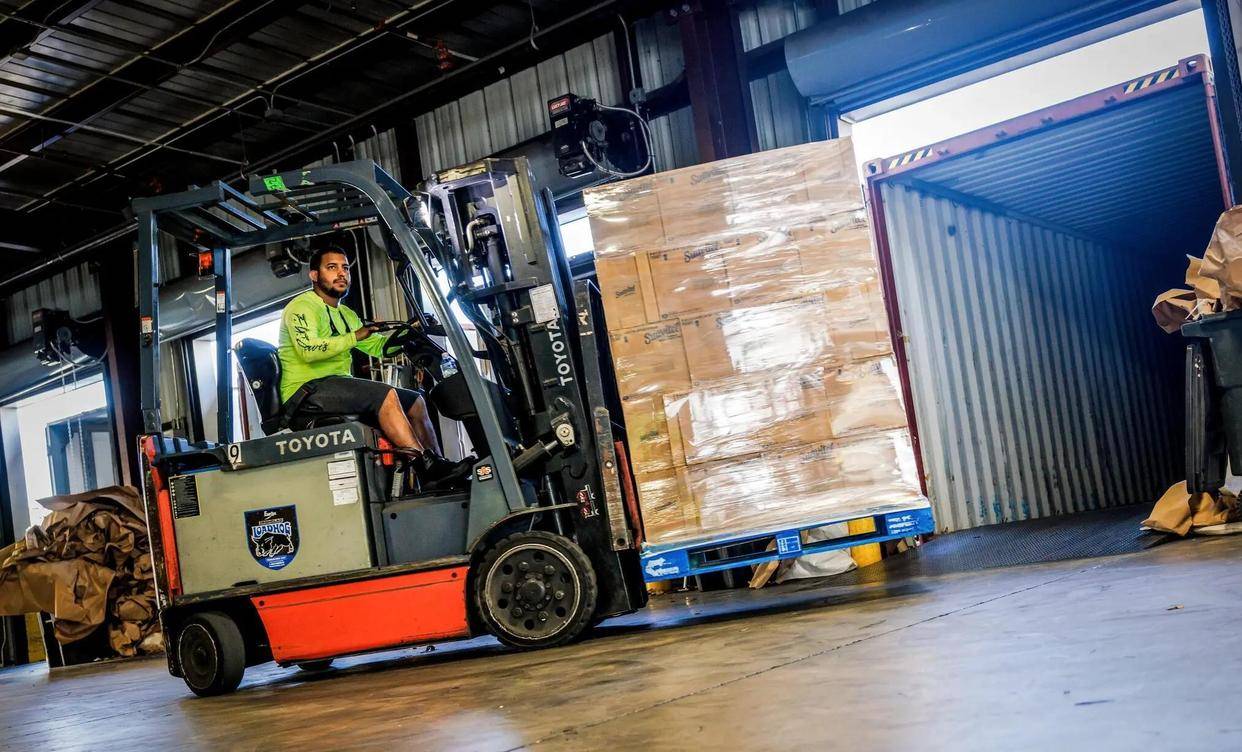
Group 1 - The U.S. economy is experiencing a price surge driven by tariffs, affecting a wide range of products and businesses, leading to a significant economic impact [2][9] - The Consumer Price Index (CPI) for June shows a 1% increase in home goods prices, with textiles rising by 4.2%, and appliances up by 1.9%, indicating widespread inflation across various sectors [3] - Companies like Procter & Gamble and Mohawk Industries are raising prices due to increased costs from tariffs, with Procter & Gamble announcing an average price increase of 2.5% on about a quarter of its products [3][5] Group 2 - A survey by HSBC reveals that 72% of small and medium-sized enterprises in the U.S. are forced to increase operational costs, with 81.5% planning to raise prices [5] - The fluctuating tariff rates have created uncertainty for businesses, with some companies unable to plan effectively due to drastic changes in tax rates [5] - The shipping volume at the Port of Los Angeles has decreased by 15% compared to the previous month, as retailers are reducing order cycles to avoid tariffs [5] Group 3 - Federal Reserve Chairman Jerome Powell warns that the impact of tariffs is more severe than anticipated, creating a conflict between maintaining price stability and ensuring employment [6] - Economists predict that tariffs could increase inflation by approximately 1 percentage point over the next 12 months, indicating a potential rise in consumer prices [6] - The current economic situation is characterized by stagnant growth and high inflation, leading to concerns about stagflation, which poses challenges for the Federal Reserve's monetary policy [6][9]

无论业绩好坏,美国消费股都在跌!高盛看不懂:为何逢低抛售?
Hua Er Jie Jian Wen· 2025-08-03 22:28
Core Viewpoint - The current earnings season for U.S. consumer stocks has led to an unusual sell-off, despite strong earnings reports, indicating deep-seated market concerns about the sustainability of consumer strength [1][2]. Group 1: Earnings Performance - 83% of the 317 S&P 500 companies that have reported earnings exceeded expectations, yet stock prices generally fell post-announcement [1]. - Companies like Procter & Gamble (PG) and PepsiCo (PEP) experienced initial stock price increases after reporting strong earnings, but ultimately saw declines in the following days [3]. Group 2: Market Sentiment - The prevailing market environment suggests a tactical "sell-the-news" approach, with investors opting to take profits rather than establish new long positions [2]. - Negative earnings surprises have led to significant stock price drops, with companies like Philip Morris International (PM) and Chipotle Mexican Grill (CMG) facing severe sell-offs following disappointing results [4]. Group 3: Exceptions to the Trend - A few companies managed to resist the broader sell-off, including Las Vegas Sands (LVS), Wingstop (WING), and Builders FirstSource (BLDR), which showed resilience due to specific business strengths [5]. - Despite these exceptions, the overall sentiment in the consumer sector remains pessimistic, with investors wary of future economic uncertainties [5].




化妆品医美行业周报:淡季国货抖音持续高增,国际美妆25Q2反攻-20250803
Shenwan Hongyuan Securities· 2025-08-03 12:41
Investment Rating - The report suggests a positive outlook for domestic brands and a recovery for international beauty brands in the Chinese market, indicating potential investment opportunities in the cosmetics and medical beauty sectors [2][3]. Core Insights - The cosmetics and medical beauty sector underperformed the market, with the Shenwan Beauty Care Index declining by 3.3% from July 25 to August 1, 2025, while the Shenwan Cosmetics Index fell by 2.6% [3][4]. - Domestic brands showed strong growth during the off-season, with notable increases such as Han Shu up 58%, Proya up 23%, Marubi up 72%, and Kefu Mei up 28%, indicating resilience in the market [7][17]. - International beauty brands, represented by L'Oréal, are recovering in the Chinese market, with a 3% growth in Q2 2025, supported by promotional events like the 618 shopping festival [7][24]. - The report highlights the success of Lin Qingxuan, a high-end domestic skincare brand, which saw revenue grow from 690 million yuan in 2022 to 1.21 billion yuan in 2024, showcasing the potential of domestic brands [13][14]. Summary by Sections Industry Performance - The beauty and medical aesthetics sector has shown weaker performance compared to the overall market, with specific indices declining [3][4]. - The report notes that the cosmetics market is transitioning from quantity to quality, with a significant increase in e-commerce sales, which accounted for 47% of cosmetics sales in 2024, up from 22% in 2016 [9][30]. Key Company Highlights - L'Oréal's sales in China for H1 2025 reached approximately 186.19 billion yuan, with a 3% year-on-year increase, indicating a recovery in the Chinese market [24]. - Procter & Gamble reported a record net sales of approximately 604.95 billion yuan for the 2025 fiscal year, with the beauty segment achieving a net sales of approximately 107.66 billion yuan, reflecting a 2% growth [25]. - Lin Qingxuan's product matrix includes 188 SKUs, with a focus on high-quality natural ingredients, and it has established a strong supply chain and distribution network [14][16]. Market Trends - The report emphasizes the growing market for high-end skincare products, with the market size expected to increase from 749 billion yuan in 2019 to 1,144 billion yuan by 2024, indicating a compound annual growth rate (CAGR) of 13.8% [14][15]. - The domestic brands are gaining market share, with the top ten brands in the skincare market now evenly split between domestic and international brands, reflecting a shift in consumer preferences [30][31].


美股市场速览:市场突发回撤,大盘价值刚性较优
Guoxin Securities· 2025-08-03 07:04
Investment Rating - The report maintains a "Weaker than Market" rating for the U.S. stock market [1] Core Insights - The U.S. stock market experienced a sudden pullback influenced by non-farm employment data, with the S&P 500 declining by 2.4% and the Nasdaq by 2.2% [3] - Among sectors, large-cap value stocks outperformed large-cap growth and small-cap stocks, indicating a preference for stability in turbulent market conditions [3] - The report highlights that three sectors saw gains while 21 sectors faced declines, with utilities, food and staples retailing, and media and entertainment being the only sectors to rise [3] Summary by Sections Price Trends - The S&P 500 fell by 2.4% and the Nasdaq by 2.2% this week, with large-cap value stocks declining by 1.8% compared to a 3.1% drop in large-cap growth stocks [3] - Utilities (+1.6%), food and staples retailing (+0.9%), and media and entertainment (+0.2%) were the only sectors to increase, while transportation (-5.9%), materials (-5.1%), and retail (-4.8%) faced the largest declines [3] Fund Flows - The estimated fund flow for S&P 500 constituents was -$16.95 billion this week, a significant increase from the previous week's -$2.2 billion [4] - Media and entertainment (+$1.59 billion), utilities (+$0.27 billion), and food and staples retailing (+$0.042 billion) saw inflows, while healthcare equipment and services (-$3.47 billion) and financials (-$4.15 billion) experienced the largest outflows [4] Earnings Forecast - The report indicates a 0.6% upward adjustment in the 12-month EPS forecast for S&P 500 constituents, with 18 sectors seeing an increase and 5 sectors experiencing downgrades [5] - Retail (+3.3%), media and entertainment (+2.0%), and technology hardware (+1.5%) led the upward revisions, while healthcare equipment and services faced a significant downgrade of -3.6% [5]




国泰海通:国际美护品牌二季度增速回暖 中国区市场全面增长
智通财经网· 2025-08-03 05:59
Group 1: Market Overview - Recent financial reports from international beauty leaders like L'Oréal and Procter & Gamble indicate a sequential improvement in growth rates for overseas brands in the Chinese market, particularly in functional skincare and medical aesthetics [1] - The beauty sector is experiencing significant changes, with a notable rise in domestic brands, highlighting a clear growth trend and increasing brand differentiation [1] Group 2: L'Oréal Performance - L'Oréal reported a sales figure of €22.47 billion for 1H25, reflecting a year-on-year growth of 3.0%, with Q1 and Q2 growth rates of 2.6% and 3.7% respectively [2] - The net profit for L'Oréal reached €3.783 billion, showing a 1.0% year-on-year increase [2] - The professional hair division led growth with a 6.5% increase, while mass skincare, premium cosmetics, and skin science segments grew by 2.8%, 2.0%, and 3.1% respectively [2] - The Chinese market showed a 3% year-on-year growth in Q2, with skin science and professional hair products performing particularly well [2] Group 3: Procter & Gamble Performance - Procter & Gamble's Q2 sales amounted to $20.889 billion, a 2% year-on-year increase, with net profit rising by 15% to $3.626 billion [3] - The beauty segment saw a slight increase of 0.2% year-on-year, while net profit in this division grew by 4% [3] - The skincare business in China continued to grow, although this was offset by a decline in North America, resulting in flat overall sales for the skincare segment [3] Group 4: Galderma Performance - Galderma reported a net sales figure of $2.448 billion for 1H25, marking a 12.2% year-on-year increase, with Q2 growth at 15.8% [4] - The company raised its full-year sales guidance to 12-14%, up from the previous 10-12% [4] - The injection aesthetics, daily skincare, and skin treatment segments grew by 9.8%, 7.7%, and 26.9% respectively, with botulinum toxin sales increasing by 14.7% [4] - Strong performance was noted in key markets such as Brazil, Canada, and mainland China, particularly in the injection aesthetics business [4]

The Motley Fool's Just-Released Report Shows U.S. Inflation Is at 2.7%. Here's How 2 Consumer Goods Staples Are Faring.
The Motley Fool· 2025-08-02 10:27
Core Viewpoint - Consumer staple companies may benefit from higher inflation due to their ability to pass on cost increases to customers, but consumer resistance to price hikes is a concern [2]. Group 1: PepsiCo - PepsiCo's second-quarter revenue increased by 2%, driven entirely by higher prices, which contributed 4 percentage points, while lower volume subtracted about 1.5 percentage points [5]. - Adjusted operating income for PepsiCo fell by 3%, indicating that price hikes were insufficient to offset rising costs [5]. - PepsiCo's share price dropped by 16.9% over the past year, contrasting with a 16.8% gain in the S&P 500 index during the same period [6]. - The price-to-earnings (P/E) ratio for PepsiCo increased from 19 to 26, which is still lower than the S&P 500's P/E of 30, suggesting potential for patient investors [7]. Group 2: Procter & Gamble - Procter & Gamble's fiscal third-quarter adjusted sales grew by only 1%, with higher prices accounting for the entire increase and volumes remaining flat [9]. - In the fourth quarter, adjusted sales increased by 2%, with higher prices and mix each contributing 1 percentage point, while volume remained constant [10]. - Procter & Gamble's stock price decreased by 7.9% over the past year, and its P/E multiple contracted from 28 to less than 25 [10].


万字拆解宝洁:培养出行业一半CEO,全靠这套体系
Sou Hu Cai Jing· 2025-08-01 11:32
Core Insights - The article emphasizes the importance of cultivating internal talent to develop future CEOs rather than relying on external recruitment, using Procter & Gamble (P&G) as a prime example of successful internal development practices [10][11][12]. Group 1: Challenges in Finding CEOs - Many entrepreneurs struggle to find suitable CEOs, often resorting to external recruitment, which is typically unsuccessful [3][14]. - The article discusses the pitfalls of hiring external candidates, including the unreliability of those who actively seek positions after previous failures [14][16]. - Industry experts often fail to transition into CEO roles due to their reluctance to leave their comfort zones, which limits their ability to manage broader business challenges [17][31]. Group 2: P&G's Approach to CEO Development - P&G has a track record of developing over 90% of its management from within, with a significant number of its CEOs being internal promotions [11][12]. - The company focuses on identifying young talent with leadership potential and nurturing them through systematic training and opportunities [58][62]. - P&G emphasizes the importance of selecting candidates based on innate qualities such as a strong drive for success, leadership ability, and resilience [58][59]. Group 3: Cultivating a Growth-Oriented Culture - P&G encourages employees to take on early responsibilities and engage in real projects, fostering a culture of proactive problem-solving [82][86]. - The company maintains a balance between providing employees with the freedom to innovate while ensuring that their proposals are grounded in solid data and practical frameworks [88][90]. - P&G's internal processes are designed to allow for continuous improvement, enabling employees to refine their skills and methodologies over time [120][128]. Group 4: Avoiding Shortcuts and Building Integrity - P&G instills a strong value system that discourages shortcuts and promotes long-term value creation, which is crucial for effective leadership [186][188]. - The company fosters a culture where employees are encouraged to design sustainable business models rather than relying on quick fixes [189][190]. - This value-driven approach helps employees develop the necessary skills to succeed in leadership roles, particularly as CEOs [197][198].

2 High-Yield Dow Jones Stocks to Buy in August
The Motley Fool· 2025-08-01 08:05
Group 1: High-Yield Dividend Stocks - The Dow Jones Industrial Average includes 30 industry-leading companies that provide high-yield dividend stocks, offering solid options for passive income [1] - The average yield on the S&P 500 and Dow Jones ranges from 1.13% to 1.50%, with Dow Jones stocks paying yields over twice the S&P 500 average [2] Group 2: Verizon Communications - Verizon has increased its dividend for 18 consecutive years, currently offering a forward dividend yield of 6.24% with a quarterly payment of $0.6775 [4] - Verizon's trailing yield of 6.4% is significantly higher than AT&T's 4%, indicating it may be undervalued [5] - Verizon reported total revenue growth of 5.2% year over year in the second quarter, outperforming AT&T's 3.5% growth [6] - The company has over 5 million fixed wireless subscribers and aims to reach at least 8 million by 2028, with an acquisition of Frontier Communications expected to boost growth [7] - Verizon's C-band rollout is ahead of schedule, enhancing its 5G Ultra Wideband service and doubling its 5G speeds [8] - The company generated $19.6 billion in free cash flow over the last year, paying less than 60% in dividends, allowing for reinvestment in the business [9] Group 3: Procter & Gamble - Procter & Gamble has paid a dividend every year since 1890, with a portfolio of household products that ensures consistent sales [11] - Despite economic headwinds, P&G's adjusted sales and earnings grew 1% year over year in the most recent quarter [12] - The company has a profit margin of 18%, allowing it to reinvest in the business while funding dividend payments [13] - P&G has increased its dividend for 69 consecutive years, with a compound annual growth rate of 5% over the last decade, currently offering a forward yield of 2.68% [15] - The company produced $15 billion in free cash flow over the last year, paying out two-thirds in dividends [15] - Analysts expect P&G's adjusted earnings to grow at an annualized rate of 4% over the long term, with dividends likely to grow in line with earnings [16]