Starbucks(SBUX)

Search documents
A Closer Look at Starbucks's Options Market Dynamics - Starbucks (NASDAQ:SBUX)
Benzinga· 2025-12-16 17:01
Core Insights - High-rolling investors are taking a bearish position on Starbucks, indicating potential insider knowledge or market sentiment shifts [1] - The sentiment among major traders shows 12% bullish and 62% bearish, with a notable disparity in options trades [2] Options Activity - A total of 8 options trades were identified for Starbucks, with one put option valued at $38,160 and seven call options totaling $333,030 [2] - The projected price targets for Starbucks are between $85.0 and $110.0, based on the volume and open interest of the options contracts [3] Volume and Open Interest - The mean open interest for Starbucks options trades is 7,132.4, with a total volume of 6,065.00 [4] - A detailed analysis of the last 30 days shows significant trading activity within the strike price range of $85.0 to $110.0 [4][5] Company Overview - Starbucks is the largest coffee brand globally, operating nearly 41,000 cafes in over 80 countries, with 52% being company-operated [9] - The company's revenue is primarily derived from North America (74%), followed by international (21%) and channel development (5%) segments [9] Market Standing - Analysts have recently adjusted their ratings on Starbucks, with an average target price set at $84.0 [11] - An analyst from TD Cowen has revised its rating to Hold, reflecting a cautious outlook on the stock [12] Current Trading Status - Starbucks shares are currently trading at $85.64, with a slight increase of 0.28% and a trading volume of 2,094,089 [14] - Current RSI values suggest that the stock may be approaching overbought conditions [14]



界面新闻揭晓2025年度跨国公司中国区CEO榜单:巴斯夫、菲婷丝、赛诺菲等10位大中华区/中国区CEO上榜
Xin Lang Cai Jing· 2025-12-16 08:08
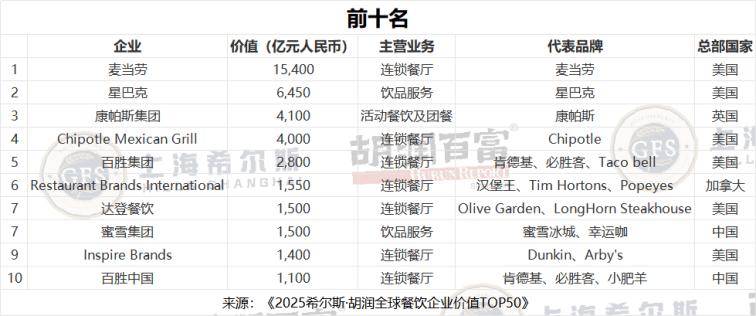
Core Insights - The article highlights the 2025 Super CEO list, which recognizes outstanding leaders across various industries who drive financial growth and shareholder returns while maintaining personal reputation [1] - China's actual foreign investment utilization is projected to decline to $116.24 billion in 2024, a 28.8% decrease year-on-year, marking the second consecutive year of decline after reaching a peak in 2022 [2] - Despite the decline, China remains the fourth-largest recipient of foreign direct investment globally, accounting for 7.7% of total global FDI in 2024 [2] Group 1: Foreign Investment Trends - The decline in China's foreign investment is attributed to a combination of global economic conditions, policy adjustments, domestic economic transformation, and changes in international competition [2] - The number of newly established foreign-invested enterprises in China is expected to reach 59,080 in 2024, a 9.9% increase year-on-year, indicating a positive trend despite the drop in investment amount [2] Group 2: Government Initiatives - The Chinese government is actively promoting policies to expand openness, including the "2025 Action Plan for Stabilizing Foreign Investment," which outlines 20 measures to enhance investment promotion and support foreign enterprises [3] - The 8th China International Import Expo showcased 4,108 companies from 138 countries, with an intention to transact $83.49 billion, a 4.4% increase from the previous year, highlighting China's commitment to global economic integration [3] Group 3: CEO Highlights - The article features notable CEOs leading multinational companies in China, such as: - Lou Jianfeng from BASF, who emphasizes green transformation and local investment despite a slight decline in sales [20] - Seto Onobu from FineToday, focusing on local innovation and sustainable practices, contributing to 40% of the company's global sales [21] - Dong Wei from Nike, who is steering the brand through challenges with a focus on local innovation and community engagement [22] - Schwann from Sanofi, who is enhancing local production capabilities with a significant investment in a new insulin production facility [23] - Yin Zheng from Schneider Electric, who is driving technological innovation and sustainable practices in response to market challenges [24] - Zhu Xiaotong from Tesla, who is adapting sales strategies to penetrate lower-tier markets [25] - Zhu Xiaojing from Walmart, who has successfully transformed the company into a leading omnichannel retailer in China [26] - Xiao Song from Siemens, who is implementing a "China Accelerate 2.0" strategy to enhance local R&D and production [27] - Liu Wenjuan from Starbucks, who is leveraging local insights to drive growth and enhance customer engagement [28] - Yang Xiaoping from Charoen Pokphand Group, who is focusing on green transformation and digitalization in the Chinese market [29]


胡润全球餐饮企业价值TOP50发布,蜜雪、瑞幸、海底捞等11家中国企业上榜
Yang Zi Wan Bao Wang· 2025-12-16 07:25
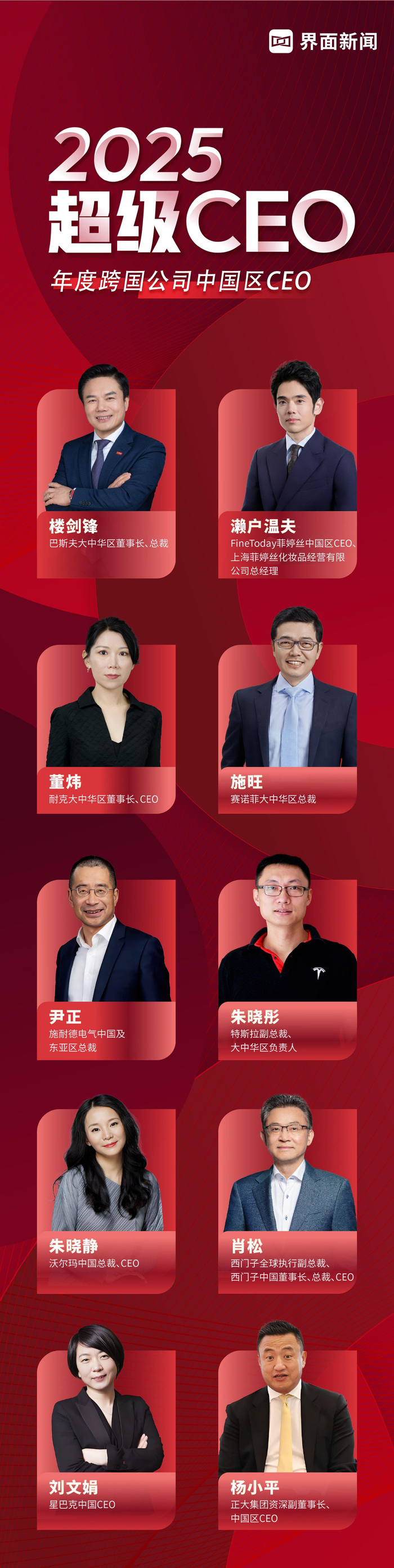
Core Insights - The HuRun Research Institute released the "2025 HuRun Global Restaurant Enterprise Value TOP 50" on December 15, with a threshold of 12 billion RMB for inclusion [1] - A total of 11 Chinese companies made the list, including Mixue Group, Yum China, Luckin Coffee, Haidilao, and others [1] - This is the fourth release of the restaurant industry ranking by HuRun and the first global valuation list for restaurant enterprises [1] Summary by Categories - The top three companies in the ranking are McDonald's valued at 15.4 billion RMB, Starbucks at 6.45 billion RMB, and Compass Group at 4.1 billion RMB [2][3] - The top 10 companies have a minimum valuation of 110 billion RMB, while the top 20 have a threshold of 61 billion RMB [3] - The ranking categorizes companies into three main types: chain restaurants, beverage services, and event catering [3] Chinese Companies Performance - Among the 11 Chinese companies, Mixue Group and Yum China are in the top 10, valued at 15 billion RMB and 11 billion RMB respectively [3] - The total value of all listed companies amounts to 55 trillion RMB [5] - Notably, three of the four recently established companies on the list are from China, including Bawang Chaji, Luckin Coffee, and Manner Coffee [5] International Expansion - Mixue Ice City has expanded significantly overseas, with over 4,700 stores in 12 countries, particularly in Indonesia [5] - Haidilao has established over 100 self-operated stores across 14 countries [5] - Heytea has successfully entered markets in Singapore, the UK, and Canada, with over 100 overseas stores [5]




快餐业竞争加剧,外企转变策略拓展在华市场
Huan Qiu Shi Bao· 2025-12-16 03:37
Core Insights - The Chinese fast food market, valued at over 5 trillion yuan, is experiencing rapid growth and intense competition, particularly among foreign brands adapting to local tastes [1][8] - Recent moves by international brands like McDonald's and Burger King to increase local partnerships indicate a strategic shift towards localization rather than withdrawal from the market [1][6] Company Developments - Burger King plans to expand its store count in China from approximately 1,200 to over 4,000 within the next decade, following a significant investment from Chinese capital [2][3] - McDonald's has successfully increased its store count from 2,000 to over 8,000 since partnering with CITIC Capital in 2017, showcasing the effectiveness of local partnerships [3] - Starbucks has also engaged in similar partnerships to enhance its market presence in China, reflecting a broader trend among foreign brands [6] Market Dynamics - The fast food sector in China is characterized by a growing number of local brands like Tasting and Wallace, which are rapidly gaining market share and challenging established foreign brands [4][5] - As of mid-2023, the fast food market comprises over 4.18 million outlets, with Chinese fast food accounting for approximately 401.8 million, while Western fast food holds around 16.9 million [5] - The competition is not only between Western fast food brands but also includes a significant rise in local Chinese fast food options, which are increasingly appealing to consumers [4][5] Consumer Trends - Chinese consumers are shifting preferences towards local brands that offer better value for money and align more closely with local tastes, impacting the growth of foreign brands [5][8] - The focus on cost-effectiveness and cultural relevance is becoming a defining characteristic of the fast food market in China, as younger consumers prioritize these factors over brand origin [5][8] Future Outlook - The fast food industry in China is expected to continue expanding, with a projected increase in restaurant registrations indicating strong market attractiveness [7][8] - The competitive landscape is evolving, with a notable emphasis on value and innovation as key drivers for success in the fast food sector [8]
2025饮料新品TOP100丨元气森林、农夫山泉、康师傅、统一激战新品、乳饮退潮谁来补位?
3 6 Ke· 2025-12-16 02:59
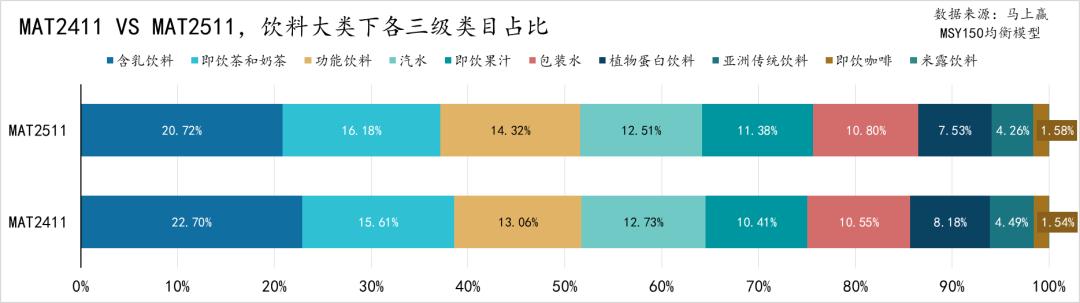
Core Insights - The article discusses the year-end review of the beverage market, focusing on the top 100 new products from December 2024 to November 2025, and compares them with the same period from the previous year to identify trends and shifts in the market [1][4]. Summary by Sections Overview of the Year-End Review - The year-end review will analyze the top 100 new beverage products and their market performance over the specified period, highlighting new trends and shifts in consumer preferences [1]. Data Collection and Methodology - The data for the top 100 products is sourced from the "马上赢" brand CT and various models, covering a wide range of retail channels across major cities in China [3]. - The selection criteria for the top 100 products exclude private label products and multi-pack items, focusing solely on individual SKUs based on sales revenue [1][2]. Market Performance Analysis - The beverage market is categorized into ten subcategories, including packaged water, functional drinks, dairy drinks, ready-to-drink tea, and more [4][5]. - The analysis reveals that dairy drinks are the only category exceeding 20% market share, while ready-to-drink tea, functional drinks, and carbonated beverages also hold significant shares [8]. Year-on-Year Comparison - A comparison between the two periods shows that the market share of dairy drinks has decreased by approximately 2%, with a sales growth decline of over 13% [13]. - Functional drinks and ready-to-drink juices have shown positive growth, while traditional categories like carbonated drinks and Asian traditional beverages have experienced declines [12][13]. New Product Trends - The top 100 new products for the current year show a significant increase in non-refrigerated ready-to-drink juices and sweetened ready-to-drink teas, while categories like sugar-free ready-to-drink tea and sports drinks have seen a reduction in new product entries [19][14]. - Notably, the top brands include "元气森林" and "康师傅," each with multiple products in the top rankings, indicating strong competition and innovation in the beverage sector [19][22]. Pricing and Specifications - The average price per 100ml for new products varies across categories, with non-refrigerated ready-to-drink juices and sweetened ready-to-drink teas generally priced higher [28]. - The distribution of product specifications indicates a growing preference for larger packaging sizes, reflecting changing consumer consumption patterns [25]. Launch Timing Insights - The timing of new product launches has shifted, with a noticeable increase in products launched in February and March compared to the previous year, suggesting a trend towards earlier market entry [31].




中国11家上榜全球餐饮TOP50
Shen Zhen Shang Bao· 2025-12-15 22:55
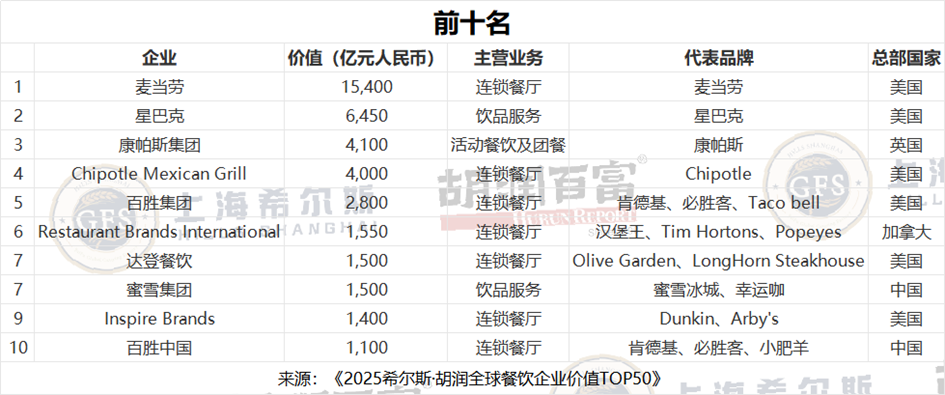
Core Insights - The "Hurun Global Restaurant Enterprise Value TOP 50" list was released, ranking companies based on market value or valuation, marking the first global ranking in the restaurant sector by Hurun Research Institute [1] - McDonald's is the most valuable restaurant company globally, valued at 1.54 trillion RMB, accounting for nearly 30% of the total value of the list [1] - China has 11 companies on the list, with two in the top ten: Mixue Group valued at 150 billion RMB and Yum China at 110 billion RMB [1] Group 1: Company Rankings - McDonald's holds the top position with a brand value of 1.54 trillion RMB, surpassing the combined value of the next three companies [1] - Starbucks ranks second with a brand value of 645 billion RMB, while Luckin Coffee, a Chinese brand, is the second coffee company on the list valued at 70 billion RMB [1][2] Group 2: Chinese Companies Performance - The highest-valued restaurant company in China is Mixue Ice City, which has over 4,700 overseas stores across 12 countries, particularly strong in Indonesia with about 2,600 stores [2] - Haidilao has also performed well internationally, operating over 100 self-operated stores across 14 countries [2] - New tea brands like Heytea and Bawang Chaji are expanding rapidly, with Bawang Chaji exceeding 200 overseas stores and adding over 50 stores in the second quarter of 2025 [2] Group 3: Industry Trends - The average age of Chinese companies on the list is only 16 years, with 7 out of 9 beverage service companies being Chinese [3] - Three of the four companies established in the last decade on the list are from China, including Bawang Chaji and Luckin Coffee [3] - The domestic consumption market in China is seen as a fertile ground for restaurant enterprises, enabling brands like Mixue and Luckin to build extensive store networks [3]
Get Paid 8.5% To Buy Starbucks Stock At A 30% Discount
Forbes· 2025-12-15 17:45
Core Viewpoint - Starbucks (SBUX) is currently trading at approximately $85.35 per share, which is about 25% below its 52-week high, as investors are concerned about slower traffic trends, near-term margin pressures, and a prolonged turnaround process [2] Company Analysis - Starbucks has a strong brand loyalty and pricing power, which contributes to its wide economic moat, making it a compelling long-term investment [8] - The company has approximately 34.3 million active members in its rewards program as of 2024, indicating a highly engaged customer base despite price increases [10] - Starbucks has maintained a positive free cash flow, although it has a significant net debt position of approximately $23.162 billion as of September 2025 [11] Industry Insights - The specialty coffee market is projected to grow at a compound annual growth rate (CAGR) of 10.4%, indicating strong industry tailwinds [9] - There is a secular trend towards premium and specialty coffee, providing a long runway for growth for companies like Starbucks [8] Pricing Strategy - Starbucks has implemented a new pricing structure in 2025, including flat fees for customizations, which has been positively received by customers [10] - Despite some customers planning to visit less due to high prices, the CEO has indicated that further price hikes may be considered in 2026, reflecting confidence in the brand's ability to retain customers [10]
Judge grants motion to reconsider ex-Starbucks CFO as defendant in ‘Triple Shot’ case
Yahoo Finance· 2025-12-15 16:18
Core Insights - The lawsuit against Starbucks alleges that the company and its former CEO made materially false or misleading statements regarding its "Triple Shot" reinvention strategy and revenue outlook for 2024 [3][5]. Group 1: Lawsuit Details - The lawsuit was filed by Charles Garbaccio on behalf of himself and other shareholders, claiming violations of federal securities law [3]. - The claims focus on the company's growth plan for China and the revenue outlook related to the "Triple Shot" strategy [5]. - A federal judge partially dismissed the case, ruling that shareholders had shown "some, but not all" of their securities fraud claims under section 10(b) of the Exchange Act [6]. Group 2: Recent Developments - A motion was granted to reconsider ex-CFO Rachel Ruggeri as a defendant in the lawsuit, reversing a previous dismissal of claims against her [7]. - The court found that the plaintiffs had adequately pleaded a § 10(b) claim, which allowed for the reconsideration of Ruggeri's role as a "controlling person" in the suit [7].
2025胡润全球餐饮企业价值TOP50发布,11家中国企业上榜
Sou Hu Cai Jing· 2025-12-15 10:33
Core Insights - The "2025 Hills·Hurun Global Restaurant Enterprise Value TOP 50" list was released, ranking companies based on their market value or valuation, marking the first global ranking in the restaurant industry by Hurun Research Institute and Hills [1] Group 1: Rankings and Values - McDonald's is ranked as the most valuable restaurant company globally, valued at 15.4 billion RMB, followed by Starbucks at 6.45 billion RMB [2] - The top five companies include Compass Group at 4.1 billion RMB, Chipotle Mexican Grill at 4 billion RMB, and Yum! Brands at 5.8 billion RMB [2] - The threshold for entering the TOP 50 is set at 12 billion RMB, while the TOP 20 and TOP 10 require 61 billion RMB and 11 billion RMB, respectively [3] Group 2: Chinese Companies Performance - China has 11 companies on the list, with Mixue Group and Yum China ranking seventh and tenth, respectively [2] - Mixue Ice City has over 47,000 stores globally, with a significant presence in Indonesia, while Haidilao operates over 100 self-operated stores across 14 countries [3] - Luckin Coffee and Wallace are also notable Chinese companies in the global store count, with nearly 30,000 and about 20,000 stores, respectively [3]
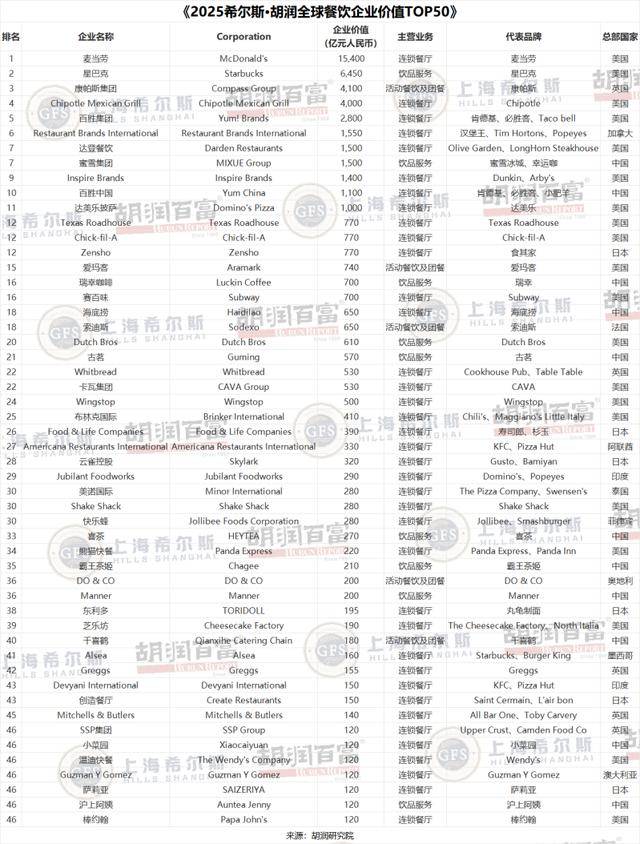
中国11家企业上榜胡润全球餐饮价值榜,蜜雪集团位居中国首位,超5.3万家门店规模全球第一
Sou Hu Cai Jing· 2025-12-15 03:00
Core Insights - The HuRun Research Institute released the "2025 Hill's HuRun Global Restaurant Enterprise Value TOP 50," revealing the latest landscape of the global restaurant industry, with McDonald's leading the list at a value of 1.54 trillion RMB, which is nearly 30% of the total value of the list [1][2]. Group 1: Top Companies - McDonald's ranks first with a value of 15,400 million RMB, dominating the fast-food sector [2]. - Starbucks is second with a value of 6,450 million RMB, and it plans to sell 60% of its China operations to Boyu Capital to form a joint venture for managing 8,000 stores in China [2]. - Compass Group ranks third with a value of 4,100 million RMB, although it has exited the Chinese market by selling its operations to Sodexo [3]. Group 2: Regional Distribution - The list features 22 companies from Asia and North America each, 7 from Europe, and 1 from Oceania, with the United States having the most companies at 20 [3][4]. - China follows with 11 companies, including notable brands like Mixue and Yum China [4]. Group 3: Rise of Chinese Brands - Mixue leads Chinese brands with a value of 1,500 million RMB, while Yum China follows with 1,100 million RMB [5]. - The average age of Chinese companies on the list is only 16 years, significantly younger than the 52-year average of non-Chinese companies [5]. - Notably, three of the four companies established in the last decade are from China, reflecting the innovative and youthful trend in the Chinese restaurant sector [5]. Group 4: Global Expansion - Mixue has over 4,700 international stores across 12 countries, with a significant presence in Indonesia [5]. - Haidilao operates over 100 self-operated stores in 14 countries, showcasing its global footprint [5]. - Heytea has successfully entered eight overseas markets, with over 100 stores in 28 cities outside China [5]. Group 5: Store Count - Mixue has the highest number of stores globally, surpassing 53,000, followed by McDonald's with over 43,000 and Starbucks with 41,000 [6].